 Skip to content

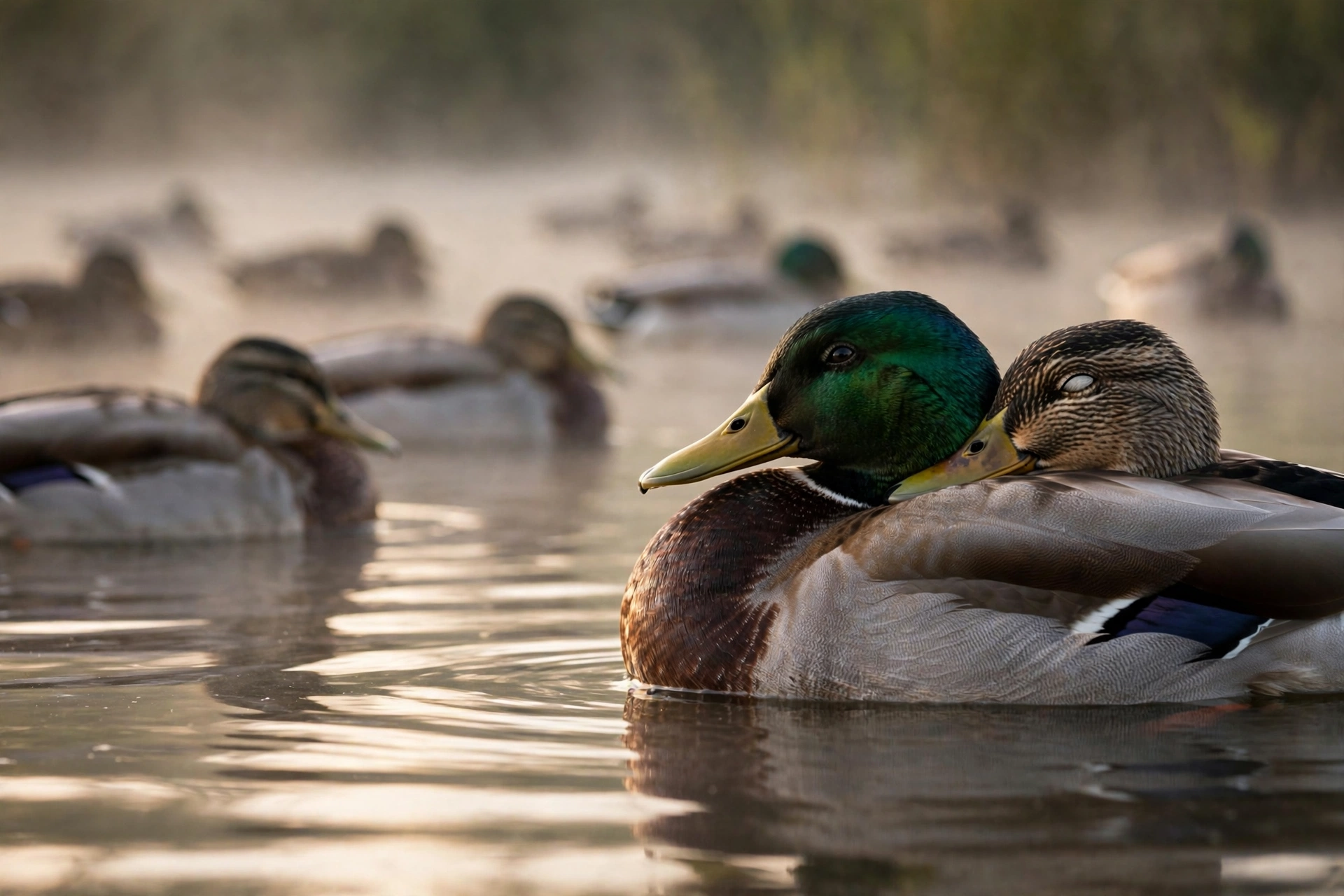
Watch a flock of ducks dozing on a still pond and you may notice something strange. Several birds rest with one eye closed while the other stays open, alert and scanning the bank. They are not being lazy about their rest. They are doing something remarkable: sleeping with only half of their brain at a time.
Scientists call this trick unihemispheric slow-wave sleep. One hemisphere of the brain drops into deep sleep while the other stays awake, keeping the eye on the awake side open. The arrangement lets a bird rest and stand guard at the same time. Ducks at the edge of a flock use it to watch for predators, and frigatebirds use it to nap while gliding over the open ocean.
In this guide we explain how half-brain sleep works, which birds use it, why the open eye always faces the danger, and how it combines with REM sleep and familiar tucked-head postures. By the end you will know exactly what is happening when a bird appears to sleep with one eye open.
The Short Answer
Yes. Many birds genuinely sleep with one eye open, and they do it through a real neurological trick rather than simple drowsiness. One half of the brain enters deep slow-wave sleep while the other half stays awake and keeps its eye open. Scientists call it unihemispheric slow-wave sleep, often shortened to USWS.
Not every bird does this all the time. Birds in safe places, such as a sheltered cavity or a dense roost, usually sleep with both eyes closed. The half-awake version appears when rest must be balanced against danger: on exposed water, at the edge of a flock, or even in mid-air during long flights. The Cornell Lab’s All About Birds guide describes it plainly: some ducks are literally half asleep, with one half of the brain resting while the other watches for predators.
What Is Unihemispheric Slow-Wave Sleep?
Slow-wave sleep is the deep, restorative stage of sleep shared by birds and mammals. In humans both halves of the brain enter it together, which is why we shut down completely. Birds have an extra option. They can let one cerebral hemisphere sink into slow waves while the other keeps the fast, low-amplitude electrical pattern of wakefulness.
The result is a bird that is literally half asleep. The sleeping half rests and recovers. The awake half processes what the open eye sees, holds the body upright, and can trigger instant full wakefulness if a shadow moves. Brain recordings from sleeping birds show that an individual in this state can react to a visual threat almost as fast as a fully awake bird, which is exactly what the system is for.
How one half of the brain stays on watch
Each eye in a bird connects mainly to the brain hemisphere on the opposite side, a crossed arrangement. When the left hemisphere sleeps, the right eye stays open. When the right hemisphere sleeps, the left eye stays open. The bird cannot keep both eyes closed and still stay half awake; the open eye always belongs to the awake half.
Birds also rotate which half sleeps. Over the course of a night a duck may rest first one hemisphere and then the other, so each side gets its share of deep sleep. Researchers believe this switching is one reason flocks shuffle positions through the night, letting the birds that have already taken their turn on watch move into the safer middle.
The crossed wiring that aims the eye at danger
Here is the detail that turns clever biology into genuine protection. Because the awake hemisphere sits opposite the open eye, a bird’s posture decides what it guards. A duck with its left side facing the reeds keeps its left eye open and rests its right hemisphere. Turn the bird around and the pattern flips.
This is not speculation. Experiments with mallards showed that birds at the edge of a group spent far more time in half-brain sleep, with the open eye consistently aimed away from the flock, toward where a predator would approach. The threat-facing eye is the entire point of the system.
The Mallard Experiment That Proved It
In one of the most elegant sleep experiments ever run, researchers placed mallards in a row and recorded which eye each bird kept open. Ducks in the middle of the row, protected on both sides, slept deeply with both eyes closed. Ducks at the two ends, exposed to the room, spent most of their rest in unihemispheric sleep with the outward-facing eye open.
Even more striking, the birds adjusted to risk. The edge ducks increased their half-brain sleep and aimed the open eye at the exposed side, while the centre ducks, feeling safe, sank into full two-hemisphere sleep. It was clean evidence that birds actively manage how deeply they sleep based on perceived danger. This “group edge effect” is now one of the textbook examples of sleep adapting to predation pressure.
Which Birds Sleep With One Eye Open?
Half-brain sleep is widespread, but it shows up most clearly in birds that sleep in risky places. The confirmed examples include:
- Ducks and mallards: the classic example. Edge birds in a sleeping flock keep the outward-facing eye open.
- Geese and swans: large waterfowl resting on open water use the same flock-edge strategy.
- Gulls and waders: species that roost on exposed shorelines and mudflats stay half alert through the night.
- Pigeons and doves: even familiar city birds can rest one hemisphere while perched on a ledge.
- Penguins: breeding chinstrap penguins in crowded, noisy colonies take thousands of micro-sleeps through the day, averaging only about four seconds each, with some of them one-sided.
- Frigatebirds: brain recordings prove they sleep with one hemisphere, or both, while soaring over the ocean.
- Swifts: long suspected of sleeping on the wing during their nonstop flights, though direct brain recordings are harder to obtain and the evidence is less complete.
The pattern is consistent: the more exposed the sleeping spot, the more likely the bird is to keep half its brain on duty.

Why the Open Eye Always Faces the Threat
Because the awake brain half sits opposite the open eye, posture is everything. A duck sleeping with its left side toward open water keeps its left eye open and its right hemisphere asleep. The arrangement means the bird is always watching the direction danger would come from, without any conscious decision.
This matters for birdwatchers. If you see a line of ducks with open eyes aimed outward on both ends, you are watching a coordinated watch rota, not random drowsiness. The flock has effectively posted sentries without waking anyone up. Individual birds trade off: the sentries get lighter rest now and deeper rest later, once they shuffle into the middle.
Sleeping in Flight: The Frigatebird Story
The most extreme use of half-brain sleep belongs to the great frigatebird. These seabirds spend weeks or even months flying over the open ocean. They cannot land on the water to rest, because their long wings and poorly waterproofed feathers make taking off again nearly impossible.
To find out whether they sleep on the wing, researchers fitted frigatebirds with tiny brain-activity loggers. A published brain-recording study showed that frigatebirds do sleep in flight, using one hemisphere at a time or both together. Sleep is more one-sided in the air than on land. The birds doze mostly while circling in rising air currents, which keeps them aloft, and they keep the eye connected to the awake hemisphere facing the direction of flight, as if watching where they are going.
Yet flying frigatebirds sleep remarkably little: far less than on land, in shorter bouts, and less deeply. The finding suggests that even half-brain sleep cannot fully meet the demands of staying airborne, and that these birds simply tolerate sleep loss that would impair most animals. If the idea of a bird nodding off mid-air fascinates you, read our full guide on do birds sleep while flying.

REM Sleep: The Other Half of Bird Sleep
Unihemispheric sleep handles danger, but birds still need the full menu of sleep stages. Like mammals, birds experience both slow-wave sleep and REM sleep, the active stage linked in humans to dreaming. Bird REM looks familiar on a brain recording: wake-like electrical activity, rapid eye movements, and brief muscle twitches.
Two differences stand out. First, bird REM arrives in tiny bursts, often lasting only seconds, scattered through the night rather than in long dream periods. Second, birds mix their stages freely. They can take slow-wave sleep with both hemispheres, REM with both hemispheres, or slow-wave sleep with just one.
Budgerigars have been studied in detail with brain recordings, and the work revealed a sleep structure surprisingly similar to that of mammals, including clear REM. So when a pet budgie’s eyes flicker and its head bobs during a daytime nap, it may genuinely be dreaming. We cannot know what a bird dreams about, and claims about dream content would be pure speculation, but the machinery for REM sleep is definitely there.
Bird Sleep Stages Compared
| Sleep stage | Brain state | Eyes | When birds use it |
|---|---|---|---|
| Unihemispheric slow-wave sleep | One hemisphere asleep, one awake | One open, one closed | Exposed roosts, flock edges, flight |
| Bihemispheric slow-wave sleep | Both hemispheres asleep | Both closed | Safe, sheltered spots |
| REM sleep | Both hemispheres active, dream-like | Closed, with flickering movements | Short bursts through the night, often after slow-wave sleep |
The Classic Sleep Postures and What They Mean
Half-brain sleep is only part of the story. The postures birds adopt reveal how seriously they take rest, and each one solves a specific problem:
- Head tucked into back feathers: the classic pose. It warms the beak, protects the face, and usually signals deep two-hemisphere sleep. Songbirds in sheltered spots favour it.
- Standing on one leg: the other leg is drawn up into the belly feathers to cut heat loss. Ducks, gulls, and herons all do it on cold nights.
- Fluffed feathers: trapping still air between the feathers for insulation, often paired with the tucked head. This is one of the main ways birds stay warm in winter.
- Clinging to vertical surfaces: swifts and swallows sleep clinging to walls and chimneys, gripped by feet that lock automatically.
- Floating in rafts: waterfowl sleep right on the water, sometimes packed in tight groups that share warmth and multiply the watching eyes.
Where Birds Choose to Sleep
Posture is only half the strategy; location is the other half. Most songbirds pick dense foliage, cavities, or nest boxes that hide them from owls and cats. Waterfowl choose open water where an approaching predator makes ripples. Each choice trades visibility against concealment, and half-brain sleep is what makes the riskier options survivable. For a full tour of roosting spots, see our guide on where birds sleep at night.

Do Pet Birds Sleep With One Eye Open?
They can, but in a safe home they rarely need to. A budgie or cockatiel in a quiet room will usually sleep with both eyes closed and its head tucked, taking normal two-hemisphere sleep. If your bird regularly sleeps with one eye open, it may be reacting to disturbance: noise, light, draughts, or movement near the cage.
A consistently half-awake pet bird is worth paying attention to. Check that the cage is in a calm corner, covered or dimmed at night, and away from televisions and night lights. Persistent one-eyed sleeping alongside fluffed feathers or daytime drowsiness can signal that the bird is not getting enough quality rest, so give it a darker, quieter sleeping spot and see if the behaviour changes.
Frequently Asked Questions
Can birds sleep with both eyes open?
No. The open eye always belongs to the awake hemisphere, so a bird cannot be asleep with both eyes open. If both eyes are open, the bird is awake, even if it is sitting very still and looks drowsy.
Do all birds sleep with one eye open?
No. It is a strategy, not a rule. Many species can use unihemispheric sleep, but birds in safe spots sleep with both eyes closed. The half-awake version appears when the sleeping site is exposed or when the bird holds an edge position in a flock.
How long do birds sleep each night?
It varies widely by species and season. Most day-active birds sleep roughly through the night, but in short cycles of slow-wave and REM sleep rather than one unbroken stretch. At the extreme, male pectoral sandpipers have been observed giving up the vast majority of their sleep during the few weeks of Arctic breeding season, apparently without losing their edge in competing for mates.
Do baby birds sleep with one eye open?
Nest-bound chicks are protected by their parents and the nest itself, so they typically sleep deeply with both eyes closed. The half-awake strategy seems to develop as young birds become independent and start roosting in exposed places, though direct recordings from chicks of most species are still limited.
Conclusion
So, do birds sleep with their eyes open? Yes, and it is one of the most remarkable adaptations in the animal kingdom. Through unihemispheric slow-wave sleep, a bird can rest half its brain while the other half stands watch, with the open eye always aimed at the likeliest direction of danger. Mallards demonstrate it in neat rows at the flock edge, and frigatebirds take it to the extreme by napping mid-flight over the open ocean.
Yet this is only one part of avian sleep. Birds also take deep two-hemisphere sleep in safe spots, cycle through genuine REM sleep in short bursts, and adopt heat-saving postures like the tucked head and the one-legged stand. Next time you see a duck dozing with one eye open, you will know you are watching a sentry at work: half asleep, half on guard, and entirely in control of the balance.





