

If you are searching for the Bird With Red Head and Black Wings Identification, the best approach is to look beyond color alone.
Pay attention to the bird’s size, bill shape, wing pattern, tail, behavior, habitat, and location. These details can help distinguish a Red-headed Woodpecker from finches, tanagers, and other red-and-black birds.
Seeing a bird with a bright red head and dark or black wings can be exciting, but identifying it is not always straightforward.
Several bird species can show combinations of red, black, and dark plumage, and differences in age, sex, season, lighting, and geographic location can make identification even more challenging.
This guide explains the most likely species, their identifying characteristics, and the key differences to look for when you encounter a red-headed bird with black wings.
Table of Contents
What Bird Has a Red Head and Black Wings?

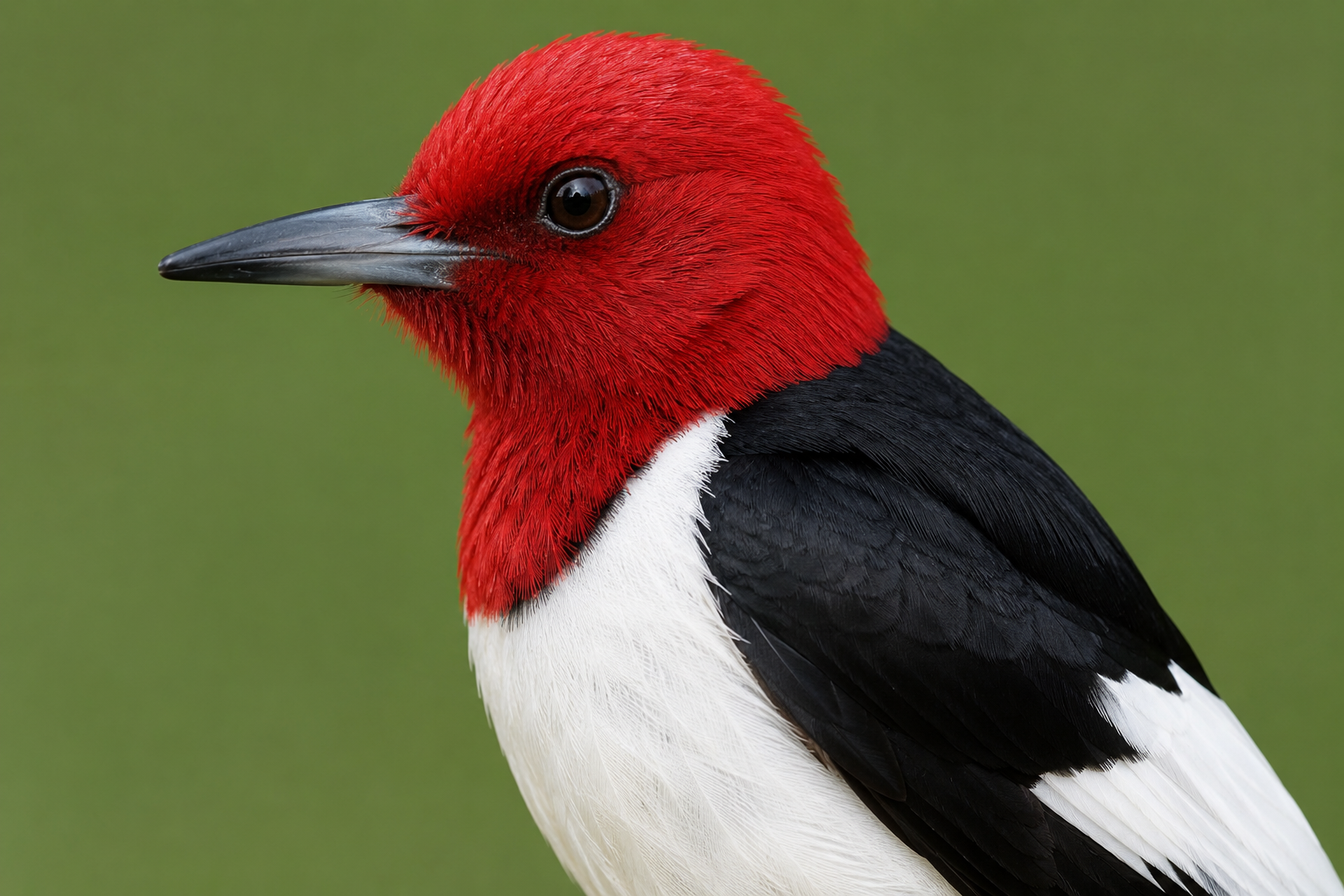
The Red-headed Woodpecker is one of the most recognizable answers when someone searches for a bird with a red head and black wings. Its entire head and neck are a vivid red, while the back and wings are largely black with prominent white patches.
However, it is not the only possibility. Depending on the bird’s size, location, and exact markings, you may also be looking at a House Finch, Purple Finch, Scarlet Tanager, Pine Grosbeak, Common Redpoll, or another species with reddish plumage and darker wings.
This is why identifying a black bird with red head requires more than matching two colors.
Bird With Red Head and Black Wings Identification
1. Red-headed Woodpecker
The Red-headed Woodpecker is the first species to consider when the bird has a completely red head combined with strongly contrasting black-and-white wings.
Key identification features
- Bright red head and neck
- Black back
- Black wings with large white patches
- White underparts
- Short, sturdy bill
- Medium-sized woodpecker shape
- Distinct contrast between red, black, and white
Unlike many finches, the Red-headed Woodpecker has the body structure of a woodpecker. Its bill is relatively strong and chisel-shaped, and its posture can make the species immediately recognizable once you know what to look for.
The white areas on the wings are also important. From a distance, the bird may appear to have black wings, but closer observation reveals conspicuous white wing patches.
Behavior
Watch how the bird moves and feeds. A Red-headed Woodpecker may perch on exposed branches, fly between trees, search for insects, or investigate food in woodland habitats. Its behavior and body shape provide useful confirmation when plumage alone is ambiguous.
2. House Finch
The House Finch is another possibility when searching for red headed birds identification, although its appearance is quite different from the Red-headed Woodpecker.
Male House Finches typically have red coloring concentrated around the forehead, face, throat, and upper breast. The rest of the body is generally brownish or streaked rather than solid black.
How to recognize it
- Small to medium-sized finch
- Red forehead and face in males
- Brown, streaked body
- Darker wings
- Short, thick, conical bill
- Often found around feeders and residential areas
A House Finch is therefore more accurately described as a red-faced or red-headed finch with darker wings, rather than a bird with a completely red head and black wings.
If the red coloration is limited to the face and the bird has obvious brown streaking, a finch is more likely than a Red-headed Woodpecker.
3. Purple Finch
The Purple Finch can also create confusion because adult males show raspberry-red coloration on the head and upper body.
The red coloring is usually blended with brownish or reddish tones rather than forming the sharply defined red head seen on a Red-headed Woodpecker.
Identification clues
Look for:
- Raspberry-red head and breast
- Brownish back
- Dark wings
- Stout finch bill
- Compact body
- Seed-eating behavior
The distinction between a Purple Finch and other red-headed birds becomes much easier when you consider body structure and overall color distribution rather than focusing on the head alone.
4. Common Redpoll
A Common Redpoll may also appear on searches for a bird with red head and black wings, particularly in regions where this species occurs.
Its red coloring is generally concentrated on the forehead and may extend toward the face and breast. The bird is small and adapted to colder environments.
Look for these features
- Small body
- Red forehead
- Pale or whitish body
- Dark wings
- Small seed-eating bill
- Often associated with birch and other seed-producing vegetation
Because redpolls can vary considerably in appearance, location and season are especially valuable when identifying them.
5. Pine Grosbeak
The Pine Grosbeak is another species worth considering when you see a large finch-like bird with reddish plumage and darker wings.
Adult males can show extensive reddish or rosy coloration across the head and body. The wings are darker, creating a noticeable contrast.
Identification features
- Relatively large finch
- Rosy-red or reddish male plumage
- Dark wings
- Thick, powerful bill
- Longish tail
- Often associated with northern or boreal habitats
Size is particularly helpful here. If the bird looks substantially larger and bulkier than a typical backyard finch, Pine Grosbeak becomes a more reasonable candidate.
6. Scarlet Tanager
A Scarlet Tanager can be confused with a red-and-black bird because males have brilliant red bodies and contrasting black wings.
However, the head is not simply a red head attached to a black body. Instead, the bird has a largely red body with black wings and tail.
Key features
- Brilliant red male
- Black wings
- Black tail
- Relatively slender body
- Thick, pale bill
- Often found in mature forests
If you see a striking red bird with clearly black wings moving through the tree canopy, a Scarlet Tanager should be considered, especially in appropriate woodland habitat.
This species demonstrates why the phrase red head black wings bird can be misleading. Looking at the entire plumage pattern gives you a much more reliable identification.
7. Red Crossbill
Red Crossbills are unusual-looking finches whose most obvious identification feature is their crossed bill.
Adult males can have reddish or orange-red plumage, while the wings remain darker.
What to look for
- Red or orange-red male
- Dark wings
- Compact finch-like body
- Strong, crossed bill
- Seed-feeding behavior
- Association with coniferous trees
The bill is the giveaway. If you notice that the upper and lower bill tips cross rather than meeting normally, you are likely looking at a crossbill.
Other Red-Headed and Black-Winged Birds to Consider
Not every bird with a red head and black wings will fit one exact species description. Plumage can change according to age, sex, season, and individual variation.
Other birds may also appear red and black under particular lighting conditions or from certain viewing angles.
When making an identification, ask:
- Is the entire head red or only the forehead?
- Are the wings actually black or simply dark brown?
- Does the bird have white wing patches?
- Is the body streaked?
- How large is the bird?
- What shape is the bill?
- Is the tail long, short, rounded, or pointed?
- What habitat is the bird using?
- What region and season are you observing it in?
These questions can narrow your options far more effectively than color alone.
How to Identify a Bird With a Red Head and Black Wings?
Successful bird with red head and black wings identification depends on combining several characteristics.
1. Examine the Head
Start by determining exactly where the red coloration occurs.
A completely red head is very different from a red forehead, red face, or reddish crown.
For example, the Red-headed Woodpecker has an exceptionally distinctive red head and neck, while several finches concentrate their red coloration around the forehead, face, or breast.
2. Study the Wings
Do not automatically assume that dark wings are black wings.
Lighting can make brown or gray plumage appear black. Look for:
- White wing patches
- Wing bars
- Solid dark wings
- Speckling
- Contrast between the wings and back
Wing pattern can be one of the most useful clues for separating otherwise similar red headed birds.
3. Check the Bill
Bill shape is one of the most reliable structural clues in bird identification.
A woodpecker generally has a strong, chisel-like bill, while finches have shorter, thicker, cone-shaped bills adapted for cracking seeds.
A Red Crossbill is particularly easy to recognize once you notice its crossed bill.
4. Consider Body Size
Compare the bird with familiar species.
Is it:
- Sparrow-sized?
- Finch-sized?
- Robin-sized?
- Larger than a robin?
Size helps eliminate unlikely candidates before you even study detailed plumage.
5. Look at the Tail
Tail length and shape can provide another useful identification clue. A short tail can point toward one group of birds, while a long or deeply shaped tail may suggest another.
The relationship between the folded wings and tail can also help distinguish species that look similar in color.
6. Observe Behavior
Behavior is often overlooked when people search for a red head black wings bird, but it can provide valuable confirmation.
Ask whether the bird is:
- Climbing a tree trunk
- Drumming on wood
- Searching bark for insects
- Feeding on seeds
- Moving through the forest canopy
- Visiting a backyard feeder
- Flying between exposed branches
A bird’s behavior can sometimes narrow the identification faster than its plumage.
Habitat and Location Matter
Geographic location is another major part of reliable bird identification.
The same color description can produce completely different possibilities depending on where you saw the bird. A species common in northern forests may be an unlikely candidate in a coastal or southern environment.
Season also matters. Migration can temporarily bring species outside the areas where observers normally expect them.
For this reason, when searching for bird with red head and black wings identification, include your location whenever possible.
Instead of searching only:
“bird with red head and black wings”
try:
“bird with red head and black wings in Michigan”
or:
“small red headed bird with dark wings at backyard feeder”
Adding habitat, region, season, or behavior makes identification searches considerably more useful.
Red Head vs. Red Face: Why the Difference Matters
One of the most common identification mistakes is treating every red facial marking as a red head.
There is a significant difference between:
- Entire head red
- Crown red
- Forehead red
- Face red
- Throat red
- Head and breast red
- Entire body red with black wings
These distinctions are especially important when comparing woodpeckers and finches.
If the entire head is uniformly bright red and the bird has a woodpecker-like body, the Red-headed Woodpecker deserves close consideration. If only the forehead or face is red and the body is streaked brown, a finch may be more likely.
Seasonal and Age Differences
Bird identification becomes more complicated when young birds and seasonal plumages enter the picture.
Adult males of some species can be dramatically brighter than females or immature birds. A bird that appears unmistakably red during one season may look much duller during another stage of its life.
This is why you should avoid relying on a single color characteristic.
Instead, combine:
Color + structure + behavior + habitat + location + season
This combination provides a much stronger identification framework.
Quick Comparison of Red-Headed Birds
| Species | Red Area | Wing Appearance | Main Clue |
|---|---|---|---|
| Red-headed Woodpecker | Entire head and neck | Black with white patches | Woodpecker shape |
| House Finch | Face, forehead, throat | Dark | Brown streaked body |
| Purple Finch | Head and upper body | Dark | Raspberry-red coloration |
| Common Redpoll | Forehead/face | Dark | Very small body |
| Pine Grosbeak | Head and body in males | Dark | Large, heavy finch |
| Scarlet Tanager | Entire body in males | Black | Brilliant red body + black wings |
| Red Crossbill | Head/body in males | Dark | Crossed bill |
This comparison shows why a simple color description is not enough. Two species may both contain red and black, yet their structure and markings can be completely different.
Frequently Asked Questions
What is the most common bird with a red head and black wings?
The Red-headed Woodpecker is one of the clearest matches when the bird has a fully red head and strongly contrasting black wings. However, other species can show combinations of red and dark plumage, so location and structure should also be considered.
What small bird has a red head and black wings?
Several small finches can show red on the head or face with darker wings, including House Finches, Purple Finches, and Common Redpolls. Their body size, streaking, bill shape, and exact distribution of red help distinguish them.
What bird has a red head and black wings with white patches?
A Red-headed Woodpecker is a strong possibility when the bird has a bright red head, black wings, and conspicuous white areas on the wings.
Is a Scarlet Tanager a bird with a red head and black wings?
Male Scarlet Tanagers have brilliant red bodies and black wings and tails. Because the red extends well beyond the head, they should be distinguished from species with a genuinely red head and otherwise contrasting body.
How can I identify a red headed bird?
Start by checking the exact location of the red coloring, then examine the wings, bill, tail, body size, behavior, habitat, and geographic location. Combining these clues is much more reliable than identifying the bird from color alone.
Why do some birds look different from pictures in field guides?
Lighting, viewing angle, age, sex, seasonal plumage, and individual variation can all change how a bird appears. A photograph taken in bright sunlight may also make colors look considerably different from what you see through binoculars.
Conclusion
Identifying a bird with a red head and black wings requires more than matching red and black colors. Several species can display some combination of these colors, but their body structures, wing patterns, bills, tails, behaviors, habitats, and geographic ranges can vary widely.
The Red-headed Woodpecker is one of the strongest matches when the entire head is bright red, and the wings are black with noticeable white patches.
Finches such as the House Finch, Purple Finch, and Common Redpoll become more likely when the bird is smaller, and the red is concentrated around the face or forehead. A Scarlet Tanager should be considered when the entire male body is brilliant red with contrasting black wings.
For the most accurate identification of a bird with a red head and black wings, remember the basic rule: start with color, then use structure, behavior, habitat, location, and season to confirm.