 Skip to content

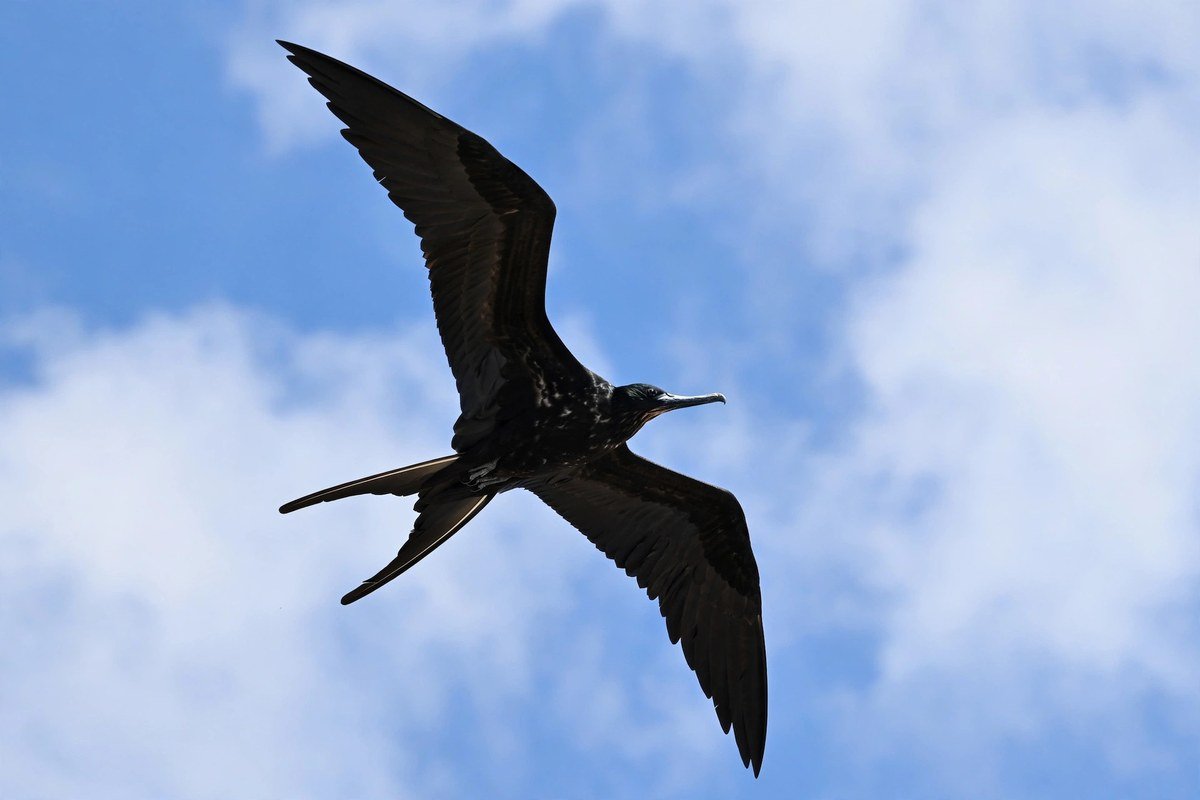
Do birds sleep while flying? The answer is yes, at least for a few remarkable species. In 2016, scientists recorded the brain waves of great frigatebirds soaring over the Pacific and caught them napping mid-flight, sometimes with only half their brain asleep. It was the first hard proof that in-flight sleep is real.
Most birds cannot pull this off. Perching birds like sparrows and robins land each night and sleep the normal way. But a handful of long-distance specialists, including frigatebirds and alpine swifts, spend days or even months aloft without ever touching down. They rest in short bursts while riding rising air, using a trick called unihemispheric sleep.
This article explains which birds sleep while flying, how the half-brain trick works, and what scientists still do not know. The details are stranger than you might expect.

Do Birds Sleep While Flying? The Short Answer Is Yes, for Some
Yes, some birds do sleep while flying, but the list of confirmed species is short and the naps are tiny. The only species with direct brain-wave proof is the great frigatebird, a tropical seabird that can stay airborne for weeks over the open ocean. During a landmark 2016 study, frigatebirds averaged only about 42 minutes of sleep per day in flight, taken in episodes of roughly 12 seconds each.
Compare that with more than 12 hours of sleep per day on land, and the picture is clear: these birds run on fumes while traveling. They appear to treat in-flight sleep as a stopgap, not a replacement for real rest. Once they return to the nest, they crash hard to catch up on what they missed.
Alpine swifts almost certainly sleep on the wing too, since tracked individuals have flown for about 200 days without landing. For other candidates, such as albatrosses and long-distance migrant shorebirds, mid-flight sleep is strongly suspected but not yet proven with brain recordings. Every other claim you read about sleeping flyers should be weighed against that standard of evidence.
What Is Unihemispheric Sleep?
Unihemispheric sleep means one half of the brain sleeps while the other half stays awake. The sleeping hemisphere shows the slow brain waves of deep rest, while the awake hemisphere keeps watch over the surroundings. In birds, the open eye always belongs to the awake half, because each eye is wired to the opposite side of the brain.
The two halves take turns. After one hemisphere rests for a while, it wakes and the other side drops off. Over time, the whole brain gets some sleep, just never all at once. This alternating pattern lets an animal rest without fully letting its guard down.
Birds are not the only animals with this trick. Dolphins and whales sleep unihemispherically so they can keep swimming and surface to breathe. Among birds, the behavior is best documented in mallard ducks. When ducks rest in a row, the birds on the exposed ends keep their outward-facing eye open most of the time, while ducks tucked in the middle sleep with both eyes shut. Researchers describe this as the group edge effect, and you can read more about the duck findings in this account of ducks sleeping with one eye open.
Half-brain sleep gives flying birds three advantages:
- Constant awareness: one hemisphere monitors the airspace for obstacles, other birds, and predators.
- Motor control: the awake half keeps the wings and tail doing what they need to do.
- Flexible depth: the bird can dial sleep up or down depending on how risky the moment feels.
The Frigatebird Discovery: Proof That Birds Nap Mid-Flight
For decades, scientists assumed birds must sleep in flight, but nobody had ever measured it. The breakthrough came from a team led by Niels Rattenborg of the Max Planck Institute for Ornithology. They fitted 14 great frigatebirds with tiny brain-wave recorders and movement trackers, then released them from the Galapagos Islands to forage over the ocean.
The birds flew nonstop for up to 10 days, covering as much as 3,000 kilometers. When the recorders were recovered, the brain data told an extraordinary story. The frigatebirds slept in flight with either one hemisphere at a time or, unexpectedly, both hemispheres at once. The full results were published in Nature Communications in August 2016.
The numbers were the biggest surprise. Frigatebirds in flight slept for only 0.69 hours per day, about 42 minutes, which is 7.4 percent of the 12-plus hours they sleep on land. Each nap lasted around 12 seconds. As coverage of the study noted, how the birds stay sharp on so little sleep remains a mystery.
Sleep did not happen randomly. It occurred mostly at night, while the birds were soaring in circles on rising air currents with their wings still. There was even a pattern to which half of the brain slept: when circling, the hemisphere connected to the eye facing into the turn usually stayed awake, likely to watch for collisions with other birds. On rare occasions the recorders also picked up brief bursts of REM sleep, the dreaming phase, lasting only a few seconds. Unlike mammals, birds seem to keep enough muscle control during REM to keep flying.
Perhaps the most startling finding was the bihemispheric sleep. Many researchers had assumed that a flying bird must always keep half its brain awake or it would fall from the sky. The frigatebirds proved otherwise. As Rattenborg put it, they can sleep with both hemispheres and just continue soaring. If you want background on these ocean wanderers, see our frigatebird facts guide.
Alpine Swifts: Months Without Landing
If frigatebirds are the proven nappers, alpine swifts are the endurance champions. In 2013, researchers at the Swiss Ornithological Institute attached tiny light and movement sensors to six alpine swifts breeding in Switzerland. The data showed that once the birds reached their African wintering grounds, they simply never landed. The trackers recorded about 200 days of continuous flight.
Think about what that means. For more than six months, these birds ate, drank, and molted without touching the ground. Sleep had to happen somewhere, so the researchers concluded that all vital processes, including sleep, must continue during flight. You can read the full story in Discover magazine’s account of the six-month flight.
One important caveat: the swift study used movement sensors, not brain recorders. The evidence for sleep is indirect, inferred from the birds’ stillness and gliding patterns at night. It is a strong inference, and most ornithologists accept it, but it is not the same grade of proof as the frigatebird EEG data. Common swifts likely manage similar feats, but the alpine swift holds the documented record.
Which Other Birds Might Sleep in Flight?
Beyond frigatebirds and swifts, several other long-haul flyers are strong candidates for mid-flight sleep. The evidence ranges from suggestive to thin, so it helps to sort them honestly.
| Species | Why it is a candidate | Evidence status |
|---|---|---|
| Great frigatebird | Flies for weeks over oceans; cannot land on water | Proven by brain-wave recordings (2016) |
| Alpine swift | Tracked flying for about 200 days without landing | Strongly inferred from movement data (2013) |
| Albatrosses | Soar over oceans for months using wind energy | Suspected, not yet proven with brain recordings |
| Bar-tailed godwit | Flies Alaska to New Zealand nonstop, over a week aloft | Unknown; no sleep data collected in flight |
| Pectoral sandpiper | Males stay active for days during breeding season | Related sleep research exists, but not in flight |
Albatrosses deserve special mention. Wandering albatrosses cross entire oceans with barely a wingbeat, using a technique called dynamic soaring to harvest energy from wind gradients. Their shoulder joints can lock the wings open, which should make dozing cheap. Everything about their lifestyle points to mid-flight sleep, but until someone records an albatross brain in flight, it stays in the suspected column.

The bar-tailed godwit is another fascinating case. Satellite tracking has shown these shorebirds flying from Alaska to New Zealand in a single nonstop push lasting more than a week. Whether they snatch micro-naps along the way or simply endure the whole trip awake is one of the open questions in migration science. Pectoral sandpipers add a different twist: during the breeding season, the most successful males sleep the least, which shows that birds can tolerate extreme sleep loss when the payoff is high.
Why Most Birds Still Land to Sleep
For the vast majority of birds, sleeping in flight is not an option and not necessary. A robin, sparrow, or cardinal ends its day by finding a safe perch and settling in. Birds have a locking tendon mechanism in their feet that grips a branch automatically, so they can doze without falling. Most songbirds sleep through the night with both brain hemispheres down, waking only if danger approaches.
Flapping flight is the other reason. Staying airborne by flapping demands constant, active control of every wingbeat. A sleeping brain cannot manage that workload. The birds that nap on the wing are almost all expert soarers that can ride rising air with their wings held still. Gliding is cheap; flapping is not. That is why you will never see a hummingbird or a finch dozing mid-air.
There is also safety in numbers on the ground. Many birds gather in communal roosts at dusk, from blackbird flocks to starlings swirling in huge murmurations before they settle. A crowded roost offers many eyes and ears against predators, which is a far simpler solution than evolving half-brain flight sleep. For the full picture of nighttime habits, see our guide on where birds sleep at night.
How Sleeping Birds Stay Aloft
The secret to napping in mid-air is to stop working so hard. Frigatebirds do almost all of their in-flight sleeping while soaring in thermals, columns of warm air rising from the ocean surface. Inside a thermal, a bird can circle upward with barely a wingbeat, gaining height for free. It is the aerial equivalent of dozing in a slowly rising elevator.
Timing matters too. The frigatebird study found that sleep clustered at night, when the birds were not actively hunting. Daytime was for foraging, with the brain fully awake. The birds also chose their moments: naps happened in smooth, stable air rather than in gusty or turbulent patches where active control was essential.
Body design helps enormously. Frigatebirds have the largest wingspan relative to body weight of any bird, which makes them supremely efficient gliders. Swifts have long, scythe-like wings built for a life on the wing. Albatrosses lock their wings with a specialized shoulder mechanism. Each of these adaptations lowers the cost of staying airborne, which in turn lowers the cost of sleeping through it. To understand the mechanics behind gliding and lift, read our explainer on how birds fly.

Frequently Asked Questions
Do birds dream while flying?
Probably not in any way we would recognize. The frigatebird recorders picked up brief flashes of REM sleep, the phase linked to dreaming in mammals, but each episode lasted only a few seconds. Whether birds experience anything like dreams during those flashes is unknown. Dreaming in birds is still an open research question even for birds sleeping safely on land.
Can birds fall out of the sky while asleep?
Nothing in the research suggests they do. Frigatebirds kept flying normally through every recorded sleep episode, including the ones where both brain hemispheres were asleep. They nap while soaring on stable rising air, which requires minimal active control, and they appear to keep enough muscle tone even in REM sleep to hold their flight posture. Evolution would quickly punish any sleeper that dropped out of the sky.
Do ducks sleep with one eye open?
Yes. Mallard ducks are the classic example of unihemispheric sleep in action. In a well-known study, ducks resting in a row kept the eye facing away from the group open about 86 percent of the time if they sat on an exposed end. Ducks in the middle of the row slept with both eyes closed. The open eye stays wired to the awake half of the brain, giving the duck a built-in lookout.
How long can swifts stay airborne?
The documented record belongs to the alpine swift: about 200 days of continuous flight during the non-breeding season, tracked with onboard sensors in a 2013 study. Common swifts are also famous for spending most of their lives on the wing, landing mainly to breed. Young swifts may even spend their first two or three years aloft before ever landing at a nest site, though that claim rests on radar observations rather than individual tracking.
Why do frigatebirds sleep so little while flying?
Nobody knows for sure. The study’s lead researcher has said openly that it remains unclear why the birds sleep so little in flight, even at night when they rarely forage. One idea is that in-flight sleep is deliberately shallow and brief because the ocean is still a risky place. Another is that frigatebirds simply tolerate sleep debt the way migrating sandpipers do, then repay it with marathon sleep sessions back on land.
Conclusion
So, do birds sleep while flying? A select few do, and they do it with an elegance that borders on the unbelievable. Great frigatebirds take 12-second micro-naps while circling on ocean thermals, sometimes letting both halves of the brain rest at once. Alpine swifts stretch the feat across months, living entirely on the wing through half the year.
The half-brain trick behind it, unihemispheric sleep, shows up across the animal kingdom wherever rest and vigilance have to coexist. Ducks use it on ponds, dolphins use it in the sea, and frigatebirds use it thousands of feet in the air. Yet most birds want nothing to do with it. They land, lock their feet around a branch, and sleep the whole-brain way, which remains the better deal whenever landing is an option.
What makes this story worth following is how much is still unknown. No one has recorded a sleeping albatross, godwit, or swift brain with EEG precision. As tracking sensors get lighter, the list of birds that sleep while flying will likely grow.






[…] energy and water. A tired bird may fly less precisely or land awkwardly. You can read more about do birds sleep while flying to see how they manage rest without losing control. A bird that cannot recover after rest may be […]