 Skip to content

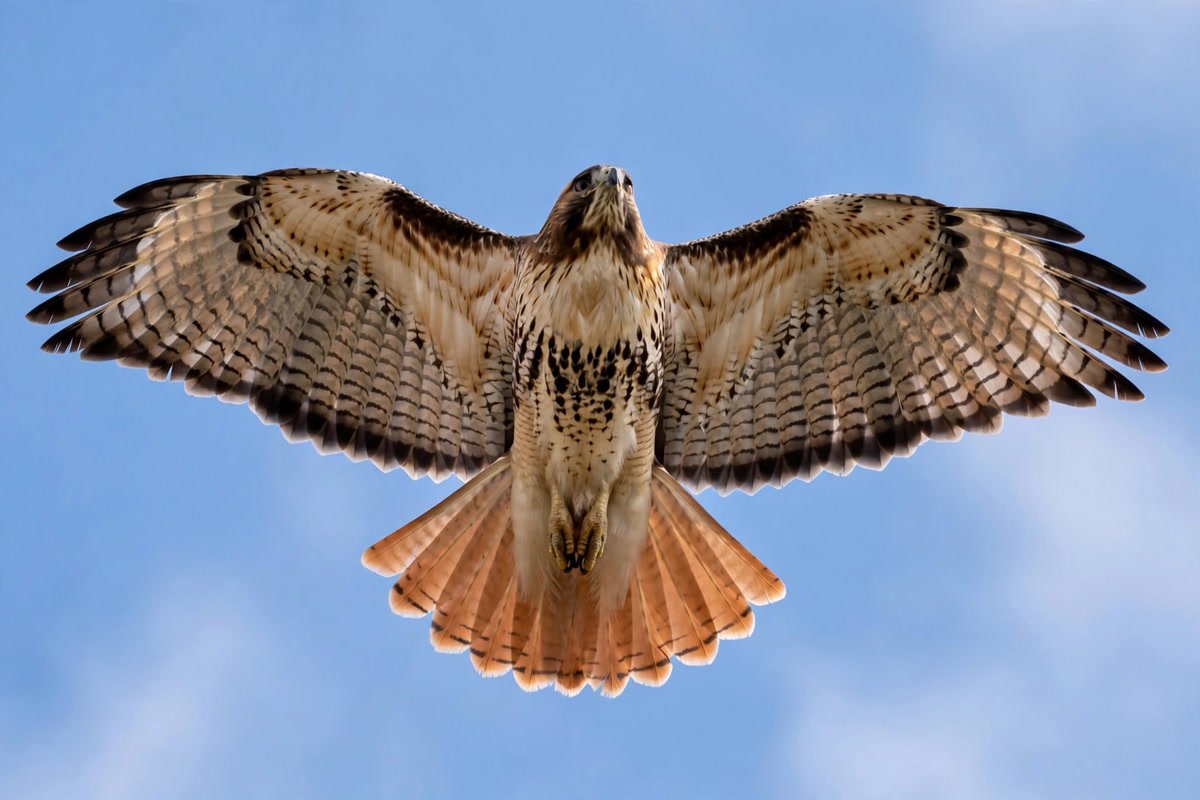
How do birds fly? The short answer is that a bird’s wing is an engine and an airfoil in one. With every wingbeat, the wing pushes air down and backward, and the air pushes the bird up and forward in return. Four forces run the whole show: lift pushes the bird up, thrust drives it forward, drag holds it back, and weight, which is gravity pulling on the bird’s body, drags it down.
A bird stays in the air when lift balances its weight and thrust beats drag. Every part of a bird’s body serves that balance, from the curve of its wing to the hollow struts inside its bones and the thousands of feathers that form its flight surfaces.
This guide explains the aerodynamics of bird flight in plain English. You will learn how wings make lift, where thrust really comes from, why feathers work like engineered machinery, and why different birds flap, glide, or soar. No physics degree required.

How Do Birds Fly? The Four Forces Behind Every Wingbeat
Flight is a constant negotiation between four forces. Physicists use the same four to describe airplanes, kites, and gliders, so a bird is really a living aircraft. When all four balance out, the bird cruises in level flight.
- Lift: the upward force created by the wings. It must equal or exceed the bird’s weight.
- Thrust: the forward force produced by flapping. It must overcome drag.
- Drag: air resistance pushing against the bird’s body and wings. Streamlining reduces it.
- Weight: gravity pulling the bird down. Lighter bodies need less lift.
Think of it as two tug-of-war matches happening at once. Lift wrestles with weight on the vertical rope, and thrust wrestles with drag on the horizontal rope. A bird climbs when lift wins its match, speeds up when thrust wins its match, and glides when both matches end in a draw. The Science Learning Hub’s guide to how birds fly, built with university researchers, uses exactly this four-forces framework to explain avian flight.
| Force | Direction | The bird’s answer |
|---|---|---|
| Lift | Up | Curved wings moving through air |
| Thrust | Forward | Powerful downstroke of the wings |
| Drag | Backward | Streamlined body and smooth feathers |
| Weight | Down | Light skeleton, no heavy teeth or jaws |
Lift: How Wings Push Air Down
Lift is the force that holds a bird up, and wings are shaped to manufacture it. Slice a bird’s wing across and you see an airfoil: rounded at the front, curved on top, and tapered at the back. Air flowing over the curved top surface speeds up, which lowers the air pressure there. The higher pressure under the wing then pushes it upward. This pressure difference is part of the story.
The other part is simpler and arguably more important. A bird tilts its wing slightly as it moves through the air, and the tilted surface deflects air downward. Newton showed that every action has an equal and opposite reaction, so the downward shove of air produces an upward shove on the wing. Caltech’s fluid dynamics analysis of bird flight demonstrates the same result: a wing tilted at a small angle generates an average upward force that balances the bird’s weight in level flight. Both the pressure difference and the downward deflection of air contribute to lift.
Angle of Attack: The Wing’s Tilt
The tilt of the wing relative to the oncoming air is called the angle of attack, and birds manage it constantly. A few degrees of tilt produce efficient lift. Tilt too far and the airflow separates from the wing’s surface, creating a stall, which is the sudden loss of lift. Birds avoid stalls by feel, adjusting each wing many times per second.
This is why a landing bird fans its tail and spreads its wingtip feathers wide. At slow speeds, a high angle of attack is the only way to keep making lift, and the spread feathers keep the airflow attached longer. Watch a hawk come in to land and you are watching angle-of-attack management in real time.
Wing Loading: Why Big Wings Glide Slowly
Wing loading is the bird’s weight divided by its wing area, and it decides how fast a bird must fly to stay up. A hawk with broad wings has low wing loading, so it can glide slowly without stalling. A duck with small wings relative to its body has high wing loading, so it must beat its wings hard and fly fast just to stay airborne.
Low wing loading also means better maneuverability at slow speeds, which is why forest hawks have rounded, broad wings for twisting between trees. High wing loading means speed and efficiency, which suits ducks and auks that commute long distances. Smaller-winged birds simply must fly faster to generate the same lift as larger-winged ones.
Thrust: The Power Stroke
Lift holds a bird up, but something has to push it forward, and that job belongs to the downstroke. The main flight muscle, the pectoralis major, anchors to the deep keel of the breastbone and makes up a large share of a flying bird’s total muscle mass. When it contracts, the wing slams downward and slightly forward, shoving air down and back. The reaction pushes the bird up and forward.
The upstroke is the recovery move. A second muscle, the supracoracoideus, lifts the wing back up through a pulley-like tendon over the shoulder. To avoid wasting energy, the bird partly folds its wing and reduces its angle of attack on the way up, slicing through the air with minimal resistance. The wing also twists automatically with each stroke to stay aligned with the direction of travel.
The motion is not a simple up-and-down flap. Schlitz Audubon’s physics of flight guide describes how a duck taking off rotates its wings in a rowing motion, scooping the air in a figure-eight pattern that pushes air behind the bird. The outer half of the wing does most of the thrust work, while the inner half near the body keeps generating lift, almost like a glider wing. More than 50 muscles coordinate each wingbeat, including tiny ones that adjust individual flight feathers.
Feathers: Nature’s Engineering
Feathers are the actual flight surfaces, and they are built like precision equipment. Each flight feather has a central shaft with a vane of interlocking barbs on either side, and the barbs carry tiny hooks called barbules that zip together. The whole feather is made of keratin, the same lightweight material as your fingernails, so it is strong, flexible, and astonishingly light.
Different feathers do different jobs. Primary feathers at the wingtip are long and narrow; they generate thrust on the downstroke and act as steering flaps. Secondary feathers along the inner wing are shorter and broader; they form the airfoil surface that makes lift. Coverts are the smooth overlapping layers that streamline the whole wing.
Look at a soaring hawk’s wingtips and you will see the primaries spread like fingers, with visible slots between them. Each separated feather works like a small wing of its own, and the slots let air flow through in a way that reduces drag and delays stalling at low speeds. This is why landing birds spread their wingtips: the slots keep lift coming when the bird is flying slowest.
Feathers also need waterproofing and maintenance. Birds spread oil from the uropygial gland at the base of the tail through their plumage while preening, which keeps water beading off instead of soaking in. That matters because wet feathers are heavy and lose their airfoil shape. Feathers do more than fly, too: they insulate and waterproof the body, which is why even flightless birds like ostriches keep a full coat of them.
Flapping, Soaring, and Gliding: Three Ways to Stay Up
Not all flight is flapping. Birds use three basic styles, and most species mix them depending on what they are doing.

Flapping: The Expensive Option
Flapping is powered flight, and it is the most energy-hungry way to move that any animal uses. Small birds flap continuously because their high wing loading gives them no choice. Hummingbirds take it to the extreme: they rotate their wings at the shoulder and beat them roughly 50 times per second in smaller species, tracing a figure-eight pattern that generates lift on both the downstroke and the upstroke. That is what lets them hover in front of a flower like a helicopter.
Flapping burns so much energy that a hovering hummingbird has one of the highest metabolic rates of any vertebrate. It must feed almost constantly to pay for it, which is why a yard full of nectar flowers can keep hummingbirds coming back all day.
Gliding: Trading Height for Distance
A gliding bird holds its wings out stiffly and does no flapping work at all. The wings sit at a slight angle that deflects air downward, producing lift, but drag is constantly slowing the bird down. To keep enough speed for lift, the bird trades altitude for speed, sliding gently downhill through the air.
Gliding is how raptors commute between thermals and how seabirds cover long stretches of ocean. It costs almost nothing, which is why a bird that has climbed high can glide for miles while barely spending energy.
Soaring: Riding Free Elevators
Soaring is gliding with a boost from rising air. Over land, the sun heats the ground unevenly, and columns of warm air called thermals rise thousands of feet. Hawks and vultures circle inside these columns, gaining altitude without a single wingbeat, then glide to the next thermal. That is why you often see hawks spiraling in loose circles on sunny afternoons; each bird is riding an invisible elevator.
Over the ocean, albatrosses use a different trick called dynamic soaring. They weave in S-patterns through the layers of wind above the waves, harvesting energy from the difference in wind speed at different heights. The Science Learning Hub notes that albatrosses can cover nearly 1,000 kilometers a day this way, barely flapping at all, and some stay aloft for years without touching land. Flocking adds another layer of coordination: the wheeling clouds in starling murmurations show how thousands of birds manage flight together in real time.
| Flight style | Energy cost | How it works | Masters of it |
|---|---|---|---|
| Flapping | Very high | Muscles drive every wingbeat | Hummingbirds, ducks, sparrows |
| Gliding | Very low | Trades altitude for forward speed | Raptors between thermals |
| Soaring | Minimal | Rises on thermals or wind gradients | Hawks, vultures, albatrosses |
Taking Off and Landing: The Hardest Parts
Cruising is easy compared with getting airborne. A bird sitting still has no airflow over its wings, so it must create lift from nothing with pure muscle. Many birds start with an exaggerated upstroke, throwing both wings high over the back, then drive them down in one violent power stroke. Ducks and other heavy birds run across the water or ground to build speed first, while birds on high perches simply step off and let gravity and the wing’s airfoil shape do the opening work.
Landing is arguably even trickier. The bird must bleed off speed without stalling and touch down softly. It flares: pitching the body up, fanning the tail as an air brake, spreading those slotted wingtip feathers, and throwing its feet forward as landing gear. Geese coming into a lake do this beautifully, skidding across the surface with wings cupped to kill the last of their speed.
Watch landings closely and you will see every concept in this article working at once: high angle of attack, slotted primaries, the tail acting as a brake and rudder, and the legs absorbing the touchdown. Takeoff and landing are where a bird’s aerodynamics get their toughest workout.
How Baby Birds Learn to Fly
No bird is born knowing how to fly. Nestlings spend days doing wing exercises in the nest, flapping stubby wings to build the pectoral muscles they will need. When they fledge, they leave the nest with short tails and unpracticed wings, and their first flights are clumsy, short hops between branches.
Parents keep feeding fledglings for days or weeks while the youngsters practice takeoffs, landings, and turns. Many young birds die in this awkward window, which is why surviving that first summer is the biggest hurdle in a bird’s life. Once a young bird masters flight, it has cleared the most dangerous stage; after that, some species go on to live remarkably long lives, as you can see in our guide to how long different birds can live.

Frequently Asked Questions
Why do birds fly in V formation?
Each bird’s wingtips create a small upwash of rising air trailing behind them. The bird flying behind and to the side positions itself in that upwash and gets free lift, which saves energy on long migrations. Geese and pelicans are the classic V-flyers, and the birds at the front and the tip of the V work hardest, so flocks rotate those positions to share the load.
How fast can birds fly?
It depends on whether the bird is diving or flying level. A peregrine falcon in its hunting dive, called a stoop, can exceed 200 miles per hour, and one famous measured dive topped 242 mph. But that is gravity-assisted falling, not flapping. In level flight, the same falcon cruises at roughly 40 to 60 mph. Claims for the fastest level-flight birds, such as the spine-tailed swift at around 105 mph, are widely repeated but hard to verify, so treat them as estimates. Birds and Blooms has a good rundown of the peregrine’s speed records, and if you spot a large raptor stooping at speed, our hawk vs falcon identification guide can help you tell which one you are watching.
Do all birds fly?
No. Ostriches, emus, kiwis, and cassowaries lost the power of flight as they grew large on predator-free land, and penguins traded flight for swimming, using their wings as flippers underwater. Roughly 60 living bird species are flightless. Most still have wings, but the wings are shrunken or repurposed, and their breastbones lack the deep keel that anchors flight muscles.
Why do birds soar in circles?
Because thermals are columns. A thermal is a narrow pillar of rising warm air, so a bird climbs fastest by circling tightly inside it, like walking up a spiral staircase instead of wandering around the building. Once the bird reaches the top of the thermal, it glides off in a straight line toward the next one. Watch a kettle of hawks on a warm afternoon and you are watching them take turns riding the same column of air.
Conclusion
Birds fly because evolution tuned every part of them to a single deal with physics: push air down and back, and let the air push you up and forward. Lift from curved wings and carefully managed angles of attack balances weight. Thrust from the mighty downstroke overcomes drag. Lightweight bodies with air-filled bones, feather engineering with slotted wingtips, and tricks like thermals and V formations squeeze the most flight from every calorie.
The next time you watch a hawk circle or a hummingbird hover, you are watching aerodynamics in action. Understanding how do birds fly turns an everyday sight into something remarkable: a machine with no engine, built from feathers and hollow bones, that solved the problem of flight millions of years before humans ever left the ground.






[…] understand how those turns work in the air, it helps to see how birds fly in the first place, since lift, thrust, and tail steering all shape how a bird changes direction […]