 Skip to content

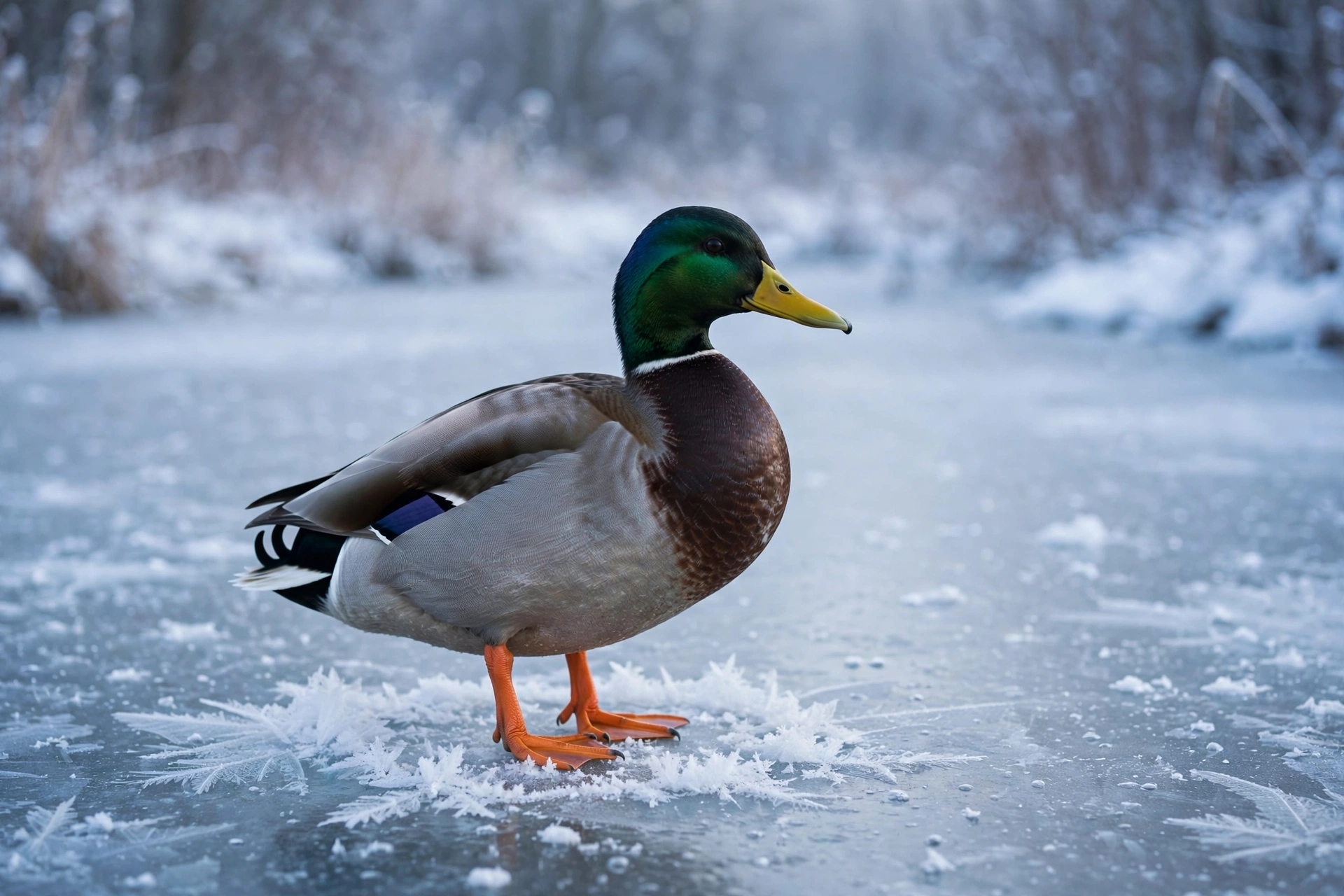
A duck stands on a frozen pond at dawn, orange feet planted flat on solid ice, looking completely unbothered. You are watching from the bank in insulated boots, and your own toes went numb ten minutes ago. It is one of winter’s great small mysteries: why don’t birds’ feet freeze? Their legs are bare, scaly, and featherless, pressed against ice and snow for hours, yet they show no discomfort and suffer no harm.
The answer is a layered defense system shaped by millions of years of evolution. Birds run a built-in heat recycling system in their legs. Their feet are anatomically designed to need almost no warmth in the first place. And they behave like clever little engineers, tucking, fluffing, and repositioning to stay ahead of the cold. This guide walks through every layer, from the wonderful net of blood vessels inside a duck’s leg to the real reason that heron is standing on one foot.
Why Don’t Birds’ Feet Freeze in Winter? The Short Answer
Here is the short version before the details. Bird feet do get cold, but cold does not hurt them the way it hurts us. A foot is mostly bone, tendon, and tough scale, with few nerves and almost no muscle, so there is little living tissue that can be damaged and little sensation to complain about.
On top of that anatomy sits a circulatory trick called countercurrent heat exchange. Warm blood flowing down the leg gives up its heat to cold blood flowing back up, so the feet stay just above freezing while the warm core loses almost nothing. Behavior closes the remaining gap: birds tuck feet into warm down, stand on one leg, and fluff their feathers into puffy insulation. Together, these layers make ice a perfectly comfortable perch.
The Heat Recycler in Their Legs
The star of this story is a structure with a lovely name: the rete mirabile, Latin for “wonderful net.” Inside a bird’s leg, the arteries carrying warm blood down from the heart run right alongside the veins carrying cold blood back up from the feet. In many species these vessels are woven into a dense, net-like mesh where heat passes directly from the warm side to the cold side through the vessel walls.
Follow a drop of blood on its round trip. Leaving the body core, arterial blood is warm. As it travels down the leg, it surrenders heat to the neighboring vein. By the time it reaches the foot, it has cooled to just above freezing. Meanwhile the venous blood, which left the foot icy cold, picks up that surrendered heat on its way up and arrives back at the body already pre-warmed. The core never receives a chilling blast of cold blood, and almost no heat is wasted on the foot.
The elegance is in what this achieves. Because the foot itself sits just above freezing, the temperature difference between the foot and the ice is tiny, so very little heat flows out into the environment. It is the same principle behind an industrial counterflow heat exchanger, and birds evolved it long before engineers drew one. As BirdNote explains, this interweaving of warm arteries and cold veins keeps a bird’s legs and feet functioning even while standing on ice.
Waterfowl show the system at its most dramatic. Ducks, geese, and penguins keep their feet in icy water or on frozen lakes for hours without frostbite, thanks to countercurrent exchange in the legs. Flamingos use the same arrangement in reverse conditions, standing in water that can be uncomfortably hot. The plumbing does not care which direction the danger comes from; it simply keeps the core isolated from the extreme at the feet.
Feet Built to Be Cold: Bone, Tendon, and Scale
Even the finest heat exchanger would struggle if bird feet were built like ours. They are not. Below the feathered part of the leg, a bird’s foot is mostly bone and tendon wrapped in tough, scaly skin. There are no muscles in the lower leg at all. The toes are worked by long tendons running down from muscles tucked safely up inside the warm, feathered thigh, like puppet strings operated from above.
This matters for two reasons. First, there is simply less living tissue down there to freeze. Bone and tendon tolerate cold far better than muscle. Second, tissue with no muscle needs very little blood, so the body can afford to send only a trickle of warm blood to the feet without starving them. The foot becomes a low-maintenance extremity that stays functional on a minimum energy budget.
The nervous system cooperates too. Bird feet and lower legs carry relatively few nerves, so the cold that would have us hopping and wincing barely registers. And unlike our feet, birds’ feet have no sweat glands. They stay dry, which means there is no moisture to freeze them to a metal perch or an icy branch. That dryness is the whole reason a chickadee can land on a frosty feeder pole without sticking to it.
Their sensory world is simply wired differently from ours, from toes to head. If you are curious how different, read do birds have ears to learn where their ears are and how they hear without any visible ear at all.
The Thermostat Trick: Turning Blood Flow Up and Down
Countercurrent exchange is always running, but birds can also adjust the volume. Specialized bypass vessels called arteriovenous shunts let birds control how much blood actually reaches the feet. In bitter cold, the shunts restrict flow to the bare minimum needed to keep tissue alive. The foot runs colder, the core stays warmer, and total heat loss drops.
The same system works in reverse all summer. When a bird is overheating, it floods those unfeathered legs and feet with blood, and the bare skin acts as a radiator, dumping excess heat into the air. This is why the one-legged posture flips with the seasons. On a scorching day, a bird stands on both feet to maximize cooling. On a freezing day, it tucks one foot away to minimize loss. As Indiana Public Media’s Moment of Science puts it, birds use their feet for temperature regulation in both directions, and the posture you see tells you which direction they need.
There is a limit, though. With one foot tucked and blood flow to the other reduced to a trickle, a bird standing exposed in brutal cold for too long can push its luck. The usual answer is to get out of the wind: hunker in a sheltered roost, settle into a nest, or, for waterbirds, slip into water that is still liquid. Liquid water cannot freeze a foot, no matter how cold the air gets.

Winter Survival Adaptations at a Glance
Feet are only one part of the winter survival kit. Here is how the main adaptations compare.
| Adaptation | What it does | Who shows it off |
|---|---|---|
| Countercurrent heat exchange | Recycles heat in the legs; feet stay just above freezing | Ducks on ice, penguins, flamingos |
| Tendon-only lower legs | Almost no muscle to freeze or keep warm with blood | All birds |
| Few nerves, no sweat glands | Feet feel little cold and stay dry on ice and metal | Songbirds on feeders |
| Adjustable blood flow | Shunts cut foot circulation to a minimum in deep cold | Most birds |
| One-legged standing | Roughly halves heat loss through the feet | Gulls, herons, flamingos, ducks |
| Fluffed feathers | Traps a thicker layer of insulating air | Chickadees, juncos, sparrows |
| Bill tucked, feet covered | Hides bare skin inside warm down while resting | Ducks sleeping on ice |
| Shivering | Burns calories in the muscles to generate heat | Small songbirds overnight |
| High-fat winter diet | Fuels the internal furnace all winter long | Chickadees at suet feeders |
Why Birds Stand on One Leg in Winter
You have seen it a hundred times: a gull, heron, or duck with one leg vanished into its belly feathers, balanced serenely on the other. It looks like a yoga pose. It is actually a heating bill reduction strategy. Tucking one foot into warm down removes it from the cold entirely, roughly halving the heat leaking out through the feet. The tucked foot gets fully rewarmed while the standing foot does its shift, and birds switch legs periodically to share the load.
There is a comfort element too. The posture lets the bird drop half its weight off the skeleton for a while, like shifting your weight from one foot to the other on a long day. Young birds develop the habit early, and it quickly becomes their default resting pose. Watch a flock of gulls on a winter beach and you will see a whole row of them doing it in loose synchrony.
Remember the seasonal flip. That same one-legged bird in July is likely doing something else, or standing on both legs to cool down. The posture is a tool, not a fixed trait, and reading it correctly means checking the thermometer first. For more on how birds read the seasons, see where birds go in winter, which covers the full range of cold-weather strategies from migration to toughing it out.

Feathers, Fat, and Good Decisions: The Supporting Cast
The legs get the glory, but the rest of the bird is working just as hard. Fluffing is the most visible defense. A bird that puffs up its feathers traps more still air against its skin, and still air is a superb insulator. That is why winter birds look round and almost spherical: they are wearing their down jackets at maximum loft. Many species also grow extra down as days shorten, the avian equivalent of a heavier coat.
At rest, birds hide every bit of bare skin they can. A sleeping duck tucks its bill into its shoulder feathers and sits down over its feet, so the only thing touching the ice is insulated belly plumage. The feet, warm under the body, never contact the cold surface at all. People sometimes call wildlife agencies in alarm, convinced a duck is frozen to the pond. Almost always, it is simply a waterbird napping on the ice, reluctant to move because standing up means exposing its feet to the air.
Then there is the furnace itself. Small birds run astonishingly hot metabolisms, and in winter they eat almost constantly to fuel them. High-fat, high-protein foods like sunflower seeds and suet are the premium fuel, which is why a stocked feeder in January is genuinely life-saving. Shivering through the night burns those calories directly into heat. Some tiny species, like chickadees, go further and let their body temperature drop overnight in a controlled torpor, saving energy while they sleep and rewarming at dawn.
Shelter rounds out the strategy. Evergreens, dense shrubs, and tree cavities break the wind and trap a pocket of slightly warmer air. A bird that has eaten well, fluffed up, tucked its feet, and found a sheltered roost is running a complete winter survival program, and the bare feet on the branch are the least of its worries. As Ask a Naturalist notes, the combination of feather insulation, shelter, and the countercurrent system in the legs is what gets birds through the hardest months.
Can Bird Feet Get Frostbite?
Rarely, but yes. The system is excellent, not invincible. Frostbite becomes a real risk when extreme cold combines with wind, wetness, injury, or exhaustion. A bird with an injured leg cannot tuck it properly or regulate its blood flow. A bird forced to stand in slush that keeps refreezing around its feet faces conditions the system was not designed for. Prolonged exposure during the worst storms can overwhelm even the best adaptations.
Domestic poultry illustrate the weak points. Chickens and turkeys are more prone to frostbite on their large combs and wattles, fleshy, blood-rich, and fully exposed, than on their feet. The feet, with their scaly armor and minimal blood flow, are comparatively safe. It is the fleshy ornaments, not the feet, that poultry keepers watch in a cold snap.
For wild birds, the honest answer is that frostbite of the feet is uncommon enough that most birders never see a case. The birds most at risk are the ones already in trouble: injured, starving, or oiled. The best help you can offer in deep cold is unglamorous but effective. Keep feeders filled with high-energy food, keep water open if you can, and leave dense shrubs and brush piles standing as shelter. The birds will handle the physiology themselves.

FAQs
Do birds feel cold in their feet?
Very little. Bird feet and lower legs carry relatively few nerves compared to ours, so the cold that would have us wincing barely registers. Their feet do get genuinely cold, often hovering just above freezing, but with so little sensation and so little vulnerable tissue, it simply does not bother them.
How do ducks stand on ice without freezing?
Ducks use countercurrent heat exchange in their legs. Warm arterial blood flowing down surrenders its heat to cold venous blood flowing up, so the feet stay just above freezing while the body core stays warm. Because the foot is nearly as cold as the ice, almost no heat flows out into it, and the duck loses surprisingly little warmth.
Why do birds stand on one leg in winter?
To cut heat loss. Tucking one foot into warm belly feathers removes it from the cold entirely, roughly halving the heat escaping through the feet. Birds switch legs periodically so each foot takes a turn warming up. In summer the same birds stand on both legs to dump excess heat.
Can birds get frostbite on their feet?
It is rare but possible. Extreme prolonged cold combined with wind, wetness, or an injury can overwhelm the system. Healthy wild birds almost never suffer frostbitten feet; the birds at risk are usually already injured, starving, or otherwise compromised.
Why don’t birds’ feet stick to metal perches in winter?
Because bird feet have no sweat glands. They stay completely dry, so there is no moisture to freeze and bond them to a frosty feeder pole or icy branch. That dryness is the whole reason a chickadee can land on cold metal without getting stuck.
Do birds’ feet change for winter?
The feet themselves do not grow winter coverings, but everything around them adjusts. Birds restrict blood flow to the feet more aggressively, tuck and cover them more often, fluff extra down over the upper legs, and eat constantly to fuel heat production. Behavior and circulation do the seasonal work that feathers cannot.
Conclusion
The duck on the frozen pond is not suffering, and it is not lucky. It is running one of evolution’s most elegant heating systems: a wonderful net of blood vessels that recycles warmth before it can escape, feet built from bone and tendon that barely need warming, circulation that can be throttled to a trickle, and the simple wisdom to tuck one foot into warm feathers and wait out the worst of it. What looks like endurance is really engineering.
It is also a reminder of how much quiet physics happens in the bird world every day. The same curiosity that wonders about cold feet leads to other everyday puzzles, like why birds don’t get electrocuted on power lines, another case of birds obeying the laws of physics so perfectly that it looks like magic. Watch the birds this winter with that in mind. The fluffed-up chickadee, the one-legged gull, the duck napping on the ice: none of them are worried about their feet. Now you know why.




