Skip to content

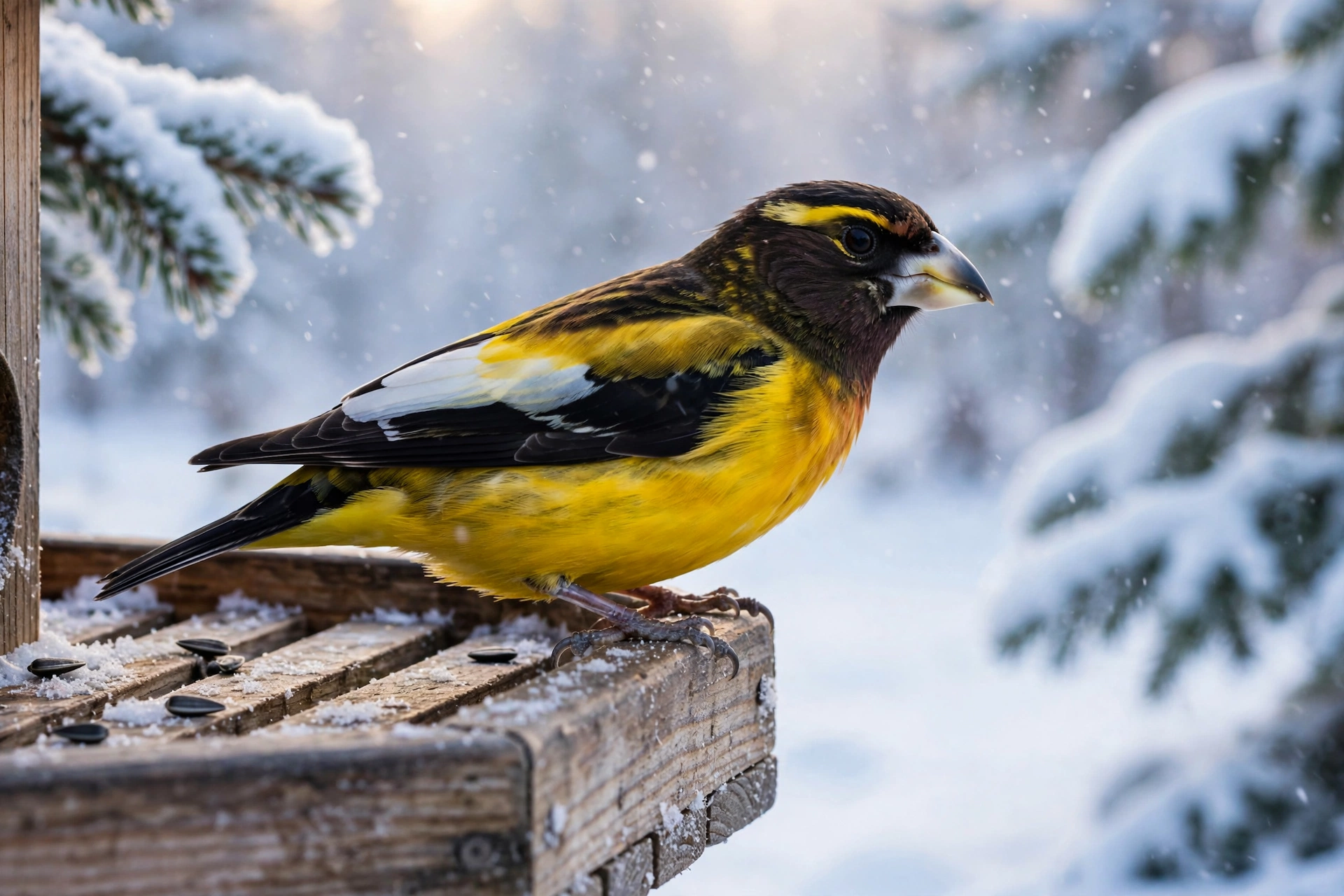
Some winters, the bird feeders of the northeastern United States turn into something out of a wildlife documentary. Flocks of chunky, golden-yellow finches with enormous ivory bills descend out of nowhere, empty a platform feeder in an hour, and vanish again by spring. These are evening grosbeaks, and their surprise appearances are called irruptions.
For winter 2026-27, the Finch Research Network has published its annual Winter Finch Forecast, and the news for grosbeak fans is cautiously exciting. A small southward movement out of the boreal forest is quite possible again this year, potentially reaching southern New York, Pennsylvania and Massachusetts. That would continue a remarkable run of irruptions in four of the last six winters.
This guide gives you everything you need to make the most of it. You will learn how to identify male, female and juvenile evening grosbeaks at a glance, why these irruptions happen, exactly where to look this winter, and how to turn your feeders into a grosbeak magnet. In an irruption year, no feeder has a better chance than a well-stocked one.
What an Irruption Actually Is
An irruption is not the same as a regular migration. Migratory birds travel between breeding and wintering grounds on a predictable schedule every year, like clockwork. Irruptive birds break that pattern entirely. They stay north in good food years and push far south only when their boreal food supply fails.
Evening grosbeaks are classic irruptive finches. In most winters they remain in the coniferous forests of Canada, feeding on seeds, buds and the larvae of spruce budworm. When seed crops crash across the boreal forest, flocks spill southward in search of food, sometimes reaching deep into the United States. Then, just as suddenly, they disappear for several years.
This boom-and-bust behaviour is exactly what makes them so thrilling. You cannot mark your calendar for an evening grosbeak irruption the way you can for a warbler migration. You can only watch the seed crops, read the forecast, stock your feeders and hope. For the full story of how these cycles work, see our complete guide to winter finch irruptions.
How to Identify an Evening Grosbeak
The evening grosbeak is a large, stocky finch, roughly the size of a starling, with a short tail and a bill that looks almost comically oversized. That massive bill is its defining tool, built for cracking the toughest seeds and cherry pits. Once you have seen one, you will never confuse it with anything else, but males, females and juveniles look quite different from each other. For range maps, sounds and life history, see the Cornell Lab’s Evening Grosbeak overview.
| Feature | Male | Female | Juvenile |
|---|---|---|---|
| Head | Dark brown-black with a bright yellow eyebrow stripe | Grey-brown, no bold markings | Grey-brown like the female |
| Body | Rich golden-yellow on the body and rump | Grey-brown with a yellowish wash on the neck and sides | Dull brown with fine streaking |
| Wings | Bold black and white | Black and white, more subdued | Dusky with developing pale patches |
| Bill | Massive, pale ivory, conical | Massive, pale ivory, conical | Large but duller |
| Overall impression | Unmistakable flash of yellow and black | Subtle and camouflaged | A streaky youngster with a big bill |
The Male: Unmistakable
The adult male is one of the most striking birds in North America. His head is dark brown-black, split by a brilliant yellow stripe above the eye that sweeps back like a painted eyebrow. His body glows golden-yellow, and his wings are a bold pattern of black and white. His bill is huge, conical and pale ivory, paler in winter and taking on a greenish tint in the breeding season.
In flight, males flash large white patches in the wings against the black, a pattern visible from a long way off. Their call is a loud, ringing note often described as a distant trumpet or a bright “clee-ip”, and a flock arriving overhead sounds like a handful of tiny brass instruments.
The Female: Subtle but Distinctive
Females are much quieter in colour but just as distinctive in shape. She is grey-brown overall with a soft yellowish wash across the neck and sides, and her wings carry the same black-and-white pattern as the male, though in muted tones. Her bill is equally massive and pale, which instantly separates her from every other grey-brown winter bird.
Beginners sometimes mistake females for large, washed-out finches or even female grosbeaks of other species. Check the bill first. Nothing else in your winter yard combines that grey-brown plumage with a bill that looks built for cracking walnuts.

Juveniles: Miniature Females
Young birds in their first autumn look like streaky, brownish versions of the female, with fine dark streaking on the underparts and duller wing markings. The bill is already noticeably large, which is your best clue. By their first winter they moult into plumage very close to the adult female, and young males begin to show the yellow tones that will make them unmistakable by spring.
Birds You Might Confuse It With
Three other birds cause occasional confusion, and each is easy to rule out with one look at the bill and wings:
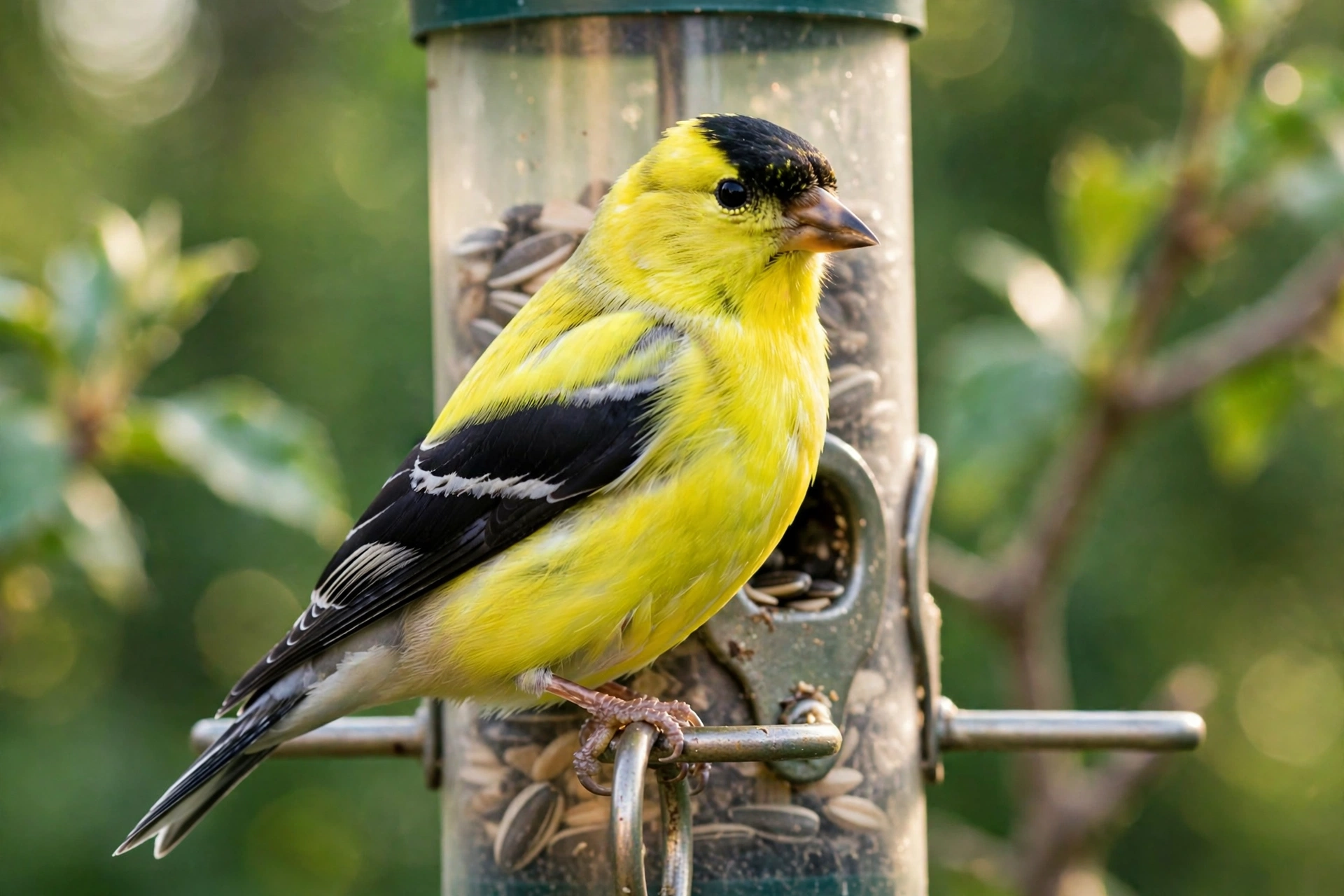
- American goldfinch: much smaller and more delicate, with a small pointed bill and, in breeding males, a black forehead rather than a full dark hood.
- Pine grosbeak: larger and longer-tailed, with rosy-red males and grey females, and a smaller bill relative to its head.
- Black-headed grosbeak: a western bird with a similar chunky shape, but males have an orange breast and black head without the yellow eyebrow.
If the bird has a bill like a pair of pliers and black-and-white wings, you are looking at an evening grosbeak.
The Winter Finch Forecast 2026-2027: What It Really Says
Every autumn, the Finch Research Network publishes its Winter Finch Forecast, written by Tyler Hoar, and it is the single best source for predicting where boreal finches will spend the winter. The forecast is built on continent-wide reports of seed and fruit crops, from spruce cones to mountain-ash berries. Here is what the 2026-2027 edition says about evening grosbeaks, in plain language.
The headline is that a small southward movement is quite possible again this winter, potentially reaching southern New York, Pennsylvania and Massachusetts. That would continue an extraordinary streak: the northeastern United States has now seen evening grosbeak irruptions out of the boreal in four of the last six winters (2020-21, 2022-23, 2024-25 and 2025-26), with birds pushing into southern New York and northwestern Pennsylvania in each of the last two.
But the forecast is a prediction, not a promise, and the details matter:
- Seed crops: good across the eastern and far western boreal, but largely poor through the central boreal, which is what pushes birds east and south.
- Mountain-ash: the berry crop is good across much of the boreal this year, and the forecast expects it to hold some evening grosbeaks and pine grosbeaks to the north.
- Cherry crops: poor this year, removing one of the post-breeding foods these finches rely on.
- Spruce budworm: the eastern outbreak has now persisted for a decade or more, and this budworm-loving finch has increased locally on that abundant food.
- Where they will be: small to medium-sized flocks should be findable in southeastern Canada near Algonquin Provincial Park, the Great Lakes region and the northeastern United States.
- The catch: because food crops in the northeastern forests are plentiful, birds will likely spend more time in the woods than at feeders.
- The southeast: no big irruptions of any finch species are expected in the southeastern states this year.
The practical takeaway is simple. If you live in the Great Lakes region, New England, New York or Pennsylvania, this is a winter to watch the skies and keep your feeders full. If you live further south, temper your expectations, but do not give up entirely: irruptions have surprised forecasters before.
Why Evening Grosbeaks Irrupt: Follow the Food
Every irruption begins with a seed crop failure. Boreal trees like spruce, fir, birch and mountain-ash do not produce steady crops. They mast, meaning they produce enormous seed crops in some years and almost nothing in others, often in synchrony across vast regions. When a poor crop year hits the central boreal, the finches that depend on those seeds have two choices: move or starve.
Evening grosbeaks have an extra twist in their story. They are enthusiastic predators of the spruce budworm, a native insect whose outbreaks defoliate conifer forests in cycles lasting years or decades. The current eastern budworm outbreak has persisted for a decade or more, and the forecast notes that grosbeaks have increased locally wherever the budworm is abundant, raising families successfully on the protein-rich larvae.
That budworm bounty explains why the Northeast has seen irruptions in four of the last six winters even in years when seed crops were reasonable. There are simply more grosbeaks alive to move. When the post-breeding foods they shift to, like cherries, fail in a given year, even a good budworm summer can end with flocks pouring south. For the deeper science of mast crops and irruption cycles, read our winter finch irruption explainer.

Where to Look This Winter
The Most Likely Regions
Based on the forecast, your odds are best in southeastern Canada, especially around Algonquin Provincial Park and the towns to its south, the Great Lakes region, and the northeastern United States. Within the US, watch southern New York, Pennsylvania and Massachusetts closely, since the forecast flags a possible small movement into exactly those areas.
Do not ignore the corridor between the known hotspots, either. Irrupting finches travel in loose flocks and drop into any promising habitat along the way. eBird is your best tool for tracking real-time reports: check the evening grosbeak sightings map weekly through November and December, when most irruptions build.
The Right Habitats
Away from feeders, evening grosbeaks are tree-top foragers with strong preferences. The forecast specifically notes that they look for maple and ash trees still holding seeds, and for mountain-ash berries, which are a favourite winter food. Box elder seeds are another classic attractant, and the birds will work through ornamental crabapples and other fruiting trees in suburban neighbourhoods.
Walk or drive slowly through areas with mature maples, ashes and berry-laden mountain-ash, and scan the crowns. Grosbeak flocks are noisy feeders, and you will often hear the crack of splitting seeds and the birds’ ringing calls before you see a single yellow feather.
Listen First, Look Second
Experienced grosbeak chasers find more birds by ear than by eye. Learn the call: a loud, clear, slightly metallic note, often given in flight as the flock moves between feeding trees. On a still winter morning, that sound carries surprisingly far. If you hear it, stop and scan the treetops, because the flock is usually close behind the first caller.
How to Attract Evening Grosbeaks to Your Feeders
Evening grosbeaks are famously feeder-friendly during irruption years, and the forecast confirms their top preference: at platform feeders, they favour black oil sunflower seeds above all else. A flock can strip a full platform feeder in a single visit, so preparation matters. Here is how to give your yard the best possible chance:
- Platform feeders: use large, open platform or hopper feeders that several chunky birds can land on at once; small tube feeders are awkward for birds this size.
- Black oil sunflower seeds: stock them generously, since this is the seed the forecast specifically names as their feeder favourite.
- Keep feeders full: grosbeaks travel in flocks and eat astonishing quantities, so buy seed in bulk before the irruption peaks.
- Add water: a heated bird bath gives you an edge, because open water is scarce in freezing weather and grosbeaks drink readily.
- Clean regularly: with heavy flock traffic comes the risk of disease, so scrub feeders every couple of weeks and rake up hulls underneath.
- Be patient: irruptions arrive in waves, and your feeders may sit quiet for weeks before a flock of thirty drops in overnight.
- Report your birds: log sightings on eBird or join Project FeederWatch so scientists can track the irruption in real time.
For a full rundown of winter feeding, including seed types, feeder styles and cleaning routines, see our guide on what to feed birds in winter. And if no grosbeaks appear, take comfort in the regulars: our guide to winter birds that do not migrate will keep your feeders busy regardless.

A Conservation Note: A Bird in Long-Term Decline
Here is the sobering side of the story. Despite the recent run of exciting irruptions, evening grosbeaks have declined steeply over the long term, with populations far below the levels birders remember from the mid-20th century. The causes are still debated, but changing forest structure, budworm cycle shifts and disease at crowded feeders are all suspects.
The decline has not gone unnoticed. Birds Canada named the evening grosbeak one of its 2026 Avian Ambassadors, a spotlight meant to rally research and public attention for a bird that needs it. You can help directly: keep feeders clean to reduce disease transmission, report every sighting to eBird so population trends stay visible, and support boreal forest conservation, because without the northern forest there are no grosbeaks at all.
An irruption is a gift, not a guarantee of recovery. Enjoy every flock that visits this winter, and let it remind you why the boreal forest matters.
Frequently Asked Questions
What is an evening grosbeak irruption?
An irruption is an irregular, large-scale southward movement of boreal birds driven by food shortages in the north. Unlike migration, it does not happen every year. Evening grosbeaks irrupt when boreal seed crops fail or when post-breeding foods like cherries are scarce, pushing flocks far south of their normal range.
When do evening grosbeaks arrive in the Northeast?
Most irruptions build through November and December, with birds sometimes lingering into March or April. Watch eBird reports from late October onward, and have your feeders stocked by early November so early arrivals find food waiting.
Do evening grosbeaks visit feeders?
Yes, enthusiastically. During irruption years they are among the most reliable feeder visitors in the Northeast, and the 2026-2027 forecast confirms they prefer black oil sunflower seeds at platform feeders. In years with abundant wild food, they may stay in the woods instead, so feeders work best as a supplement to good habitat.
How can I tell a male evening grosbeak from a female?
Males are bold golden-yellow with a dark head, a bright yellow eyebrow stripe and black-and-white wings. Females are grey-brown with a yellowish wash on the neck and sides and more subdued black-and-white wings. Both sexes share the massive pale bill.
Are evening grosbeaks endangered?
They are not currently listed as endangered, but they have declined significantly over the past several decades. Birds Canada highlighted the species as a 2026 Avian Ambassador to draw attention to that decline and the need for more research.
Will the 2026-27 irruption reach my state?
The forecast suggests the best chances are in the Great Lakes region, the northeastern United States and southeastern Canada, with a possible small movement into southern New York, Pennsylvania and Massachusetts. No significant movement is expected into the southeastern states. Remember that forecasts describe probabilities, not certainties.
Conclusion
Winter 2026-27 has the makings of another memorable evening grosbeak season. The Finch Research Network’s forecast points to a possible small southward movement into southern New York, Pennsylvania and Massachusetts, continuing a run of irruptions that has thrilled northeastern birders in four of the last six winters. Good mountain-ash crops may hold some birds north, but poor central boreal seed crops and a decade-long budworm bounty mean flocks are out there and on the move.
Your job is simple: learn the field marks, listen for that ringing flight call, scan the maple and ash crowns, and keep a platform feeder heaped with black oil sunflower seeds from November onward. Report what you see, keep your feeders clean, and savour every visit. In a species facing long-term decline, each irruption winter is a reminder of what the boreal forest can still produce. Do not miss it.