 Skip to content

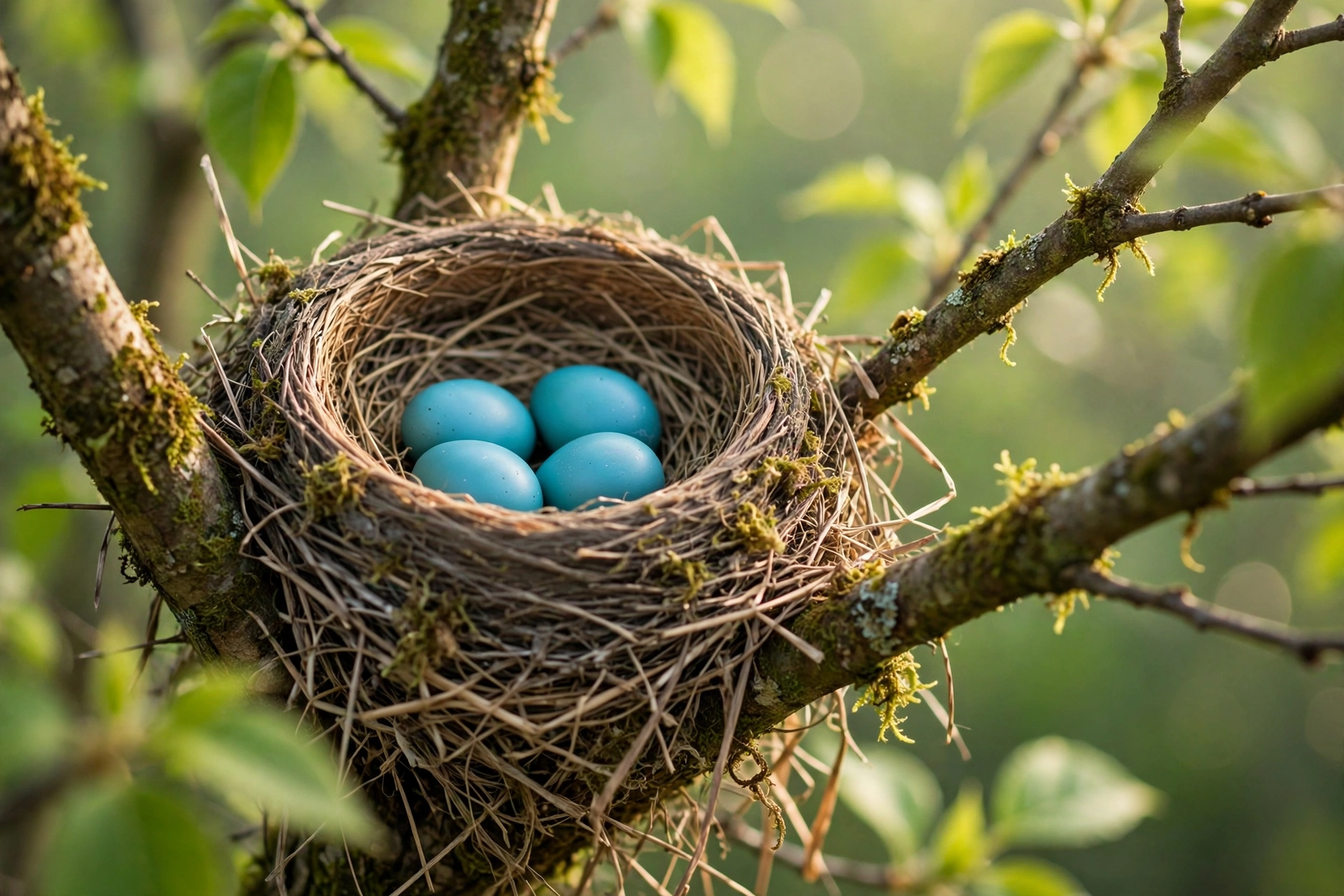
Ask a dozen birders when birds lay eggs and you will get a dozen different months. That is because there is no single answer. Across the United States, egg laying stretches from the depths of January, when great horned owls are already sitting on eggs in frozen woods, all the way into September, when goldfinches are still feeding fluffy nestlings while other birds are migrating south.
Most songbirds, though, follow a familiar rhythm. Eggs start appearing in March and April, peak in May and June, and taper off through the summer. This guide gives you the full seasonal picture: what triggers egg laying, a month-by-month nesting calendar, species-by-species timing, clutch and brood facts, and what to do when you find a nest in your yard.
When Do Birds Lay Eggs? The Short Answer
For most North American backyard birds, egg laying begins in March or April, peaks in May and June, and wraps up by August. That window covers the vast majority of songbirds, from robins and cardinals to wrens, bluebirds, and chickadees.
The exceptions make the calendar interesting. Great horned owls and bald eagles lay eggs in January and February, deep in winter. American goldfinches wait until July or August, when thistle seed ripens. And a few species, like mourning doves in the South, can nest in nearly any month of the year. Timing also shifts with latitude: southern birds start weeks earlier than their northern cousins, and a cold spring can delay everything.
What Tells a Bird It Is Time to Lay Eggs?
Day Length: The Master Clock
The primary trigger for egg laying is photoperiod, the length of the day. Light-detecting cells deep in a bird’s brain register the lengthening days of late winter and spring, which sets off a hormonal cascade through the hypothalamic-pituitary-gonadal axis. Gonads grow, sex hormones surge, and the reproductive system switches on with remarkable precision. A 2025 review of seasonal reproduction in wild birds confirms photoperiod as the main environmental cue driving this process.
Day length is the ideal trigger because it never lies. Temperatures bounce around from year to year, but the calendar of sunrise and sunset is identical every spring. Evolution settled on the one signal that cannot mislead.
Temperature and Food: The Fine Tuners
Once the light switch flips, temperature and food availability fine-tune the exact timing. A warm March with early insects can pull egg laying forward; a cold snap can delay it. Birds need to be in good body condition to produce eggs, and they need to know food will be abundant when chicks hatch, so a lean spring means later or smaller clutches.
This is where climate change creates trouble. Birds that time migration and breeding by fixed day length can arrive to find that insect peaks, which respond to temperature, have already passed. The mismatch can cut breeding success sharply in some species.
Light Pollution: A Confusing Signal
Artificial light at night can scramble the master clock. Birds in brightly lit urban areas sometimes start singing, courting, and even laying earlier than their rural counterparts. Researchers are still working out how much this helps or harms them, but a streetlight that never goes out is a poor substitute for spring.

Nesting Season by Month: The Full Calendar
Think of this calendar as the typical pattern for the United States. Southern states run a few weeks ahead, northern states a few weeks behind, and weather moves everything around. The North American Breeding Bird Survey places the peak of nesting season in May and June.
January and February: The Owls Are Already at It
While the rest of the bird world is focused on surviving winter, great horned owls are pairing up in November, courting through December, and sitting on eggs by January. They do not build nests. They take over old hawk, crow, or heron nests, lay 2 to 4 eggs, and incubate for 30 to 35 days. By March, while songbirds are just arriving, owl chicks are nearly grown.
Bald eagles follow a similar early schedule in the southern US, with eggs appearing as early as January. If you hear hooting on cold winter nights, you are hearing the breeding season’s opening act. Our guide on how birds survive winter’s cold covers what the rest of the avian world is doing while owls nest.
March: Bluebirds and the Early Risers
Eastern bluebirds are among the first songbirds to get serious. In the Southeast, they are scouting nest boxes and defending territories by late February, with first eggs often appearing in March. Farther north, activity peaks in late April and May.
American robins start arriving and staking claims, and the first robin nests of the year appear in the South. Chickadees begin excavating cavities. Cardinals, which pair up early, start building in dense shrubs. March is setup month: territories, nest sites, and the first mud-gathering robins.
April and May: Peak Season Arrives
This is when the nesting season ignites. Robins lay their first clutches of 3 to 5 blue eggs, usually by mid-April. BirdFact’s robin nesting guide notes the breeding season runs April through August, with two to three broods typical. Chickadees lay their single large clutch of 6 to 8 eggs in late April. Bluebirds, cardinals, wrens, and thrashers are all laying.
May brings the migrants. Warblers, vireos, orioles, and flycatchers arrive from the tropics and get straight to business, compressing courtship, nest building, and egg laying into a few frantic weeks. For sheer volume of eggs being laid, late May is the busiest moment of the year.
June: Second Broods and First Fledglings
June is the month of overlap. First broods are fledging while parents start second clutches. Robins build a fresh nest for each brood, often moving from evergreens to leafed-out deciduous trees. Bluebirds raise two to three broods, and clearing the old nest between broods encourages them to re-nest in the same box.
Cardinals are on their second round too, with the male feeding fledglings while the female incubates the next clutch. If your yard sounds like a nursery in June, that is because it is one.
July and August: The Late Shift
Most songbirds are winding down, but the American goldfinch is just getting started. Goldfinches are famously late nesters, beginning in late July and nesting into September. The timing lines up with thistle and composite seed ripening, which feeds their nestlings, and with thistle down becoming available as nesting material. While robins are finishing their third broods, goldfinches are laying their first eggs.
Cardinals can keep going into August in good years, and second or third broods of bluebirds fledge. By late August, the great wave of nesting is nearly over.
September Through December: Winding Down, Gearing Up
September belongs to the stragglers: late goldfinch broods, and in the warmest regions, doves still nesting. October is cleanup time. Nest boxes should be emptied and scrubbed once nesting is done, and fall is the ideal moment. November and December are quiet on the nesting front, but great horned owls begin courting again, and the cycle quietly restarts.

Species Spotlights: Six Birds, Six Schedules
American Robin: The Spring Standard
Season: April to July. Clutch: 3 to 5 blue eggs. Broods: 2 to 3. Incubation: 12 to 14 days, by the female alone. Robins are one of the first songbirds to lay eggs each spring, build a new mud-lined nest for every brood, and can occasionally squeeze in a fourth brood in a great year.
Eastern Bluebird: The Early Box Nester
Season: March to July (earlier in the South). Clutch: 4 to 5 pale blue eggs. Broods: 2 to 3. Incubation: 12 to 14 days. Bluebirds scout boxes in late winter, and Loudoun Wildlife’s bluebird nesting guide lays out the full cycle from April nest building to fledging. Remove old nests between broods to encourage re-nesting.
Black-Capped Chickadee: One Big Bet
Season: Late April to June. Clutch: 6 to 8 eggs. Broods: usually 1. Incubation: 11 to 14 days. Chickadees excavate their own cavities in soft or rotting wood, lay one large clutch, and put everything into a single brood. It is a concentrated burst of parenting from a bird that weighs less than half an ounce.
Northern Cardinal: The Long Season
Season: March to September. Clutch: 3 to 4 eggs. Broods: 2 to 3, sometimes 4. Incubation: 12 to 13 days. Cardinals run one of the longest breeding seasons of any backyard songbird. The male feeds the fledglings while the female starts the next clutch, an efficient assembly line that keeps cardinals nesting for half the year.
American Goldfinch: Fashionably Late
Season: Late July to September. Clutch: 3 to 6 eggs. Broods: 1 to 2. Incubation: 12 to 14 days. Goldfinches wait for thistle seed and thistle down, then nest when almost every other songbird is done. If you see a bright yellow male feeding begging youngsters in August, you are watching the season’s last act.
Great Horned Owl: Winter Nester
Season: January to February. Clutch: 2 to 4 eggs. Broods: 1. Incubation: 30 to 35 days. The owl flips the calendar upside down, nesting in the coldest months so its young hatch just as spring prey becomes abundant. No nest building required: an old hawk nest will do nicely.
Clutch Sizes and Broods: How Many Eggs?
Clutch size is a trade-off. Small birds that live fast tend to lay more eggs or raise more broods; large birds that live long lay few. Here is how common backyard species compare:
| Species | Eggs per clutch | Broods per year | Peak laying months |
|---|---|---|---|
| American Robin | 3 to 5 | 2 to 3 | April to June |
| Eastern Bluebird | 4 to 5 | 2 to 3 | April to June |
| Black-capped Chickadee | 6 to 8 | 1 | May |
| Northern Cardinal | 3 to 4 | 2 to 3 | April to July |
| American Goldfinch | 3 to 6 | 1 to 2 | August |
| Great Horned Owl | 2 to 4 | 1 | January to February |
| House Wren | 5 to 8 | 2 | May to June |
| Mourning Dove | 2 | Up to 6 | April to September |
Females lay one egg per day until the clutch is complete, then begin full incubation. That is why chicks in a nest tend to hatch within a day of each other. Food-rich years mean larger clutches and more broods; lean years mean the opposite. Wondering whether birds reuse those nests for the next round? Our guide on whether birds reuse their nests has the answer, and it varies more than you would think.
What To Do If You Find a Nest
Finding a nest in your yard, on your porch, or in an inconvenient spot comes with a legal responsibility. The Migratory Bird Treaty Act makes it illegal to disturb, move, or destroy an active nest, meaning any nest with eggs or chicks, of nearly all native US birds. Sialis.org’s MBTA summary explains the rules clearly: active nests are hands-off, no matter how inconvenient the location.
Here is what to do instead:
- Leave active nests alone: Do not move, touch, or trim around a nest with eggs or chicks. Most songbirds fledge within a month, so the inconvenience is temporary.
- Nestling vs fledgling: A featherless baby on the ground needs help, ideally returned to the nest or taken to a rehabilitator. A feathered, hopping fledgling is normal: parents are still feeding it. Leave it be.
- Keep pets away: Keep cats indoors and dogs leashed near nesting areas during the breeding season. Predation is the top cause of nest failure.
- Watch from a distance: Enjoy the show with binoculars. Repeated close visits can stress parents or lead predators to the nest.
- Empty nests are different: Once the young have fledged and the nest is truly inactive, removal is generally allowed. When in doubt, contact your state wildlife agency.
When to Clean Nest Boxes
Timing your nest box cleaning to the nesting calendar keeps boxes attractive and parasite-free. The rules are simple:
- Between broods: For multi-brood species like bluebirds, remove the old nest as soon as the young fledge. A clean box strongly encourages the pair to nest again in the same spot.
- Fall cleanout: Once nesting is finished for the year, usually by October, empty every box, scrub it out, and let it dry. Our fall birdhouse cleaning guide walks through the whole process step by step.
- Leave boxes up over winter: Clean, empty boxes become winter roosting shelters for chickadees, bluebirds, and wrens. Take them down only for repairs.
- Late winter prep: Give boxes a quick check in February, before bluebirds start scouting. Tighten screws, clear debris, and make sure drainage holes are open.

FAQs
What month do birds lay eggs?
Most US songbirds lay eggs from March or April through July, with a peak in May and June. Owls and eagles lay as early as January, while goldfinches wait until July or August. Timing shifts earlier in the South and later in the North.
Do birds lay eggs in winter?
Yes, a few do. Great horned owls nest in January and February, and bald eagles lay in midwinter in the southern US. These species time their breeding so chicks hatch when spring food becomes abundant.
How long does nesting season last?
For an individual songbird pair, the active season usually runs 3 to 5 months, covering 1 to 3 broods. Across all species, the US nesting season stretches from January (owls) through September (goldfinches).
What triggers birds to lay eggs?
Lengthening daylight in spring is the primary trigger, detected by light-sensitive cells in the brain that activate reproductive hormones. Temperature and food availability then fine-tune the exact timing.
How many eggs do birds lay?
It varies widely. Chickadees lay 6 to 8 eggs in a single clutch, robins lay 3 to 5 per clutch across 2 to 3 broods, and mourning doves lay just 2 eggs but can raise up to 6 broods a year. Larger birds like owls lay 2 to 4 eggs once a year.
Can I remove a bird nest from my property?
Not if it is active. The Migratory Bird Treaty Act makes it illegal to disturb, move, or destroy a nest containing eggs or chicks. Once the young have fledged and the nest is inactive, removal is generally permitted.
When should I clean out birdhouses?
Clean boxes between broods for multi-brood species, and do a full cleanout in fall after nesting ends, usually October. Leave clean boxes up over winter as roosting shelters.
Conclusion
When do birds lay eggs? From the owl eggs of January to the goldfinch eggs of August, the answer spans most of the year, with the great songbird rush concentrated between April and July. Day length sets the schedule, food and weather adjust it, and each species has tuned its own timing to the moment its chicks will find the most to eat.




