 Skip to content

A group of birds is called a flock, at least most of the time. But English never settles for one good word when it can invent fifty better ones. So what is a group of birds called when you want to be precise, poetic, or impressive at trivia night? A murder of crows, a parliament of owls, a flamboyance of flamingos, and dozens more, each with its own story.
This guide gives you the full answer. You will learn the simple generic term, the famous collective nouns with the tales behind them, how the same bird can earn different names on land, water, and in the sky, a complete alphabetical table of 65 collective nouns for birds, where these strange names came from, and which ones are medieval originals and which are modern inventions.
What Is a Group of Birds Called? The Short Answer
Flock. That is the word that covers almost everything. A flock of sparrows, a flock of pigeons, a flock of ducks. Birders, ornithologists, and dictionary writers all agree, and no one will ever correct you for using it.
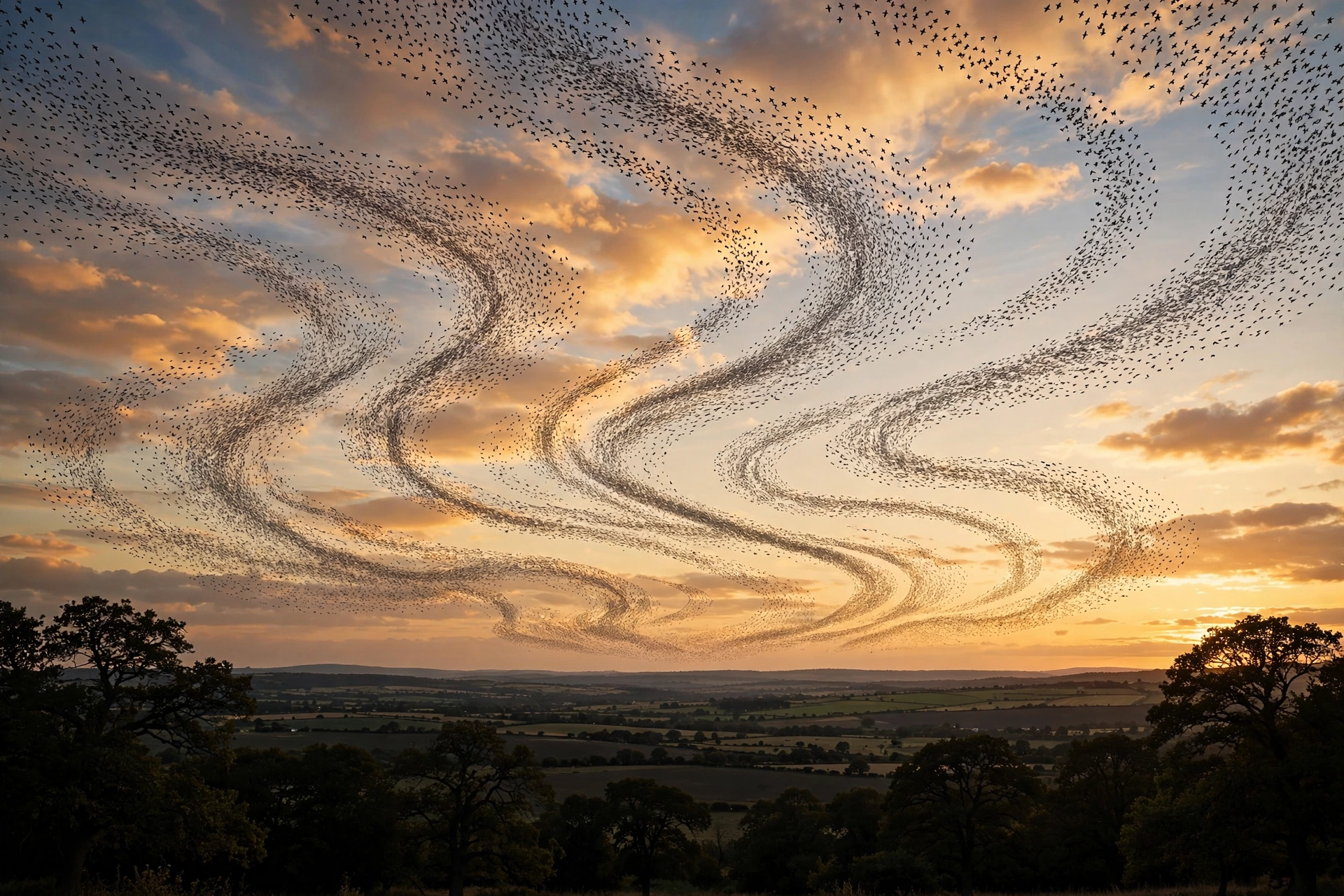
But “flock” is the plain option, and English keeps a wardrobe of spectacular alternatives. Most of them were invented in the 1400s as hunting slang for English aristocrats, and they survived because they are vivid and oddly accurate. A murmuration of starlings describes not just the birds but the low rustle of ten thousand wings moving as one.
The Famous Collective Nouns, With Their Stories
Before the full list, here are the greatest hits, the names people actually ask about:
- Murder of Crows: The most famous of them all. Medieval folklore tied crows to battlefields, executions, and omens of death, and the name stuck. Real crow gatherings, called roosts, can number in the tens of thousands. Our guide to why crows gather in roosts explains what those massive evening assemblies are really about.
- Parliament of Owls: Owls look like solemn judges, with forward-facing eyes and grave expressions, so someone imagined them debating like lawmakers. It is pure personality-based naming, and it fits perfectly.
- Flamboyance of Flamingos: This one is modern, not medieval, coined for the sheer showiness of pink birds doing synchronized dances. It may be the most deserved name on this list.
- Gaggle, Skein, and Wedge of Geese: Geese get three names depending on where they are. A gaggle honks on the ground or water, a skein flies overhead in trailing lines like yarn unwinding, and a wedge flies in sharp V formation.
- Raft, Paddling, Team, and Flush of Ducks: Ducks on the water form a raft or a paddling, ducks in the air fly as a team, and ducks bursting from cover are a flush.
- Murmuration of Starlings: Named for the soft murmur of thousands of wings in those shape-shifting sky ballets.
- Exaltation of Larks: Larks sing as they climb straight up into the sky, and the name captures the joy of it.
- Charm of Finches: From “chirm,” an old word for birdsong. A group of finches singing together genuinely charms the ear.
- Wake of Buzzards: A wake, as in a funeral wake. Buzzards and vultures gather over carrion, and medieval observers did not miss the symbolism.
- Unkindness of Ravens: Dark folklore again. Ravens, like crows, were birds of battlefields and ill omens.
- Pandemonium of Parrots: Anyone who has heard a wild parrot flock at dawn knows this needs no explanation.
- Scold of Jays: Jays announce intruders with harsh, scolding calls that the whole wood can hear.
You will often see these gatherings lined up on wires and rooftops, which raises the obvious question of why perched birds do not get electrocuted. The short version: it is about completing a circuit, not about the size of the flock.
Land, Water, and Sky: Why One Bird Gets Many Names
One of the quirkiest features of collective nouns is that the same species can earn different names depending on what it is doing. Geese are the classic example: a gaggle on the ground, a skein or wedge in the air. Ducks do the same trick, shifting from raft to team the moment they take off.
This was not sloppiness. Medieval hunters needed precise language for what they saw, and a flock of geese honking in a field is a very different sight from one streaming overhead in October. The names record behavior, not just species. Swans keep the pattern too: a bevy on the water, a wedge in flight.
It also explains why so many waterbirds have both a floating noun and a flying noun. A raft of ducks, a paddling of ducks, a dopping of goosanders: each describes birds doing something specific. The collective noun is really a tiny snapshot of bird behavior, frozen in a phrase.

The Complete List: 65 Collective Nouns for Birds
Here is the full reference, alphabetical by bird. Where a bird has several nouns, each gets its own row with its own story.
| Bird | Collective noun | Why this name |
|---|---|---|
| Auks | Colony | They pack onto cliff ledges in dense breeding colonies |
| Bitterns | Sedge | Named for the marsh sedges where these secretive herons hide |
| Bobolinks | Chain | They string out along fences and wires like links in a chain |
| Bullfinches | Bellowing | From their soft, low piping calls |
| Buzzards | Wake | A wake, as in a funeral; they gather over carrion |
| Capercaillies | Tok | From their booming lekking display in spring forests |
| Chickens | Brood | A hen’s hatched young, kept close under her wings |
| Chickens | Peep | From the sound of the chicks themselves |
| Choughs | Chattering | Noisy red-billed corvids of sea cliffs |
| Coots | Covert | A covert is a thicket, the shelter where they gather |
| Cormorants | Gulp | They swallow fish whole in one dramatic gulp |
| Cranes | Siege | Tall birds standing together like an army laying siege |
| Crows | Murder | Medieval folklore tied crows to death and bad omens |
| Dotterels | Trip | A trip is a light, short journey, like their quick movements |
| Doves | Dole | Dole means grief; doves were symbols of mourning |
| Doves | Piteousness | Same mournful symbolism, in an even sadder word |
| Ducks | Flush | Ducks bursting from cover when flushed by hunters |
| Ducks | Paddling | Ducks swimming together on the water |
| Ducks | Raft | A floating group riding the water like a raft |
| Ducks | Team | Ducks flying together in formation |
| Dunlins | Fling | Their quick, darting flight over tidal mudflats |
| Eagles | Convocation | A formal assembly, fit for the king of birds |
| Emus | Mob | Australian slang for a rough, rowdy crowd |
| Falcons | Cast | Falconry term for hawks flown together |
| Finches | Charm | From “chirm,” an old word for birdsong |
| Flamingos | Flamboyance | Modern coinage celebrating their showy pink plumage |
| Flamingos | Stand | They stand in shallow water in great numbers |
| Geese | Gaggle | On land or water; imitates their noisy cackling |
| Geese | Skein | In flight; a skein is a length of yarn unwinding |
| Geese | Wedge | Flying in sharp V formation |
| Goldfinches | Charm | Same musical root as finches |
| Goosanders | Dopping | Diving ducks; from dipping and diving for fish |
| Grouse | Covey | From Old French covee, a small brood |
| Guillemots | Bazaar | Noisy, crowded cliff colonies like a marketplace |
| Gulls | Squabble | They fight loudly over every scrap of food |
| Hawks | Kettle | Soaring in a circling kettle on rising thermals |
| Herons | Siege | Patient hunters standing motionless like a besieging army |
| Hummingbirds | Shimmer | Modern coinage for their iridescent, glittering flight |
| Jays | Scold | Their harsh calls scold every intruder in the wood |
| Lapwings | Deceit | They fake injury to lure predators away from nests |
| Larks | Exaltation | They sing joyfully as they climb into the sky |
| Linnets | Parcel | A small, neat package of little brown birds |
| Magpies | Tidings | Folklore: one for sorrow, two for joy, three for a girl |
| Mallards | Sord | From French sourdre, to rise up when flushed |
| Nightingales | Watch | They sing through the night like a night watch |
| Ostriches | Pride | Echoing a pride of lions |
| Owls | Parliament | Solemn faces gathered like debating lawmakers |
| Parrots | Pandemonium | Loud, chaotic flocks at dawn and dusk |
| Peacocks | Ostentation | Their showy, fan-tailed courtship displays |
| Pelicans | Pod | They scoop fish together, herding like whales |
| Penguins | Huddle | Pressed together against the Antarctic cold |
| Pheasants | Bouquet | As colorful as a bunch of cut flowers |
| Pheasants | Nye | From “nide,” an old word for a nest or brood |
| Pigeons | Kit | Flown together as a trained group by fanciers |
| Quail | Bevy | A small, merry company of game birds |
| Ravens | Unkindness | Dark folklore, like their crow cousins |
| Rooks | Parliament | Noisy debating in the communal rookery |
| Snipe | Wisp | Thin birds with quick, darting flight |
| Sparrows | Host | A great multitude descending on seed and grain |
| Starlings | Murmuration | The low murmur of thousands of wings in flight |
| Storks | Muster | A formal, stately gathering of tall birds |
| Swans | Lamentation | From the myth of the dying swan’s song |
| Teal | Spring | They burst from the water together in a spring |
| Turkeys | Rafter | Like the beams of a roof; also called a gang |
| Woodcocks | Fall | They drop into woodland cover at dusk |

Where Do These Names Come From?
Blame the 15th century. In 1486, a book called the Book of Saint Albans printed a chapter titled “The Compaynys of Beestys and Fowlys,” a list of 164 terms for groups of animals. These were “terms of venery,” venery being an old word for hunting, and they were fashionable slang for the aristocracy. Knowing that a group of larks was an exaltation marked you as a person of refinement. Saying “a bunch of larks” marked you as someone who did not get invited to dinner.
The terms caught on because many were genuinely observant. A murmuration of starlings captures a sound. A siege of herons captures how those patient hunters stand motionless like an army outside a castle wall. Others were jokes from the start. The Book of Saint Albans also lists a “gagle of women” and a “sentence of juges,” which tells you the compilers were having fun.
As the Collins Dictionary language blog notes, nobody owns these words and nobody polices them. They spread because people enjoy using them. HowStuffWorks traces the whole fad to upper-class hunting culture in the 1300s and 1400s, when inventing elaborate group names became a courtly sport and the Book of Saint Albans turned it into a printed reference.
An Honest Note: Some of These Are Modern Inventions
Not every poetic noun is medieval. “Flamboyance of flamingos” is a 20th-century coinage. “Pandemonium of parrots,” “shimmer of hummingbirds,” and “wake of vultures” are modern too, or at least modern popularizations. They caught on because they are good, not because they are old.
That is fine. Collective nouns have always been wordplay first and science second. The Book of Saint Albans itself mixed genuine hunting terms with obvious jokes, and five hundred years of writers have kept adding to the list. If someone coins a great new one tomorrow and people like it, it will end up in a list like this one.
The practical takeaway: use the famous ones freely, enjoy the obscure ones, and do not worry about official status. There is no academy of collective nouns. If your reader pictures the birds, the noun did its job.
Putting Them to Use: Trivia, Teaching, and Conversation
Collective nouns earn their keep far beyond medieval dinner parties. They are quiz-night gold, and “a murder of crows” might be the single most asked animal trivia question in English. Teachers use them to make vocabulary lessons stick, because a child who learns “a parliament of owls” remembers both the word and the bird.
They also make you a better birder, in a small but real way. Learning that a group of feeding ducks is a raft while flying ducks are a team trains you to notice what birds are doing, not just what they are. The noun becomes a prompt to look closer. And in writing, one well-chosen collective noun can replace a whole sentence of description.
So do not treat the table above as a museum exhibit. Steal from it. The next time you see starlings wheeling over a field at dusk, say “murmuration” out loud and watch everyone around you look up.

FAQs
What is a group of crows called?
A murder of crows. The name comes from medieval folklore linking crows with death and omens. Large real-world gatherings of crows are called roosts.
What is a group of owls called?
A parliament of owls, named for their solemn, wise appearance.
What is a group of geese called?
It depends on what they are doing. On the ground or water, a gaggle. In flight, a skein or a wedge.
What is a group of ducks called?
On the water, a raft or a paddling. In flight, a team. Bursting from cover, a flush.
What is a group of flamingos called?
A flamboyance of flamingos, or a stand. Flamboyance is the modern favorite.
What is a group of baby birds called?
A brood, meaning chicks hatched together, or a clutch, meaning the eggs or the newly hatched young in one nest.
How do birds in a flock stay coordinated?
Mostly by sight. Each bird watches its nearest neighbors and adjusts in fractions of a second, which is how murmurations ripple so smoothly. Hearing plays a role too, especially in noisy flocks. For more on avian hearing, see do birds have ears.
Conclusion
So what is a group of birds called? Usually a flock, and sometimes something far more wonderful. A murder, a parliament, a flamboyance, an exaltation: these names turn a simple sighting into a small story, which is exactly why they have survived five centuries of use.
The best part is that the list is still growing. Every generation of bird lovers adds its own coinages, and the good ones stick. Learn the classics, drop “a murmuration of starlings” into conversation at the next opportunity, and keep an eye out. The next great collective noun might be yours to invent.





