 Skip to content

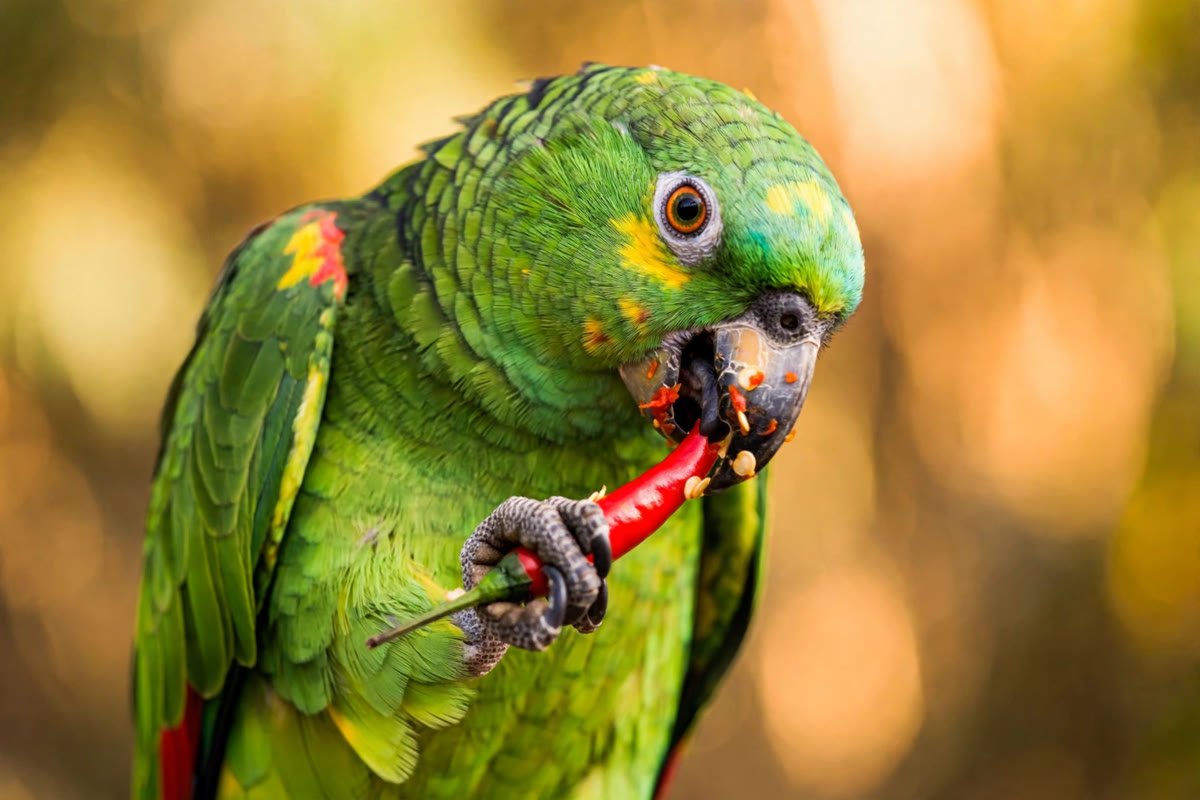
Hand a parrot a chili pepper and it will crunch away happily, seeds and all, without so much as a blink. Offer the same pepper to a squirrel and you will get a very different reaction. The difference is not toughness. It is biology.
Can birds taste spicy food? For the most part, no. The burning sensation of chili peppers comes from a compound called capsaicin, which triggers a specific heat receptor, TRPV1, found in mammals. Birds have a version of this receptor that capsaicin cannot activate, so the heat signal never fires. A ghost pepper and a bell pepper taste roughly the same to most birds: like food.
In this article, you will learn how the missing receptor works, why pepper plants evolved heat as a deal struck specifically with birds, the surprising new research showing that extreme heat can overwhelm even avian immunity, what birds actually can taste, and whether the famous capsaicin squirrel deterrent really works at your feeder.

Can Birds Taste Spicy Food? The Short Answer
Most birds cannot taste the heat in spicy food. Capsaicin, the compound that makes chili peppers burn, works by binding to the TRPV1 ion channel, a receptor on sensory nerves that normally detects dangerously hot temperatures. In mammals, capsaicin flips this receptor on, and the brain reads it as burning heat.
Birds carry their own version of this receptor, but with a critical difference. Researchers who cloned the avian TRPV1 channel from chicken sensory neurons found that while it still responds to actual heat and other noxious stimuli, capsaicin fails to activate it. The molecular key does not fit the avian lock. The pepper’s chemical weapon simply does not register.
This is not a matter of birds being tougher or more accustomed to spice. At the receptor level, the signal never starts. A bird eating a habanero gets the pepper’s flavor compounds, its sugars, and its nutrients, but none of the fire.
The Receptor Birds Don’t Have (Quite)
To be precise, birds do have a TRPV1-like channel. It functions as a general detector for harmful stimuli: real heat, acids, and certain irritants still trigger it. What it specifically ignores is capsaicin, along with the related capsaicinoid compounds that give peppers their punch.
The discovery came from molecular biology rather than birdwatching. Scientists isolated the vanilloid receptor from chicken sensory neurons and tested it in the lab. The avian channel behaved like the mammalian one in almost every way except one: capsaicin left it silent. That single difference explains a whole ecological relationship.
There is nuance. A few experiments have found mild aversion to capsaicin in certain game birds under controlled conditions, suggesting partial sensitivity in some species rather than a universal blank. But the broad pattern holds across the thousands of bird species tested behaviorally: where a mouse recoils, a bird keeps eating.
Why Peppers Evolved Heat: A Deal Struck With Birds
Capsaicin did not evolve to punish mammals for fun. It evolved as a targeted strategy, and birds are the intended beneficiaries.
Pepper plants face a dispersal problem. Their seeds need to travel far from the parent plant to germinate successfully. Mammals make poor couriers: rodent teeth grind seeds to paste, destroying them, and mammalian guts are harsh on seed coats. Birds make ideal couriers: they swallow fruits whole, their digestive tracts soften the fruit without damaging the seeds, and then they fly the seeds miles away before depositing them, conveniently fertilized.
Capsaicin is the plant’s way of choosing its courier. The compound deters the seed-destroying mammals while leaving the seed-dispersing birds completely unbothered. Wild chiltepin peppers, the tiny fiery ancestors of cultivated chilis, are so closely associated with birds that one of their common names is literally “bird pepper.” On the Mariana Islands, the doni sali chili is named for the Micronesian starling that spreads its seeds.
Capsaicin pulls double duty as an antimicrobial, protecting seeds from fungal infection. The heat mammals feel is, from the plant’s perspective, almost a side effect: the real targets were fungi and seed predators, and the real partners were birds.
The Birds That Eat the Most Peppers
In the wild, the pepper-bird partnership plays out daily. Curve-billed thrashers in the Arizona desert feast on wild chilies alongside the rodents that refuse them, a contrast researchers have watched in controlled feeding trials: the rats and mice ate everything except the hot chilies, while the thrashers ate all of it. Parrots across Central and South America are enthusiastic chili eaters, cracking the fruits open and scattering seeds through the canopy.
The relationship even named a species. The doni sali chili of the Mariana Islands takes its name from the Micronesian starling, the Sali, which is its principal disperser. On islands where the starling has declined, the chili’s fortunes fade with it, a reminder that the plant’s entire reproductive strategy rests on birds doing what mammals cannot.
Backyard birders see a tame version of the same story whenever a northern mockingbird or gray catbird strips a berry bush. The principle is identical: fruits evolved to be eaten by the animals that spread their seeds intact, and chemistry enforces the guest list. Peppers just enforce it more dramatically than most.
The Plot Twist: Even Birds Have a Limit
For decades the story ended there: birds are immune to spice, full stop. Then researchers started asking an awkward question. If birds cannot taste heat at all, why don’t wild peppers keep getting hotter?
In the wild, peppers top out around 500,000 Scoville heat units, extremely spicy by any human standard, but far below the million-plus Scovilles of ghost peppers and the super-hots humans have bred. Biologist Gabriel Colbeck and his students at Maryville University suspected birds might be the reason, and their experiments suggested the conventional wisdom was incomplete.
The emerging picture is that avian capsaicin immunity has limits. At the extreme concentrations found in the hottest cultivated peppers, even birds appear to feel something. The receptor that ignores normal capsaicin doses may be overwhelmed, or other trigeminal irritation pathways may kick in, when the dose becomes absurd. Wild peppers, the thinking goes, stopped getting hotter because beyond a certain point, even their chosen couriers would balk.
This does not overturn the classic finding. Your backyard birds will not notice the cayenne on their seed, and wild birds eat wild peppers with total indifference. It only means that immunity is dose-dependent, like so much in biology, and that the super-hots humans invented exist outside anything evolution prepared birds for.

The Squirrel Trick: Does Capsaicin-Coated Seed Work?
This biology has a famous practical application. Many birders coat their birdseed with cayenne or chili powder to deter squirrels, on the theory that mammals hate it and birds cannot taste it. Does it actually work?
The science says the premise is sound. Squirrels, like all mammals tested, have functional TRPV1 receptors and find capsaicin genuinely unpleasant. Birds at the same feeder eat the treated seed without apparent discomfort. Countless backyard birders report that squirrels sample the hot seed once and move on.
A few caveats keep this honest. Determined or very hungry squirrels sometimes push through the discomfort, especially in winter. The coating must be reapplied after rain, and handling large quantities of chili powder is unpleasant for humans too: wear gloves and avoid breathing the dust. It is a deterrent, not a force field.
For a fuller anti-squirrel arsenal, see our guide on how to stop squirrels from stealing bird food. Capsaicin works best as one layer of defense alongside baffles, feeder placement, and seed choice. And if you are rethinking your whole feeding setup, our best bird seeds for different birds guide matches foods to species.
What Birds Actually Can Taste
Immunity to capsaicin does not mean birds taste nothing. Their taste system is simply built differently from ours, tuned to the compounds that matter in a bird’s life.
- Bitter: birds detect bitter compounds well through TAS2R receptors, which helps them avoid many plant toxins. This is a critical survival sense for fruit and seed eaters.
- Sweet and umami: receptors for sugars and amino acids exist in many species, guiding birds toward ripe fruit and protein-rich foods.
- Salt: birds taste salt and need it in small amounts, though their tolerance is far lower than a mammal’s.
- Fat: the CD36 receptor helps birds detect fatty acids, steering them toward energy-dense foods like suet and oil-rich seeds.
- General irritants: the trigeminal nerve can respond to strong chemical irritants even when capsaicin-specific pathways stay quiet, which likely explains the extreme-heat limit described above.
What birds lack, compared to mammals, is fine-grained taste discrimination. They have far fewer taste buds, a few hundred versus our roughly ten thousand, and they rely more on vision, texture, and post-ingestive feedback. A bird decides food is good largely by seeing it, grabbing it, and feeling fine afterward. The senses work as a package: taste is only one channel, and for birds it was never the main one. For comparison with another underrated sense, see whether birds can birds smell.

Frequently Asked Questions
Can I feed hot peppers to my pet bird?
Many parrots relish chili peppers, and plain fresh peppers are generally safe for them in moderation. The capsaicin will not burn them the way it would burn you. As with any fresh food, wash the peppers, offer them as part of a varied diet rather than a staple, and watch for any individual sensitivity. Avoid pepper sprays, hot sauces with additives, and anything containing onion or garlic.
Will cayenne pepper hurt birds’ eyes?
There is little evidence of harm from capsaicin-treated seed under normal use, but the dust can irritate any animal’s eyes and airways, including yours. Apply the powder outdoors, let it settle, and avoid creating airborne clouds around feeders. If you notice birds sneezing or avoiding the feeder, discontinue use.
Do all mammals hate capsaicin?
Almost all. Humans are the famous exception, and we are the only species that actively enjoys the burn, a quirk psychologists attribute to thrill-seeking and learned pleasure. The Chinese tree shrew is another odd exception with reduced sensitivity. Every other mammal tested, from mice to squirrels to foxes, finds capsaicin aversive.
Why don’t birds just evolve to avoid all peppers?
Because peppers are good food for them. The fruits offer sugars, vitamins, and water, and the seeds pass through unharmed. There is no selective pressure to avoid a food that does not hurt you and nourishes you well. The plant and the bird settled into a mutualism millions of years ago, and neither has a reason to break it.
Can birds taste anything spicy at all, like mustard or horseradish?
Mustard oils and horseradish heat work through different chemical pathways than capsaicin, and birds’ responses to them are less studied. The trigeminal system that detects general irritants may respond to very strong doses. In practice, birds rarely encounter these compounds in nature, so the question matters less than the capsaicin story.
Does the heat level of a pepper affect seed dispersal?
Indirectly, yes, and that is the heart of the Colbeck research. If peppers get hot enough to bother even birds, dispersal suffers, which may cap how hot wild peppers evolve to be. The cultivated super-hots exist only because humans, the one mammal that enjoys the burn, kept breeding them hotter on purpose.
Conclusion
Can birds taste spicy food? Within the range nature produces, essentially no. The TRPV1 receptor that makes capsaicin burn for mammals stays silent in birds, so a chili pepper registers as food, not fire. Pepper plants evolved this chemistry on purpose, deterring seed-destroying mammals while recruiting birds as long-distance couriers, a partnership written into the botany of every wild chili.
The new research adds a fascinating footnote: immunity has limits, and the absurd heat of human-bred super-hots may exceed what even birds comfortably ignore. But for the peppers of the natural world, and for the cayenne on your birdseed, the classic story holds. The squirrel will object. The bird will not notice.
It is a neat reminder that taste is not a universal sense but a negotiated one, shaped by who needs to eat what. The next time you watch a parrot demolish a chili without flinching, you are watching millions of years of co-evolution at work, one painless bite at a time.





