 Skip to content

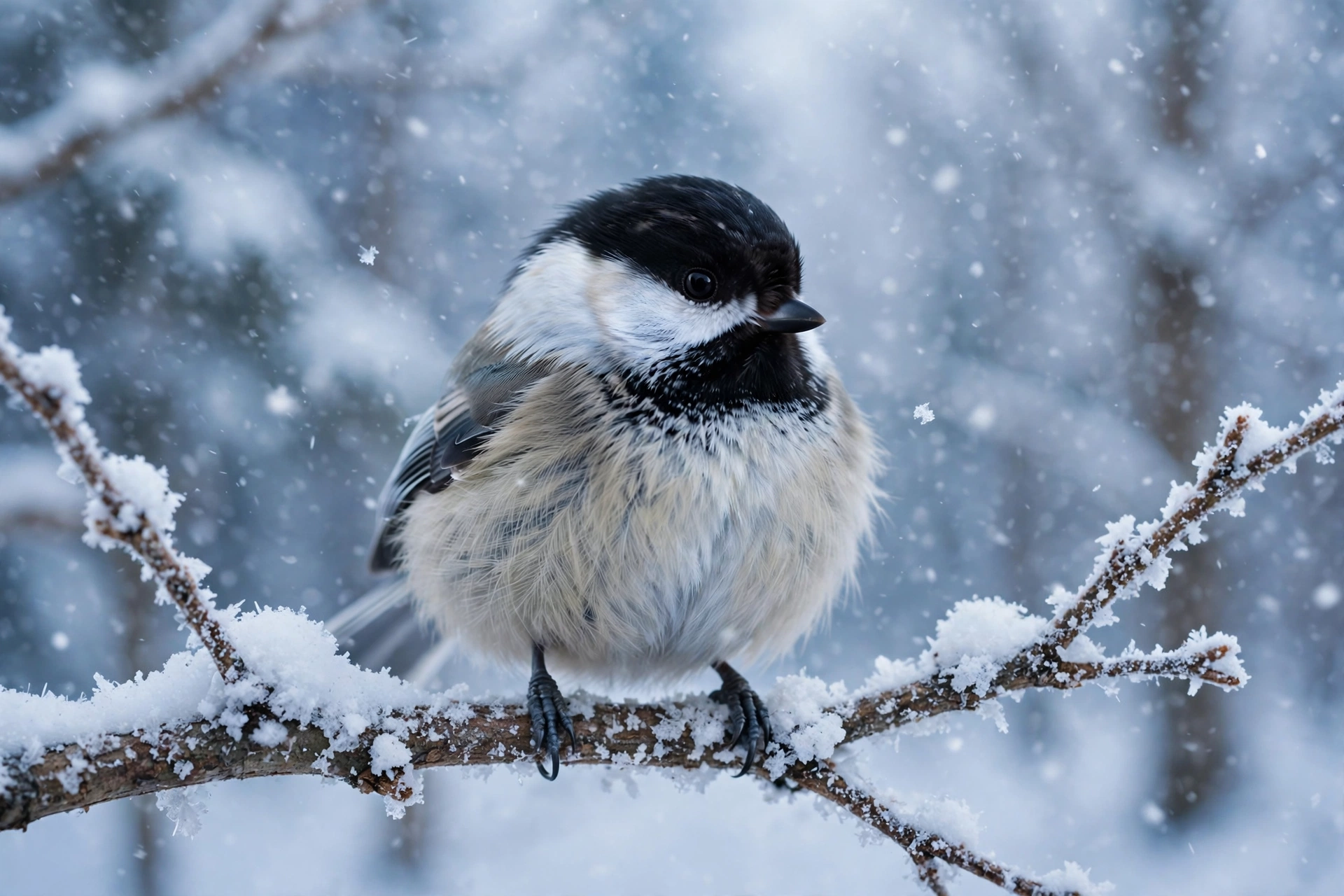
Every winter morning, birds flit between snowy branches as if the freezing cold means nothing. A black-capped chickadee weighs less than half an ounce, yet it survives nights far below freezing with no coat, no shelter heater, and no warm bed. How do birds stay warm in winter when their bodies are so small and the cold is so brutal?
The short answer: birds run hotter than we do, wear one of the best insulators in nature, and carry a whole toolkit of heat-saving behaviors. Their core body temperature runs around 104 to 108 degrees Fahrenheit (40 to 42 degrees Celsius), several degrees above ours. On top of that furnace they layer down insulation, shivering, heat-recycling blood vessels, strategic tucking, group huddles, overnight torpor, and smart shelter choices. This guide walks through all seven tricks, plus what you can do to help the birds in your own backyard.
Trick 1: Fluffed Feathers Work Like a Down Jacket
The single most important piece of winter survival gear a bird owns is its feathers. Beneath the stiff outer contour feathers lies a layer of soft down. Down feathers lack the interlocking barbs of flight feathers, so they form a loose, fluffy mat that traps a thick layer of still air against the skin.
Still air is a poor conductor of heat, and that is exactly the point. The trapped air forms an insulating barrier between the bird’s hot body and the freezing air outside. On cold days you can watch birds deliberately puff up. They use tiny muscles at the base of each feather to lift the plumage and thicken that warm air layer.
Preening keeps the insulation working
Insulation only works when it stays dry. A soaked bird loses heat fast, because water replaces the trapped air. To stay waterproof, birds preen regularly, spreading oil from the uropygial gland near the base of the tail over their feathers. This oil conditions the feathers and keeps water beading on the surface instead of soaking in.
That is also why a bird with damaged or contaminated feathers struggles in winter. Without a dry, well-maintained feather coat, even the best down cannot hold its warm air pocket. Preening may look like idle grooming, but in winter it is maintenance on a life-support system.
Trick 2: Shivering Generates Heat All Night
Insulation slows heat loss, but it does not create heat. For that, birds shiver. Unlike mammals, birds do not visibly tremble the way a cold person does. Instead, large muscle groups, especially the massive flight muscles in the breast, contract and relax involuntarily in tiny, rapid pulses.
Every one of those contractions burns fuel and releases heat. This shivering thermogenesis runs quietly through the night while a bird sleeps. The bird does not have to be awake or even aware of it. The muscles fire automatically in response to dropping body temperature, topping up the heat that leaks through the insulation.
Shivering is expensive, though. Burning through the night means burning through calories, which is why winter birds spend almost every daylight hour eating. The furnace needs constant fuel, and shivering is one of the hungriest appliances in the house.

Trick 3: Legs Recycle Heat Like a Radiator
Feathers cover most of a bird, but the legs and feet are bare. When a duck stands on ice, you would expect those exposed legs to drain heat straight out of the body. They would, except for a clever bit of plumbing called countercurrent heat exchange.
In a bird’s leg, the artery carrying warm blood down runs directly alongside the vein carrying cool blood back up. Heat passes from the warm artery into the cold vein before the arterial blood ever reaches the foot. The returning blood gets pre-warmed on its way back to the heart, so cold blood never floods the core.
The result is striking. A duck’s core can sit near 104 degrees Fahrenheit while its feet rest just above freezing, supplied with just enough warmth to avoid tissue damage. Birds also constrict blood vessels in the legs in extreme cold, cutting flow even further. We cover this foot-saving system in detail in our guide to why birds’ feet don’t freeze in winter.
Trick 4: Tuck the Bill, Tuck the Feet
Every bare surface radiates heat, so birds hide as much of it as possible. On a cold perch, a bird will often rotate its head and tuck its bill deep into the feathers of its back or shoulder. Some species, like gulls and herons, sleep with the bill buried among the back feathers, warming each breath with body heat.
The legs get the same treatment. A bird standing on one leg on a cold morning is not injured. It has simply folded the other leg up into its belly feathers, where the warm air pocket keeps it cozy. Many birds alternate legs through the day, warming one while the other takes the cold shift.
Small songbirds take this further by squatting low so their fluffed belly feathers cover both feet at once. It is a simple strategy, but physics is on its side. Less exposed surface means less heat lost to the wind.
Trick 5: Roosting Huddles Share Body Heat
Some birds refuse to face the cold alone. Eastern bluebirds and Carolina wrens pile into tree cavities or roost boxes together on the coldest nights, sometimes a dozen or more in a single cavity. Packed shoulder to shoulder, each bird loses less heat and gains warmth from its neighbors.
Bobwhite quail take teamwork even further. A covey sleeps in a tight circle with every bird facing outward. The huddle shares warmth, and the outward-facing ring keeps every eye on the lookout for predators. If danger appears, the whole circle explodes into flight in every direction, startling the attacker.
You can support this behavior in your own yard. A simple roost box, different from a nesting box because it has perches inside and small entrance holes, gives small birds a shared warm bedroom on freezing nights. Leaving a brush pile of fallen branches offers the same service for ground-feeding species.
Trick 6: Torpor Lowers the Thermostat Overnight
The most dramatic trick of all is torpor, a controlled overnight drop in body temperature. Instead of burning fuel all night to defend a 104-degree core, some birds deliberately let the thermostat slide. Metabolism slows, breathing shallows, and the bird slips into a deep, unresponsive rest.
Black-capped chickadees use a mild form called nocturnal hypothermia. On the coldest nights they can drop their body temperature roughly 7 to 10 degrees Celsius (about 12 to 18 degrees Fahrenheit) below daytime levels, burning far less of their precious fat reserves. They tuck into a cavity or dense evergreen, ball up with the head under the shoulder feathers, and ride out the night on a fraction of the usual energy.
Hummingbirds take torpor to the extreme
Hummingbirds are the undisputed champions of torpor. Research on the black metaltail hummingbird of the Peruvian Andes found that it can cool from a daytime temperature near 40 degrees Celsius to just above freezing, around 3 degrees Celsius. Its heart rate plunges from roughly 1,200 beats per minute to as low as 40. That near shutdown can cut energy use by about 95 percent.
At sunrise, the bird reheats itself by vibrating its flight muscles, warming about a degree per minute until its eyes pop open and it is ready to feed. If you find a motionless hummingbird on a cold morning, there is a good chance it is simply in torpor, not dead. Leave it alone unless it is clearly injured or on the ground in danger.
To read more about this remarkable adaptation, see Science News on the black metaltail hummingbird’s record cold torpor.

Trick 7: Shelter Choice Blocks Wind and Cold
Even the best insulation fails in a strong wind, so birds pick their nighttime real estate carefully. Dense evergreens, tangled thickets, and brush piles all break the wind and trap slightly warmer air. A bird roosting inside a cedar tree can experience conditions many degrees milder than one sitting on an exposed branch.
Tree cavities are premium winter housing. Wood insulates, the small entrance limits drafts, and the enclosed space holds body heat. Woodpecker holes, natural hollows, nest boxes, and even openings in buildings all serve as winter shelters for chickadees, nuthatches, titmice, and screech-owls.
Ruffed grouse use the most surprising shelter of all: snow itself. On cold nights with deep powder, a grouse will plunge into a snowbank and roost buried inside it. Powder snow is full of trapped air, which makes it an excellent insulator, and the bird stays far warmer under the snow than above it.
The Furnace: Why Small Birds Eat Constantly in Winter
All of these tricks protect heat, but the heat itself has to come from somewhere. Small birds lose heat fast because of simple geometry. A tiny body has a huge surface area relative to its volume, so warmth escapes quickly through the skin and feathers.
To keep the furnace stoked, winter birds feed almost nonstop during daylight. A chickadee may spend the whole short winter day hopping from feeder to tree, caching seeds in bark crevices and eating high-fat foods like sunflower seeds and suet. Researchers have found that chickadees can add roughly a tenth of their body weight during a cold-weather feeding day, then burn much of that reserve overnight.
This is why a well-stocked feeder matters so much. Foods rich in fat and calories, such as black oil sunflower seeds, peanuts, and suet, deliver the dense energy a small bird needs to survive a 14-hour winter night. Our complete guide to what to feed birds in winter breaks down the best options for every common backyard species.
Tricks at a Glance: Which Birds Use Which Ones
Not every bird uses every trick. The table below shows how the seven strategies line up across different types of birds.
| Trick | How It Saves Heat | Birds That Rely on It Most |
|---|---|---|
| Fluffed down feathers | Traps still air as insulation | All birds, especially songbirds |
| Shivering thermogenesis | Burns fuel to generate heat | All birds, through the night |
| Countercurrent heat exchange | Recycles heat in the legs | Ducks, geese, gulls, shorebirds |
| Tucking bill and feet | Reduces exposed surface area | Perching birds, herons, gulls |
| Communal roosting | Shares body heat between birds | Wrens, bluebirds, quail |
| Overnight torpor | Lowers body temperature to save fuel | Hummingbirds, chickadees, swifts |
| Shelter seeking | Blocks wind and traps warm air | All birds, especially cavity nesters |
How You Can Help Backyard Birds Stay Warm
Winter is the season when backyard birders make the biggest difference. Birds burn enormous energy to stay warm, and a helping hand from your yard can genuinely tip the odds in their favor. Three things matter most: food, water, and shelter.
Food comes first. Offer high-fat, high-calorie foods like black oil sunflower seeds, suet cakes, and unsalted peanuts. Keep feeders full and consistent, because birds plan their daily routes around reliable food sources. A feeder that goes empty during a cold snap can leave its regulars short on fuel.
Water is the forgotten winter need. Natural water freezes, and birds still need to drink and keep their feathers in preening condition. A heated birdbath or a simple heater added to an existing bath keeps water open all winter and will draw birds from across the neighborhood.
Shelter completes the trio. Leave a brush pile of fallen branches, plant dense evergreens, and put up a roost box or two before the coldest months arrive. For a full seasonal plan, read our guide on how to help birds in winter. The Cornell Lab of Ornithology also has a wonderful winter survival explainer with video from their backyard series.

FAQs
Do birds actually feel cold in winter?
Birds certainly experience cold, and their bodies respond to it constantly. Their bare legs have fewer nerve endings than ours, so cold feet bother them less, but they still work hard to protect their core temperature. Everything in this article is evidence of how seriously they take the cold.
Why do birds look so puffy on cold mornings?
A puffy bird is a warm bird. By lifting its feathers, the bird thickens the layer of still air trapped against its skin, boosting insulation the way a thicker down jacket keeps you warmer. If you see a sleek, flat-feathered bird, it is probably comfortable or actively trying to cool down.
How do birds keep their feet from freezing on ice?
They use countercurrent heat exchange, a system where warm blood flowing down the leg pre-warms the cold blood returning to the body. The feet are allowed to cool to near freezing while the core stays hot, and constricted blood vessels limit flow to the bare skin. This is the same countercurrent heat exchange system described earlier in this guide.
Do birds go into torpor every night?
It depends on the species and the weather. Hummingbirds enter torpor routinely because their tiny bodies burn fuel so fast. Chickadees and other small songbirds use milder overnight hypothermia mainly on the coldest nights, and the depth of the temperature drop tracks how cold it gets. Larger birds generally do not use torpor at all.
What is the best thing I can put out for birds in winter?
High-fat foods top the list: black oil sunflower seeds, suet, and peanuts deliver the dense calories birds need to fuel a night of shivering. Open water from a heated birdbath is a close second, since natural water sources freeze. Consistency matters as much as the menu, so keep feeders filled through the cold snaps.
Should I knock a bird out of torpor if I find one?
No. A motionless hummingbird or small bird on a cold morning is most likely in torpor, and waking it burns the very energy reserves it is trying to save. Leave it undisturbed. Intervene only if the bird is injured, on the ground where cats can reach it, or clearly in danger.
Conclusion
Birds survive winter with a system, not a single trick. Feathers trap warm air, shivering generates heat, leg vessels recycle it, tucking hides bare skin, huddles share warmth, torpor slashes overnight fuel costs, and smart shelter blocks the wind. Together these adaptations let a bird the weight of a few coins hold a body temperature hotter than ours through the coldest nights of the year.
The next time you spot a puffed-up chickadee on a snowy branch, you will know you are looking at a master of energy management. And if you keep your feeders full, your water open, and a brush pile in the corner of the yard, you become part of that survival system too. Winter is hard on birds, but with the right help from your backyard, they are remarkably well equipped to handle it.





