 Skip to content

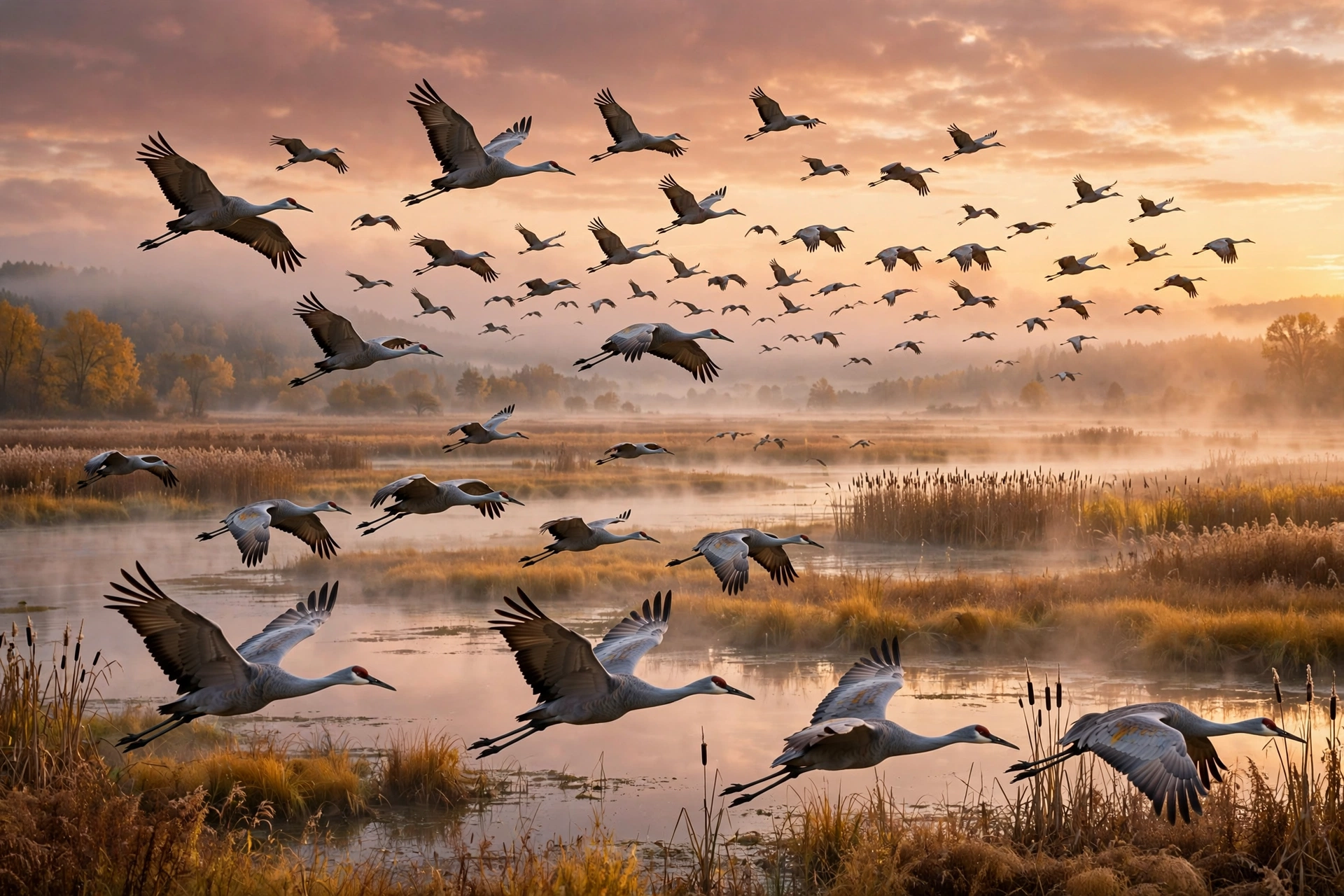
Every October, the skies over the American Midwest fill with a sound that stops conversation: the rattling, bugling calls of thousands of sandhill cranes on the move. These tall grey birds gather in huge flocks at a handful of famous wetlands, feeding in harvested fields by day and returning to shallow marshes to roost as darkness falls. In 2026, the fall show is already under way, and this weekend brings two standout opportunities: CraneFest in Michigan on October 10 and 11, and free viewing events in Utah’s Uintah Basin on October 10. Whether you are planning a dedicated trip or hoping to catch cranes closer to home, this guide covers the best places to see sandhill crane migration this fall, the timing for each region, what the experience is like, and how to get the most from your visit. If you are taking part in the October Big Day 2026 birding event this month, these gatherings are a spectacular way to add an unforgettable species to your list.
Why October Is Prime Time for Sandhill Crane Migration
Sandhill cranes breed across Alaska, Canada and Siberia, then move south as their northern wetlands begin to freeze. Shortening daylight tells their bodies it is time to go, and passing cold fronts give them the tailwinds they need for long flights. October sits right at the heart of this movement, which is why the great staging areas fill up now.
A staging area is a wetland where migrating birds pause to rest and refuel. The same sites draw cranes year after year because they offer two things side by side: shallow marshes where flocks can roost safely overnight, and harvested grain fields where they can feed during the day. The combination lets thousands of birds linger for weeks, building into the enormous gatherings that make October so special.
Timing varies by population. Cranes that breed farthest north leave first, while birds nesting in the Upper Midwest gather a little later. Weather plays a role too: a strong cold front can push big flocks south in a single night, while mild conditions may hold them back. That is why the famous counts swing from hundreds one week to tens of thousands the next.
This Weekend: CraneFest 2026 at Big Marsh Lake, Michigan
The most immediate opportunity is the 31st annual CraneFest, running Saturday October 10 and Sunday October 11 from noon until dusk at the Kiwanis Youth Conservation Area, 22300 15 Mile Road, near Bellevue, Michigan. The event celebrates the fall migration of thousands of sandhill cranes that stage on Big Marsh Lake, which lies within Michigan Audubon’s Bernard W. Baker Sanctuary.
Each October evening, just before dusk, the cranes leave their favourite feeding fields and pour into the marsh to roost. The fly-in typically begins around 4 p.m., with the largest numbers arriving between 5 p.m. and dusk. Festival organisers suggest arriving early to enjoy the Artist Village, guided nature walks from about 1 p.m. to 4:30 p.m., bird viewing areas, children’s activities and food trucks, then settling in for the evening spectacle.
Practical details are straightforward. Parking is $10 per vehicle, which includes admission for both days, and guests are encouraged to bring binoculars, cameras, chairs and warm layers for the cooler evening air. Restrooms and a pavilion are on site. If you cannot make the festival weekend, the cranes generally keep gathering at Big Marsh Lake through October and into November. Michigan’s Department of Natural Resources also recommends Kensington Metropark and the Waterloo Recreation Area as additional southern Michigan viewing spots.
Jasper-Pulaski, Indiana: The Midwest’s Biggest Crane Gathering
For sheer numbers, no fall crane site in the eastern United States rivals the Jasper-Pulaski Fish & Wildlife Area in northwest Indiana. Each fall, thousands of sandhill cranes visit the property’s shallow marshes from mid-October through mid-December, with numbers peaking in late November or early December. Weekly counts have topped 32,000 birds in recent years, and the 2026 season is under way, with 540 cranes logged on October 6.
The daily rhythm here is one of nature’s great performances. At sunrise, enormous flocks rise from their roosting marshes and fly out to feed in surrounding farmland, sometimes stopping in the open grasslands of the refuge. During the day, the birds feed, socialise and dance in harvested fields. About an hour before sunset, flocks kite back into the refuge from all directions, gabbing and jostling before settling onto the marshes at dusk.
The best vantage point is the observation platform at the Sandhill Crane Observation Area, which has a few stationary viewing scopes, although bringing your own binoculars or spotting scope is strongly recommended. The roosting marshes themselves are closed to the public so the birds can rest undisturbed. For extra insight, the International Crane Foundation hosts Sandhill Crane Saturdays at the viewing tower from 5:30 to 7:30 p.m. Eastern time on Saturdays from October 17 through December 19, 2026, excluding the Halloween and Thanksgiving weekends. Staff answer questions, and sharp-eyed visitors may even pick out an endangered whooping crane among the sandhills. The Indiana DNR’s sandhill crane page posts the weekly counts and full viewing guidance.
Utah’s Uintah Basin: Free Viewing Events This Saturday
Western birders get their own celebration this weekend. The Utah Division of Wildlife Resources and its partners are hosting two free sandhill crane viewing events on Saturday, October 10, in the Uintah Basin. Participants drive themselves between viewing areas on guided auto tours, and binoculars and spotting scopes are available to borrow, although bringing your own equipment is advised.
Sandhill cranes are already arriving in the basin’s fields, and they are easy to spot: about four feet tall, with grey bodies, long legs and a bare crimson crown. Their calls can carry up to two and a half miles, so you may hear the gathering before you see it. Utah’s cranes are part of the Rocky Mountain population, which stages in the basin before continuing south to wintering grounds in New Mexico and beyond.
More Fall Hotspots Worth the Drive
If the headline events do not fit your plans, several other sites deliver superb fall crane viewing across the season.
Horicon Marsh, Wisconsin
Horicon Marsh is a 32,000-acre wetland about an hour northwest of Milwaukee and the largest freshwater cattail marsh in the country. Sandhill cranes, once threatened in Wisconsin, have made a strong comeback and now stop at the marsh in large numbers, with peak viewing from mid-October to mid-November depending on weather and food. At peak times, observers have reported a couple of thousand cranes pouring over the marsh at dusk.
The best viewing comes at sunrise or about an hour before sunset, when the birds congregate in the marsh. The refuge’s three-mile auto tour loop and the Bud Cook Hiking Area on the northeast side are the recommended starting points. During the day, the cranes scatter to surrounding farm fields to feed, so plan your visit around the roosting flights.
Bosque del Apache, New Mexico
For the later part of the season, head south to Bosque del Apache National Wildlife Refuge on the Rio Grande in central New Mexico. The first cranes begin arriving in October, and through the winter the refuge hosts thousands of sandhill cranes alongside enormous flocks of snow geese, Ross’s geese and ducks. The 57,331-acre refuge is one of America’s classic winter wildlife spectacles.
The Festival of the Cranes, organised by the Friends of Bosque del Apache, is reported for December 2 to 5, 2026, with expert-led tours, workshops and keynote speakers. Even outside the festival, the refuge’s tour loops offer the famous sunrise “blast-offs,” when thousands of cranes and geese lift off the ponds in a thunder of wings and calls.

Sandhill Crane Migration Timing by Region
Fall migration is a rolling wave rather than a single event. Here is how the season typically unfolds across the continent:
- Northern breeding grounds: Cranes depart Alaska, Canada and Siberia from September into October as wetlands freeze and food becomes scarce.
- Upper Midwest staging: Wisconsin and Michigan gatherings build through October. Michigan’s breeding cranes are bound mainly for Florida, which is why the Baker Sanctuary birds linger into November before pushing south.
- Indiana staging: Jasper-Pulaski fills from mid-October through mid-December, with the biggest counts in late November and early December.
- Western staging: Rocky Mountain population cranes gather in places like Utah’s Uintah Basin during October, then continue to wintering areas in New Mexico, Texas and northern Mexico.
- Wintering grounds: From November through March, the birds settle in the southern United States and northern Mexico, feeding in wetlands and farmland until spring.
Because cold fronts can move birds in sudden pulses, it pays to watch the weather. Live migration forecast tools such as BirdCast show when big nocturnal movements are expected, helping you pick the best nights and mornings. For a broader look at how the seasons work, our guide to spring and fall migration seasons explains the cues that set the whole show in motion.
What to Expect: The Sights, Sounds and Dancing
A crane gathering engages every sense. The first thing you will notice is the sound: a rolling, rattling bugle that carries for miles and rises into a chorus when thousands of birds call at once. Visitors often hear the flock well before the first birds appear over the horizon.
The numbers are staggering. What begins as a few dozen birds in early October can swell to tens of thousands at peak staging areas. Watch long skeins of cranes arrive in loose V formations, necks outstretched and legs trailing, circling down to the marsh as the light fades. At Jasper-Pulaski, counts above 30,000 have been recorded in late November in recent years.
Then there is the dancing. Sandhill cranes are famous for their elaborate displays: pairs leap into the air with wings spread, bow, toss sticks and grass, and call in duet. Dancing strengthens pair bonds and helps young birds practise the moves they will use in courtship later. On a crisp October morning in a harvested cornfield, a group of dancing cranes is pure theatre.
During the day, the birds are more relaxed: feeding on waste grain, preening and socialising. Keep watching, though, because a distant whooping crane, taller and snow white, sometimes hides among the grey sandhills at sites like Jasper-Pulaski.
Compare the Top Fall Viewing Locations
Use this table to match a destination to your schedule and travel plans. All of these sites are at their best around dawn or dusk, when the cranes move between feeding fields and roosts.
| Location | Best timing | Peak numbers | Notes |
|---|---|---|---|
| CraneFest, Big Marsh Lake, Michigan | Early to mid-October | Thousands | Festival October 10-11, 2026; fly-in begins about 4 p.m. |
| Jasper-Pulaski FWA, Indiana | Mid-October to mid-December | Tens of thousands (32,000+ in past years) | ICF Crane Saturdays October 17 to December 19; weekly counts published online |
| Uintah Basin, Utah | October | Hundreds to thousands | Free DWR viewing events October 10, 2026; guided auto tours |
| Horicon Marsh, Wisconsin | Mid-October to mid-November | A couple of thousand at peak | Three-mile auto loop; Bud Cook Hiking Area recommended |
| Bosque del Apache, New Mexico | November to February | Thousands, plus snow geese | Festival of the Cranes December 2-5, 2026; famous sunrise blast-offs |
Viewing Tips: How to See Cranes Like a Pro
A little preparation turns a good crane outing into a great one. Follow these steps:
- Go at dawn or dusk: The great movements happen when cranes leave the roost at sunrise and return about an hour before sunset. Midday birds are scattered in distant fields and much harder to enjoy.
- Bring optics: Cranes often roost several hundred yards from viewing areas. Binoculars are essential, a spotting scope is better, and photographers should use their longest lens rather than creeping closer.
- Dress for the weather: October and November evenings at a marsh are cold and windy. Wear warm layers, a windproof outer shell, gloves and a hat, and bring a chair or blanket for comfort.
- Arrive early and stay quiet: Reach the viewing area well before the fly-in begins, keep voices low and avoid sudden movements. Cranes spook easily, and one startled flock can lift thousands of birds.
- Check the latest counts: Sites like Jasper-Pulaski publish weekly crane counts. A quick check before you leave tells you whether the birds have arrived in force or are still building.
- Give the birds space: Never enter closed roosting areas or approach feeding flocks. Watching from designated platforms and roads keeps the cranes calm and the spectacle going for everyone.

Know Your Crane: A Quick Field Guide
Sandhill cranes are unmistakable once you know what to look for. Adults stand about four feet tall with slate-grey plumage, a bare crimson-red crown on the forehead, a long straight dark bill and black legs that trail behind in flight. The wingspan reaches up to seven feet, and in flight the neck stretches straight out, which separates them at a glance from herons, which fly with necks folded.
Listen for the call: a loud, rattling, trumpet-like bugle produced by an extra-long windpipe that coils inside the breastbone. It is one of the great sounds of the natural world and carries for miles across open country. Young birds of the year are smaller and browner, and they lack the red crown, which develops as they mature.
The main confusion species is the whooping crane, which is taller, snow white with black wingtips, and critically endangered. If you spot a white crane among the grey flock, report it to refuge staff, as every sighting helps track this rare bird’s recovery.

A Conservation Comeback Worth Protecting
The spectacle we enjoy today nearly vanished. In the late 1800s and early 1900s, sandhill crane numbers crashed under pressure from hunting, egg collecting and the draining of wetlands. In some states, only a handful of breeding pairs remained; Michigan was down to just a few pairs sixty years ago.
Protection under the Migratory Bird Treaty Act of 1918, combined with wetland conservation, turned the story around. Populations have held steady or increased over recent decades, and the species is now one of North America’s great conservation success stories. The International Crane Foundation, founded in 1973 and based in Baraboo, Wisconsin, works worldwide to protect cranes and the wetlands they depend on, including the outreach programmes at Jasper-Pulaski.
The recovery is not finished business. Cranes still depend on a fragile chain of wetlands along their migration routes, and every staging marsh lost to drainage or development weakens the whole flyway. Visiting, learning and supporting wetland conservation are simple ways to keep the bugling flocks returning each October.
Sandhill Crane Migration FAQs
When do sandhill cranes migrate in fall?
Fall migration runs from September through December, with October at the centre of the action. Northern breeders leave first as wetlands freeze, staging areas in the Midwest fill through October, and the biggest Indiana gatherings peak in late November or early December. Most birds reach their wintering grounds by December.
Where is the best place to see sandhill cranes in October?
For October specifically, CraneFest at Big Marsh Lake in Michigan (October 10-11, 2026) and Utah’s Uintah Basin viewing events (October 10, 2026) are perfectly timed. Horicon Marsh in Wisconsin peaks from mid-October to mid-November. Jasper-Pulaski in Indiana is superb all season but reaches its greatest numbers later, in late November and early December.
How far away can you hear a sandhill crane?
Their rattling bugle calls can carry up to two and a half miles across open country, according to the Utah Division of Wildlife Resources. At a big staging area, the combined chorus of thousands of birds is audible long before the flocks come into view, which is part of what makes the experience so thrilling.
What is the red patch on a sandhill crane’s head?
The crimson crown is a patch of bare skin on the forehead of adult sandhill cranes, not feathers. It becomes more vivid during the breeding season and social displays, when increased blood flow deepens the colour. Juvenile birds lack the red crown entirely and develop it as they mature.
Are sandhill cranes endangered?
No. Sandhill cranes are not endangered and their overall population is stable or growing, but they are federally protected under the Migratory Bird Treaty Act of 1918, which makes it illegal to hunt, harm or harass them. Two small subspecies, the Mississippi and Cuban sandhill cranes, are listed as endangered, but the widespread greater and lesser sandhill cranes that fill the fall staging areas are thriving.
Conclusion
The fall sandhill crane migration is one of North America’s finest wildlife spectacles, and October 2026 offers exceptional chances to witness it. This weekend alone brings CraneFest at Michigan’s Big Marsh Lake and free viewing events in Utah’s Uintah Basin, while Jasper-Pulaski in Indiana builds toward its tens of thousands through November and December, and Horicon Marsh and Bosque del Apache extend the season into winter. Time your visit for dawn or dusk, bring binoculars and warm layers, and let the bugling chorus do the rest.
Beyond the spectacle, the cranes carry a hopeful message. A century ago these birds were sliding toward oblivion, and today their autumn gatherings fill entire skies because people chose to protect them and their wetlands. Every visit to a staging marsh, every count reported and every wetland conserved helps keep that story going. Pick your spot from the table above, check the latest counts, and go stand among the cranes while the season is at its peak.





