 Skip to content

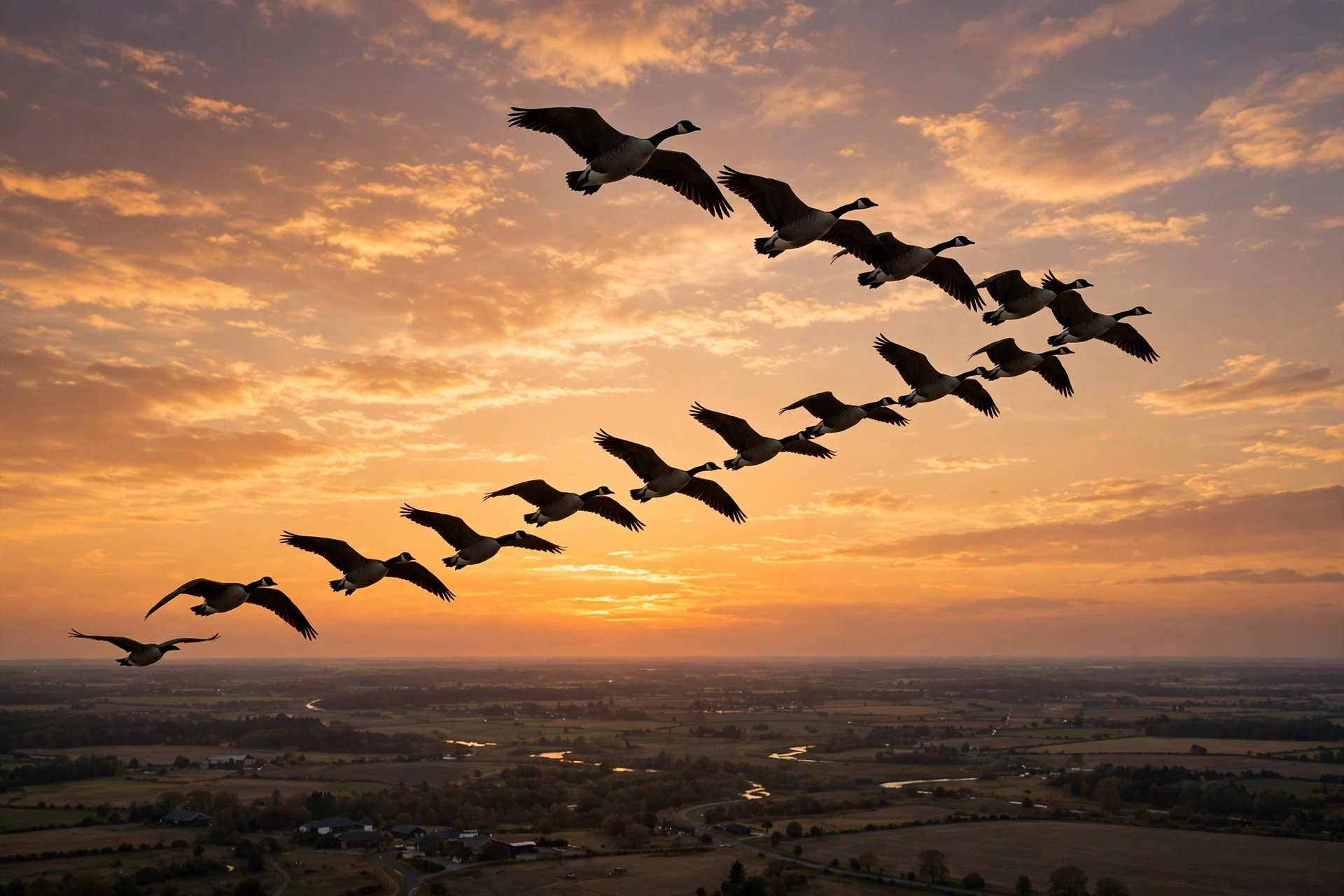
If you have ever watched a noisy flock stream overhead on a crisp autumn morning, you have probably wondered why do geese honk so constantly while they travel. The short answer is that honking is the flock’s wireless network: a steady stream of calls that keeps every bird informed, encouraged, and in its proper place. It is loud, it is rhythmic, and it is doing far more work than most watchers realize.
Canada geese are among the most vocal birds in North America, and their honking is far from random noise. The Cornell Lab of Ornithology describes the Canada goose as a highly social bird with a varied vocal repertoire: a range of distinct calls used to coordinate movement, greet flock mates, and signal danger. In the air, that vocabulary becomes a lifeline for the whole flock.
In this guide, we break down the 7 reasons behind the famous honking chorus, explain how those calls work together with the V-formation, and show how honking on the ground differs from calls made in flight. By the end, you will hear a passing flock in a completely new way.
In short: Geese honk in flight mainly to keep the flock together and communicating. The calls coordinate navigation, encourage tired birds to hold formation, help families stay near each other, warn of danger, and signal turns and landings. Without constant honking, a migrating flock would quickly scatter and waste precious energy.
Why Do Geese Honk to Stay in Formation?
The number one reason geese honk in flight is communication, plain and simple. A migrating flock can stretch for hundreds of yards across the sky, and birds at the back cannot always see the leaders clearly. Researchers call these cohesion calls: short, repeated vocalizations whose job is to keep every member of the group aware of its neighbors.
Think of it as a rolling roll call. Each honk tells nearby birds where the caller is, how fast it is moving, and whether the formation is holding steady. When the whole flock calls together, the overlapping sounds create an acoustic map of the entire group.
This constant chatter also reduces stress within the flock. Birds are social animals, and separation calls are common across many species. For geese, the steady rhythm of honks reassures each bird that it is still part of the group. That reassurance matters on journeys that can cover hundreds of miles in a single day.
Listen closely next time a flock passes and you may notice that the honking is not a single uniform sound. Different birds call at different pitches and tempos, and the chorus rises and falls as the flock adjusts its shape. This is real-time communication happening above your head, and it is one of the clearest answers to why do geese honk while they travel.
Do Geese Honk to Encourage Each Other?
Yes, and scientists take this idea seriously. The leading theory holds that birds flying behind the leaders honk to encourage the birds ahead to keep up the pace. Migration is exhausting work, and a flock that loses its rhythm loses its efficiency.
The encouragement flows in both directions. Birds at the front honk to signal that they are still strong and holding the course, while birds in the back honk their position and readiness. This two-way encouragement helps the flock maintain a steady speed over long distances, which is critical when bad weather or headwinds make flying harder.
Some researchers have suggested that the honking from behind may actually cue the lead bird, which does the hardest work by breaking the wind. When the lead bird hears strong, steady honking from the ranks, it gets feedback that the flock is together and keeping up.
Whatever the exact mechanism, the pattern is clear: the flock honks more on the toughest legs of the journey. During calm, easy flying, the chorus often quiets down. When the flock climbs, fights a headwind, or pushes through a long stretch, the honking picks up again, like teammates cheering each other through the hard part of a race.
How Does Honking Help Geese Navigate?
Geese are remarkable navigators, using landmarks, the position of the sun, and even Earth’s magnetic field to find their way along traditional flyways: the established migration routes that bird populations follow year after year. Honking plays a supporting role in this navigation system by coordinating the flock’s responses to the route.
When the lead birds spot a landmark or decide to change direction, the shift ripples through the flock, and honking helps it travel faster than sight alone. Many waterfowl travel these same flyways, and you can read about how ducks migrate along similar routes.
Honking also helps the flock make altitude decisions together. Climbing to a higher altitude can catch a favorable tailwind, while descending may avoid turbulence or prepare for a rest stop. The lead birds signal these changes, and the chorus confirms that every bird is responding.
Young geese, in particular, depend on this system. First-year migrants have never flown the full route before, and they learn the flyways by following experienced adults. The constant honking keeps young birds locked onto the flock’s movements, effectively giving them turn-by-turn directions from birds that know the way.

Why Do Geese Fly in a V? Teamwork in the Air
The V-formation is one of nature’s most elegant teamwork strategies, and honking is the communication layer that makes it work. Each bird flies slightly behind and to the side of the bird ahead, catching the upwash: the rising air that curls off the wingtips of the bird in front. This free lift means every bird except the leader spends less energy staying aloft.
But the formation only delivers those energy savings when every bird holds its position precisely. Honking gives each bird continuous audio feedback about its position relative to its neighbors, letting the flock fine-tune the V in real time.
How Upwash Saves Energy
As each goose flaps, its wings create a swirl of air at the wingtips. The outer part of that swirl pushes upward, and a bird positioned correctly in the slipstream rides that rising air like a surfer catching a wave. Audubon notes in its explainer on why geese fly in a V that this aerodynamic teamwork is a key reason geese can migrate thousands of miles in a season.
Rotating the Lead Bird
The lead bird works the hardest because it flies into undisturbed air with no upwash to ride. No single goose can hold that position forever, so the flock regularly rotates the lead. When it is time to switch, the honking changes noticeably: the new leader calls out, trailing birds answer, and the whole formation reshuffles without losing speed or shape. For a deeper look at the aerodynamics, read our full guide on why geese fly in a V-formation.

Do Geese Honk to Keep Their Families Together?
Canada geese mate for life, and family ties within a flock are strong. Mated pairs and parents traveling with young birds from the previous breeding season use softer, more specific calls to stay in contact with each other inside the larger chorus.
These family calls work like names in a crowd. Each goose can recognize the calls of its mate and offspring, and pairs frequently answer each other with short duets. During the chaos of takeoff, a course change, or a landing, these personal calls help family members confirm that they are still close.
Parent geese are famously protective, and that protectiveness extends into the air. Adults flying with young birds tend to position themselves nearby, and their calls guide the youngsters through tricky moments. This bonding behavior continues year-round, not just during migration.
Honking as an Early Warning System
A sharp, loud honk from a flying goose is often an alarm. Geese are watchful birds, and dozens of eyes scanning the ground and sky make a flock an excellent early warning system. When one bird spots a potential threat, its urgent honking alerts the entire formation in an instant.
The most common threats are predators, especially eagles and hawks that hunt from above. A raptor attack on a flying flock is rare but dangerous, and the flock’s response is coordinated: alarm honks trigger the group to tighten formation and change altitude.
Alarm honking sounds different from the steady rhythm of cohesion calls. It is typically louder, more abrupt, and repeated rapidly. If you hear a flock suddenly shift from a relaxed chatter to sharp, insistent honking, something below or ahead has caught their attention.

Why Do Geese Honk When Landing?
Some of the loudest honking of all happens just before touchdown. As a flock approaches a lake, field, or marsh, the calls shift from the steady cruising rhythm to an excited, rising chorus. This landing communication coordinates one of the most dangerous moments of the flight.
Landing requires every bird to slow down, lower its landing gear, and descend at the right angle without colliding with a neighbor. The honking synchronizes this process: calls from the front signal the start of the descent, and the birds behind answer as they follow.
The calls also serve as a final safety check. The lead birds honk about the landing site itself, and the flock’s response helps confirm that the area looks safe and clear. If something is wrong, the honking changes and the flock can abort the landing and circle for another pass.
Do Geese Honk on the Ground Too?
Yes, geese honk on the ground as well, but the calls sound different and serve different purposes. On land or water, honking is less about coordinating flight and more about defending territory, greeting flock mates, and warning of ground predators. The flight chorus is rhythmic and flowing; ground honking is often sharper and more conversational.
One of the most common ground calls is the greeting ceremony. When a goose returns to the flock after being away, or when two groups merge, the birds engage in an excited bout of honking with necks outstretched. Territorial honking is another ground specialty: during the breeding season, pairs defending a nest site honk aggressively at intruders. At night, geese gather at communal roosts on lakes and wetlands, and the evening arrival is another honking event. Like many waterfowl, geese are vulnerable while they sleep, so learning where ducks sleep at night gives you a good picture of how geese choose their own nighttime waters.
The 7 Reasons Geese Honk: Quick Summary
Here is a compact reference for all seven reasons covered in this guide.
| Reason | What the Honking Does | When You Hear It |
|---|---|---|
| 1. Flock communication | Cohesion calls keep every bird aware of its neighbors’ positions | Throughout the entire flight |
| 2. Encouragement | Honks from behind urge tired birds to keep up the pace | Long, difficult legs of the journey |
| 3. Navigation cues | Calls signal turns, climbs, descents, and course corrections | When the lead birds change direction |
| 4. Pair and family bonding | Mates and parents use personal calls to stay in contact | As softer duets inside the flock chorus |
| 5. Warnings | Sharp alarm honks alert the flock to predators and hazards | Sudden threats below or ahead |
| 6. Landing coordination | Rhythmic calls sync the descent and check the landing site | The final approach before touchdown |
| 7. Flock cohesion | Contact calls help stragglers find and rejoin the group | When a bird drifts off or rejoins |
Notice how every reason comes back to the same theme: connection. A goose that cannot hear its flock is a goose in trouble, so evolution shaped the honk into a versatile tool that covers navigation, safety, family, and teamwork in a single call.
Frequently Asked Questions About Geese Honking
Do geese honk only when they are flying?
No. Geese honk on the ground and water too, but the calls differ. Flight honking is rhythmic and focused on coordination, while ground honking covers greetings, territory defense, and predator warnings.
Why are geese so loud when they migrate?
Migration is the hardest work a goose does all year, and the flock depends on constant communication to stay together over hundreds of miles. The volume increases because dozens of birds are calling at once, and the calls must carry across a long, spread-out formation.
Do geese honk at night?
Geese mostly migrate and travel during the day, so nighttime honking is less common in flight. However, you can hear honking at night when flocks arrive at roosting lakes in the evening or when a predator disturbs a sleeping flock.
Can geese recognize each other’s honks?
Yes. Research on goose vocalizations shows that individuals can distinguish the calls of their mates and family members from the calls of strangers. Each bird is essentially listening for familiar voices.
Why do geese fly in a V instead of a straight line?
The V-formation lets each bird ride the upwash from the wingtips of the bird ahead, which saves energy over long distances. Only the lead bird flies without this free lift, so the flock rotates the lead position.
What is the difference between a honk and a hiss?
A honk is a social and coordination call used in flight and flock life, while a hiss is an aggressive threat display made on the ground, usually with the neck lowered and wings spread. If a goose hisses at you, it feels threatened and wants you to back away.
Do all goose species honk the same way?
No. The classic loud honk belongs mainly to the Canada goose. Snow geese make higher-pitched, more yapping calls, while brant geese produce a low, rolling croak. For reference on the Canada goose’s calls, see the Cornell Lab’s species profile at All About Birds.




