 Skip to content

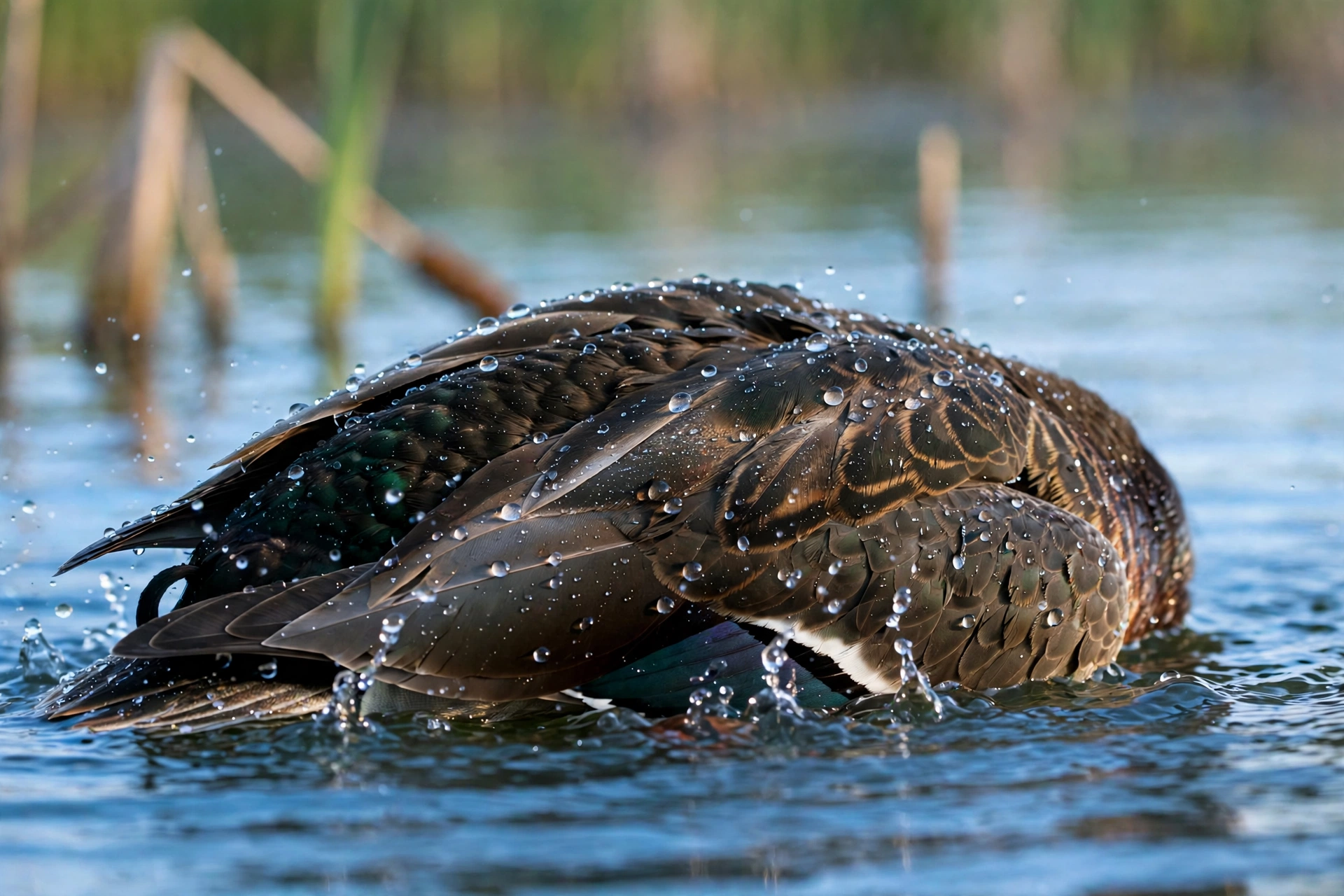
If you have ever watched a duck glide through a pouring rainstorm looking completely unbothered, you have probably asked the same question every birdwatcher asks: how do ducks stay dry? The bird climbs out of the pond, gives one quick shake, and flies off as if the rain never touched it.
The answer is not luck, and it is not magic. It is a three-part waterproofing system built into every duck: a tiny oil factory near the tail, feather architecture that traps air and sheds water, and a daily grooming routine that keeps the whole system running. Each part does a different job, and all three have to work together.
In this guide, you will learn what the preen gland does, how feather microstructure beads water away, why ducks preen so much, how ducklings survive before their waterproofing is ready, and why oil spills are so deadly to waterbirds.
In short: Ducks stay dry through a three-part system: a preen gland near the tail produces waterproofing oil, feather microstructure traps air and beads water off, and daily preening spreads the oil evenly. Soft down underneath adds insulation. So how do ducks stay dry in heavy rain? Oil, structure, and maintenance working together.
What Is the Preen Gland?
The preen gland, also known by its scientific name, the uropygial gland, is a small oil-producing gland that sits right at the base of a duck’s tail. It is one of the few glands in a bird’s skin, and in waterbirds it is especially well developed. All day long it secretes a waxy, yellowish oil made of fatty substances.
This tiny gland raises a big question: how do ducks stay dry with just one small oil source? The answer is careful, constant maintenance. The duck presses its bill against the gland, collects a dab of oil, and then works that oil through its feathers, section by section, in a grooming routine called preening.
According to the Cornell Lab of Ornithology’s mallard guide, healthy plumage depends on constant upkeep, and the preen gland sits at the center of that routine. Without regular oiling, feathers dry out, fray, and lose the tight structure that keeps water out.
Where exactly is the preen gland located?
You can spot the location if you know where to look. It sits on the duck’s back just above the tail, sometimes visible as a small raised bump with a tuft of tiny feathers around it. When a duck twists its head all the way around and nibbles at the base of its tail, it is collecting oil.
How Does Preen Oil Waterproof Duck Feathers?
Preen oil is the waxy secretion of the preen gland, and it is the first half of the answer to the question “how do ducks stay dry.” The oil is hydrophobic, which simply means water-repelling. When a duck spreads it across its feathers, each feather gets a thin, water-resistant coating.
Water behaves differently on an oiled feather than on a dry sponge. Instead of soaking in, droplets bead up into round spheres and roll off, the same way rain beads on a freshly waxed car. The oil also keeps the feathers supple, so the microscopic parts of each feather stay zipped tightly together.
But oil alone cannot do the job, which is why the question “how do ducks stay dry” needs feather structure for a complete answer. A coating helps, but the real engineering is in the feathers themselves.
What Do Duck Feathers Look Like Up Close?
Zoom in on a single contour feather, the stiff outer feather that forms the duck’s visible coat, and you will find a structure built like a zipper. A central shaft called the rachis runs down the middle. Fine branches called barbs spread out from the shaft on both sides. Even tinier branches called barbules grow off each barb, and microscopic hooks called hooklets latch the barbules together.
When the hooklets are latched, the feather becomes a smooth, continuous surface with almost no gaps. Air gets trapped in the tiny spaces beneath and between the feathers, and that trapped air is the secret weapon. Water cannot easily push past a cushion of air, so rain and pond water sit on top of the feather coat instead of soaking through to the skin.

So how do ducks stay dry at the microscopic level? Through this combination of interlocked feather parts and trapped air, topped with a fresh coat of preen oil. Damage any part of the system and the waterproofing fails, which is exactly what happens in an oil spill.
Why does trapped air matter so much?
Trapped air does two jobs at once. First, it blocks water from reaching the skin. Second, it insulates the duck, because still air is a poor conductor of heat. This is the same principle behind a down jacket or a double-glazed window: a layer of motionless air keeps warmth in and cold out.
Why Do Ducks Preen So Much?
Preening is the grooming behavior in which a bird uses its bill to clean, arrange, and oil its feathers. A duck will draw individual feathers through its bill, nib the base of each one, and smooth the vane back into shape. Because the answer to “how do ducks stay dry” only works when the oil is fresh and evenly spread, ducks repeat this routine many times a day.
Preening does more than spread oil. Each pass of the bill re-latches hooklets that have come unzipped, removes dirt and parasites, and lines the feathers up so they overlap like shingles on a roof. After a swim or a bath, most ducks climb out, shake hard, and launch into a long preening session.

A typical preening session follows a familiar order:
- Tail first: the duck collects fresh oil from the preen gland
- Back and wings: oil is worked through the largest feather areas
- Chest and sides: the bill reaches every patch it can touch
- Head rub: the duck rubs its head against oiled back feathers to coat the head
It looks fussy because it is. A duck with unkempt feathers is a duck that gets cold and wet, so this fussiness is survival.
Why do ducks bathe if they want to stay dry?
It sounds backward, but ducks bathe in water to keep their feathers working. A quick dip loosens dirt and dust, and the shake-and-preen routine afterward resets everything. Clean feathers zip together better than dirty ones, so bathing is maintenance, not contradiction.
What Does the Down Layer Do?
Underneath the stiff contour feathers lies a cloud of down feathers: short, soft, fluffy feathers with no interlocking hooklets at all. Their only job is to trap air close to the body. Because the contour feathers above keep liquid water out, the down stays dry and keeps doing its job even while the duck floats in near-freezing water.
Think of it as a two-layer clothing system. The contour feathers are the rain shell, and the down is the insulating mid-layer. When a duck fluffs up on a cold morning, it is thickening the trapped-air layer to hold more warmth.
The down layer is also why a duck can look dry on the outside while sitting in cold water for hours. After a long day on the water, ducks tuck the bill and feet into this warm envelope to rest, which is part of where ducks sleep at night and how they stay comfortable doing it.
How Do Ducks Stay Dry in Winter and Rain?
Winter is the final exam for the question “how do ducks stay dry,” and ducks pass it every year. In driving rain, water beads on the oiled contour feathers and rolls off before it can soak in. A quick shake throws off the rest.

Cold water is a bigger challenge than cold air, because water steals body heat far faster. Ducks handle it with the same waterproofing plus extra insulation: thicker winter down, a deeper trapped-air layer, and circulation that keeps the body core warm while the extremities run cooler. Their feet are a separate trick entirely, which is why birds’ feet don’t freeze in winter even while the bird stands on ice.
Not every duck faces the worst of winter in place. Many species migrate to warmer waters before lakes freeze solid. If you are curious about those journeys, read our guide on do ducks migrate.
How Do Ducklings Stay Dry Before Their Preen Gland Matures?
Ducklings hatch covered in soft down, not waterproof contour feathers, and their preen gland is not fully working yet. So how do the babies manage? Mostly through behavior and mothering. Ducklings spend their first days largely out of deep water, and when rain comes, they huddle under the mother’s body and wings.
The mother helps in another way too. As ducklings snuggle against her oiled feathers, they pick up traces of her preen oil on their own down. Within a few weeks, juvenile contour feathers grow in, the preen gland ramps up, and the duckling’s own system takes over.
How Do Ducks Stay Dry When Oil Spills Hit?
They don’t. That is the tragic answer. When crude oil or other petroleum coats a duck’s feathers, it mats the barbs together and breaks the hooklet connections apart. The smooth, air-trapping surface collapses into clumps, water floods in, and the insulation fails. A duck that was perfectly dry minutes earlier becomes soaked to the skin.
The consequences stack up fast. Wet down cannot insulate, so the bird loses body heat and can die of hypothermia even in mild weather. Waterlogged feathers lose buoyancy, so the duck rides lower, struggles to swim, and can drown. When the duck tries to preen the oil away, it swallows petroleum, which poisons the liver and kidneys.
According to Ducks Unlimited, protecting clean water and wetland habitat is one of the most direct ways to keep waterfowl safe. Wildlife rehabilitators wash oiled birds with gentle dish detergent to strip the petroleum, then rinse for hours and let the bird preen its own oils back into place.
Can a Duck Drown If Its Feathers Get Waterlogged?
A healthy duck with intact waterproofing will not drown from rain or swimming. The system is simply too good. But a duck whose feathers are waterlogged from oil contamination, illness, or severe feather damage can absolutely drown. Without trapped air, the body loses insulation and buoyancy at the same time.
Molting ducks face a milder version of this risk. During the annual molt, old feathers fall out and new ones grow in, and the waterproofing is temporarily patchy. Most ducks time the molt for late summer, when water is warm and food is plentiful.
Duck Waterproofing System: The Layers at a Glance
Here is the whole system in one view, from the outside in:
| Layer | What It Is | Its Waterproofing Job |
|---|---|---|
| Preen oil | Waxy secretion from the uropygial gland near the tail | Coats feathers so water beads and rolls off instead of soaking in |
| Contour feathers | Stiff outer feathers with interlocking barbs, barbules, and hooklets | Form a smooth, shingled shell that traps air and blocks water |
| Down feathers | Soft, fluffy underlayer with no hooklets | Trap warm air against the body for insulation, staying dry beneath the shell |
| Preening behavior | Daily bill-grooming that spreads oil and re-zips feathers | Maintains the oil coat and repairs feather structure so the system keeps working |
Remove any one layer and the system weakens. Remove two, as an oil spill does, and it collapses entirely.
Frequently Asked Questions
Still curious about duck waterproofing? These quick answers cover the details readers ask about most.
Do ducks ever get wet?
The outer contour feathers do get wet on the surface, but the water beads up instead of soaking through. Underneath, the skin and down stay dry. After swimming, a duck shakes off the surface water and preens the feathers back into shape.
Why do ducks preen so much after swimming?
Swimming loosens the feather structure and washes away some oil. Preening re-spreads fresh oil from the preen gland and re-latches the tiny hooklets between barbules.
Do baby ducks have waterproof feathers?
Not at first. Ducklings hatch with soft down and an immature preen gland, so they are not waterproof. They stay dry by huddling under their mother and limiting time in deep water until juvenile feathers and the oil gland develop.
What is preen oil made of?
Preen oil is a waxy mixture of fatty substances secreted by the uropygial gland at the base of the tail. It is hydrophobic, meaning it repels water, and the duck spreads it over its bill during preening.
Can a duck fly with wet feathers?
A healthy duck shakes off surface water and flies normally, because the feathers underneath stay dry and light. A duck with truly waterlogged feathers, from oil contamination or damage, becomes too heavy and cold to fly well.
Why do ducks flap and shake after a bath?
The vigorous shake throws off loose water clinging to the feather surface. Flapping realigns the feathers and fluffs the down back up. Both actions are the warm-up for a thorough preening session.
Do all birds have a preen gland?
Almost all birds have a uropygial gland, but it is largest and most active in waterbirds like ducks. A few species, including ostriches, lack the gland and rely on powder down instead.
What should you do if you find an oiled duck?
Do not try to wash it yourself, and do not feed it. Contact a local wildlife rehabilitator or wildlife agency right away, since oiled birds need specialized cleaning and medical care.
The next time you see a duck cruising through a rainstorm without a care, you will know the secret: a tiny oil gland, microscopic feather engineering, fluffy insulation, and a lot of daily grooming. It is one of nature’s best waterproofing systems, and ducks wear it every day of their lives.





