Skip to content

Yes, you should leave the leaves for birds. When you let fallen leaves stay where they fall, you are not being lazy. You are running a bird feeder that restocks itself. That soft layer of leaves shelters the insects, spiders, chrysalises, and worms that birds eat all winter and that parent birds feed their nestlings in spring.
Every October the National Wildlife Federation celebrates its annual Leave the Leaves month, and the message is simple: leaves are their own small ecosystem. Instead of bagging them up and sending them to the curb, you can rake less, leave more, and watch your yard attract towhees, sparrows, thrashers, juncos, robins, and wrens that scratch, flip, and sift through the leaf litter for food. If you leave the leaves for birds this fall, you also help fireflies, bumblebee queens, and the moths whose caterpillars become next spring’s baby-bird food. Here is how the leaf layer works, which birds benefit most, and what to do when raking still makes sense.

The Short Answer: Rake Less, Feed More Birds
Most of the food birds eat never comes from a feeder. It comes from the living layer under their feet. Fallen leaves create a moist, sheltered microclimate where insects, spiders, millipedes, earthworms, and overwintering caterpillars spend the cold months. Ground-foraging birds know exactly where to find them, flipping leaves aside one by one with bills and feet.
When you rake every leaf off the property, you remove that entire pantry. What is left is a bare lawn that offers birds almost nothing once the feeder empties. When you leave the leaves for birds instead, your yard keeps working through winter and into spring, when parent birds need soft protein for their nestlings.
The National Wildlife Federation puts it plainly: birds may love your feeders, but most of their food comes from foraging in the natural environment, and the leaf layer is one of the best places to forage. If you are just getting started with wildlife gardening, pair your new habit with proven ways to attract more birds to your backyard fast for the best of both worlds: a stocked feeder plus a living yard.
Why You Should Leave the Leaves for Birds: A Living Pantry
Think of fallen leaves as a slow-release food supply. Underneath that crisp layer, beetles, spiders, snails, worms, and other invertebrates stay active longer into the season and emerge earlier in spring. Birds that scratch through litter find meals on days when nothing else is available. This matters most in winter, when insects seem to vanish but are really just hiding.
The deeper magic is happening with moths and butterflies. According to the Xerces Society, the vast majority of butterflies and moths in cold climates spend winter tucked into leaf litter as eggs, caterpillars, chrysalises, or adults. Woolly bear and great spangled fritillary caterpillars curl into leaf piles for protection from cold and predators. Red-banded hairstreaks lay their eggs on fallen oak leaves, which become the caterpillars’ first food. Luna moths wrap their cocoons in leaves, and swallowtail chrysalises look so much like dried leaves that they disappear among the real ones. Rake and bag those leaves, and you throw away next spring’s moths, which are food for birds.
Those moths matter more than most people realize. Entomologist Doug Tallamy’s research, reported by the University of Delaware, found that native oaks support 557 species of caterpillars, while a non-native ginkgo supports none. A chickadee pair delivers one caterpillar to the nest about every three minutes, all day long, totaling 6,000 to 9,000 caterpillars to raise a single clutch. No caterpillars means no baby birds, and caterpillars come from native plants and the leaf litter those plants produce.
The Xerces Society adds that mated bumblebee queens burrow only an inch or two into the soil to hibernate, and a thick layer of leaves gives them welcome protection from the elements. Even your lawn benefits: a thin layer of leaves adds organic matter and nutrients rather than harming the grass. The leaf layer also gives birds nesting material in spring. Many backyard species gather fallen leaves and twigs for nests, and birds like ovenbirds and Kentucky warblers nest right in deep leaf litter, which hides them from predators.
Which Birds Benefit Most
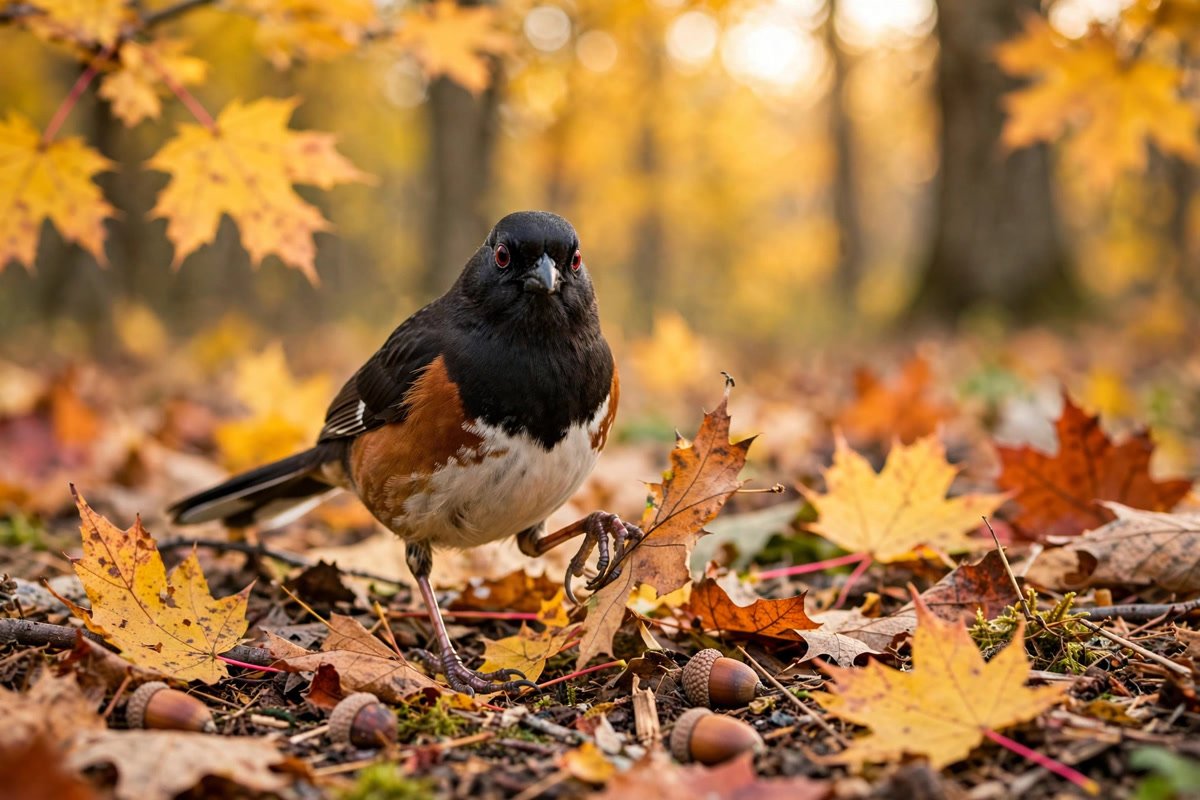
The birds that love leaf litter most are the ground foragers, the ones you rarely see at a hanging feeder. Eastern towhees are the poster birds for this habit. They hop backward through leaves, kicking up both feet at once to expose insects, spiders, millipedes, and snails, along with seeds and acorns. Spotted towhees in the West do the same. Listen for their loud rustling on a quiet fall morning and you will know they found your un-raked patch.
Sparrows are leaf-litter specialists too. Fox sparrows use a distinctive double scratch to uncover seeds and insects, and they need ample leaf litter to forage, especially in winter. Dark-eyed juncos, white-crowned sparrows, and white-throated sparrows hop and scratch through fallen leaves from October through March. If you are seeing a lot of streaky little brown birds you cannot name, check our guide to identify small brown birds in your yard, because half of them are probably leaf flippers.
Thrashers take the technique to an art form. The Cornell Lab of Ornithology notes that California thrashers use their long, curved bills like brooms, sweeping leaf litter aside to uncover beetles, earwigs, millipedes, spiders, and moths. Brown thrashers and mockingbirds do similar work in the East and South. Large thrushes, including American robins, hermit thrushes, and veeries, flip leaves to find worms and grubs. Carolina and winter wrens probe the layer for spiders and tiny insects. Even wild turkeys, jays, and woodpeckers work leaf litter, and woodcocks probe moist leafy soil with their long bills at dusk.
The pattern is clear: where there are leaves, there are birds. More than a hundred North American species have been observed feeding in or using leaf litter, according to birding guides. A yard with a healthy leaf layer is simply a yard with more birds in it.

Fireflies Need Fallen Leaves Too
Here is the bonus hook that surprises most people. Those flashing summer lights are firefly adults, but the animals that make them spend most of their lives as larvae hiding in leaf litter. According to the Xerces Society, larval fireflies spend their time underground or under damp logs and leaf litter, and decaying leaves are ideal habitat. The larvae are also useful garden residents: they prey on slugs, snails, and soft-bodied soil insects.
Rake away the leaves, mulch them into dust with a mower, or bag them for the curb, and you destroy the nursery. Because fireflies live as larvae, pupae, or eggs at almost any time of year, there is no safe season to strip the yard bare. This matters because fireflies are in trouble. One in three firefly species in North America may be at risk of extinction, according to a Xerces Society study, with habitat loss and light pollution among the main pressures.
You do not have to choose between a tidy yard and fireflies. Leaving a few leafy corners, a ring of mulch under trees, and a damp wild edge gives larvae the dark, moist shelter they need while the rest of your yard stays presentable. You get summer light shows, free slug control, and birds get one more reason to visit. A yard that supports fireflies is a yard that supports birds, because both depend on the same un-manicured ground layer.
What to Do Instead of Raking Everything
You do not have to leave every leaf where it falls. The goal is to keep leaves on your property, where they keep feeding the food web, rather than sending them to the curb. Here is a practical approach that works in almost any yard.
- Leave garden beds alone: Let fallen leaves settle into your beds over winter. A layer 3 to 5 inches thick makes a natural mulch that preserves soil moisture, suppresses weeds, and composts in place, which the National Wildlife Federation recommends as its top leaf strategy.
- Rake leaves into beds as mulch: If leaves pile up on the lawn, rake them onto planting beds, around shrubs, and under trees instead of bagging them. You are moving the habitat, not destroying it.
- Mulch-mow a thin layer into the lawn: A scattering of leaves mowed into small pieces breaks down quickly and feeds the grass. The Xerces Society notes that a thin layer of leaves actually benefits lawns by adding organic matter and nutrients.
- Keep paths and edges tidy: Mow, edge, and clear sidewalks, patios, and driveways. A crisp border tells everyone that the leafy beds are intentional, not neglected.
- Pile extras in a back corner: Excess leaves make an excellent compost pile or a simple habitat stack that breaks down into rich compost for spring planting.
If raking everything off the lawn is required in your area, the next best option is to rake leaves directly into garden beds, or add them to a compost pile, rather than sending them away in bags. The less distance leaves travel off your property, the more wildlife value they keep. Pair this strategy with turning your yard into a bird-friendly garden for a full habitat makeover.
When You Should Still Rake
Leaving the leaves is great advice, but it is not a rule without exceptions. Honest wildlife gardening means knowing when a rake is the right tool.
Heavy mats of wet leaves can smother grass. If a thick, soggy layer sits on the lawn all winter, it blocks light and air, and you can lose patches of turf. Thin layers are fine and even beneficial, but a deep mat belongs in the beds or the compost pile, not on the lawn.
Diseased leaves should be removed and disposed of, not composted. Leaves with tar spot on maples, apple scab, or other serious fungal diseases can carry infection into next season. Bag these and put them in municipal yard waste collection rather than spreading them around.
Leaves also belong nowhere near storm drains. Wet leaves in gutters and drains block water flow and send extra nutrients into streams, which harms water quality. Clear your drains and the street edge, and keep leaves at least a few feet from the curb if your neighborhood has curbside collection.
Finally, if you mulch-mow, do it early and often rather than waiting until a deep layer builds up. And skip shredding leaves directly where wildlife lives: the Xerces Society warns that shredding leaves atop the lawn can destroy the eggs, caterpillars, and larvae sheltered within them. Mow the lawn areas, leave the bed areas whole.
How to Handle Neighbors and HOAs
The biggest barrier to leaving leaves is rarely biology. It is people. The National Wildlife Federation’s annual survey found that 40 percent of homeowners say they are required to rake by a homeowners association, a city ordinance, or both. If that is you, here is how to keep both your neighbors and the birds happy.
Use the tidy-edge trick. A yard with crisp mowed edges, cleared paths, and defined bed borders reads as intentional even when the beds themselves are full of leaves. Most complaints are about sloppy appearance, not leaves themselves. Mow a neat strip along the sidewalk and driveway, and rake leaves off the front lawn into the back beds.
Post a sign. Pollinator habitat signs from groups like the Xerces Society or the National Wildlife Federation explain what you are doing in one glance: “This garden provides habitat for pollinators and birds.” A sign turns a strange-looking yard into a story neighbors can appreciate, and it gives you an opening to talk about why you leave the leaves for birds.
Start with the back yard. Many ordinances only govern what is visible from the street. You can keep the front picture perfect while letting the back beds go wild, and birds will find the back just fine.
Talk before there is a problem. Mention your plan to neighbors in fall before the leaves drop. Most people soften once they hear the reason, especially the part about fireflies. Offer to rake their leaves into your beds if they were going to bag them anyway. You get free mulch and habitat; they get free leaf removal.

Frequently Asked Questions
Will leaving leaves kill my grass?
A light scattering will not, and a thin layer actually feeds the lawn. Problems start only when thick, wet mats sit on the grass for months, blocking light and air. The fix is simple: mulch-mow thin layers into the lawn and rake thicker piles onto beds. Your grass gets the nutrients; the birds keep the habitat.
Do fallen leaves attract pests like mice or termites?
Leaf litter is normal habitat, not a pest magnet. It shelters the same insects, spiders, and small animals that live in any healthy garden. Rodents are attracted by accessible food and shelter near structures, like birdseed piles against the house or brush stacked by the foundation. Keep leaf piles a few feet from the foundation and keep stored food sealed, and leaves will not create a rodent problem.
What about leaf blowers?
Leaf blowers are loud, burn fossil fuel, and blast away the entire top layer of soil life along with the leaves. The National Wildlife Federation asks people to avoid them for all three reasons. A rake lets you move leaves precisely, leaves the habitat under shrubs intact, and is far kinder to nesting and overwintering insects. If mobility is an issue, a blower used gently on the lawn only, not in beds, is a reasonable compromise.
Can I just mow all the leaves into the lawn?
Mowing a thin layer is fine and good for the grass. But mowing an entire yard’s deep leaf fall destroys the overwintering eggs, caterpillars, and larvae sheltering in whole leaves, which is exactly the wildlife value you are trying to protect. The better split: mulch-mow what is on the lawn, leave what is in the beds whole.
When should I clean up leaves in spring?
Wait until nighttime temperatures stay consistently above 50 degrees Fahrenheit, which usually means late April or early May in most of the country. This is the rule of thumb recommended by Cornell Extension, and it gives most overwintering insects time to emerge.
Will leaves make my yard look messy?
Only if everything else is messy too. Leaves in defined beds with crisp edges look like mulch, which is what they are. The messy look comes from leaves scattered across sidewalks, driveways, and ragged lawn edges. Keep the hardscapes clear and the bed edges sharp, and a leaf-covered bed reads as a deliberate, cared-for garden.
Conclusion
When you leave the leaves for birds, you are doing the simplest, cheapest wildlife project a homeowner can do. You skip the raking, the bagging, and the trips to the curb, and your yard pays you back with towhees scratching through litter, sparrows and juncos working the beds all winter, moths returning in spring, and fireflies flashing over the lawn in July.
Start this fall: leave the beds alone, rake lawn leaves into them as mulch, and mulch-mow only the thin scatter that remains. You do not need to convert the whole yard at once. Even one un-raked bed, plus a feeder stocked with what to feed birds in winter, turns an ordinary yard into working habitat. The leaves were never trash. They were always the pantry.