 Skip to content

Every October, backyards across North America go quiet. The warblers that flashed through the trees in September vanish. The hummingbird feeder sits untouched for days. If you are wondering where birds go in winter, you are asking one of the oldest questions in birding, and the answer is more varied than most people expect.
Some birds embark on journeys that stretch from pole to pole. Others shift just a few hundred miles south and call it done. A surprising number never leave at all, toughing out subzero nights in the same trees where they raised chicks in June. Where a bird spends the winter depends on its species, its food, and the survival strategy evolution handed it.
This guide maps winter destinations by bird group, from marathon migrants to hardy residents. You will learn how far each group travels, what triggers the journey, and exactly how the birds that stay put survive the coldest months of the year.
The Short Answer: Most Leave, Some Stay, a Few Wander
Of the more than 650 bird species that breed in North America, over half migrate, according to the Cornell Lab of Ornithology. But migration is not one single behavior. Birds follow at least four distinct winter strategies, and many species mix and match depending on weather, food, and even their age.
Long-distance migrants travel thousands of miles to the tropics. Short-distance and partial migrants relocate within the continent, sometimes only a few hundred miles. Resident birds stay on or near their breeding territories all year. And a wild-card group, the irruptive finches, wanders wherever the food is, with no fixed destination at all.
The trigger is mostly about food, not cold. Shortening days in fall set the internal clock ticking, and dwindling insects, nectar, and seeds do the rest. Many birds can handle freezing temperatures just fine. What they cannot handle is an empty pantry. If you want the full timing story, our guide to the spring and fall migration seasons breaks down when each wave moves.
Neotropical Migrants: The Long-Distance Champions
Neotropical migrants breed in North America and spend the winter in the tropics of Mexico, Central America, South America, or the Caribbean. This group includes most of our warblers, orioles, tanagers, vireos, flycatchers, and the ruby-throated hummingbird. They are insect and nectar specialists, so when northern bugs die off and flowers fade, they have no choice but to follow the food south.
Where Exactly Do They Go
Destinations vary by species, and the geography is surprisingly specific:
- Mexico and Central America: the most common wintering zone. Ruby-throated hummingbirds settle from southern Mexico through Panama, while many warblers and orioles spread across the region.
- The Caribbean islands: a winter home for warblers like the American redstart and the black-throated blue warbler.
- South America: the deep-south travelers. Barn swallows reach Argentina, and bobolinks trade northern hayfields for South American grasslands.
These birds are chasing two things: abundant food and long daylight hours. The tropics deliver both through the northern winter, then the birds reverse course in spring to claim northern territories bursting with insects for raising chicks.
Record-Breaking Journeys
A few migrants push the limits of what seems physically possible:
- Arctic tern: the longest migration of any animal on Earth. These seabirds average about 44,000 miles on a round trip between Arctic breeding grounds and Antarctic waters, zigzagging across oceans to ride favorable winds. One tracked individual logged nearly 60,000 miles in a single year. Read more in National Geographic’s Arctic tern profile.
- Bar-tailed godwit: holder of the longest nonstop flight ever recorded. Satellite-tagged godwits have flown more than 7,200 miles from Alaska to New Zealand in a single unbroken flight lasting over eight days, without landing, eating, or drinking. Before departure they gorge until more than half their body mass is fat, and even shrink their digestive organs to save weight.
- Ruby-throated hummingbird: a three-gram bird that flies roughly 500 miles nonstop across the Gulf of Mexico, an 18 to 22 hour flight over open water with nowhere to land. To prepare, it nearly doubles its body weight in fat. Each bird travels alone, and males typically head south before females. Audubon’s ruby-throated hummingbird facts capture just how extreme this journey is.
Short-Distance and Partial Migrants: Moving Just Far Enough
Not every migrant crosses the equator. Short-distance migrants relocate within North America, often just far enough to stay ahead of frozen ground and empty feeders. For these birds, migration is a practical commute, not an expedition.
The American robin is the classic example, and its strategy surprises most people. Robins are partial migrants, meaning some individuals migrate while others stay put, and the decision runs on food rather than temperature. When the ground freezes and earthworms become unreachable, northern robins drift south to the southern United States and central Mexico, where they switch their diet almost entirely to fruit and berries. They gather in large nomadic flocks that roam from one berry-laden tree to the next, roosting together at night for warmth. In mild winters with plenty of fruit, many robins simply stay. The robin on your January lawn may be a different bird than the one that nested in your maple in May.
Dark-eyed juncos, nicknamed snowbirds, breed across Canada and the northern United States, then filter south across the country each fall. Interestingly, females and young birds tend to travel farther south than adult males, a pattern biologists call differential migration. White-throated sparrows, fox sparrows, and eastern bluebirds follow the same playbook: slide south within the continent, track the food, and return at the first hint of spring.
Waterfowl: Following the Open Water
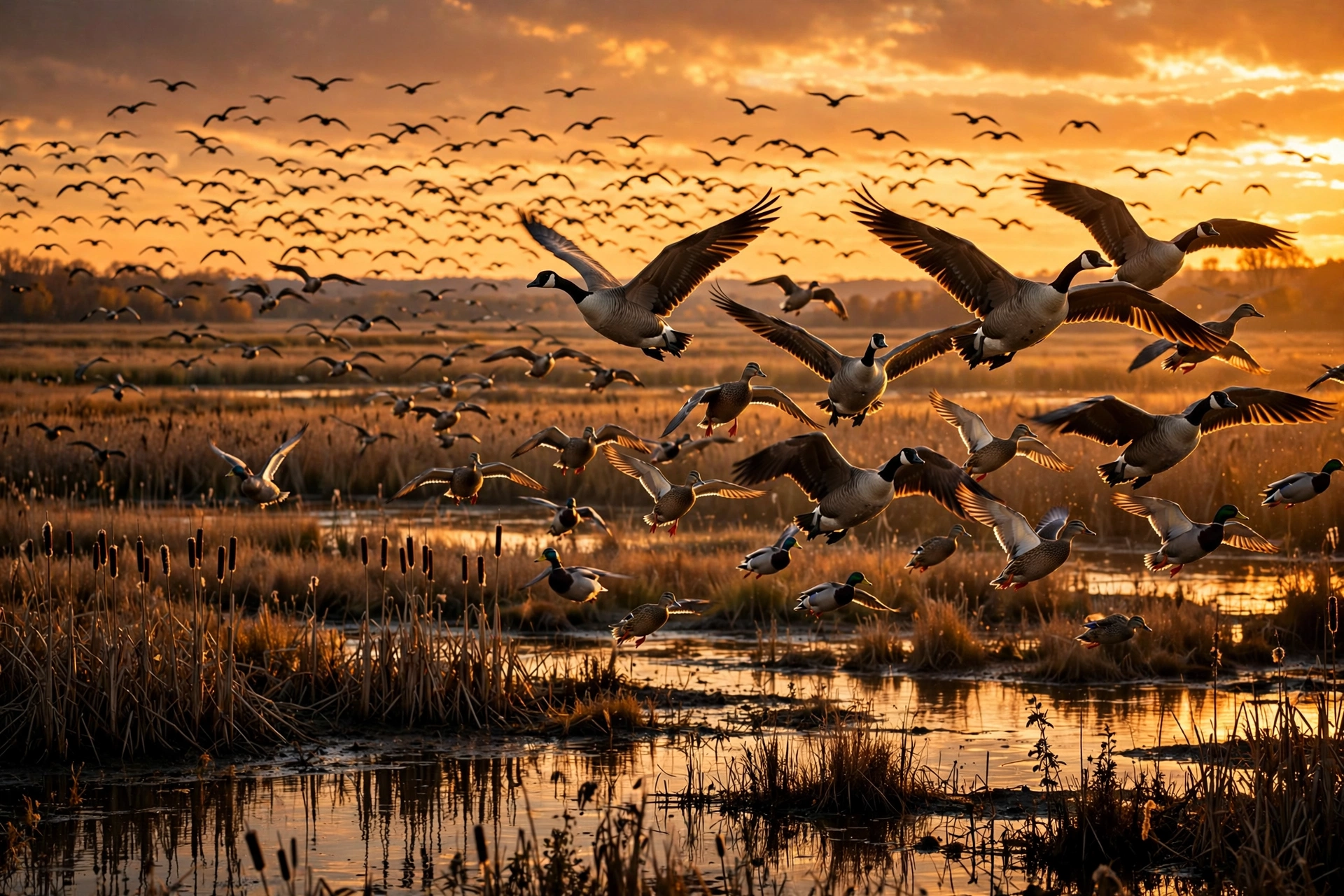
Ducks and geese migrate on a simpler rule: go where the water stays liquid. As northern lakes and marshes freeze, waterfowl lose both their food and their landing strips, so they head south along four broad aerial highways biologists call flyways: the Pacific, Central, Mississippi, and Atlantic.
Many dabbling ducks, like mallards and pintails, winter along the Gulf Coast and in southern wetlands, sometimes traveling 500 to 3,000 miles. Diving ducks, such as goldeneyes and mergansers, gather on large lakes and coastal waters that resist freezing. Canada geese fly in those famous V-formations, which let each bird ride the updraft of the bird ahead and save energy over long distances.
Not all waterfowl leave, though. Wherever fast-moving rivers, warm springs, or coastal waters stay ice-free, you will find ducks riding out the winter close to home. And in many suburbs, resident flocks of Canada geese have stopped migrating entirely, finding everything they need on golf courses and park lawns year-round.

Irruptive Finches: The Unpredictable Nomads
Then there are the wanderers. Irruptive finches, including pine siskins, evening grosbeaks, purple finches, common redpolls, and crossbills, spend the summer in Canada’s boreal forest eating conifer seeds. When those seed crops fail, which happens in irregular cycles, huge numbers pour south into the United States searching for food. When crops are good, they barely budge.
Nobody can predict exactly where they will show up, but every September the Finch Research Network publishes the Winter Finch Forecast, which assesses cone and seed crops across the boreal forest and predicts which species are likely to irrupt. In big years, several species flood south at once in what researchers call a superflight, and backyard feeders from New England to the Great Lakes suddenly fill with birds that were nowhere to be found the previous winter.
For birders, irruption years are pure excitement. If the forecast calls for a finch flight, keep your feeders stocked with black oil sunflower and nyjer seed. You might host an evening grosbeak, a bird many southern birders wait years to see.
The Stayers: How Resident Birds Survive Winter
Northern cardinals, black-capped chickadees, nuthatches, titmice, and woodpeckers spend the entire winter on their breeding territories. No tropical vacation, no thousand-mile commute. For a chickadee that weighs less than half an ounce, surviving a minus 20 degree Fahrenheit night seems impossible. Yet they do it, night after night, using a toolkit of remarkable adaptations.
Caching Food Like Tiny Hoarders
Chickadees are obsessive planners. Through fall, a single bird hides thousands of seeds one by one in bark crevices, needle clusters, and knotholes, then remembers the locations for up to 28 days. Nuthatches wedge seeds into bark furrows. Jays bury acorns by the hundreds. These hidden pantries let residents eat through storms and cold snaps when foraging is impossible.
Torpor: The Overnight Power-Save Mode
On bitter nights, black-capped chickadees drop their body temperature by as much as 12 degrees Celsius from the normal 42, entering a state of regulated torpor that slashes energy use. Hummingbirds use torpor every single night, even in summer, to survive until dawn without feeding. This controlled shutdown is rare among birds, and it is one reason chickadees can wake up lively after nights that would kill most animals their size.
Feathers, Shivering, and Huddling
A fluffed-up chickadee is a master of insulation. By puffing its feathers, it traps a thick layer of still air against its skin, and many species grow significantly denser plumage for winter. Shivering burns calories to generate heat, which is why a steady food supply matters so much. In the legs, a countercurrent heat exchange system keeps warmth in the body core instead of leaking it into icy feet. And many residents team up: robins pack into communal night roosts, while chickadees lead mixed-species foraging flocks of titmice, nuthatches, and kinglets that find food more efficiently together than any of them could alone.

Where Do Hummingbirds Go in Winter?
This question deserves its own answer because hummingbirds break the usual rules. Ruby-throated hummingbirds, the only species breeding in eastern North America, migrate entirely alone, all the way to southern Mexico and Central America. Many cross the Gulf of Mexico in that famous 500-mile nonstop flight, a journey of 18 to 22 hours that spans day and night over open water. Males leave first in late summer, females and juveniles follow, and they return north in March and April, timing their arrival to the first spring flowers.
Not all hummingbirds leave, though. Anna’s hummingbirds along the Pacific coast stay year-round where winters are mild and flowers, or well-kept feeders, keep blooming. And the rufous hummingbird makes one of the longest migrations relative to body size of any bird, traveling up to 3,900 miles each way between Alaska and Mexico. If you keep a feeder up into fall, you are fueling one of nature’s most extreme athletes, not delaying its departure. Healthy hummingbirds leave when their instincts say go, feeder or not.
Winter Destinations by Bird Group
Here is the whole picture in one glance:
| Bird group | Examples | Where they go | Typical one-way distance |
|---|---|---|---|
| Neotropical migrants | Warblers, orioles, tanagers, ruby-throated hummingbirds | Mexico, Central and South America, Caribbean | 1,500 to 3,000 miles |
| Short-distance and partial migrants | Robins, juncos, white-throated sparrows, bluebirds | Southern US, Mexico | 100 to 1,000 miles |
| Waterfowl | Ducks, geese | Gulf Coast, southern wetlands, ice-free water | 500 to 3,000 miles |
| Irruptive finches | Pine siskins, evening grosbeaks, redpolls, crossbills | Wherever seed crops are, varies yearly | Unpredictable |
| Residents | Cardinals, chickadees, nuthatches, woodpeckers | Stay on breeding territory | 0 miles |
How You Can Help Winter Birds
Whether your backyard hosts departing migrants fueling up or hardy residents settling in, fall is the best time to make your yard winter-ready. Keep feeders clean and consistently filled, since birds come to depend on reliable food sources once cold sets in. A heated birdbath offers something even more precious than seed: liquid water when everything else is frozen. Leave seed heads standing in the garden, pile brush in a quiet corner for shelter, and resist the urge to prune every berry bush.
Small actions add up to real survival odds. Studies have found that chickadees with access to feeders are far more likely to survive severe winters than those without. To go further, read our guides on how to help birds survive winter and what to feed birds in winter.

Frequently Asked Questions
Do all birds fly south for winter?
No, and the split surprises most people. Only a little over half of North America’s breeding species migrate at all. The rest either stay put like cardinals and chickadees, or move partway like robins and juncos, shifting only as far as food requires.
Where do hummingbirds go in winter?
Ruby-throated hummingbirds winter from southern Mexico through Central America, many after a 500-mile nonstop flight across the Gulf of Mexico. Anna’s hummingbirds on the Pacific coast typically stay year-round, and rufous hummingbirds travel between Alaska and Mexico.
Do birds freeze in winter?
They can die in extreme cold, but healthy birds are superbly equipped for it. Dense winter plumage, torpor, food caching, shivering, and communal roosting carry most residents through. The real killer is usually starvation during long storms, not the temperature itself, which is why reliable feeders matter.
When do birds come back in spring?
Most migrants return between March and May, triggered by lengthening days. Males often arrive first to claim territories. Short-distance migrants like robins and blackbirds are usually the earliest, sometimes appearing while snow is still on the ground.
Where do ducks go in winter?
Ducks follow open water south along the four North American flyways, with many wintering on the Gulf Coast and in southern wetlands. As long as water stays unfrozen and food is reachable, some ducks stay surprisingly far north.
Where do robins go in winter?
Robins are partial migrants that follow food, not temperature. Many winter in the southern United States and central Mexico in large berry-eating flocks, while others stay north wherever fruit remains plentiful through the season.
Conclusion
So where do birds go in winter? Everywhere from Antarctica to your own backyard. Arctic terns chase an endless summer between the poles, hummingbirds gamble everything on a single night over the Gulf, robins drift south in berry-hunting flocks, and chickadees simply refuse to leave, caching seeds by day and dropping into torpor by night.
The deeper pattern is elegant. Migration is not about escaping cold for its own sake. It is about food, daylight, and timing, solved differently by every species. Long-distance migrants trade enormous effort for tropical abundance. Short-distance movers make smaller bets closer to home. Residents invest everything in surviving where they are.
Knowing which strategy your backyard birds use changes how you see October. Those restless flocks overhead are not just leaving. They are executing travel plans millions of years in the making. And the chickadee still scolding from the feeder has its own plan, one that involves your sunflower seeds. Keep them coming.





