 Skip to content

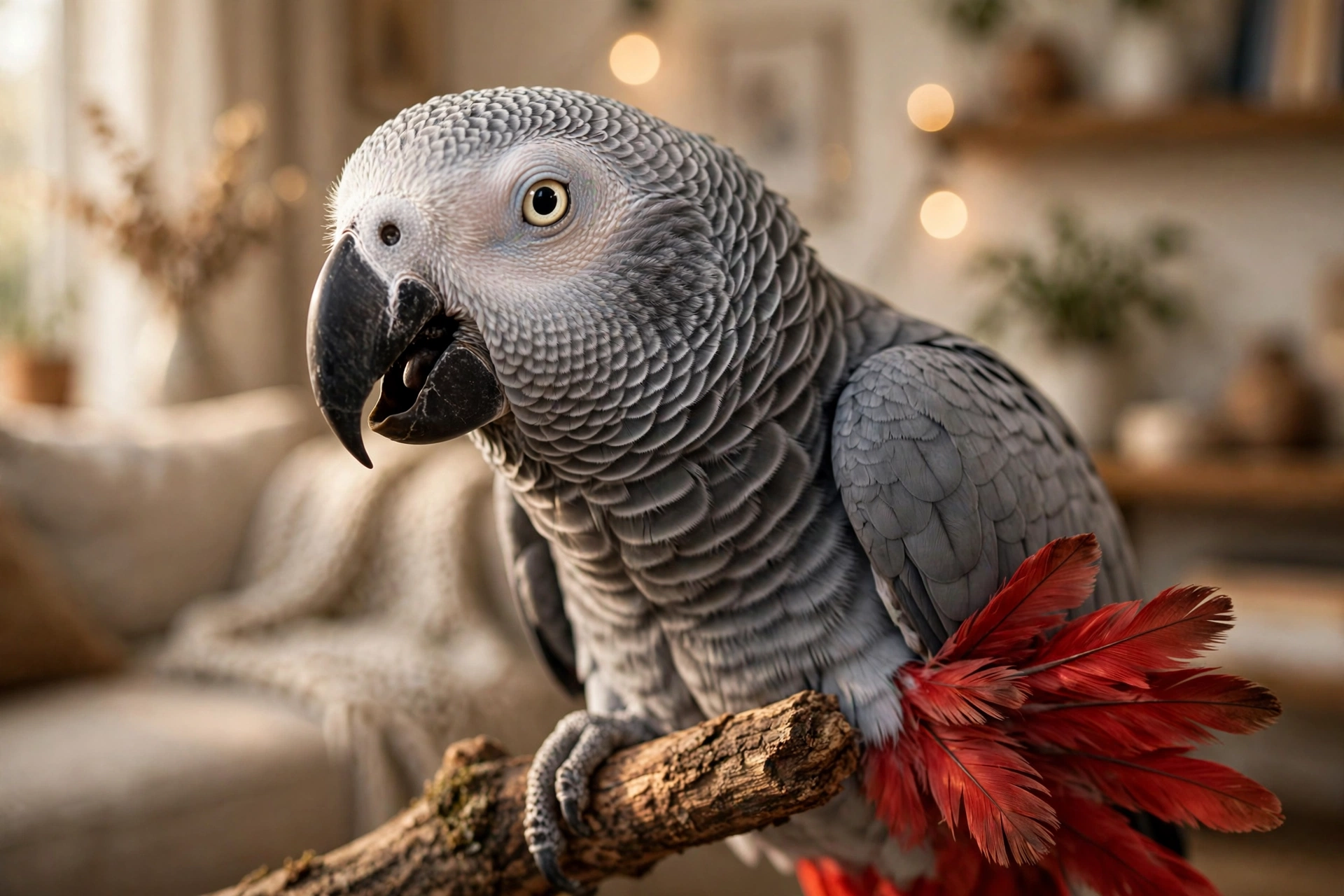
A parrot greeting you with a cheerful “hello” never stops feeling like a small miracle. Here is a feathered dinosaur descendant with a beak instead of lips, a voice box buried in its chest, and a brain the size of a walnut, casually speaking your language. It raises the obvious question: why can parrots talk when even chimpanzees, our close cousins with far bigger brains, cannot manage a single word?
The answer turns out to be one of the great stories in animal biology. Parrots do not talk because they are smart in the human sense. They talk because evolution handed them a rare combination: a voice box with almost absurd flexibility, a brain wired specifically to learn new sounds, and a social life that makes copying sounds a survival strategy.
This guide walks through the full science of parrot mimicry: how the syrinx works, what makes the parrot brain special, why they copy sounds in the first place, which species talk best, and what one extraordinary African grey named Alex taught researchers about what parrots actually understand.
The Syrinx: A Voice Box Built Differently
Humans speak with a larynx, a structure at the top of the windpipe fitted with vocal cords that vibrate as air passes over them. Parrots do not have vocal cords at all. Instead they use an organ called the syrinx, which sits deep in the chest where the windpipe splits into the two bronchi. Air from the lungs pushes through the syrinx, and thin flexible membranes inside it vibrate to make sound.
The syrinx is not just a substitute for vocal cords. In several ways it is a more flexible instrument. Its two sides can work independently, which means a bird can produce two different sounds at the same time, a trick musicians call polyphony. Parrots have exceptional motor control over the tiny muscles around the syrinx, tightening and loosening the membranes to change pitch, tone, and rhythm with great precision.
Raw sound is only half the story. Speech needs shaping, and that is where the rest of the parrot’s anatomy comes in. Parrots have a thick, highly muscular tongue that moves with remarkable dexterity, acting as a stand-in for the lips humans use to shape words. Add a beak controlled by flexible jaw joints, and the bird can open, close, and resize its mouth with fine control, sculpting airflow into recognizable vowels and consonants.
So why can a parrot pull off “Polly wants a cracker” while a crow, with a perfectly good syrinx of its own, sticks to caws? The hardware helps, but the real difference lives in the brain.
A Song-System-Within-a-Song-System: The Parrot Brain
Most birds vocalize using fixed, hardwired calls. They are born knowing their songs, the way a human is born knowing how to cry. Parrots belong to a rare group called vocal learners. They are not born knowing the sounds they will make. Instead they listen to the sounds around them, attempt copies, hear the results, and adjust, a learning loop that looks a lot like a human child picking up words.
Among birds, only three groups can do this: songbirds, hummingbirds, and parrots. Parrots, however, are in a class of their own as mimics. To find out why, researchers led by Duke University neurobiologist Erich Jarvis examined the brains of eight parrot species, from budgerigars to African greys to macaws, using gene-expression mapping. What they found was published in the journal PLOS ONE in 2015, and it finally cracked a long-standing mystery.
The parrot brain contains a song system inside a song system. There is a “core” vocal-learning circuit similar to the ones found in songbirds and hummingbirds, and around it an additional “shell,” an outer ring of brain tissue with its own distinct gene activity. The shell is proportionally largest in the species famous for talking, including African greys, Amazon parrots, and the blue-and-gold macaw.
Researchers believe this supercharged speech center evolved for a very parrot reason. Parrots are deeply social birds that learn the contact calls of their flock, and different flocks speak in different “dialects.” A brain that can rapidly pick up and switch dialects would be a real social advantage. The shell, in other words, may exist for copying flockmates, and human speech is simply the most flattering target that ever walked into their living room.
A newer study added another layer. In 2025, researchers reported that the budgerigar brain holds a neat map of vocal sounds, with different groups of neurons handling different sounds the way keys on a keyboard represent different notes. Human brains have similar vocal maps, which means the neural machinery for learned vocalizations sits closer between parrots and humans than between parrots and songbirds.
Why They Bother: Mimicry Is Social Glue
In the wild, a parrot’s mimicry is not a party trick. It is a social passport. Parrots live in noisy, fluid flocks where recognizing who belongs matters. Members of a flock share contact calls, and young parrots learn these calls the way children learn the accent of their neighborhood. Flocks even develop local dialects, and a parrot that can pick up the local sound fits in.
This explains the pet parrot’s obsession with human speech perfectly. A hand-raised parrot does not consider itself a bird living in a human house. It considers itself a member of a strange, featherless flock: you and your family. When your parrot says “hello,” it is doing exactly what evolution designed it to do. It is speaking flock.
The motivation also explains why parrots copy things that are not speech at all: doorbells, microwave beeps, ringing phones, dogs barking, even the sound of a dripping tap. Anything that is loud, repeated, and gets a reaction is worth learning. The famous Australian superb lyrebird, though not a parrot, takes this to the extreme, copying chainsaws and camera shutters with disturbing accuracy.

Alex the African Grey: Proof That Parrots Understand More Than Words
No discussion of parrot speech is complete without Alex, the African grey who changed what science believed about bird minds. In 1977, psychologist Irene Pepperberg, then a doctoral student at Harvard, bought a one-year-old African grey from a pet store, choosing him at random to keep the experiment honest. She named him Alex, short for Avian Learning EXperiment, and spent the next thirty years showing the world what he could do.
Alex did not just repeat words. He used them. Over his lifetime he learned more than 100 labels and could identify 50 different objects by name. He could distinguish seven colors and five shapes, count quantities up to six, and grasp concepts like bigger, smaller, same, and different. He even developed something like a concept of zero. When shown an apple, a fruit he had never been taught to name, he spontaneously called it a “banerry,” which Pepperberg’s linguist friends heard as a blend of “banana” and “cherry,” the two fruits he knew best.
One famous moment captured his depth. Looking in a mirror, Alex asked, “What color?” After being told “grey” six times, he learned the word, making him the first non-human animal ever documented asking a question. He also practiced words alone in his cage at night, the way a student reviews vocabulary.
Pepperberg trained Alex with a technique called the model/rival method, in which two humans demonstrated interactions over an object while Alex watched, learning through social context rather than rote repetition. She assessed his emotional development as comparable to a two-year-old child and his intellect to a five-year-old. Alex died in 2007 at age 31, but the research continues with other African greys, and it permanently retired the idea that parrots are mere tape recorders.
Which Parrots Talk Best? The Species Ranking
Not every parrot is an equal talker. Decades of owner reports and research point to a clear hierarchy, and it lines up neatly with the brain science: the species with the largest song-system shells tend to be the stars. Here is how the best-known talkers compare.
| Species | Talking talent | Clarity of speech | Notes |
|---|---|---|---|
| African grey parrot | Exceptional | Very clear, almost human-like | The gold standard. Largest vocabulary, strongest evidence of understanding words, star of the Alex research. |
| Amazon parrots (yellow-naped, blue-fronted, yellow-crowned) | Excellent | Clear, often with a comical tone | Natural-born performers. Yellow-naped Amazons are famous for large vocabularies and singing. |
| Eclectus parrot | Very good | Clear and precise | Often underestimated. Males and females both learn readily and speak distinctly. |
| Macaws (blue-and-gold, scarlet, green-winged) | Good | Raspy but understandable | Big voices, big personalities. Better at volume and drama than fine pronunciation. |
| Budgerigar (budgie) | Surprisingly good | High-pitched, can be hard to catch | Tiny body, huge talent. Individual budgies have learned hundreds of words, far more than most owners expect. |
| Cockatiel | Moderate | Whistly and unclear | Much better at whistling tunes than speaking words. Charming, but not a true talker. |
| Cockatoos | Moderate | Loud, less precise | More famous for dancing and screaming than conversation. Some individuals learn a handful of words. |
Two caveats matter here. First, individual variation is enormous: a motivated budgie in a chatty household can out-talk a bored African grey. Second, talking ability says nothing about which bird makes a good pet. African greys and Amazons are demanding, long-lived, emotionally complex animals that need hours of daily interaction. Never choose a parrot for its vocabulary alone.

Do Parrots Understand What They Are Saying?
This is the question everyone really wants answered, and the honest answer is: partly, and it depends on the bird. Most pet parrots understand words the way a dog understands “walk.” They grasp the consequence of a sound, not its dictionary definition. A parrot that says “hello” when you walk in has learned that this sound predicts your arrival and your attention. That is functional understanding, built on association and reward, and it is genuinely impressive.
A smaller number of parrots go further, and Alex is the proof. He could answer questions about objects he had never seen combined in that way before, combine labels to request and refuse specific items, and use “I want” and “wanna go” phrases with the correct objects and locations. That is not rote mimicry. It is flexible, meaningful use of learned symbols, closer to how a young child uses words.
What parrots do not do is grammar. No parrot has been shown to use syntax the way humans do, building novel sentences from rules. They also do not hold conversations about abstract ideas or the past and future. Their understanding lives in the present: this word gets that result, this label names that thing. For a walnut-sized brain, that is plenty.
There is one more behavior worth knowing. Parrots often rehearse new sounds quietly when they think no one is listening. Owners call it “babbling,” and researchers see it as the parrot equivalent of a child practicing in an empty room. If you hear your bird whispering to itself, it is studying.
How Parrots Learn New Words (and How You Can Help)
Parrot vocal learning follows the same broad pattern as human language learning: listen, attempt, compare, refine. The juvenile period is the prime window, when the brain is most plastic, but adults keep learning throughout life if the social motivation is there. Repetition and social feedback are the two great accelerators.
If you want to teach your parrot to talk, the research points to a few principles that work far better than leaving a radio on:
- Teach in context: Say the word when the thing happens. Say “good morning” at the cage cover, “shower” at bath time. Context is how words gain meaning.
- Keep sessions short and fun: A few minutes of enthusiastic one-on-one beats an hour of background chatter. Parrots learn from social partners, not speakers.
- Start simple: Short, clear words with hard consonants, like the bird’s name or “hello,” are easiest. Build from there.
- Reward attempts, not perfection: Any approximation of the word deserves excitement and a treat. The parrot will refine it on its own.
- Be the flock: Talk to your parrot the way you would talk to a toddler, often and with feeling. Exaggerated, cheerful speech is the most copyable kind.
One warning from behaviorists: a parrot that talks constantly, repeating the same phrases in a flat loop, may not be showing off. Constant, context-free vocalizing can be a sign of boredom or stress in an understimulated bird. Watch the whole bird, not just its vocabulary. A happy talker varies its sounds, uses words in the right moments, and spends plenty of time on non-vocal play too.
Why Most Birds (and Apes) Cannot Do This
Put the parrot next to the rest of the animal kingdom and its talent looks even stranger. Crows and ravens are brilliant problem solvers, arguably the smartest birds alive, yet they cannot mimic speech. They have a fine syrinx but lack the parrot’s specialized vocal-learning brain circuits. Intelligence and vocal learning are separate talents, and evolution handed them out to different birds.
Songbirds sit in the middle. They are vocal learners with real brain song systems, but they have only the “core” circuit, not the parrot’s extra shell, and most learn just one or a few songs in youth. A nightingale’s song is beautiful and complex, but it is still its own species’ song, not your voice.
Then there are the great apes, and here the story flips. Chimpanzees and gorillas have throats physically capable of making many speech sounds, and brains far larger than any parrot’s. But they lack dedicated vocal-learning circuits, and they carry a slightly different version of the FOXP2 gene, a gene involved in the fine motor control of speech. Humans have two small changes in that gene that apes do not. The result is one of biology’s best ironies: the parrot talks and the ape cannot, because talking is about wiring, not brain size.
Only a handful of mammals made the vocal-learner list at all: humans, some whales and dolphins, elephants, seals, and bats. Every one of them, like the parrot, is a highly social species. The pattern is consistent across the tree of life. Vocal learning evolves where social life makes copying sounds useful.

Frequently Asked Questions
Do parrots understand what they say, or are they just copying?
Mostly they understand the function of words rather than their definitions. A parrot learns that saying “hello” brings you over, which is real but limited understanding. Exceptional birds like Alex the African grey went much further, using words flexibly to identify, request, refuse, and categorize objects, showing genuine comprehension of what the labels meant.
Which parrot species talks the best?
The African grey parrot is widely considered the best talker, with the clearest speech and largest vocabularies. Amazon parrots, especially yellow-naped and blue-fronted Amazons, are close behind and often more entertaining. Budgerigars are the surprise stars of the small parrots, capable of learning hundreds of words despite their size.
At what age do parrots start talking?
Most parrots begin attempting words between 6 and 12 months of age, though this varies a lot by species. African greys often start around their first birthday, while budgies can start babbling within a few months. The juvenile period is the easiest learning window, but healthy adult parrots can learn new words throughout their lives with patient, social training.
Can you teach any parrot to talk?
No. Species matters, and so does the individual. Within the talented species, some birds become chatterboxes and some never say a word, and that is normal. Forcing training on a bird with no interest only creates stress, so let the parrot set the pace.
Why does my parrot copy the microwave and the dog but not me?
Parrots copy sounds that are loud, frequent, and get a reaction. A microwave beep happens the same way every time and often makes everyone in the room move, which is fascinating to a parrot. Your speech is variable and constant, so it is harder to lock onto. Short, enthusiastic, repeated phrases said in the same context work best.
Do wild parrots mimic other species?
Wild parrots mainly copy each other. Flock members share contact calls, and different flocks develop distinct dialects that young birds must learn. Some wild parrots have been recorded copying other bird species and even environmental sounds, but elaborate mimicry of human speech is a captivity phenomenon, because in captivity humans are the flock.
Is it true parrots have no vocal cords?
Yes. Parrots and all other birds lack vocal cords entirely. They produce sound with the syrinx, an organ at the base of the windpipe deep in the chest. The syrinx’s vibrating membranes, combined with precise muscle control and shaping by the tongue and beak, give parrots their remarkable vocal range.
How many words can a parrot learn?
It varies enormously. A typical talkative pet parrot learns a few dozen words and phrases. Exceptional African greys have learned well over 100 labels used with understanding, and record-holding budgerigars have been documented with vocabularies in the hundreds. Quality matters more than quantity: a parrot that uses ten words in the right context understands more than one that repeats fifty at random.
The Takeaway
Parrots talk because they are built to copy and born to belong. The syrinx gives them the instrument, the shell-wrapped song system gives them the learning machinery, and flock life gives them the reason. Humans simply became the flock, and our words became the dialect to master.
The deeper lesson is the one Alex taught. A parrot saying “hello” is not a trick and not quite a conversation. It is a social animal reaching across the species gap with the best tool evolution gave it, learning the calls of its flock so it will never be alone. When your parrot talks to you, it is telling you, in the only words it has, that you are family.
Related reading on BirdsBuzz: How Smart Are Crows? 9 Proofs of Their Intelligence, Crow vs Raven: How to Tell Them Apart, and A Realistic Guide to Teach a Parakeet to Talk.




