 Skip to content

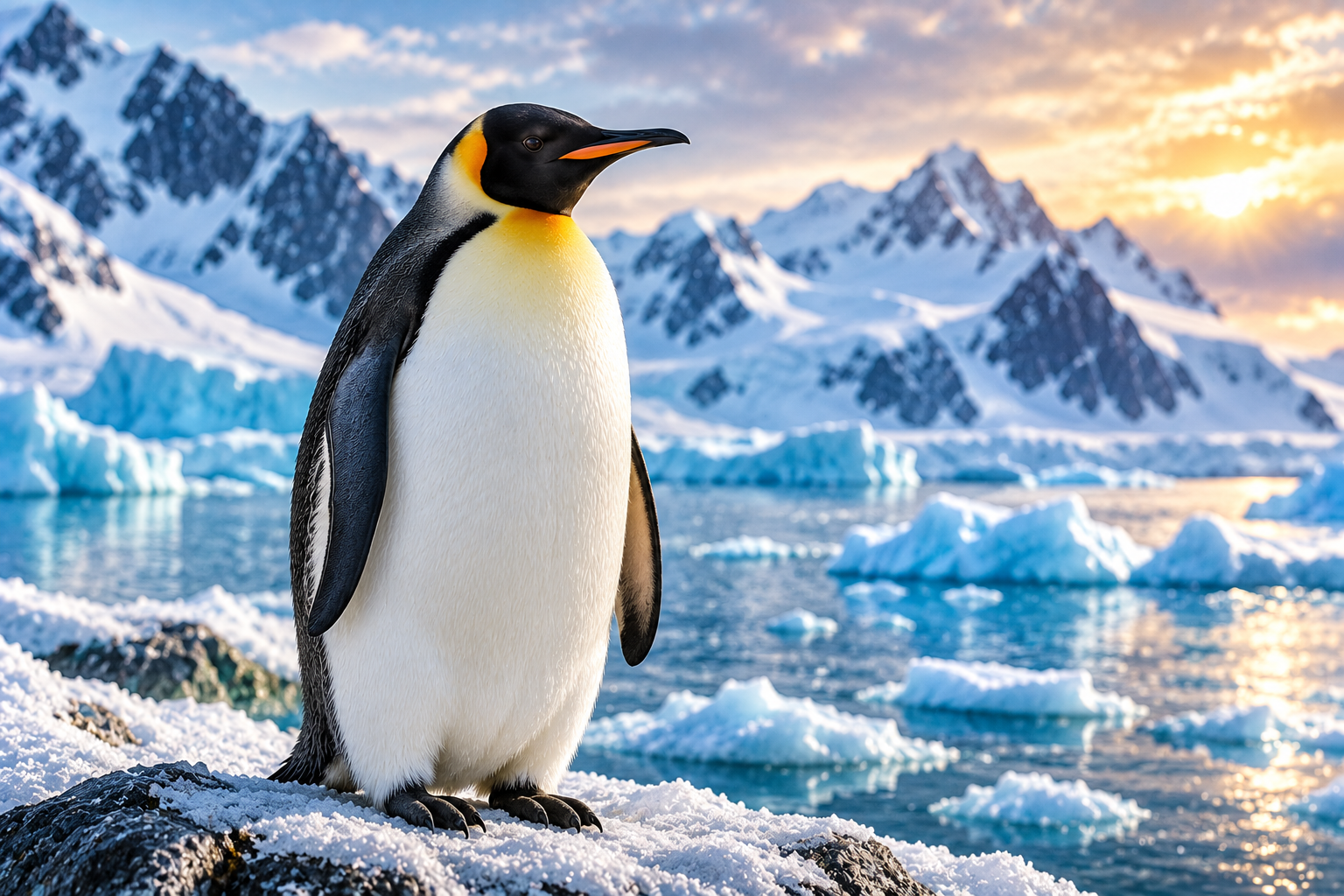
Penguins gave up the sky, and that turned out to be the best trade any seabird ever made. Every feature that makes a penguin look comical on land the upright waddle, the stubby wings, the barrel chest is a swimming machine that got optimized so hard it stopped working in air.
This guide covers what a penguin actually is, what it looks like, where it lives, what it hunts, how it swims, how it raises chicks, and which species you’re most likely to encounter at an aquarium, in a documentary, or on a boat headed south.
First, the question that comes up constantly: are penguins birds? Yes. Feathers, beaks, eggs, warm blood penguins tick every box on the list. Flight was never part of the definition. Ostriches don’t fly either, and nobody demotes them.
Here’s the part worth holding onto: penguins sit at the hinge between ocean and coastline, which makes them one of the clearest readouts we have on the health of southern seas.
How to Identify a Penguin You Have Spotted
By the end of this sequence you’ll be able to take a penguin you’ve spotted — in a photo, at a zoo, on a beach in South Africa — and place it into a species group, a habitat, and a feeding niche. You need nothing but a clear view of the bird’s head and chest, or a decent image of it.
- Check the location first. Note the hemisphere and coastline. Location eliminates more species than any physical feature does.
- Estimate the bird’s height against a nearby reference — a rock, a railing, a person’s knee. You should land in one of three rough bands: small, mid-sized, or tall.
- Look at the head markings. Find the color and shape of any stripe, patch, or band. This is the single most reliable identification feature.
- Check for crest feathers above the eyes. Yellow or orange plumes narrow the field immediately.
- Examine the bill for color patches near the base and for length relative to the head.
- Note the chest pattern — one band, two bands, a clean white front, or speckling.
- Watch how it moves on land. Walking, hopping, and belly-sliding split the groups further.
- Confirm your call by matching all five features at once, not just the most obvious one.
What Is a Penguin Bird?

A penguin is a flightless seabird built for pursuit swimming. The lineage split from flying seabirds a very long time ago, and everything since has pushed in one direction: wings shortened, flattened, and stiffened into flippers that can’t fold the way a flying bird’s wing folds. The bones inside got dense and solid rather than hollow, which kills any hope of lift but kills buoyancy too — useful when your food lives underwater.
The body followed the same logic. Penguins are torpedo-shaped, with the head, neck, and body blending into a single smooth line and the feet trailing at the back like rudders. On land that geometry forces an upright stance, because the legs are set far to the rear. It looks awkward. Underwater it looks like nothing else in the bird world.
Classification isn’t in doubt. Penguins lay eggs with hard shells, incubate them, have keratin beaks, and grow true feathers — three overlapping layers of them. They’re warm-blooded and they molt. Flightlessness is a strategy, not a disqualification. A penguin is as much a bird as a pigeon; it just spends its life in the wrong fluid.
What Do Penguins Look Like?
Start with the silhouette. A standing penguin is a vertical oval on short legs, chest forward, flippers held slightly out from the body for balance. There’s no visible neck in the resting posture — the head tucks down into the shoulders, which conserves heat. The tail is short and stiff, and many species use it as a prop, sitting back on it like a tripod.
The feather coat is the most misunderstood part of the animal. Penguin feathers aren’t the loose, airy plumes of a flying bird. They’re short, stiff, overlapping, and packed tight across the whole body, more like roof shingles than fluff. Underneath sits a layer of down that traps air against the skin.
The color scheme is near-universal: dark back, white belly. Species differences ride on top of that base — a yellow ear patch, a black chinstrap, a white eye ring, an orange bill stripe, a crest of loose feathers over the eyes.
Beaks vary with diet. Fish-eaters carry longer, hooked bills; krill specialists have shorter, broader ones. The feet are webbed, set well back, and usually pink, black, or dusky orange.
Size spans a wide range. The emperor penguin sits at the large end of the family, tall enough to reach an adult’s waist, while the little penguin of Australia and New Zealand occupies the opposite extreme — small enough to hold in two hands.
Where Do Penguins Live?
Ask most people where do penguins live and you’ll hear “Antarctica” and then nothing. Antarctica is correct for a handful of species and wrong for most of the family.
Penguins are Southern Hemisphere birds, and the range runs far wider than the ice. Colonies sit along the coasts of Antarctica and the sub-Antarctic islands, across southern New Zealand and Australia, up the Atlantic and Pacific coasts of South America, along the southern tip of Africa, and out to the Galápagos Islands, which straddle the equator. No wild penguin lives in the Arctic. None. Penguins and polar bears never meet outside of soft drink advertising.
Habitat type varies as much as latitude. Emperor penguins breed on sea ice with no nest at all. Gentoos and chinstraps use rocky, snow-free shorelines. African penguins nest in burrows dug into guano or sand, sheltering from heat rather than cold. Galápagos penguins live among volcanic rock and shade themselves from tropical sun.
The one constant is cold, productive water. Penguins follow nutrient-rich currents, not snow.
What Do Penguins Eat?
So what do penguins eat? Meat, exclusively, and all of it comes from the sea. Penguins are carnivorous marine predators with no plant matter in the diet at all.
The menu covers three broad categories: small schooling fish such as anchovies, sardines, and lanternfish; cephalopods, mainly squid; and crustaceans, above all krill. Which of the three dominates depends on the species and the water it hunts in. Adélie and chinstrap penguins lean heavily on krill. Emperor and king penguins take more fish and squid, hunting deeper and colder. African penguins chase sardine and anchovy shoals along the coast.
Penguins have no teeth. Instead, backward-pointing spines line the tongue and roof of the mouth, gripping slippery prey and steering it down the throat. Everything is swallowed whole, underwater, head-first.
Diet also shifts with the season and with what’s available. When a preferred fish stock collapses or moves, a colony either switches prey, travels farther, or breeds badly — which is precisely why penguin feeding data doubles as a fisheries report.
How Do Penguins Swim and Hunt?
Penguins fly underwater. That’s not a metaphor — the flipper stroke generates thrust on both the downbeat and the upbeat, exactly like a flying bird’s wing, and the shoulder joint is built to handle the load. The feet and tail steer; the flippers do the work.
The result is speed with very little effort. Water flows over the smooth feather surface with minimal drag, and solid bones keep the bird from bobbing to the surface every time it stops kicking. Many species porpoise while traveling — leaping clear of the water in a repeating arc to breathe without slowing down.
Hunting happens on breath-hold dives. A penguin slows its heart rate, drops into the dark, and finds prey by sight, which is why good light and clear water matter. Some species feed near the surface in short repeated dives. Others go deep and stay down far longer, targeting fish and squid well below the sunlit zone.
Underwater, the turning radius is tight enough to track a single fish through a scattering school.
Penguin Adaptations That Help Them Survive
Insulation comes in layers. Closest to the skin is a thick pad of fat that blocks heat loss and doubles as a fuel reserve during fasts. Above it sits dense down, then the overlapping outer feathers, which lock a cushion of warm air in place. Penguins waterproof the whole assembly with oil from a gland near the tail, worked through the plumage during long preening sessions. A penguin that stops preening gets wet to the skin and dies of cold.
The black-and-white coloring is countershading, and it’s camouflage, not decor. Seen from above against dark water, the black back disappears. Seen from below against bright sky, the white belly disappears. It hides the bird from leopard seals looking up and from fish looking down at the same time.
Heat management runs deeper than the coat. Blood vessels in the flippers and legs run alongside each other in counter-current bundles, so outgoing warm blood pre-heats incoming cold blood before it reaches the core. Warm-climate species dump heat instead, using bare facial patches and oversized flippers as radiators. Salt glands above the eyes strip salt from seawater, letting penguins drink the ocean.
Types of Penguins: Major Species to Know
The family splits into several genera, and the types of penguins you’ll actually encounter in media, aquariums, or travel cluster around a handful of names.
- Emperor penguin. The giant of the group and the only bird that breeds through the Antarctic winter. Males incubate a single egg on top of their feet under a fold of belly skin, fasting in the dark while females feed at sea.
- King penguin. Similar build, smaller, with vivid orange ear patches and a long slim bill. Breeds on sub-Antarctic islands in enormous, noisy colonies. Chicks wear thick brown down for so long that early explorers described them as a separate species.
- Adélie penguin. The classic cartoon penguin — clean black head, white eye ring, no fuss. Breeds on Antarctic rock in the brief summer and depends heavily on krill.
- Gentoo penguin. Recognizable by the white bonnet stripe across the top of the head and a bright orange bill. Fast, adaptable, and doing better than most relatives.
- Chinstrap penguin. Named for the thin black line under the chin. Aggressive, loud, and comfortable on steep, ice-free rock.
- African penguin. The burrow-nesting species of southern Africa, with a pink gland above the eye and a black chest band. Braying call, which earned it the old nickname “jackass penguin.”
- Little penguin. The smallest member of the family, blue-gray rather than black, nesting in burrows around Australia and New Zealand and coming ashore after dark.
Beyond these, the crested group — rockhopper, macaroni, fiordland, erect-crested, snares — carries yellow head plumes, while Humboldt, Magellanic, and Galápagos penguins occupy the warmer American coastlines. Every penguin species in the world lives south of the equator, with the Galápagos population barely sneaking across it.
Penguin Behavior and Social Life
Penguins are colonial to an extreme degree. Breeding sites hold thousands of pairs packed at arm’s length, each defending a patch of ground barely wider than the bird itself. Fights over nest space and stolen pebbles are constant and mostly theatrical.
Communication carries the whole system. Each bird’s call is individually distinct, which is how a parent returning from a week at sea finds its own chick in a crowd of identical gray fluff. Calls also announce territory, advertise for mates, and warn of predators. Add visual signals — flipper flapping, head swinging, bowing — and the colony runs on a full display vocabulary.
Land movement is where penguins earn their reputation. The rolling waddle is actually efficient for the body plan, storing and returning energy with each sway. On snow, many species drop onto the belly and toboggan, pushing with feet and flippers.
Emperor penguins take social behavior furthest. During winter storms they form dense huddles, rotating slowly so every bird cycles from the frozen outer edge to the warm core and back.
Penguin Mating, Eggs, and Chicks
Most penguin species are seasonally monogamous and show strong site fidelity — birds return to the same colony, often the same nest scrape, and frequently the same partner. Courtship runs through display: the ecstatic call with head thrown back and flippers spread, mutual bowing, and in pebble-nesting species, the ritual gift of a well-chosen stone.
Nesting styles vary widely. Rock species build pebble rings. African and little penguins dig burrows or use crevices. Emperors build nothing at all, balancing the egg on their feet beneath a brood pouch.
Clutch size is usually one or two eggs. Incubation is shared in most species, with partners trading shifts while the other feeds at sea — except in emperors, where the male does the entire winter shift alone.
Chicks hatch blind, helpless, and covered in down. Parents feed them regurgitated fish and krill. Once thermally independent, chicks gather in crèches — nursery groups that pool warmth and reduce predation. Fledging arrives with the first waterproof adult plumage, and the young bird leaves for the sea untrained.
Penguin Conservation and Threats
Wild penguins face pressure from every direction. Leopard seals, orcas, and sea lions hunt adults in the water; skuas, gulls, and introduced cats, rats, and dogs take eggs and chicks on land.
Warming oceans shift prey away from established colonies, and shrinking sea ice removes emperor and Adélie breeding platforms outright. Commercial fishing competes directly for the same sardines, anchovies, and krill. Oil spills destroy waterproofing, and plastic and bycatch kill quietly.
Several species now sit on lists of endangered birds and animals, with African, Galápagos, and yellow-eyed penguins among the most pressured.
Conservation work centers on marine protected areas, fishing limits near colonies, predator removal on breeding islands, artificial nest boxes, and oiled-bird rehabilitation. Watch the penguin numbers and you’re watching the ocean underneath them.
Penguin vs Puffin: What Is the Difference?
They look similar in silhouette and share nothing but a color scheme. Puffins belong to the auk family, an entirely separate branch of birds.
- Flight: Puffins fly, and fly fast. Penguins cannot.
- Range: Puffins are Northern Hemisphere birds of the North Atlantic and Pacific. Penguins are exclusively southern.
- Bill: Puffins carry a deep, brightly colored triangular bill in breeding season. Penguin bills are narrower and duller.
- Size: Puffins are small, comparable to a pigeon. Penguins range far larger.
- Wings: Puffin wings still work in air; penguin flippers are rigid paddles.
10 Interesting Penguin Facts
The best facts about penguins are the ones that sound made up:
- They drink seawater and excrete the salt through glands above the eyes.
- They have no teeth — backward spines in the mouth grip prey instead.
- Solid, heavy bones help them sink rather than float.
- They molt every feather at once and can’t swim until it regrows.
- Male emperors incubate eggs on their feet through the polar winter.
- Each bird has a unique voiceprint.
- Some species toboggan on their bellies across snow.
- Countershading hides them from above and below simultaneously.
- Pebbles function as courtship gifts.
- One species lives on the equator.
Frequently Asked Questions About Penguin Birds
Are penguins fish? No. They’re birds with feathers, beaks, and hard-shelled eggs that happen to hunt underwater.
Do penguins live at the North Pole? Never. All wild populations are in the Southern Hemisphere, so penguins and polar bears share no territory.
Can penguins breathe underwater? No. Every dive is a breath-hold, and the bird must surface to refill.
Do penguins have knees? Yes. The upper leg is hidden inside the body outline, which is why the walk looks so stiff.
What eats penguins? Leopard seals, orcas, sea lions, and sharks at sea; skuas, gulls, and introduced mammals on land.
Are penguins warm-blooded? Yes, and they maintain a high body temperature even in polar conditions.
Do penguins mate for life? Many re-pair with the same partner across seasons, though it isn’t guaranteed. These penguin facts hold across most of the family.
Conclusion
Penguins are remarkable birds with unique adaptations that help them survive some of the world’s most challenging environments. From their streamlined bodies and powerful flippers to their specialized feathers and insulating body fat, every feature supports life in and around cold waters.
Different penguin species have adapted to varied habitats, diets, and climate conditions, showing the incredible diversity of these flightless birds. Their diet mainly includes fish, krill, squid, and other marine prey, while their excellent swimming abilities make them highly effective hunters.
Understanding penguin bird facts, habitat, diet, species, and adaptations provides a closer look at how these animals thrive. Protecting their marine ecosystems remains essential for supporting healthy penguin populations and preserving these fascinating birds for future generations.





