 Skip to content

Most people meet the wild turkey as a cartoon a plump, dim-witted bird that wanders into traffic and gets outsmarted by a fox. That picture is wrong, and it costs the bird respect it has earned.
The wild turkey is one of North America’s most alert, fast-moving, sharp-eyed ground birds, a forest animal that survives by seeing trouble long before trouble sees it. Confusing it with the heavy white bird bred for the dinner table is the single biggest reason it gets underestimated.
This guide walks through the real animal: where it lives and why forest edges matter so much, what it eats through the changing seasons, how its body is built for scratching and sprinting, how flocks organize themselves, how courtship and nesting work, and which adaptations keep it alive among a long list of predators. Along the way, the turkey bird’s stranger features the snood, the wattle, the spurs start to make practical sense.
How to Spot a Wild Turkey in the Field
By the end of this sequence you will have located a wild turkey in the field, identified it as male or female, and left without disturbing the flock. You need nothing but binoculars, quiet footwear, and legal access to the land.
- Choose a spot where mature woods meet a field, pasture, logging road, or power line cut. Turkeys use that seam more than either habitat alone.
- Arrive in the dark, at least half an hour before first light, and settle with your back against a tree trunk to break up your outline.
- Listen for the roost. Wing beats, soft yelps, or a gobble overhead tell you birds are still in the trees above you.
- Scan the ground line, not the treetops. You are looking for a dark, upright silhouette moving slowly — turkeys walk far more than they fly.
- Check the dirt for three-toed tracks and shallow scratched-out patches in the leaf litter. Fresh scratchings mean birds fed here recently.
- Identify the sex using the head: bare, colorful skin and a chest beard mean a male; a dull, feathered gray head means a female.
- Watch for a strut — fanned tail, dragged wingtips, puffed body.
- Count the flock and note whether it holds hens, poults, or bachelor males.
- Retreat slowly the way you came, without feeding the birds.
What Is a Wild Turkey Bird?

A wild turkey is a large, ground-feeding game bird native to North America, built for walking, scratching, and roosting in trees. It belongs to the same broad group as grouse, pheasants.
And quail heavy-bodied birds with strong legs, short rounded wings, and a preference for keeping their feet on the ground. Whether you search for it as a bird turkey or a wild turkey, you are looking at the same native species.
The domesticated turkey descends from wild stock, but centuries of breeding for meat produced a very different animal: heavier in the breast, slower, mostly white-feathered, and largely incapable of sustained flight. The wild bird stayed lean, dark, and fast. It can outrun a person on the flat and disappear into timber in seconds.
Native status matters here. Wild turkeys evolved in North American forests and woodland openings, alongside the oaks, beeches, and grasses they feed on and the predators that hunt them. They were not introduced. Populations in South America, Europe, and elsewhere trace back to domesticated descendants carried abroad, not to wild birds establishing themselves.
Are Wild Turkeys Really Birds?
Yes — and every diagnostic trait is right there in plain view. Turkeys have feathers, a horny beak, hollow-boned wings, and scaled legs, and hens lay hard-shelled eggs in a nest and incubate them with body heat. Nothing about the bird is ambiguous.
The confusion comes from flight, or the assumption of it. People see a bird that spends its day walking and conclude it cannot leave the ground. It can. A wild turkey launches almost vertically when startled, clears the canopy, and flies to a roost limb every evening of its life. What it does not do is migrate or soar. Its wings are short and broad, tuned for explosive escapes and short hops between cover, not for distance. Ground-dwelling is a lifestyle, not a limitation.
What Does a Wild Turkey Look Like?
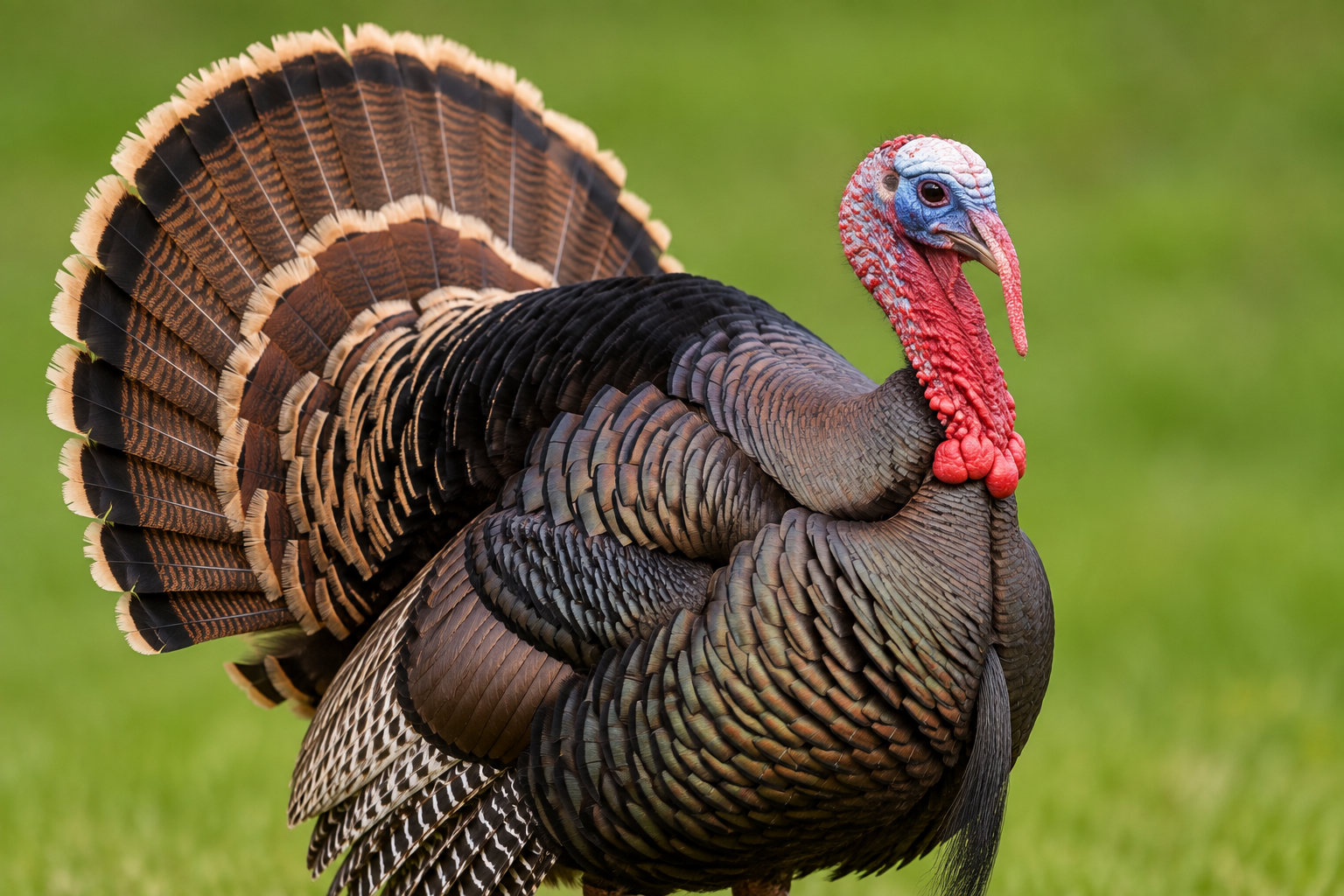
The overall impression is dark, tall, and lean. A wild turkey stands on long, sturdy legs with a deep chest, a small head on a long neck, and a broad fan-shaped tail it carries closed most of the time. The body sits horizontally when the bird feeds and rises almost upright when it goes on alert — that posture change is usually the first thing an observer notices.
Up close, the feathers are the best part. What reads as plain brown or black at a distance turns out to be iridescent: bronze, copper, green, and deep violet shifting with the angle of the light. Each body feather has a dark band at the tip, giving the plumage a scaled appearance. Tail and wing feathers are barred in buff, brown, and black, and the flight feathers show bold white bars across the folded wing.
The head is bare skin, and it changes color with mood and season — red, white, and blue-gray can all appear on the same bird within minutes. Several structures sit on or near it:
- Snood: a fleshy flap over the beak that lengthens and hangs when a male displays.
- Wattle: loose skin at the throat, often bright red.
- Caruncles: bumpy growths on the neck.
- Beard: a bristly tuft of modified feathers on the chest.
- Spurs: sharp bony points on the back of the legs, used in fighting.
Male vs Female Wild Turkey
Males, called toms or gobblers, are the larger sex by a clear margin — taller, heavier, and bulkier through the chest. Their plumage carries the strongest iridescence, their bare heads flush with color, and they grow both a chest beard and leg spurs. In full display a tom looks almost spherical: tail fanned into a wheel, body feathers erect, wings dropped so the tips scrape the dirt.
Hens are smaller and deliberately drab. Their feathers show duller bronze with buff tips, their heads are gray-blue and covered in fine feathers, and they lack a beard and spurs in almost all cases. That plainness is protective — a hen sitting on eggs in dead leaves needs to vanish, not shine.
Behavior splits along the same line. Toms gobble, strut, and compete for attention while contributing nothing to nesting. Hens do everything else: choose the nest site, incubate the clutch, and raise the poults alone. Young males, called jakes, look like awkward intermediates with short beards and an uneven tail fan.
How Big Is a Wild Turkey?
Wild turkeys are among the largest birds most North Americans will ever see on foot. A mature tom stands roughly waist-high to an adult, and with his wings open he spans well beyond the reach of a person’s outstretched arms. Hens run noticeably smaller in every dimension. Body weight is substantial enough that a flushed bird makes a startling amount of noise getting airborne.
Scale it against a backyard feeder and the difference is comic. A robin or cardinal disappears into a turkey’s silhouette. Even a crow — a bird people think of as large — looks slight beside one. The closest common comparison is a goose, though the turkey is taller and longer-legged, and it walks rather than waddles.
Where Do Wild Turkeys Live?
So where do wild turkeys live? Across most of the United States, into southern Canada, and down into Mexico, in a range that has expanded steadily as birds were restored to old ground.
The core wild turkey habitat is mature hardwood or mixed forest that produces nuts and acorns, interspersed with clearings, fields, pastures, marsh edges, and stream bottoms. Some populations live in dry oak canyons and mesquite country, others in pine woods, swamps, or mountain forest — the bird is far more flexible about tree species than about structure.
That structure is the real requirement, and it explains why forest edges matter so much. Turkeys need tall, open-limbed trees to roost in at night, thick low cover to nest and hide in, and open ground with short grass where poults can chase insects and adults can see approaching danger.
One habitat type rarely supplies all three. An edge does, which is why a flock’s daily route so often traces the boundary between woods and open land instead of crossing through the middle of either.
Wild Turkey Habitat by Season
Habitat use shifts through the year rather than staying fixed. In spring, hens move into brushy cover, field margins, and young regrowth with enough tangle to hide a nest. Summer pulls broods into grassy openings and hayfields thick with insects, where poults can feed at ground level.
Fall sends flocks back under mature trees to work the nut crop. Winter concentrates birds wherever food stays reachable — spring seeps, south-facing slopes, manure spread on farm fields, standing corn stubble.
Roosting and feeding areas stay separate all year. Birds fly up into large trees, often over water or on a slope, to sleep out of a predator’s reach, then fly down at dawn and walk to feeding ground. The commute between the two is where turkeys are most predictable.
What Do Wild Turkeys Eat?
Wild turkeys are omnivores with a menu that changes as the woods change. Acorns, beechnuts, hickory nuts, and pecans anchor the fall and winter diet, supplemented by waste grain, wild grapes, dogwood and hawthorn fruit, seeds, and green forage.
Spring and summer bring grasshoppers, beetles, caterpillars, snails, spiders, and the occasional small lizard, frog, or salamander. Poults live almost entirely on insects at first, because growing feathers demand protein.
Two requirements get overlooked. Turkeys need drinking water within their daily range, especially in dry country, and they swallow grit — coarse sand and small stones — which lodges in the gizzard and grinds hard seeds and nuts the bird cannot chew.
How Do Wild Turkeys Find Food?
Watch a feeding flock and you will see the same motion over and over: a backward rake of one strong foot, then a quick look down at what the leaves gave up. Those scratched patches of bare dirt, often in loose clusters under oaks, are the clearest sign turkeys have worked an area. Birds also strip seed heads from standing grass, pluck fruit from low branches, and snap insects out of the air or off leaf surfaces.
Flocking makes the search cheaper and safer at once. More eyes cover more ground, and a bird that finds a productive patch effectively signals it to the rest. Meanwhile, at any given moment some heads are up and scanning while others are down feeding — an arrangement that lets individual birds eat without ever leaving the group blind.
Can Wild Turkeys Fly?
Wild turkeys fly, and they do it well within their own design limits. A flushed bird can go from standing to above the treetops almost immediately, powered by a heavy breast and short, broad wings that generate thrust fast. In level flight through timber they are quick and surprisingly maneuverable, and they can cross a river or a wide valley when they need to.
Flight serves two purposes: escape and roosting. Every evening the flock leaves the ground for tree limbs, and every morning it drops back down. Between those two flights, the bird walks. Distances are covered on foot, food is found on foot, and a pursued turkey often prefers running to flying. Sustained, long-range flight is not part of the repertoire, and no migration is involved.
Wild Turkey Behavior and Social Life
Turkeys live in flocks that sort themselves by sex and season. Hens gather with their broods and with other hens, forming loose family groups that can merge into large winter flocks. Toms band together in bachelor groups outside the breeding season and split apart when courtship starts. Within any group, a pecking order gets settled through posturing, chasing, and occasional real fights involving wings, feet, and spurs — and once settled, it holds, which cuts down on daily conflict.
Nights belong to the roost. Flocks fly up to the same favored trees repeatedly, choosing limbs high enough and open enough that a climbing predator cannot approach unseen. Sleeping off the ground removes the single greatest risk a ground bird faces, and the collective racket of a disturbed roost warns everyone at once.
Why Do Wild Turkeys Gobble?
Gobbling is advertising. A tom gobbles to announce his location to hens and to challenge rival males, most intensely around dawn in spring, often from the roost limb before he flies down. The sound carries a long way through timber, which is the whole point.
It is only one call in a large vocabulary. Hens yelp to assemble the flock and cluck softly while feeding. Alarmed birds putt sharply. Lost poults whistle a rising kee-kee. Toms also drum — a low thump and hum felt more than heard — while strutting.
Wild Turkey Mating and Courtship
Breeding is a spring affair, triggered by lengthening days and warming weather, and the timing runs earlier in the South than in the North. Toms begin gobbling before dawn, gather hens into temporary harems, and compete with neighboring males for access.
The display is the whole argument. A strutting tom fans his tail into a full wheel, puffs his body feathers, drops his wings until the primaries drag, tucks his head back, engorges his snood and wattle with color, and drums as he pivots in place. He may keep it up for hours.
Hens do the choosing, and they are not easily impressed. They favor males in prime condition — long beards, heavy spurs, vivid heads, tireless display. After mating the tom leaves entirely. He defends no nest, feeds no chicks, and moves on to court the next hen.
Wild Turkey Nesting, Eggs, and Chicks
A hen nests on the ground, scratching a shallow depression at the base of a tree, inside a brush pile, under fallen limbs, or in thick grass — anywhere overhead and lateral cover breaks up her outline. She lays one egg a day over a stretch of more than a week, producing a sizable clutch of cream-colored, brown-speckled eggs, then incubates them almost continuously.
Poults hatch within a few hours of each other, covered in down and ready to walk. They leave the nest with the hen on the first day and never return to it. For the first couple of weeks they cannot fly and must be brooded on the ground at night, which is when losses run highest. Grassy cover thick enough to hide a poult but open enough for it to chase insects is the single most important thing the hen can find.
How Long Do Wild Turkeys Live?
The wild turkey lifespan is short by bird standards and heavily front-loaded with risk. Most poults never reach their first fall. Birds that survive that first year have a reasonable chance at several more, and a few reach old age with worn spurs and long beards to show for it.
Almost every cause of death is external: predators, severe weather during nesting, disease, vehicle strikes, habitat loss, and regulated hunting. Old age is a rare way for a turkey to go.
Wild Turkey Adaptations That Help It Survive
Nearly everything about the bird answers a specific threat. Vision is the headline adaptation — wide-set eyes give an enormous field of view, with sharp daytime color vision that spots movement at distance. Hearing is acute and directional enough to place a sound in thick cover.
Then the body: powerful legs for sprinting and raking soil, a gizzard packed with grit to process hard nuts, explosive short-burst flight, and iridescent barred plumage that reads as broken shadow among leaves.
Behavior does the rest. Roosting in trees removes nighttime ground risk. Flocking multiplies the number of watchful eyes. A flexible omnivorous diet lets birds ride out a failed nut crop. Hens nest in dense cover and sit motionless. Alarm calls turn one bird’s discovery into the whole flock’s head start.
What Are the Different Wild Turkey Subspecies?
One wild turkey species covers the continent, divided into regional subspecies that differ in size, feather tone, and country.
- Eastern: the most widespread, found across the eastern half of the continent in hardwood forest; dark birds with chestnut-tipped tail feathers and loud gobbles.
- Osceola: restricted to peninsular Florida; smaller, darker, with less white barring in the wings, at home in swamps and palmetto flats.
- Rio Grande: birds of the south-central plains and brush country, paler and tan-tipped in the tail, tied closely to river corridors and roost trees in open landscapes.
- Merriam’s: a western mountain bird of ponderosa pine country, notably dark with white-tipped tail feathers and a pale rump.
- Gould’s: the largest-bodied of the group, found in mountain ranges of the Southwest and northern Mexico, with long legs and snowy tail tips.
Wild Turkey Predators and Natural Threats
The predator list changes with the bird’s age. Eggs are taken by raccoons, skunks, opossums, snakes, crows, and foxes. Flightless poults are vulnerable to nearly everything, including hawks, owls, bobcats, coyotes, and domestic cats and dogs. Adults face fewer enemies but still lose birds to coyotes, bobcats, foxes, great horned owls, eagles, and — for roosting turkeys in the South — alligators at water’s edge. Nesting hens are the most exposed adults, because sitting still is their only defense.
Non-predatory threats matter just as much. Cold spring rain during hatching, drought that kills the insect supply, hard winters that bury food, and outbreaks of disease all suppress populations. Human pressures add habitat loss to development, fragmentation of big forest blocks, and vehicle collisions.
Wild Turkey Conservation and Population Recovery
The wild turkey nearly disappeared. Unregulated market hunting and the wholesale clearing of eastern forests pushed the bird out of most of its historic range, leaving scattered remnant flocks in rough country nobody had logged or plowed.
The comeback came from patient, unglamorous work. Wildlife agencies abandoned failed attempts to stock pen-raised birds and instead trapped wild turkeys alive — first with cannon nets, later with rocket nets — and released them into vacant habitat where forests had regrown. Hunting seasons were regulated and funded through license sales and excise taxes on equipment, with hunter-conservation groups matching the effort.
Habitat management keeps the gains. Prescribed fire, timber thinning, and openings maintained in grass and forbs produce the nesting cover and insect-rich brood range turkeys need. Where that structure disappears, numbers slide regardless of how many birds were once released.
Wild Turkey vs Domestic Turkey
Put the two side by side and the only obvious shared trait is the head. The wild bird is lean, dark, iridescent, and wary; the domestic bird is heavy, broad-breasted, usually white, and tame enough to approach a person. Breeding for rapid weight gain shifted the domestic turkey’s center of mass forward and largely ended its flying career.
| Trait | Wild turkey | Domestic turkey |
|---|---|---|
| Build | Lean, deep-chested, long-legged | Heavy, broad-breasted, short-legged |
| Plumage | Dark and iridescent with barred tips | Commonly all white |
| Flight | Strong short bursts; roosts in trees | Limited or absent |
| Running speed | Fast | Slow |
| Temperament | Extremely wary | Tolerant of people |
| Nesting | Hen nests and raises poults alone | Typically incubated artificially |
| Lifespan driver | Predation and weather | Production schedule |
10 Interesting Wild Turkey Facts
- A turkey’s bare head changes color with mood and can shift within minutes.
- Toms drum as well as gobble, producing a low hum you feel through the ground.
- Wild turkeys sleep in trees every night, not on the ground.
- Poults leave the nest on their first day and never come back.
- Turkeys swallow small stones to grind food in the gizzard.
- The beard is not hair but a tuft of modified chest feathers.
- Leg spurs keep growing and get longer and sharper with age.
- Hens can lay a full clutch over a stretch of more than a week before starting to incubate.
- Turkeys would rather run from danger than fly from it.
- Their scratched-out feeding patches are easier to find than the birds themselves.
Frequently Asked Questions About Wild Turkeys
- Are wild turkeys dangerous to people? Not usually, though toms in breeding season and birds that have been fed by humans can get bold. A turkey that struts at a person is treating them as a rival. Stop feeding it, stand your ground, and it backs off.
- Do wild turkeys attack pets? They may confront a dog that chases them, using wings and spurs. Most conflicts end when the dog is leashed and the birds are left alone.
- Can wild turkeys swim? Yes. They can cross water when they have to, holding their tails up and paddling, though they avoid it when a flight or a walk will do.
- Do wild turkeys roost in the same tree every night? Often, but not always. Flocks favor certain roost trees and return to them repeatedly, shifting when weather, disturbance, or food pulls them elsewhere.
- How do you tell a jake from a mature tom? Look at the tail fan and the beard. A jake’s middle tail feathers stick out past the rest, and his beard is short and stubby.
- What should I do if a turkey is in my yard every day? Remove the attraction. Take in spilled birdseed and pet food, stop any deliberate feeding, and the flock moves on to better foraging.
- Do wild turkeys migrate? No. They stay within a home range year-round, shifting seasonally between roosting, nesting, and feeding areas rather than traveling long distances.
- Why do turkeys walk along roads? Roadsides offer grit, grass, insects, and clear sightlines. That combination also makes vehicle collisions a real cause of death.
- Can a hen have a beard or spurs? Rarely, yes. A small number of hens grow a thin beard or small spurs, which makes head color and body size the more reliable field marks.
- Is it legal to feed wild turkeys? Rules vary by state, and many wildlife agencies discourage or prohibit it because concentrating birds spreads disease and creates aggressive, habituated flocks.
Final Takeaway
Strip away the barnyard caricature and what remains is a serious animal: a large native bird built for scratching a living out of forest floors, sprinting from trouble, and sleeping in the canopy above it.
Its habitat needs are specific — nut-bearing timber, thick nesting cover, open brood range, roost trees, water. Its diet flexes with the season. Its social life runs on hierarchy and shared vigilance.
That combination makes the wild turkey a useful indicator of whether a landscape still works. Manage land well enough to hold turkeys, and a great many other species stay too.





