 Skip to content

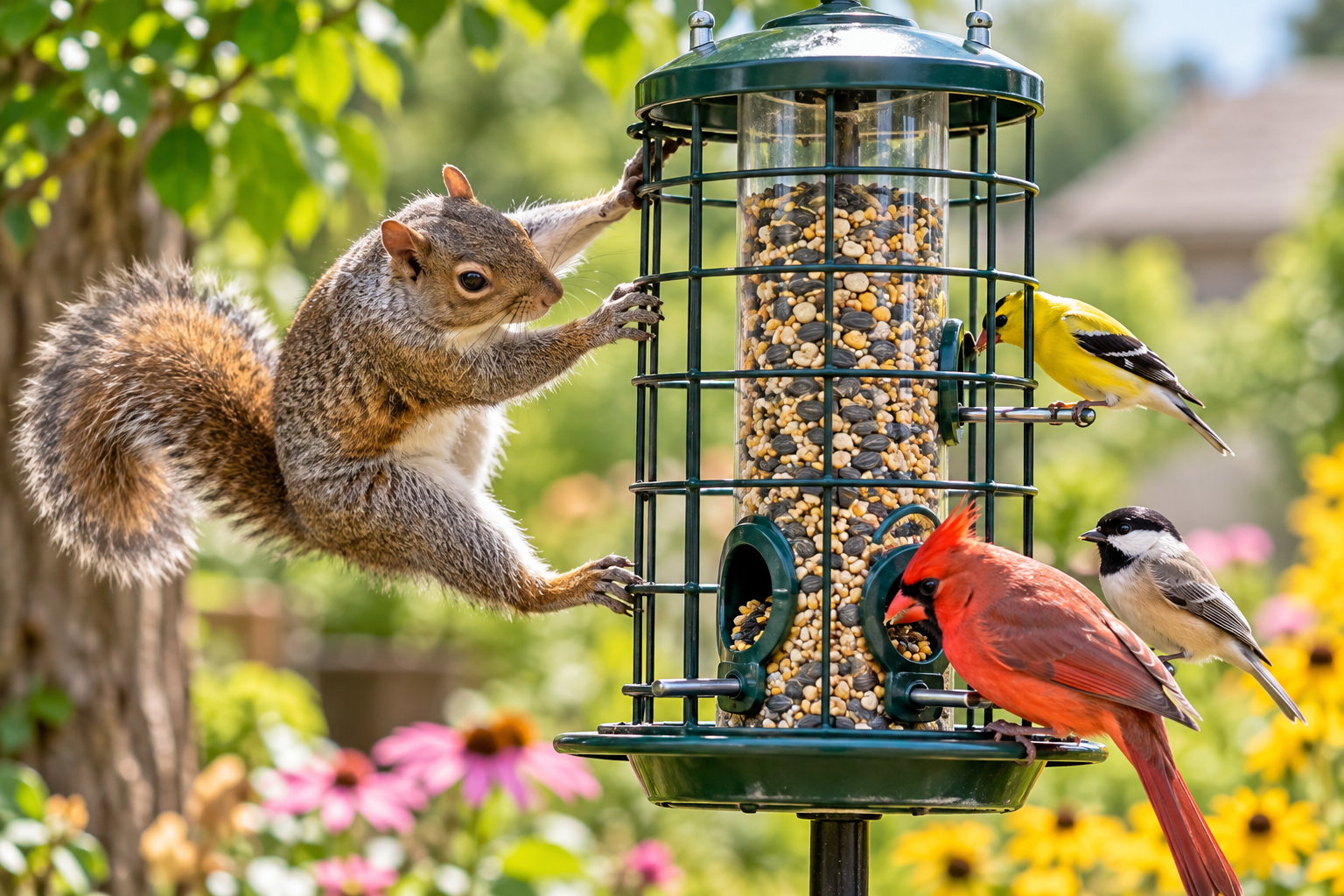
You fill the feeder on Saturday morning. By Sunday afternoon it’s empty, the perches are chewed, and a squirrel is sitting on the lid looking at you without apology. Meanwhile, the chickadees you bought the seed for are waiting in the hedge.
The solution is straightforward: no single product reliably stops squirrels on its own, but a layered setup a weight-activated feeder, a correctly mounted baffle, and smart placement away from launch points stops them almost every time. Squirrels beat one defense. They rarely beat three stacked together.
Approach this as a strategic challenge rather than a shopping problem. Squirrels are solving a puzzle: reach the food with the least effort. Your job is to make every route expensive too far to jump, too slick to climb, too heavy to trigger. The methods below work because they address different aspects of the challenge simultaneously.
Why Do Squirrels Keep Getting Into Bird Feeders?

Squirrels aren’t invading your feeder out of malice. They’re doing exactly what their bodies were built for, in a yard that happens to be full of concentrated calories.
Start with the physical reality. Gray squirrels can rotate their hind ankles to climb down headfirst, grip bark and rough plastic with claws built for vertical travel, and launch itself sideways across open air with startling accuracy.
It can hang upside down by its back feet and still eat. Most feeder designs smooth plastic tubes, wide platform trays, wooden hoppers with generous roofs are effectively climbing furniture to an animal with that skill set.
Then add the incentive. Black oil sunflower, peanuts, and mixed seed are dense, high-fat, and sitting in one place at a known height. A squirrel that learns your refill schedule has found the best food source in its territory, and it will defend that discovery with real persistence.
The last piece is usually your setup, not the animal. A feeder suspended from a tree limb, mounted on a thin wooden post, or placed within easy reach of a fence rail, deck railing, or garage roof gives the squirrel a free approach.
Baffles installed too low let a squirrel jump over them from the ground. Feeders with wide seed trays give it a place to sit and work. Most of the time, the equipment isn’t failing — the geometry around it is.
1. Use a Weight-Activated Feeder
A weight-activated bird feeder is one of the most reliable tools in this effort. The mechanism is simple physics: a spring-tensioned outer shroud sits over the seed ports, calibrated so a finch or nuthatch is too light to move it.
When a squirrel’s body weight lands on the perch ring, the shroud slides down and seals the ports. The squirrel gets nothing, learns nothing useful, and eventually leaves.
Designs like the Brome Squirrel Buster Classic work on exactly this principle, in contrast to ordinary tube bird feeders, which happily dispense seed to whatever is heaviest.
- Hang or mount the feeder so nothing sits within reach of the shroud — a squirrel that can brace a back foot on a bracket defeats the weight trigger.
- Adjust the spring tension if your model allows it, tightening it only until large birds like grackles also close the ports.
- Fill it and watch for one full day; you should see small birds feeding normally and squirrels sliding off.
- Clean the shroud track monthly so seed dust doesn’t jam the mechanism open.
2. Install a Pole Baffle
A baffle is a physical wall in the middle of the climb. There are two useful shapes. A cone or dome baffle looks like an upside-down bowl and works by tilting and wobbling when a squirrel reaches the rim, dumping it back to the ground.
A cylinder or “stovepipe” baffle is a tube, usually at least four inches in diameter, that a squirrel cannot wrap its arms around or reach past. Sizing and height decide whether it works. A cone narrower than about fifteen inches across lets a determined squirrel stretch around the edge.
A cylinder shorter than roughly two feet gives it enough reach to grab the pole above. Mount the top of the baffle at least four to five feet off the ground, because a squirrel can jump straight up from a standing start and will simply skip the lower section of the pole entirely.
Check that the baffle pivots or slides freely on the bird feeder pole. A baffle bolted rigidly in place becomes a step. One that tips under weight becomes a slide.
3. Apply the 5-to-6-Foot Jumping Buffer
Hardware fails when geometry hands squirrels a shortcut. A squirrel can clear roughly five feet of horizontal distance from a standing launch, and more when dropping from above. So measure the open air around your feeder before you blame the feeder.
Walk a circle around the pole and look for anything solid within five to six feet: fence tops, deck railings, tree trunks, low branches, trellises, garbage cans, the corner of a shed, a stacked woodpile, patio furniture you moved last week. Any one of them is a launch pad.
Then look up. Overhanging limbs and roof edges give a squirrel a downward trajectory, and gravity extends its range well past what it can manage from flat ground keep a wider gap overhead, closer to eight or ten feet where you can.
Move the feeder rather than the furniture when you have the choice. An open lawn position with nothing nearby is worth more than any accessory you can buy, and it’s free.
This buffer also makes every other layer work harder. A baffle only has to stop a climber if no squirrel can bypass the pole altogether.
4. Hang Feeders From a Slippery, Open Line
If you hang rather than pole-mount, the suspension line is your defense. Squirrels grip thick rope, chain, and wooden dowels easily. They struggle with thin, smooth, flexible material that spins and offers nothing to hook a claw into.
Run a length of coated steel cable or heavy monofilament between two points with several feet of clearance at each end, and thread a few spinning spacers short lengths of plastic pipe or empty thread spools — onto the line on either side of the feeder. A squirrel that tries to cross rolls the spacer and drops off.
Skip fishing line thin enough to cut, loose string that birds can tangle in, and anything greased. Petroleum jelly and cooking oil mat bird feathers and destroy their insulation. The goal is a surface that offers no purchase, not a surface that coats anything touching it.
5. Consider a Slinky as a Simple Pole Deterrent
Using a Slinky is an economical experiment in backyard defense. Take a metal Slinky, thread the bird feeder pole through the center of the coil, and fasten the top end just under the feeder mount with a zip tie or wire. The rest of the spring hangs loose down the pole.
When a squirrel starts climbing and grabs the coil, the Slinky stretches and rides down under its weight, lowering the animal gently back to the grass. Nothing breaks, nothing gets hurt, and the squirrel has no stable surface to push against.
It works best on smooth metal poles of small diameter, and it works poorly on wide wooden posts where a squirrel can climb beside the coil. Buy a metal one, not plastic — plastic coils lose their spring outdoors in a season. Treat it as a test, and upgrade to a proper baffle if it holds up.
6. Try Spicy Seed as a Deterrent
Birds and mammals process capsaicin — the compound that makes chili peppers hot — very differently. Birds lack the receptor that registers the burn, so they eat treated seed without reaction. Squirrels experience the heat and typically avoid returning to that food source after a few attempts.
Buy pre-treated seed or a commercial hot pepper additive formulated for feeders rather than mixing kitchen cayenne yourself. Manufactured products coat evenly and use food-grade carriers, while loose powder blows off, clumps in humidity, and drifts into your eyes when you pour it.
Wear gloves when you fill, fill on a still day, and keep the treated seed away from where children or pets will handle it. Some regions restrict pepper-treated products, so check your local rules first. Spice reduces pressure — it rarely eliminates it by itself, especially with hungry squirrels in late winter.
7. Switch to Safflower or Nyjer Seed
Not all seed is equally attractive to squirrels. Safflower has a thick, bitter shell that most squirrels find unrewarding, while cardinals, house finches, chickadees, titmice, and doves take it readily. Nyjer — the tiny black thistle seed served in fine-mesh finch feeders — is small enough that a squirrel burns more energy harvesting it than it gains, so many leave it alone.
Compare that with black oil sunflower, peanuts, and corn, which are exactly what squirrels want most. If your mix leads with those, you’re advertising.
Expect a quiet period after you switch. Birds need a week or two to recognize the new food, and you may lose a few species that preferred sunflower. Seed choice thins the crowd rather than closing the door, so treat it as one layer sitting underneath your hardware, not a replacement for it.
8. Use a Caged Feeder
A caged feeder wraps a welded metal grid around the seed container. Small birds slip through the mesh and feed inside; squirrels, along with grackles, starlings, and jays, can only cling to the outside and reach empty air.
Mesh spacing is everything. Openings around one and a half inches admit chickadees, finches, titmice, nuthatches, and downy woodpeckers while blocking larger bodies.
Anything wider lets a young squirrel squeeze in. Check that the gap between the cage and the seed ports is wide enough that a squirrel stretching through cannot touch the food — cheap cages sit too close.
Buy steel or coated metal; squirrels chew through plastic mesh in days. Caged bird feeders need more cleaning than open ones because seed hulls collect in the grid, so choose a model that opens fully for washing.
9. Keep the Ground Clean
Spilled seed under the feeder is a standing invitation. It feeds squirrels at ground level, teaches them where the food comes from, and gives them every reason to start climbing. Clean ground removes the reward before the climb begins.
Fit a seed tray or catcher below the feeder to intercept what birds kick out. Trays also cut waste and keep the seed you paid for in play, though they need draining and scrubbing after rain so nothing molds.
Sweep or rake the area under the feeder every few days. Use no-mess hulled mixes if the mess keeps winning — no shells, less debris. Store your seed supply in a sealed metal container, not a paper bag in the garage, because squirrels find and chew through bags quickly.
Keeping the ground clear also discourages rats, which matters as much as the squirrel problem.
10. Set Up a Separate Squirrel Diversion Feeder
Some yards are easier to manage when the squirrels have their own restaurant. Set up dedicated squirrel feeders — a corn cob spike, a peanut box, or a simple ground platform — stocked with whole corn and peanuts, the cheap high-calorie items they prefer over your finch mix.
Place it as far from the birds as your yard allows, ideally on the opposite side of the house or behind a structure that breaks the line of sight. Keep it full, because an empty diversion feeder sends them straight back to the birds.
Be honest about the tradeoff. A reliable food source can draw more squirrels to the property over time, and this method only works alongside real hardware on the bird side. Used with a baffled pole and a weight-activated feeder, it lowers pressure. Used alone, it raises it.
Build the Best Bird Feeder and Squirrel Proof Setup
Stop thinking about which single product wins and start thinking in layers. Three is the working minimum: one that controls access from below, one that controls access from the side, and one that controls what happens if a squirrel reaches the feeder anyway.
A setup that holds up through a hard winter usually looks like this:
- A metal pole, not wood. Smooth, narrow, and impossible to grip — wooden posts are ladders.
- A cylinder or dome baffle, mounted with its top four to five feet off the ground and free to tilt.
- A weight-activated squirrel proof bird feeder as the last line of defense.
- Five to six feet of clear air on every side and more overhead.
- Safflower or nyjer seed instead of straight sunflower or peanuts.
- A clean ground zone, swept regularly and backed by a seed tray.
| Layer | What it stops | Action |
|---|---|---|
| Pole and baffle | Climbing from below | Mount baffle high, check it pivots |
| Placement buffer | Jumping from the side | Measure six feet, clear launch points |
| Weight mechanism | Feeding once they arrive | Adjust spring tension, clean the track |
| Seed and cleanup | Attraction and habit | Switch seed, sweep spills |
Where Should You Put a Squirrel-Proof Bird Feeder?
Squirrel proof bird feeder placement decides whether your hardware ever gets tested. Pole-mounted setups give you the most control, because you choose the exact spot and the baffle does predictable work. Put the pole in open lawn, sink it deep enough that it doesn’t lean under a squirrel’s weight, and confirm nothing solid sits within jumping range in any direction.
Hanging placement is harder to secure but works well off a long shepherd’s hook set away from the house, or from a line strung between two poles. Avoid hanging from tree limbs, eaves, gutters, and pergola beams — all of them give a squirrel an approach from above, which is the one angle a baffle can’t cover.
Balance the defense against the birds’ needs. Feeders placed within about ten feet of shrubs or a brush pile give small birds cover to escape hawks, and that cover shouldn’t double as a launch pad. A low shrub works. A fence does not.
Keep the feeder in view of a window so you can watch what actually happens, and leave enough room around it to refill and clean without dragging a step stool into the launch zone.
What Bird Seed Helps Keep Squirrels Away?
The best seed to keep squirrels away is the one your target birds want and squirrels don’t. Safflower leads the list — bitter, hard-shelled, and popular with cardinals, finches, chickadees, and titmice. Nyjer is second, too small and fiddly for a squirrel to bother with, and the standard choice for goldfinches and pine siskins in mesh feeders.
Straight black oil sunflower is the opposite: irresistible to nearly every bird and equally irresistible to squirrels. Peanuts, cracked corn, and cheap mixes heavy on milo pull in squirrels, starlings, and rodents together.
Match the seed to the birds you actually want. Woodpeckers need suet, hummingbirds need nectar, and neither belongs in this comparison. If safflower brings your species in, it’s the strongest seed-level defense available.
Bird Feeder and Squirrel Proof Mistakes to Avoid
Most failures repeat the same handful of errors. Mounting a baffle too low, so a squirrel jumps straight over it. Using a wooden post, which squirrels climb like bark. Bolting a baffle rigid instead of letting it tip. Placing a feeder near a fence, deck rail, or overhanging limb and expecting the hardware to compensate.
Greasing the pole with petroleum jelly, which coats feathers and harms the birds you’re protecting. Leaving spilled seed on the ground. And buying one accessory, watching it fail alone, and concluding the whole approach doesn’t work.
How to Tell If Your Squirrel-Proof Setup Is Working
Watch for three signs over about a week. Seed levels drop slowly and steadily rather than vanishing overnight. Small birds feed without interruption and return within minutes of a disturbance. Squirrels appear on the ground, attempt the pole once or twice, and give up without reaching the feeder.
If seed still disappears after dark, suspect raccoons or deer rather than squirrels. If a squirrel reaches the feeder but can’t eat, the weight mechanism is doing its job. If it eats, check the baffle height first and the jumping buffer second — those two account for most failures.
Troubleshooting – Why Are Squirrels Still Getting Into My Bird Feeder?
| Problem | Likely cause | What to do |
|---|---|---|
| Squirrel reaches feeder without climbing the pole | Launch point within jumping range | Move the feeder or remove the object |
| Squirrel climbs past the baffle | Baffle mounted too low or too narrow | Raise it above four feet, size up |
| Weight mechanism stays open | Seed dust in the track, or tension set too loose | Clean the shroud, tighten the spring |
| Seed vanishes overnight | Raccoons, deer, or rats | Bring feeders in at dusk |
| Squirrel sits and feeds from a tray | Wide tray gives a stable platform | Remove the tray, use a narrower catcher |
Frequently Asked Questions
Do squirrel proof bird feeders work?
Yes, when the rest of the setup supports them. A weight-activated feeder hung from a tree branch will be defeated in a day, because a squirrel can hang from above and brace against the mount. The same feeder on a baffled metal pole in open lawn holds. Judge the hardware only after the geometry around it is right.
How do you make a bird feeder squirrel proof without buying a new one?
Move it first. Relocate the existing bird feeder. Bird feeder position, baffle height, and clear air around the pole cost nothing and fix more problems than any purchase. Then add a Slinky or a cylinder baffle to the pole and switch to safflower seed.
Will squirrels chew through plastic bird feeder tubes?
Yes. Squirrels enlarge seed ports and gnaw through plastic and soft wood quickly. Choose feeders with metal port surrounds and metal perches, and repair chewed openings rather than leaving them — a widened port spills seed continuously.
Can I use grease or oil on the pole?
No. Petroleum jelly, cooking oil, and similar coatings transfer to bird feathers and ruin their waterproofing and insulation. Use a physical baffle instead.
Is there one product that solves this permanently?
No single item does. Combining quality bird feeders and poles with correct placement and seed choice gets you close to permanent, and that combination is what actually ends the raiding.
Final Thoughts
Stopping squirrels from stealing seed does not require abandoning your birds. With the bird feeder and squirrel proof strategy, combine weight-activated feeders, baffles, placement, seeds, and regular cleanup to protect your food supply.
A PVC pipe and squirrel-proof bird feeder setup can add a layer of distance and protection. For yards with persistent wildlife, consider a squirrel- and raccoon-proof bird feeder, especially when feeders are mounted near trees or fences.
If rodents are a concern, a bird feeder squirrel- and rat-proof design can help reduce access to spilled food. In larger properties, a deer- and squirrel-proof bird feeder may offer broader protection. Start with one or two methods, observe what works, and adjust your feeding station.





