Skip to content

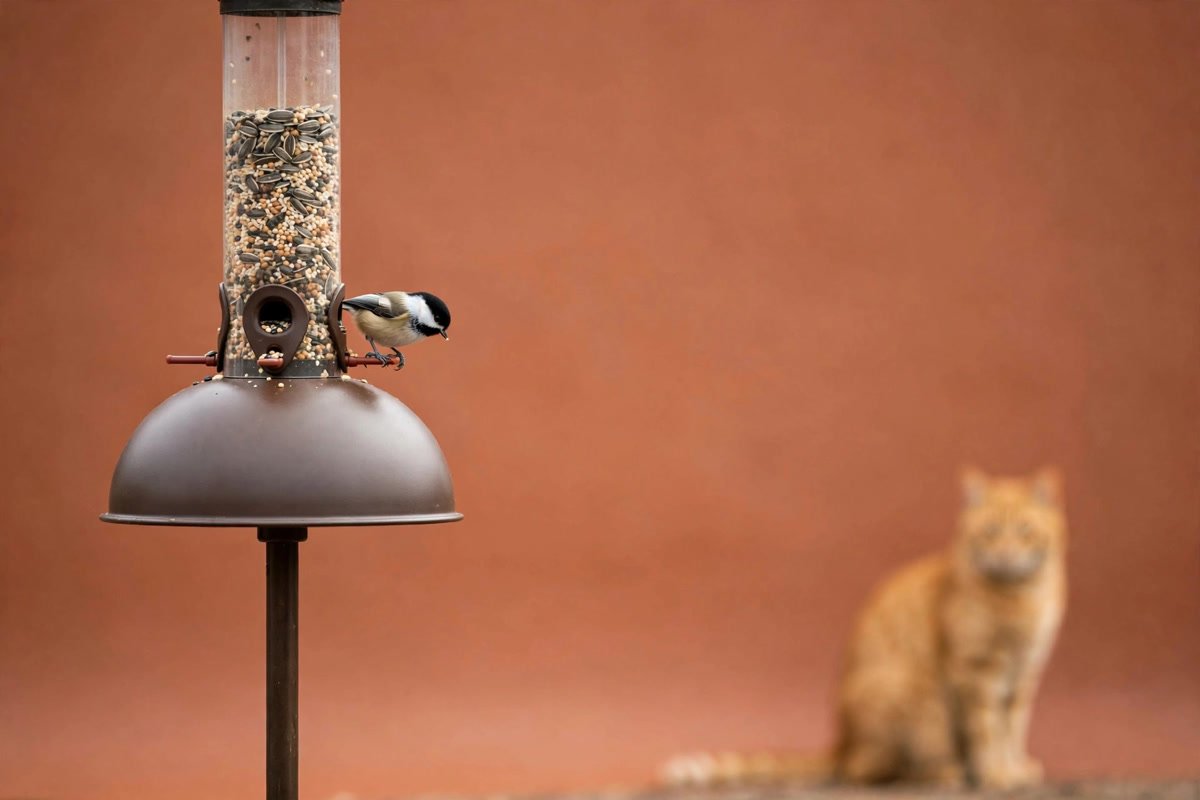
Watching a cat stalk your bird feeder is a heart-sinking moment for any backyard birder. You put the feeder out to help birds, not to set a trap for them. The good news is you do not have to choose between loving cats and protecting birds. Learning how to keep cats away from bird feeders comes down to smart placement, simple hardware, and a few honest conversations.
Outdoor cats are one of the most serious threats wild birds face in the United States, but every solution in this guide is humane. Nothing here harms cats, and nothing here asks you to stop feeding birds. You will learn nine practical ways to make your feeding station safer, from pole baffles and caged feeders to collar covers and catios, plus the tactics to avoid. The first step is understanding why the problem is bigger than one hungry cat.

Why Cats at Bird Feeders Are a Serious Problem
Cats are superb hunters, and a feeder concentrates birds in one predictable spot. A landmark study published in Nature Communications in 2013 by researchers from the Smithsonian Conservation Biology Institute and the U.S. Fish and Wildlife Service estimated that outdoor cats in the U.S. kill a median of about 2.4 billion birds every year. The authors found that unowned cats account for roughly 69 percent of that bird mortality.
Those are estimates, and researchers continue to debate the exact numbers. The Cornell Lab of Ornithology cites a conservative range of 1.3 to 4 billion birds killed annually, with 60 to 100 million unowned free-ranging cats in the country. Either way, the American Bird Conservancy identifies outdoor cats as the top source of direct human-caused bird mortality in the United States, ahead of window strikes, cars, and pesticides. Cats have also been linked to the extinction of more than 60 species worldwide, mostly on islands.
What surprises most people is that a well-fed cat hunts anyway. Hunting is instinct, not hunger. An owned cat let outside for an hour can kill just as readily as a feral cat, and owners rarely see the evidence, because cats usually leave or eat their kills away from home.
Even a cat that never catches anything does damage. Its presence stresses feeding birds, scares them off, and can keep parent birds from returning to nearby nests. A feeder guarded by a cat is a feeder birds learn to avoid.
How to Keep Cats Away From Bird Feeders: 9 Humane Solutions
No single fix solves a cat problem on its own. The yards with the safest feeders combine several of these methods: good placement, protective hardware, gentle deterrents, and cooperation from the humans involved. Work through this list and apply as many as fit your situation.
1. Hang Feeders High and Keep Them Away From Cover
Placement is the cheapest and most effective defense you have. Cats are ambush hunters. They crouch in shrubs, behind fences, or under low branches, then sprint the last few yards. Take away their cover and you take away most of their advantage.
Keep feeders at least 5 feet off the ground, and position them 10 to 12 feet away from shrubs, dense bushes, fences, and low-hanging branches that a cat could hide behind. A pole-mounted feeder standing alone in an open stretch of lawn is far safer than a feeder hung from a low branch or mounted on a deck railing, both of which give cats an easy launch point. If you enjoy building your own bird feeder, plan the mounting height and the clear zone into the design from the start.
Birds still need somewhere to flee, so keep some escape cover a short flight away rather than right at the feeder. A few small trees or shrubs 10 to 15 feet out give birds a refuge without giving cats a hiding spot next to the seed.
2. Install Baffles and Pole Guards
A baffle is a smooth dome or cone that wraps around the feeder pole below the feeder. Cats cannot get a grip on it, and its wide flare blocks them from climbing past. Mount the baffle high enough that a cat cannot simply jump over it, typically around 4 feet off the ground, and make sure it wobbles a little. A wobbling baffle is even harder to climb.
Stovepipe-style pole guards work the same way: a section of smooth metal or plastic pipe around the pole that offers no purchase for claws. Smooth metal or plastic poles are already harder to climb than wood, so a pole-mounted feeder with a guard is a strong combination. These same guards are a staple of squirrel-proof bird feeder setups, so one upgrade solves two problems at once.
For feeders hung from a branch or hook, add a dome baffle above the feeder. It blocks climbing cats coming down from above and doubles as a rain and snow shield for the seed.
3. Switch to Caged Feeders
Caged feeders surround the feeding ports with a wire mesh cage. The openings are sized so chickadees, finches, titmice, and other small songbirds slip through easily while cats, and larger birds, cannot reach the seed or the birds eating it. For a feeder that cats have learned to stake out, a caged feeder is one of the most reliable fixes.
Caged tube and hopper feeders are sold ready-made, and cage attachments can be added to some existing feeders. They also keep out starlings and grackles, which many backyard birders consider a bonus. Clean the cage along with the feeder, since droppings can collect on the mesh, and check that the openings are not bent wide enough for a cat’s paw to slip through.
4. Stop Feeding Birds on the Ground
Most feeder kills happen on the ground, not at the feeder itself. Doves, juncos, sparrows, and towhees feed on spilled seed below the feeder, exactly where a stalking cat wants them. If cats patrol your yard, ground feeding is the riskiest habit to allow.
Fit seed trays or catch trays under your feeders to intercept falling seed, and sweep up spills regularly. Switch to hulled or “no-mess” seed so there are fewer shells and less waste to attract ground feeders in the first place. Avoid cheap seed mixes padded with milo and other fillers that birds kick aside; less waste on the ground means fewer birds feeding where cats hunt. Wildlife specialists at the University of Nebraska-Lincoln recommend these same cleanup steps for keeping all kinds of unwanted visitors away from feeding stations.
If doves or other ground-feeding species are your favorites, you do not have to abandon them. Feed them from a raised platform feeder with a baffle-protected pole instead of scattering seed on the lawn.
5. Use Motion-Activated Deterrents
Motion-activated sprinklers give an approaching cat a startling burst of water. Cats hate the surprise, and most birds tolerate water without trouble, so the deterrent is selective in practice. Position the sprinkler to cover the approach paths to the feeder rather than the feeder itself, and move it every week or two so cats do not learn to skirt around it.
Ultrasonic deterrents emit a high-pitched burst when they detect motion. They are inaudible to people, and models designed for yards let you choose settings meant to target cats. Humane World, the animal welfare organization, suggests picking a device with a frequency that will not disturb birds, and pairing it with other methods rather than relying on it alone.
Scent deterrents are a gentler option. Many gardeners report that cats avoid citrus peels, lavender, mint, and vinegar-based sprays. Scatter peels or apply sprays around the feeder area, not on the feeder or seed, and reapply after rain. Results vary from cat to cat, so treat scent as a supplement to placement and hardware, not a standalone solution.

6. Plant Thorny, Cat-Unfriendly Landscaping
Cats have the same soft skin under their fur that we do, and they dislike pushing through thorns and sharp foliage. Planting holly, barberry, roses, or other prickly shrubs around the perimeter of your feeding area makes the ground near feeders an uncomfortable place for a cat to crouch and stalk. Birds, with their light weight and feathers, navigate the same plants without trouble.
Keep the overall landscape open near the feeder. Trim bushes, mow grass short, and remove woodpiles, brush piles, and clutter where cats like to hide. Then place your escape cover, the shrubs birds dart into when alarmed, a short distance away rather than right beside the seed. This kind of planning is a core part of any bird-friendly garden: shelter for birds, no ambush cover for cats.
7. Talk to Your Neighbors About Roaming Cats
Most cats at feeders are not feral. They belong to someone on your street. A calm, friendly conversation often works better than any gadget, because an owner who understands the problem can simply keep the cat inside during peak feeding hours or contain it altogether.
Keep the tone neighborly, not accusatory. Share one striking fact, such as the 2.4 billion annual estimate, and frame it as a shared problem: their cat is also at risk from cars, dogs, coyotes, and disease outdoors. Suggest concrete options like indoor enrichment, a catio, or leash walks. Many owners have simply never connected their pet’s outdoor time to dead birds.
For cats with no identifiable owner, contact your local animal shelter or animal control office for guidance instead of handling the animal yourself. Do not feed stray cats near your feeders; a reliable food source draws more cats and keeps them hunting in your yard. Some communities have volunteer-run trap-neuter-return programs for unowned cats, which your shelter can tell you about. Opinions on these programs differ among conservation and welfare groups, so ask local experts what is recommended in your area.
8. Fit Your Own Cat With a Collar Cover or Bib
If the hunter is your own cat, you can reduce its kill rate without locking it up. The best-studied option is the Birdsbesafe collar cover, a sleeve of brightly patterned fabric worn over a quick-release collar. The bright colors are designed to warn birds of the cat’s approach.
The research behind it is unusually solid. A 2015 study published in Global Ecology and Conservation found that cats wearing the covers killed 19 times fewer birds than uncollared cats in a spring trial and 3.4 times fewer in a fall trial. A larger 2022 follow-up by U.S. Geological Survey scientists, testing 94 cats across New York and Florida, found cats brought home 61 percent fewer birds while wearing the cover, with no meaningful difference in how well it worked across cat ages, sexes, or hunting environments. The same studies found little or no significant reduction in small mammal kills, so a cover is a bird-specific tool, not a general hunting fix.
Cat bibs, such as the CatBib, take a different approach: a flap of fabric hanging under the chin that interferes with the timing of the pounce. A simple bell on a breakaway collar can help too, though evidence suggests determined hunters learn to stalk without ringing it, so bells work best combined with other measures. Whatever you choose, use a breakaway or quick-release collar so the cat cannot get snagged outdoors. Read the USGS summary of the collar-cover research if you want the full numbers before you buy.
9. Keep Your Cat Indoors and Build a Catio
The single most effective step is also the simplest: keep cats indoors. An indoor cat kills zero birds. It also lives a longer, safer life.
The Cornell Lab of Ornithology notes that outdoor cats live less than half as long on average as indoor cats, facing cars, predators, fights, parasites, and disease every time they roam. Keeping a cat inside protects the cat as much as the birds.
Indoor life does not have to mean a boring life. Puzzle feeders, climbing trees, window perches, and daily interactive play go a long way toward satisfying a cat’s instincts. For safe outdoor time, a catio, a screened enclosure attached to a window, patio, or wall, lets a cat enjoy sunshine, breezes, and birdwatching without touching a feather.
Leash walks with a harness are another option for adventurous cats. The American Bird Conservancy’s solutions for indoor cats page has catio designs and containment ideas for every budget and living situation.

What NOT to Do: Cruel or Risky Tactics to Avoid
Protecting birds never justifies harming cats. Do not use poisons, antifreeze, pellet guns, leg-hold traps, or any device designed to injure an animal. Besides being cruel, these tactics are illegal in most places and can kill or maim wildlife, pets, and even children.
Do not trap cats and dump them somewhere else on your own. Relocation is illegal in many areas, it is a death sentence for a house cat abandoned in unfamiliar territory, and it rarely works anyway: remove one cat and another usually moves into the territory. If an unowned cat is a persistent problem, call your local animal shelter or animal control office and let professionals handle it.
Finally, keep your frustration aimed at the situation, not the animal. Cats hunt because they are cats. The responsibility sits with the humans who let them roam, feed strays next to feeders, or abandon them. Humane solutions protect birds and treat cats decently at the same time, which is exactly what this guide is built around.
Frequently Asked Questions
Will a bell on my cat’s collar stop it from killing birds?
A bell helps, but it is not a complete solution. Bells warn some birds some of the time, but experienced hunters learn to move without ringing them. Use a bell on a breakaway collar as one layer of protection, combined with keeping the cat indoors during dawn and dusk, when birds are most active, or with a proven device like a Birdsbesafe collar cover.
Do outdoor cats really kill that many birds?
The widely cited estimate comes from a 2013 Nature Communications study by Smithsonian and U.S. Fish and Wildlife Service researchers: a median of about 2.4 billion birds killed per year in the United States by outdoor cats. Estimates vary, and the Cornell Lab cites a conservative range of 1.3 to 4 billion, but every major bird conservation organization agrees cats are the leading direct human-caused source of bird deaths in the country. Even one cat at one feeder can kill dozens of birds in a season.
Can I trap a neighbor’s cat that keeps hunting at my feeder?
Trapping someone else’s pet yourself is a bad idea and may be illegal where you live. Start with a polite conversation with the owner, most people do not realize their cat is killing birds. If the cat is unowned or the owner will not act, contact your local animal shelter or animal control office for advice. They can tell you what options exist in your area and handle the animal humanely.
Do ultrasonic cat repellers actually work?
They can help as part of a layered approach, but results are mixed and some cats habituate to them. Choose a motion-activated model with settings intended for cats, position it along the routes cats use to approach the feeder, and move it periodically. Do not rely on an ultrasonic device alone; combine it with good feeder placement and baffles.
Should I take my feeders down if cats keep coming?
As a last resort, temporarily removing feeders for a week or two can break a cat’s hunting routine and scatter the bird activity that attracted it. Before you do that, try the fixes in this guide: raising and repositioning the feeder, adding a baffle, switching to a caged feeder, and cleaning up spilled seed. If you do take feeders down, remember that colliding with windows is another major feeder-area hazard worth addressing at the same time.
Will keeping my cat indoors make it unhappy?
Most cats adjust well, especially with enrichment. Interactive play, puzzle feeders, cat trees, and window perches satisfy hunting and climbing instincts without live prey. A catio or harness walks add safe outdoor time. Indoor cats avoid the injuries, diseases, and early deaths common in outdoor cats, and surveys of owners consistently find indoor cats living noticeably longer lives.
Conclusion
Keeping cats away from bird feeders is not about picking sides in a battle between cat lovers and bird lovers. It is about managing one specific, fixable conflict in your yard. Hang feeders high and clear of cover, add baffles and caged feeders, clean up spilled seed, and use gentle deterrents for the cats you cannot control. Talk to your neighbors, collar your own cat with a proven device, and consider a catio so your cat can enjoy the outdoors without endangering wildlife.
Every measure here is humane, affordable, and backed by real evidence or long-tested field practice. You do not need all nine to see a difference; even two or three changes can turn your feeding station from a hunting ground back into the safe haven you intended. If this issue opened your eyes to the wider pressures on backyard birds, read about the biggest threats wild birds face and the solutions giving them a fighting chance. Small changes in one yard, repeated across a neighborhood, add up to thousands of birds saved.