 Skip to content

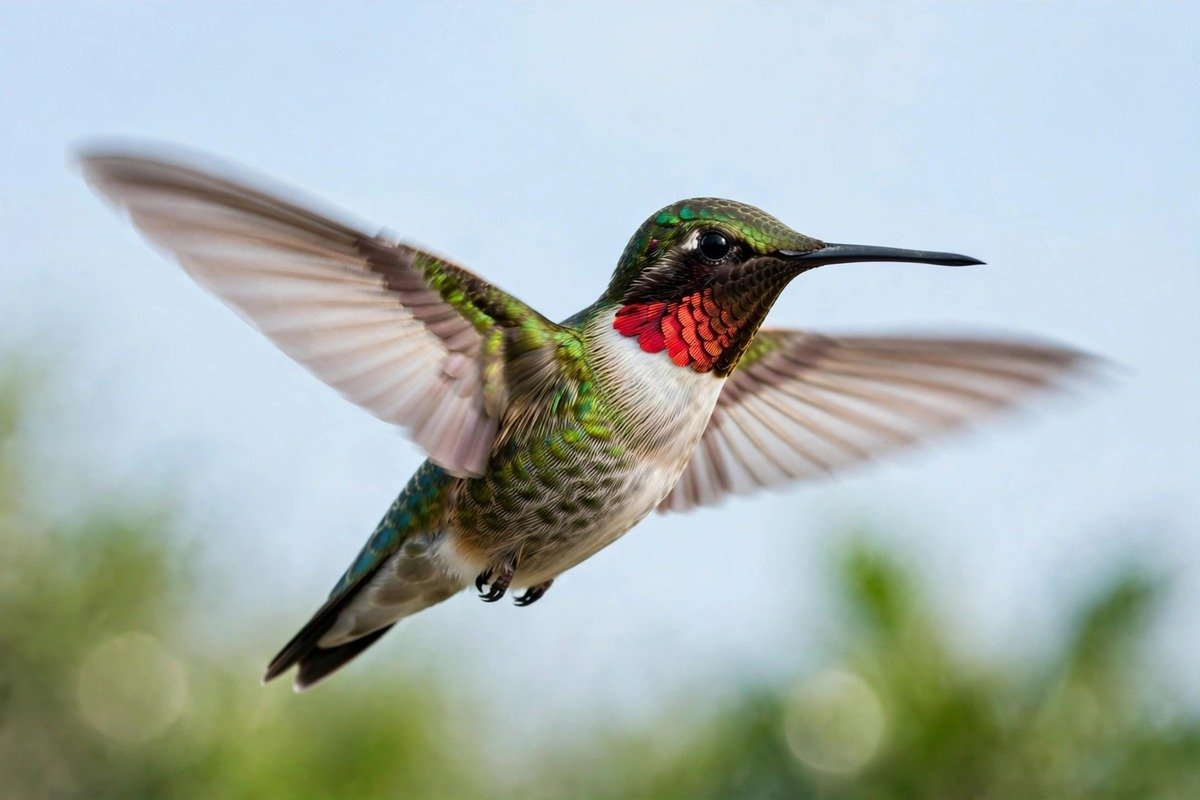
When do hummingbirds migrate? For most backyard watchers in the eastern United States, the answer arrives earlier than expected: adult males start leaving as early as mid-July, and the main southbound movement sweeps through August, September, and October. The trigger is not the weather, and it is not your feeder. It is the steady shortening of daylight, a signal no amount of sugar water can switch off.
The bird making this trip is almost certainly the ruby-throated hummingbird, the only hummingbird that breeds across eastern North America. Weighing less than a nickel, it doubles its body fat and then flies up to 500 miles nonstop across the Gulf of Mexico, an 18 to 22 hour flight with no place to land, rest, or feed. This guide walks through fall departure timing by region, the science behind the Gulf crossing, where these birds spend the winter, and the one feeder myth you can safely ignore. All timing is typical and shifts with each year’s weather.

When Do Hummingbirds Migrate? Fall Timing by Region
There is no single departure date. Hummingbirds leave when their internal clock and shortening days tell them to, and that moment arrives sooner in the north and later in the south. Adult males leave first, sometimes weeks before females and the young of the year. Females follow, and juveniles, many on their first solo journey, bring up the rear.
| Region | Typical departure window | What to expect |
|---|---|---|
| Southern Canada and northern tier (Minnesota, Wisconsin, New England) | Mid-August to early September | Adult males may vanish by late July; feeders go quiet first |
| Midwest and Mid-Atlantic (Ohio, Pennsylvania, Missouri, Virginia) | Late August through September | Peak passage of migrants from farther north |
| Southeast (Carolinas, Tennessee, Georgia) | September into early October | Heavy feeder traffic as northern birds pass through |
| Gulf Coast and Florida | October into early November | Last departures, plus a few birds that winter along the coast |
Research supports this staggered pattern. A Cornell Lab of Ornithology summary of a study in The Auk found that fall migration peaks in September and that older birds travel ahead of younger ones, with hummingbirds moving through southern Alabama between late August and late October. Once they reach the northern breeding range’s edge, the southbound movement is essentially complete by mid-November. Individual timing still varies: a warm autumn with plenty of late-blooming flowers can stretch the season, while an early cold snap can push birds out faster.
You can watch the movement unfold in real time with Journey North’s hummingbird migration maps, where volunteers report sightings that trace the southbound wave. For the bigger picture across all songbirds, our overview of spring and fall migration seasons puts hummingbird timing in context.
How Hummingbirds Know When to Leave
Shortening day length is the main cue. As late-summer daylight shrinks, hormonal shifts trigger restlessness and intense feeding, and the birds begin packing on fat. This internal calendar works independently of temperature or food supply. In fact, hummingbirds begin migrating south at the time of greatest food abundance, when flowers are still blooming and insects are plentiful.
That detail matters because it destroys a persistent myth: cold weather does not push them out, and warm weather does not hold them back. A hummingbird cannot simply decide to stay because your yard still has blooms. The urge to fatten up and head south is written into its biology, and once the bird is fat enough, it goes.
The fattening phase is dramatic. A ruby-throat preparing for the Gulf crossing can nearly double its weight, rising from about 3.25 grams to more than 6 grams of pure fuel. That extra mass is burned almost entirely during the long over-water flight, and birds arriving on the far shore may weigh as little as 2.5 grams, exhausted and ravenous.
The Gulf Crossing: 500 Miles Nonstop
The most famous leg of the journey is the nonstop flight across the Gulf of Mexico, a stretch of up to 500 miles that takes 18 to 22 hours depending on weather. Most birds depart at dusk, climbing into the evening sky and flying through the night over open water, where there are no flowers, feeders, or safe places to land. Some land briefly on offshore oil rigs or fishing boats, but for most, there is no stopping until landfall.
Not every bird takes the water route. Many fly around the Gulf instead, following the Texas coast down into Mexico in a series of shorter hops with feeding stops. Evidence suggests fewer ruby-throats cross the Gulf in fall than in spring, possibly because hurricane season makes the over-water gamble riskier. Landfall can happen anywhere from southern Texas to central Florida.
How far can one tiny bird fly in a single push? The Cornell Lab research on ruby-throated hummingbird migration estimated the average bird’s flight range at around 2,200 kilometers, meaning most could make the crossing when weather cooperates. Older birds and males were predicted to travel farther at a stretch than younger birds and females, which matches the observation that experienced adults lead the way south.
Fueling stations matter enormously for birds taking the coastal route. Late-blooming flowers that attract hummingbirds fast give migrants the nectar they need to rebuild fat between flight segments, and well-maintained feeders serve the same purpose.
Where They Go for Winter
Most ruby-throated hummingbirds winter in southern Mexico and Central America, ranging from the southern tip of Florida and the Yucatan down through Guatemala, Belize, Honduras, Nicaragua, Costa Rica, and into northern Panama. Audubon’s Ruby-throated Hummingbird field guide notes that nearly all leave North America in the fall, with some crossing the Gulf and many traveling around it along the Texas coast.
On the wintering grounds, they settle into forest edges, shade coffee and citrus plantations, gardens, and flowering hedges. Because hummingbirds live solitary lives, each bird picks its own winter patch, though banding studies suggest individuals return to the same winter location year after year. Winter is not idle time. The birds defend small feeding territories, chase rivals away from rich flower patches, and eat far more insects and spiders than most people realize, since protein matters as much as nectar. They also complete their annual molt there, replacing worn flight feathers so the wings are fresh for the spring return. A few hardy or unlucky individuals skip the full journey and remain along the Gulf Coast or in the Outer Banks of North Carolina, where survival depends on how mild that particular winter turns out to be.
Do Hummingbirds Migrate at Night?
Mostly, hummingbirds travel by day, feeding as they go. The big exception is the Gulf crossing, which begins at dusk and continues straight through the night. An 18 to 22 hour nonstop flight cannot be completed in daylight alone, so these birds keep their wings beating long after sunset.
During the overland portions of the trip, nights are for rest. Hummingbirds roost in sheltered spots and, on cold nights, can slip into torpor, a deep energy-saving state in which body temperature and metabolism drop sharply. Torpor lets a bird that burned huge amounts of energy all day survive a chilly night without starving, then it wakes and feeds heavily at dawn. Ruby-throats do not enter torpor as readily as some western species, but the ability is there when they need it. If you spot a motionless, puffed-up hummingbird on a cold morning, give it space: it may simply be warming back up from an overnight torpor bout.
One thing they do not do is travel in flocks. Hummingbirds migrate alone, each bird following its own internal map and schedule. They may occasionally fly near mixed flocks of other songbirds over water, but they never hitch rides on other birds, despite the old tall tale.
Should You Keep Feeders Up During Migration?
Yes. Keep them up, keep them clean, and keep them filled until freezing weather becomes a real problem. This is the single most useful thing a backyard birder can do in fall, and it costs the birds nothing.
The myth says a full feeder will delay migration and trap birds into winter. It is false. Migration is triggered by shortening daylight, not by food availability, and a well-stocked feeder cannot override that hormonal signal. Cornell Lab experts confirm that keeping feeders out does not hold migrating hummingbirds back.

Late in the season, every bird at your feeder is already migrating. The summer residents left weeks ago, and the visitors you see now are travelers from farther north, refueling for the next leg. Pulling your feeder down early only removes a critical fuel stop from their route, and it may even discourage them from returning to your yard next year. The detailed Migration Basics from hummingbirds.net, based on decades of banding observations, recommends maintaining feeders until freezing becomes a problem.
Fresh nectar matters most when birds are burning energy at record rates. Change the solution every two to three days in warm weather, and skip the red dye, which adds nothing the birds need. If you want the full routine, our complete hummingbird feeder guide covers choosing, filling, cleaning, and placing feeders, and our companion piece on when to take down hummingbird feeders in fall walks through the timing decision region by region.
When Hummingbirds Return in Spring
The northbound trip reverses the pattern, but with its own timing. Ruby-throats begin moving north as early as January, reaching the northern coast of the Yucatan by the end of February, where they gorge on insects to rebuild fat for the spring Gulf crossing. The first birds reach the U.S. Gulf Coast in late February or early March.
From there, migration moves north at roughly 20 miles per day, following the earliest blooms of the flowers hummingbirds prefer. Males arrive about ten days before females, and the northward migration is complete by late May. Early males that outrun the flowers raid sapsucker wells for sugar, a clever backup plan while they wait for nectar sources to catch up.
Frequently Asked Questions
When should I take down my hummingbird feeder?
Leave feeders up until you have gone at least two weeks without a sighting and nighttime temperatures are regularly near freezing. Late migrants and stragglers still need fuel, and an available feeder cannot delay a bird whose migration is driven by daylight.
Do hummingbirds migrate in flocks?
No. Hummingbirds are solitary migrants. You might see several feeding at the same stopover, but each bird is traveling on its own schedule, not as part of a coordinated group.
How far do ruby-throats fly?
A single sustained flight can cover up to 500 miles across the Gulf of Mexico, and researchers estimate the average bird’s maximum range at about 2,200 kilometers. Over land, they average roughly 20 miles per day, so the full journey from Canada to Central America spans thousands of miles over several weeks.
Will cold weather kill migrating hummingbirds?
Usually not, because they leave before true winter arrives. Torpor helps them survive cold nights at stopovers, and a brief cold snap rarely stops a healthy, well-fueled bird. The greater dangers are storms over open water and running out of food at stopovers, which is why keeping feeders filled matters.

Conclusion
When do hummingbirds migrate? The short version is August through October for the fall journey south, with adult males leading, females following, and juveniles closing the parade. Daylight sets the schedule, fat fuels the flight, and neither cold snaps nor full feeders change the plan. The 500-mile Gulf crossing remains one of the great feats in bird migration, performed by a bird that weighs less than a nickel.
It helps to think of migration as a season rather than a single event. In the southern states the movement stretches from midsummer into November, while northern watchers see most of the action in a shorter September burst. Wherever you live, the two-week rule is the simplest guide: keep feeding until the birds have clearly moved on, then clean and store your feeders for spring.
Your role in this story is simple and genuinely helpful. Keep feeders clean and filled through the migration window, plant late-blooming nectar flowers where you can, and report your sightings to Journey North so the southbound wave stays visible to science. Do that, and the same travelers that emptied your feeders this fall may be back at your door next spring, right on schedule.




