 Skip to content

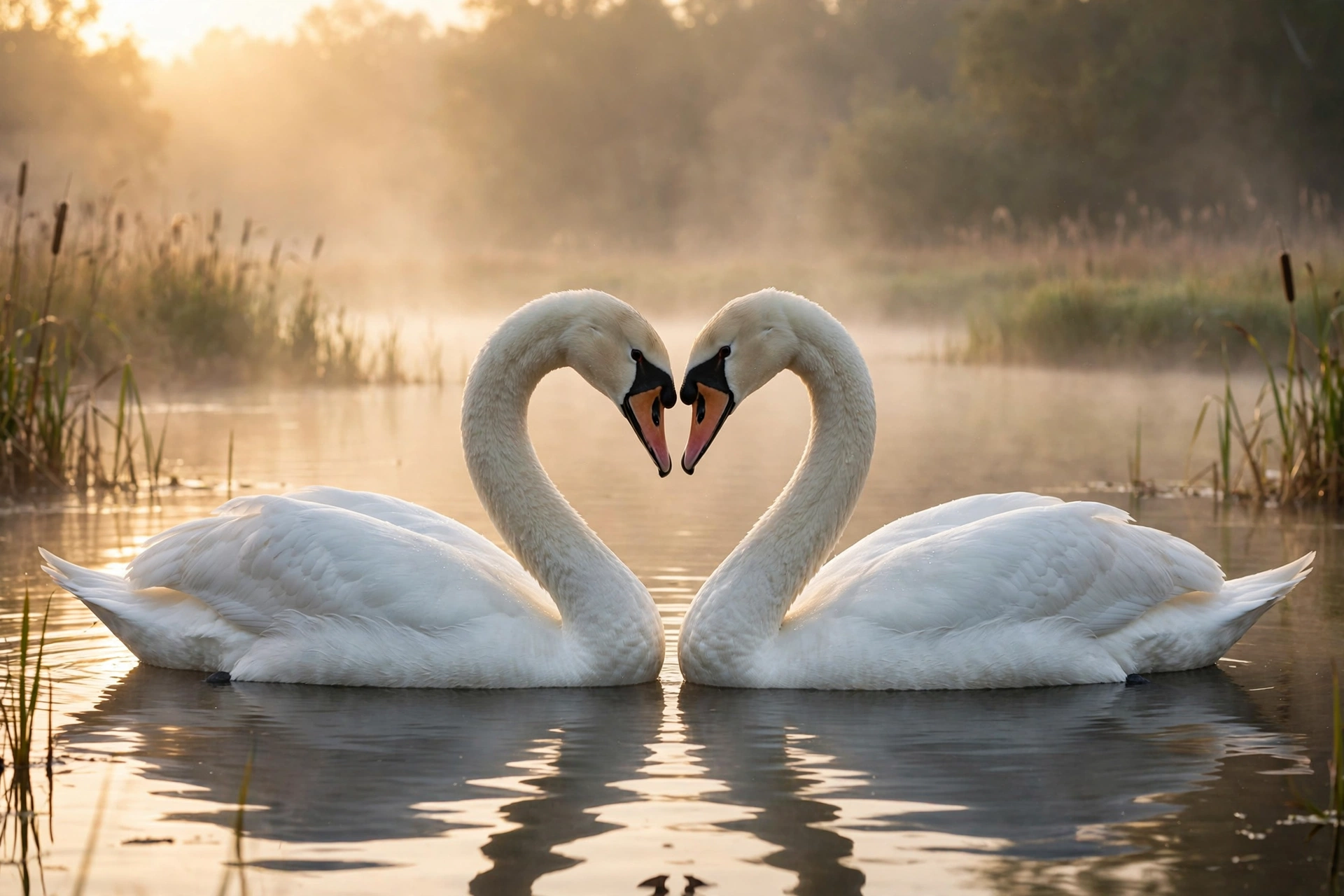
Two swans gliding side by side, necks curved into a perfect heart. It is one of nature’s most romantic images, and it has convinced generations of people that birds are paragons of lifelong devotion. But is the romance real? The honest answer is more interesting than the fairy tale.
Roughly nine out of ten bird species form socially monogamous pairs, which makes birds the most monogamous group of vertebrates on Earth. Yet “mating for life” means different things to different species. Some birds, like albatrosses, stay with one partner for decades. Others, like mallards, pick a new mate every single year. And even the most devoted pairs have their limits: failed nests, lost partners, and better options can all end a bird marriage.
In this guide, you will learn what scientists actually mean by monogamy in birds, which species truly stay together for life, why this strategy evolved, when birds “divorce,” and which birds want nothing to do with long-term commitment.
What “Mate for Life” Really Means
Before naming names, it helps to know what biologists mean when they talk about monogamy. The term covers three different things, and they do not always go together.
Social monogamy means two birds form a pair, share a territory, and raise young together. This is the common one. Around 80 to 90 percent of bird species are socially monogamous, according to researchers who study mating systems across the animal kingdom.
Sexual monogamy means the pair mates exclusively with each other. This is much rarer. Many socially monogamous birds quietly mate with birds other than their partner, a behavior scientists call extra-pair copulation.
Genetic monogamy means DNA testing confirms all of a female’s offspring were fathered by her social partner. This is the rarest of all and is almost never confirmed outside laboratory settings.
The gap between social and genetic monogamy can be startling. In one famous experiment, female blackbirds paired with sterilized males still laid eggs that hatched, proof the females had found fertile partners elsewhere. So when someone says a bird “mates for life,” they almost always mean social monogamy: one partner at a time, cooperating to raise young.
How Many Birds Are Monogamous?
Depending on which study you read, between 80 and 92 percent of bird species practice social monogamy. A Royal Society paper puts the figure at approximately 80 percent of species. An infographic in The Scientist, summarizing research across the animal kingdom, gives 80 to 90 percent. A study published in Scientific Reports cites 92 percent. However you slice it, the pattern is clear: monogamy is the default setting for birds.
To appreciate how unusual that is, compare birds with mammals. Fewer than one in ten mammal species practice any form of monogamy, with prairie voles, beavers, wolves, and gibbons among the exceptions. Birds stand nearly alone as a group where pairing up is the norm.
But here is the catch that most listicles skip. Social monogamy only means one partner at a time. A robin that pairs with a new mate every spring is still socially monogamous. True lifelong pairing, where two birds stay together until one of them dies, is a much smaller club. The rest of this article separates the genuine lifers from the seasonal romantics.
Birds That Truly Mate for Life
These species form pair bonds that typically last for years, often for life.
Swans
Swans are the poster birds of lifelong love, and the reputation is mostly deserved. Mute swans, trumpeter swans, and whooper swans all form strong pair bonds and cooperate in building nests and raising cygnets. A bonded pair will defend its territory together and often return to the same nesting site year after year, timed to the nesting season like clockwork.
The romance has limits, though. Research from the Cornell Lab of Ornithology has shown that some swan pairs do split up, usually after infertility or repeated nesting failure. The majority stay loyal, but a swan that cannot raise young with its partner may eventually look elsewhere. Even icons have deal-breakers.
Albatrosses
If any bird deserves the title of most faithful, it is the albatross. The vast majority of Laysan albatrosses pair for life, returning to the same colony where they were born to breed with the same partner, year after year. Buller’s albatross has been recorded with a divorce rate of effectively zero.
Their courtship is famously elaborate. Young albatrosses spend years perfecting a synchronized dance of sky-pointing, bill-touching, and wing-spreading before they settle on a partner. All that rehearsal pays off: once bonded, pairs may stay together for decades. The famous Laysan albatross named Wisdom was still breeding at over 70 years old.
Bald Eagles
Bald eagles are among the most celebrated lifelong partners in the bird world. Pairs perform spectacular courtship flights, locking talons and cartwheeling toward the ground before pulling apart at the last moment. They build enormous nests together and often reuse the same nest for many years, adding to it each season.
The bond is strong but not blind. If one member of a pair dies or disappears, the survivor will find a new mate rather than pine away. Pairs that repeatedly fail to raise young may also split and try their luck with new partners. Loyalty, for eagles, is a strategy, not a suicide pact.

Barn Owls
Barn owls form monogamous pairs that often stay together for life. Unlike migratory species that separate for months, barn owl pairs frequently remain on their territory year-round, roosting near each other even outside the breeding season. Their eerie nighttime calls help partners stay in contact across the dark.
Because barn owls can breed more than once in a good year, a stable partnership is a real advantage. A pair that already knows how to hunt and raise young together wastes no time renegotiating roles each season.
Cranes
Sandhill cranes and the critically endangered whooping cranes are classic lifelong partners. Whooping cranes can live up to 40 years, and a bonded pair will migrate together, returning to the same nesting area summer after summer. Their unison calls, loud trumpeting duets performed with heads thrown back, reinforce the bond and advertise the territory to rivals.
For cranes, the partnership is practical as much as romantic. Raising a crane chick takes months of coordinated effort, and experienced pairs simply do it better than new ones.
Atlantic Puffins
Atlantic puffins form monogamous bonds and typically return to the same burrow with the same mate in subsequent breeding seasons. What makes this remarkable is that puffins spend the winter far apart at sea, sometimes not seeing each other for eight months, yet reunite at the colony each spring.
According to the Cornell Lab’s All About Birds, paired puffins maintain their bond by rubbing their bills together. National Geographic reports that divorce is rare and usually happens only when a pair fails to breed successfully in its first few attempts. Interestingly, when puffin pairs do split, the female tends to move to a new burrow with a new mate while the male keeps returning to the same empty burrow.
Ravens
Common ravens, among the most intelligent of all birds, form lifelong pair bonds. A raven pair holds its territory together year-round, and their partnership involves constant communication, cooperative hunting, and playful aerial acrobatics. For a bird smart enough to hold grudges and remember faces, choosing a partner appears to be a deliberate, lasting decision.
Pigeons and Doves
The humble pigeon deserves more romantic credit than it gets. Rock pigeons and mourning doves form devoted pairs that stay together across breeding seasons. Both parents share incubation duties and produce crop milk, a nutritious secretion, to feed their squabs. A pigeon that loses its mate will grieve visibly, and widowed birds often take a long time to pair again.
Geese
Canada geese and barnacle geese are famous for their lifelong bonds. A goose pair migrates together, defends its nesting territory together, and raises its goslings as a team. Studies of barnacle geese have even shown that older, more experienced birds are considered more desirable mates, and divorce rates rise when prime older partners become available after a die-off. Even in the goose world, it seems, some birds trade up.
Black vultures, California condors, golden eagles, and ospreys show similarly strong long-term fidelity.
Why Did Monogamy Evolve in Birds?
Monogamy is not about romance. It is about chicks surviving, and bird chicks are extraordinarily demanding.
Most songbirds hatch blind, naked, and helpless. Raising them requires constant feeding, brooding, and protection, far more work than one parent can manage alone. When two parents are essentially mandatory, natural selection favors birds that pair up and cooperate. This is the leading explanation for why monogamy became the avian default.
There are other advantages too. Staying with a proven partner saves the time and energy of finding a new mate each year, which matters enormously for long-distance migrants that arrive at breeding grounds with limited time. Familiarity also improves coordination: research shows that breeding success often increases the longer a pair stays together, because experienced partners hunt, defend, and raise young more efficiently as a team.
Long-term bonding can even reduce conflict between mates. In species with biparental care, both partners’ interests align more closely when they expect to breed together again. Overworking your partner this season hurts your own chances next season, so cooperation pays.
When Birds “Divorce”
Bird divorce is real, studied, and surprisingly common. Scientists define it precisely: both partners are still alive, but at least one of them breeds with a new partner in a subsequent attempt.
A landmark review found that divorce has been recorded in 92 percent of socially monogamous bird species where researchers have looked for it. But rates vary enormously. At one extreme, imperial shags and great blue herons re-pair every single breeding season, a 100 percent divorce rate. At the other extreme, Buller’s albatross shows essentially zero divorce. Blue tits fall somewhere in the middle, with divorce rates ranging from 8 to 85 percent depending on the population.
The most consistent trigger for divorce is breeding failure. Black-legged kittiwakes, cliff-nesting seabirds, are two to three times more likely to split after a season in which their eggs failed to hatch. Puffins usually divorce only after repeated failed breeding attempts. Ospreys and eagles may separate after unsuccessful seasons. The logic is cold but clear: if the partnership is not producing chicks, one or both birds may do better with someone else.
Personality plays a role too. A University of Liverpool study of kittiwakes found that pairs with similar personalities raised chicks more successfully and were less likely to divorce, while mismatched pairs lost more chicks and split more often. Even birds benefit from marrying someone on their wavelength.

Birds That Definitely Don’t Mate for Life
For balance, here is the other side of the story. Plenty of birds treat pair bonds as strictly temporary, or skip them entirely.
Seasonal monogamists: Mallards and many other ducks form a new pair bond each winter and split after breeding. For them, monogamy is a one-season arrangement, renewed annually with whoever is available.
Serial monogamists: Emperor and gentoo penguins form strong bonds and usually reunite with the same partner each breeding season, but the partnership is renegotiated yearly rather than guaranteed for life. Southern rockhopper penguins take this to an extreme, spending only about a month together each year.
No pair bond at all: Male ruby-throated hummingbirds contribute nothing but sperm. After mating, the male leaves, and the female builds the nest and raises the young entirely alone. Lekking species like sage-grouse gather at display grounds where males show off and females choose, with no lasting relationship whatsoever.
Polygynous species: In some species, such as red-winged blackbirds, one male defends a territory containing several females. Monogamy never enters the picture.
The takeaway is that monogamy in birds is a spectrum, not a switch. Lifelong albatross pairs and commitment-free hummingbirds are opposite ends of a continuum, with most species somewhere in between.
Lifelong vs Seasonal Bonds: A Quick Comparison
| Species | Pair Bond Style | Key Detail |
|---|---|---|
| Laysan albatross | Lifelong | Vast majority pair for life; elaborate multi-year courtship dance |
| Mute swan | Lifelong (usually) | May split after infertility or repeated nesting failure |
| Bald eagle | Lifelong | Re-pairs if mate dies; may split after failed breeding attempts |
| Barn owl | Lifelong | Pairs often stay together on territory year-round |
| Atlantic puffin | Lifelong | Reunites at same burrow yearly after months apart at sea |
| Canada goose | Lifelong | Migrates and raises goslings as a team |
| Emperor penguin | Serial | Usually reunites each season but bond is renegotiated yearly |
| Mallard | Seasonal | New mate each year; bond ends after breeding |
| Black-legged kittiwake | Long-term | Divorce 2 to 3 times more likely after breeding failure |
| Ruby-throated hummingbird | None | Male leaves after mating; female raises young alone |
Frequently Asked Questions
Do birds stay with the same mate if their partner dies?
Most do not, and biologists do not consider re-pairing after death a betrayal of monogamy. Bald eagles, swans, and geese typically find a new mate, sometimes within the same breeding season. The “for life” in “mate for life” really means “for as long as both partners live and the partnership keeps working.” A widowed bird that refuses to re-pair would simply fail to reproduce, so natural selection favors moving on.
Do penguins mate for life?
It depends on the species. Emperor and gentoo penguins form strong pair bonds and often reunite with the same partner each breeding season, but the bond is renewed yearly rather than guaranteed for life. Some individuals do switch partners between seasons. Southern rockhopper penguins spend only about a month together per year. Penguins are better described as serially monogamous than lifelong partners.
Do swans really mate for life?
Mostly, yes. Swans form some of the strongest pair bonds among waterfowl, cooperating to build nests, defend territories, and raise cygnets. However, research from the Cornell Lab of Ornithology has documented swan “divorces,” usually following infertility or failed nesting attempts. The majority of pairs stay together, but the bond is conditional on reproductive success.
Which bird is the most faithful?
Albatrosses are the strongest candidates. Laysan albatrosses pair for life with remarkably low divorce rates, and Buller’s albatross has been recorded with effectively zero divorce. Their bonds can last for decades, reinforced by elaborate courtship rituals that pairs repeat throughout their lives. Few vertebrates of any kind can match that record.
Do monogamous birds ever cheat on their partners?
Yes, frequently. Social monogamy means one social partner at a time, not sexual exclusivity. Extra-pair copulations are well documented in many songbirds, which is why scientists distinguish social monogamy from genetic monogamy. The famous blackbird experiment, in which females paired with sterilized males still laid hatching eggs, proved that females were mating outside the pair bond. As a BBC Science Focus review of animal monogamy puts it, many socially monogamous birds “have flings on the side when no one is watching.”

Conclusion
So, do birds mate for life? Some absolutely do. Albatrosses, swans, eagles, cranes, and puffins form bonds that can last for decades, built on cooperation, shared parenting, and the simple efficiency of not starting over each spring. Around nine in ten bird species are socially monogamous, making birds the great romantics of the vertebrate world.
But the full picture is more nuanced than the greeting card version. Social monogamy is not the same as lifelong pairing, and lifelong pairing is not the same as fidelity. Birds divorce after failed nests, re-pair after losing a mate, and sometimes mate outside the bond. Penguins renegotiate yearly, ducks start fresh each season, and hummingbirds skip the relationship entirely.
The real lesson is that monogamy in birds is a practical strategy, not a love story. It evolved because raising demanding chicks takes two parents, and experienced partners do the job better. Understanding that makes the lifelong pairs even more remarkable: not because birds are romantic, but because millions of years of evolution shaped them into some of nature’s most committed teammates.
Next time you watch a pair of ducks, geese, or doves in your local park, look closer. You may be watching a partnership years in the making. And if you listen on a spring morning, you might even hear those partnerships being negotiated in song during the dawn chorus, a daily reminder that for birds, communication is the foundation of every lasting bond, just as it was for their dinosaur ancestors millions of years ago.





