 Skip to content

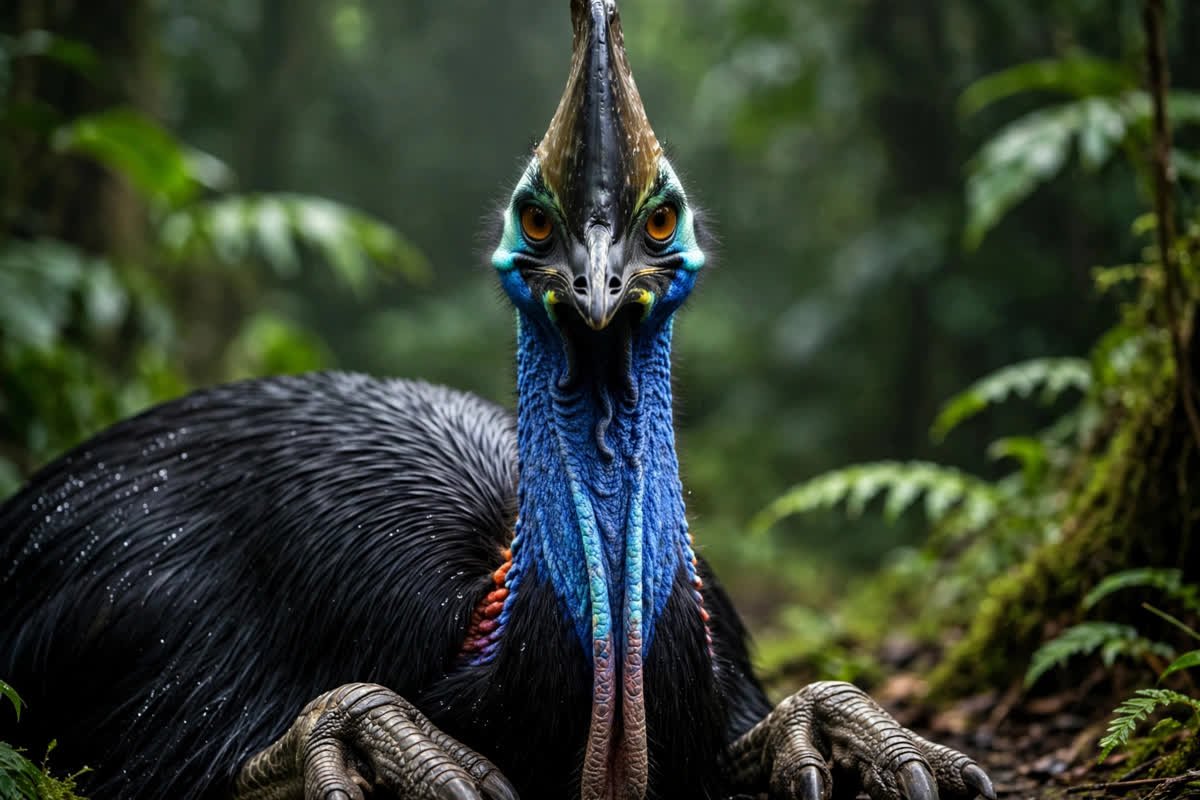
Yes, birds are dinosaurs. Not distantly related, not merely descended from them in some poetic sense. Every bird alive today, from the sparrow hopping through your garden to the hawk circling a highway, is a living theropod dinosaur, part of the same family tree that produced Tyrannosaurus rex and Velociraptor. Paleontologists settled this question decades ago, and the fossil record has only made the answer more certain since.
The idea still surprises most people because our mental image of a dinosaur is a giant, scaly reptile. Feathers, hollow bones, and nests full of eggs feel like bird things, not dinosaur things. But that is exactly what the fossils show: feathers, hollow bones, brooding parents, and wishbones were all invented by dinosaurs long before the first bird took flight. When you watch a chickadee crack a seed or a hawk fan its tail, you are watching behavior that dinosaurs were practicing 150 million years ago.
Below, the evidence piece by piece: what scientists mean by are birds dinosaurs, the fossils that proved it, the dinosaur traits your backyard birds still carry, the lab test that matched T. rex protein to chicken, and why birds survived the asteroid when the rest did not.
The Short Answer: Yes, Birds Are Living Dinosaurs
Modern biology does not draw a line between birds and dinosaurs. The group called Dinosauria includes every extinct dinosaur and every one of their living descendants, and birds are those living descendants. The American Museum of Natural History puts it plainly: all members of the dinosaur group, including living birds, descended from the very first dinosaur, their common ancestor. That is why birds are a kind of dinosaur, just as humans are a kind of primate.
The idea is not new, though the proof is much stronger than it used to be. Thomas Huxley, the Victorian anatomist nicknamed Darwin’s bulldog, proposed the bird-dinosaur link about 150 years ago after studying fossils like Archaeopteryx. In the 1970s, paleontologist John Ostrom revived Huxley’s argument, pointing out that Archaeopteryx looked remarkably like the small theropod Compsognathus, plus feathers.
The real turning point came in the 1990s and 2000s, when fossil beds in Liaoning, China began yielding feathered dinosaurs preserved in exquisite detail. One discovery after another showed that traits once thought to define birds, from feathers to wishbones to brooding on nests, belonged to dinosaurs first. Today the question of whether birds are dinosaurs is no longer debated among paleontologists. What remains interesting is the detail: which dinosaurs they are, and exactly how the transition happened.
The American Museum of Natural History’s own reading material on the dinosaur-bird connection explains the cladogram evidence with simple diagrams worth studying.
Are Birds Dinosaurs? What Scientists Mean by “Dinosaur”
Part of the confusion comes from the word “dinosaur” itself. In everyday speech it means “extinct giant reptile.” In science it means something precise: Dinosauria, the group of animals that evolved from one particular common ancestor more than 240 million years ago. Every animal that descends from that ancestor is a dinosaur, whether it lived 200 million years ago or showed up at your feeder this morning.
This is standard practice in classification. Birds do not “descend from dinosaurs” in the way you might descend from a grandparent, standing outside the family. They sit inside the family, on a specific branch called theropods, the two-legged mostly carnivorous dinosaurs. The theropod branch includes the giants like T. rex and Allosaurus, the fleet-footed hunters like Velociraptor, and one smaller twig that kept shrinking, growing feathers, and eventually flying: birds.
So the famous phrase “birds evolved from dinosaurs” is true but undersells the story. Birds evolved from theropod dinosaurs and they still are theropod dinosaurs, the same way a dolphin is still a mammal even though it lives in the sea and looks like a fish. Extinction ended most branches of the dinosaur family 66 million years ago. One branch kept going, and its members now number roughly 10,000 species on every continent.
The Fossil Evidence Behind the Answer
The most famous transitional fossil is Archaeopteryx, which lived about 150 million years ago in what is now southern Germany. It was roughly the size of a raven and carried a perfect mosaic of traits: flight feathers, a wishbone, and wings, combined with the teeth, clawed fingers, and long bony tail of a theropod dinosaur. The first specimen was announced in 1861, just two years after Darwin published On the Origin of Species, and it became one of evolution’s most celebrated pieces of evidence. Only about a dozen specimens have ever been found, all from the fine-grained Solnhofen limestone of Bavaria.
Scientists no longer call Archaeopteryx the first bird, because slightly older or equally ancient bird-like dinosaurs such as Anchiornis have since been found. But its importance stands. It showed that the bird body plan, feathers included, was already taking shape deep inside the dinosaur family, 84 million years before the asteroid that ended the Cretaceous.
Then came Liaoning. In 1996 a Chinese research team unearthed Sinosauropteryx in the lakebed deposits of northeastern China, the first dinosaur found with clear fossilized feather coverings. This chicken-sized theropod wore simple filamentous protofeathers over its body, proof that feathers existed long before birds. What followed was a flood: Caudipteryx, a turkey-sized dinosaur with modern-looking feathers on its tail and forelimbs; Microraptor, a four-winged glider with feathers on all four limbs; and Anchiornis, described in a 2009 paper in Nature, a roughly 160-million-year-old feathered dinosaur older than Archaeopteryx itself.
The Liaoning fossils are preserved in astonishing detail because volcanic ash buried the animals in oxygen-free mud, leaving feather barbs, pigments, and even stomach contents intact. As Scientific American’s overview of the discoveries explains, the unavoidable conclusion is that feathers evolved their essentially modern structure in terrestrial, bipedal, carnivorous dinosaurs before the appearance of birds or flight. Feathers were not invented for flying. They were dinosaur technology, repurposed later for the sky.
Traits Birds Inherited From Dinosaurs
Fossils tell one half of the story. The other half is sitting on your windowsill. Birds did not just inherit their feathers from dinosaurs. They inherited a whole toolkit of dinosaur anatomy and behavior, and you can spot the echoes at any feeder.
The wishbone
That little forked bone you pull apart at Thanksgiving is the furcula, a fused pair of collarbones. It is found in theropod dinosaurs as well as birds, where it braces the flight muscles. Archaeopteryx had one, and so did Velociraptor. This one bone ties birds directly to their extinct relatives.
Hollow bones
Both birds and many theropod dinosaurs have hollow, air-filled bones, a weight-saving design that helps big animals move and flying animals fly. Your hawk’s wing bones and a T. rex’s limb bones share the same engineering.
Three-toed feet
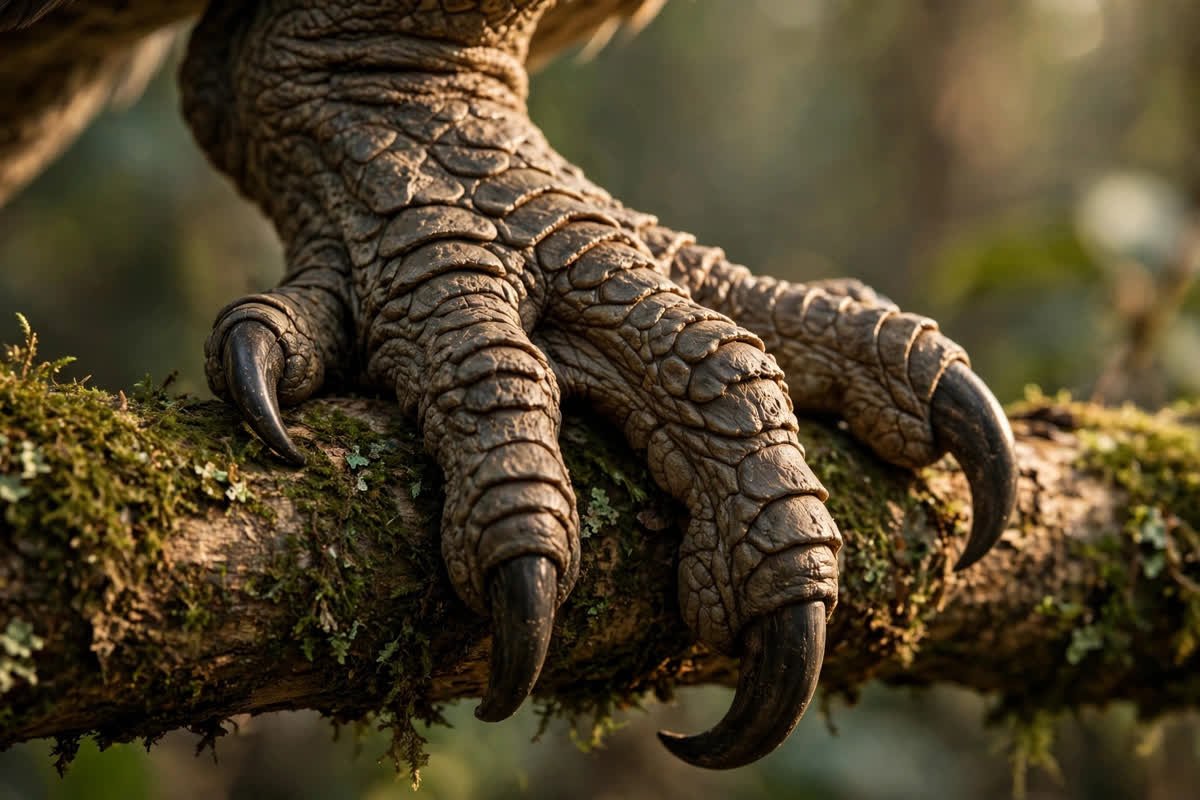
Look at the foot of any songbird, chicken, or hawk: three toes forward, one back, wrapped in scales. Theropod trackways show the same footprint. The scales on a bird’s legs are dinosaur scales, and the claws on an eagle’s toes are dinosaur claws doing exactly what dinosaur claws always did.
Brooding parents
Fossils of oviraptorid dinosaurs like Citipati show adults frozen in a brooding posture, body centered over a ring of eggs with feathered forelimbs spread protectively, essentially the way a hen sits. One famous specimen, nicknamed Big Mama, was preserved sitting on her nest about 75 million years ago. Oviraptor itself was first discovered on top of a nest in the 1920s and was wrongly named “egg thief” because scientists assumed it was raiding another dinosaur’s eggs. Later finds proved the eggs were its own. Dinosaurs were already devoted parents, long before birds existed.
Lungs and breathing
Birds breathe with a one-way airflow system, air moving through the lungs in a single direction, far more efficient than the in-and-out breathing of mammals. Evidence from fossil air sacs suggests this system evolved in dinosaurs before birds, giving even giant dinosaurs the high-octane metabolism that active predators needed.
| Dinosaur invention | Where you see it today |
|---|---|
| Furcula (wishbone) | Every bird, from chickens to condors |
| Hollow pneumatic bones | Hawk wings, duck skeletons |
| Three-toed scaly feet | Songbirds, chickens, eagles |
| Brooding on nests | Hens, robins, nesting raptors |
| Feathers | Every bird on Earth |
| One-way airflow lungs | The warbler singing at dawn |
Look closely at how birds fly and you will see how much of flight is built on dinosaur hardware.
The T. Rex and Chicken Connection
Fossils show the relationship in bone and feather. In 2007, scientists showed it in protein. Mary Schweitzer of North Carolina State University, John Asara of Beth Israel Deaconess Medical Center and Harvard Medical School, and Jack Horner of Montana State University published two papers in Science describing collagen extracted from bone fragments of a 68-million-year-old Tyrannosaurus rex.
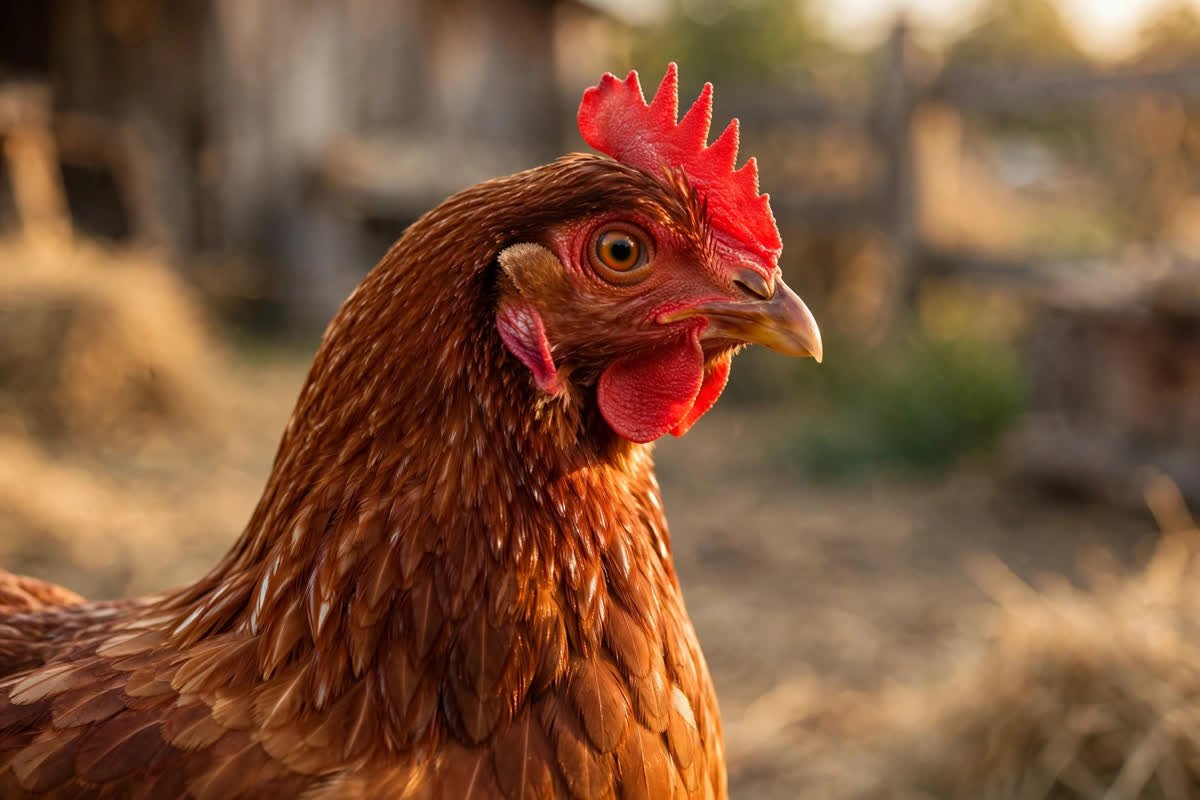
Using a mass spectrometry technique originally developed for studying tiny amounts of protein in human disease, Asara sequenced seven protein fragments from the T. rex bone and confirmed they were collagen. When the team compared those sequences to a database of modern species, the T. rex collagen most closely matched the sequences of modern chickens. The finding was controversial, since scientists had long assumed protein could not survive that long in fossils, and later follow-up work, including a 2009 study on an 80-million-year-old hadrosaur, supported the result.
Honesty matters here. The researchers could not compare the T. rex collagen to alligators or other reptiles, because nobody had sequenced those animals’ collagen yet. So the study did not prove chickens are the closest living relatives of T. rex. What it did show is exactly what dinosaur anatomy already predicted: a molecular fingerprint from a tyrannosaur that looks like the molecular fingerprint of a bird. Schweitzer herself said the similarity to chicken was what they would expect given the relationship between modern birds and dinosaurs.
The chicken at your local farm is not some special ambassador. Every modern bird is equally a dinosaur, equally related to T. rex. The chicken just happened to be the bird in the database.
The original 2007 report on the T. rex protein discovery includes the full context of the Science paper and the controversy it created.
Why Birds Survived the Asteroid (and Other Dinosaurs Did Not)
Sixty-six million years ago, an asteroid roughly six miles wide struck Earth, ending the Cretaceous period and wiping out about three quarters of all species, including every dinosaur except one lineage: the group that includes all modern birds. Scientists have several leading explanations for why birds made it through. These are hypotheses, not settled facts, and they probably worked in combination. It is also worth remembering that most birds died too. Toothed bird groups like the enantiornithes vanished along with the other dinosaurs. Only a small sliver of bird diversity crossed the boundary.
Small bodies needed less food
The surviving birds were small. Research on fossil bone measurements of more than 400 ancient species found that while most dinosaur lineages evolved toward massive sizes, the maniraptoran line leading to birds kept adjusting body mass, with birds weighing under two pounds. When the impact’s dust clouds blocked sunlight and collapsed the food web, a small animal that needed little food had an enormous advantage over an eight-ton predator. Smithsonian coverage of the body-size research describes how being small made birds adaptable in a catastrophe.
Beaks and seeds beat teeth and insects
One of the strongest hypotheses centers on diet. Paleontologist Derek Larson and colleagues studied more than 3,000 fossilized teeth from bird-like maniraptoran dinosaurs, finding that their diversity stayed steady right up to the boundary and then vanished abruptly. Working backward from modern bird diets, the team hypothesized that the last common ancestor of today’s birds was a toothless, beaked seed eater. Seeds can survive in soil for years, so when the forests burned and the plants died, beaked birds could pick through the wreckage for hard, persistent food while insect-eaters and fruit-eaters starved. The full account of the seed-survival study lays out the tooth evidence in detail.
Flight and ground-dwelling flexibility
Flight let birds escape local fires and floods and search far afield for surviving pockets of food. There is also evidence that the bird lineages which survived tended to live on the ground or near water rather than depending on intact forest canopies, which the impact destroyed. Forest specialists, including many toothed birds, had nowhere left to live.
None of these explanations is proven alone, and luck surely played a part. But together they paint a plausible picture: the dinosaurs that survived were small, beaked, flying generalists that could eat seeds and live anywhere, while the specialized giants, and the specialized birds, could not adjust in time.
If you fill a feeder, you are directly feeding the descendants of those survivors. Choosing the right seeds for different birds continues the story that started 66 million years ago.
What This Means at Your Backyard Feeder
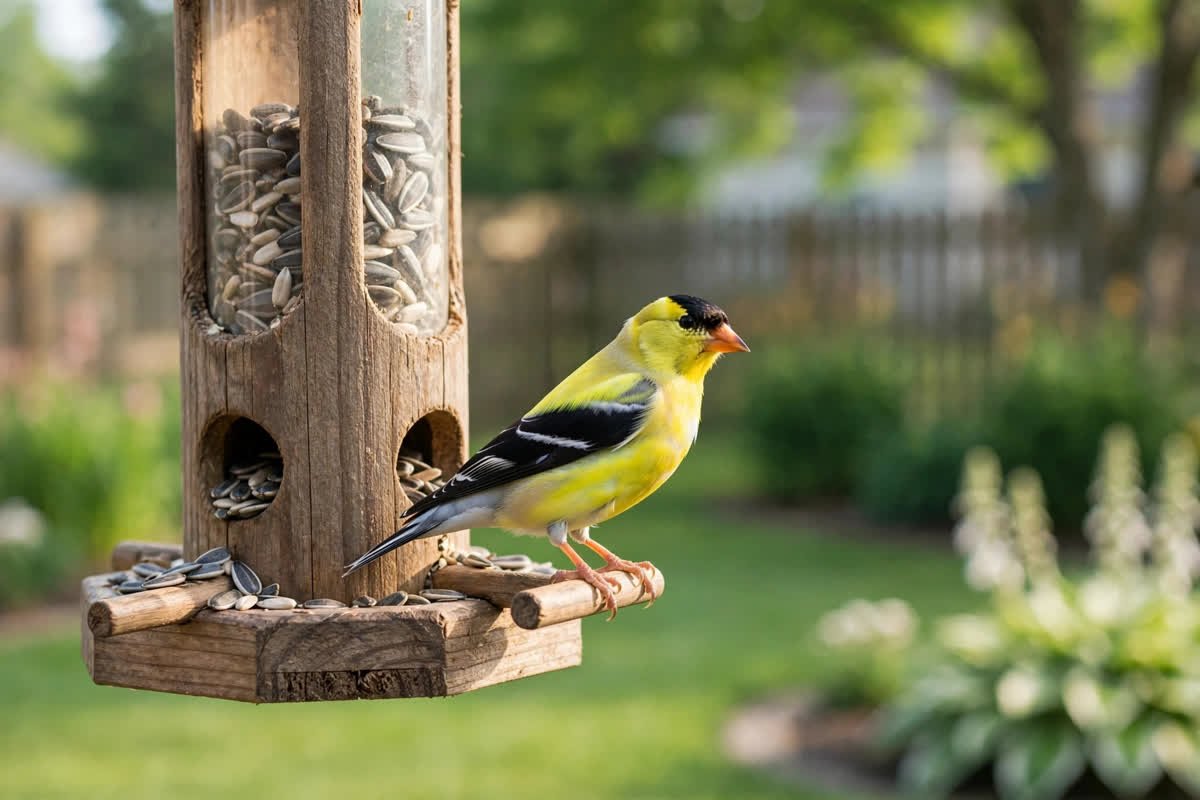
Once you know birds are dinosaurs, the feeder becomes a time machine. Watch a blue jay hammer a peanut with its beak, and you are watching a behavior with 66 million years of survival behind it. Watch a mourning dove inflate its crop, or a chickadee flash the iridescent structure of its feathers in morning light, and you are looking at dinosaur technology in action.
The practical takeaway is simple: observe like a paleontologist. Feet are the easiest place to see the dinosaur in a bird. Next time a bird lands on your feeder, look past the feathers at its legs. The scales, the claws, the jointed toes, these are the parts of a bird that barely changed since theropods walked the Earth. Nesting season shows more dinosaur behavior: parents brooding eggs, turning them, sheltering hatchlings under feathered wings, exactly what Citipati did 75 million years earlier.
You can also impress visitors. Point at the most ordinary bird in your yard and say it is a living dinosaur, then explain the wishbone, the hollow bones, and the T. rex protein that matches chicken. It never fails. To turn your yard into a better observation post, start with the beginner guide to attracting birds, which covers feeders, water, and shelter, and if your regulars suddenly vanish, here is how to troubleshoot a quiet feeder.
Frequently Asked Questions
Did all dinosaurs have feathers?
No. Feathers were widespread among theropods, especially the maniraptoran group closest to birds, but many dinosaurs were scaly. Giant sauropods and most armored and horned dinosaurs appear to have been featherless, and even large tyrannosaurs may have carried only patches of feathers, possibly as juveniles. What changed in the 1990s was not the discovery that every dinosaur was feathered, but the discovery that feathers were a dinosaur invention, not a bird invention.
Are chickens the closest living relative of T. rex?
Not exactly. The 2007 protein study matched T. rex collagen to chicken because chicken was one of the sequenced birds in the comparison database, not because chickens are special. Every modern bird, from ostriches to hummingbirds, is equally a living theropod dinosaur and equally related to T. rex. Among all living animals, birds as a group are the dinosaurs. Crocodilians are the closest living relatives that are not dinosaurs.
What was Archaeopteryx?
Archaeopteryx was a raven-sized, feathered theropod dinosaur that lived about 150 million years ago in what is now Germany. It had flight feathers, a wishbone, and wings, plus teeth, clawed fingers, and a long bony tail. Scientists once called it the first bird, but older bird-like dinosaurs such as Anchiornis have since been found, so Archaeopteryx is now understood as one branch near the origin of birds rather than the ancestor of all of them.
Why did scientists change “birds evolved from dinosaurs” to “birds are dinosaurs”?
The shift came from cladistics, the method of classifying life by common ancestry. In this system, a named group must include an ancestor and all of its descendants. Since birds descend from the first dinosaur, leaving them out of Dinosauria would be like leaving humans out of primates. “Evolved from” is still true, but “are” is the more precise statement.
Why are flightless birds like ostriches and penguins still dinosaurs?
Because flight is not what makes a bird a dinosaur. Ostriches, penguins, kiwis, and cassowaries all sit on the same theropod branch and carry the same core anatomy: wishbone, hollow bones, feathers, and three-toed feet. Penguin wings simply became flippers, and ostrich wings became balance aids for running. Dinosaurs never required flight. Only one twig of the family evolved it, and a few twigs later gave it up again.
What actually killed the other dinosaurs?
An asteroid struck Earth 66 million years ago, marking the end of the Cretaceous. The impact threw up dust and sulfur that blocked sunlight, collapsed photosynthesis, and triggered a global extinction that removed about three quarters of species. Birds, the only surviving dinosaurs, rode out the aftermath with small bodies, beaks, seeds, and flight.
Conclusion
The question are birds dinosaurs has a simple answer and a rich backstory. Yes, birds are living theropod dinosaurs, members of Dinosauria in the full scientific sense, not just relatives of the extinct giants. The proof comes from wishbones, hollow bones, and three-toed feet shared across the family, from feathered dinosaurs preserved in Liaoning’s ash beds, from Archaeopteryx’s mosaic of bird and dinosaur traits, and even from collagen protein in a T. rex bone that reads like chicken.
What makes the story meaningful is what it changes about the everyday. Dinosaurs did not simply vanish. They shrank, feathered up, took to the sky, and survived the worst day in Earth’s history on seeds and small bodies. The sparrow outside your window is the end of that 150-million-year chain, and it still carries the scales, claws, and brooding instincts of its ancestors. Watch a bird tomorrow and remember: you are looking at a dinosaur, and it is thriving.





