 Skip to content

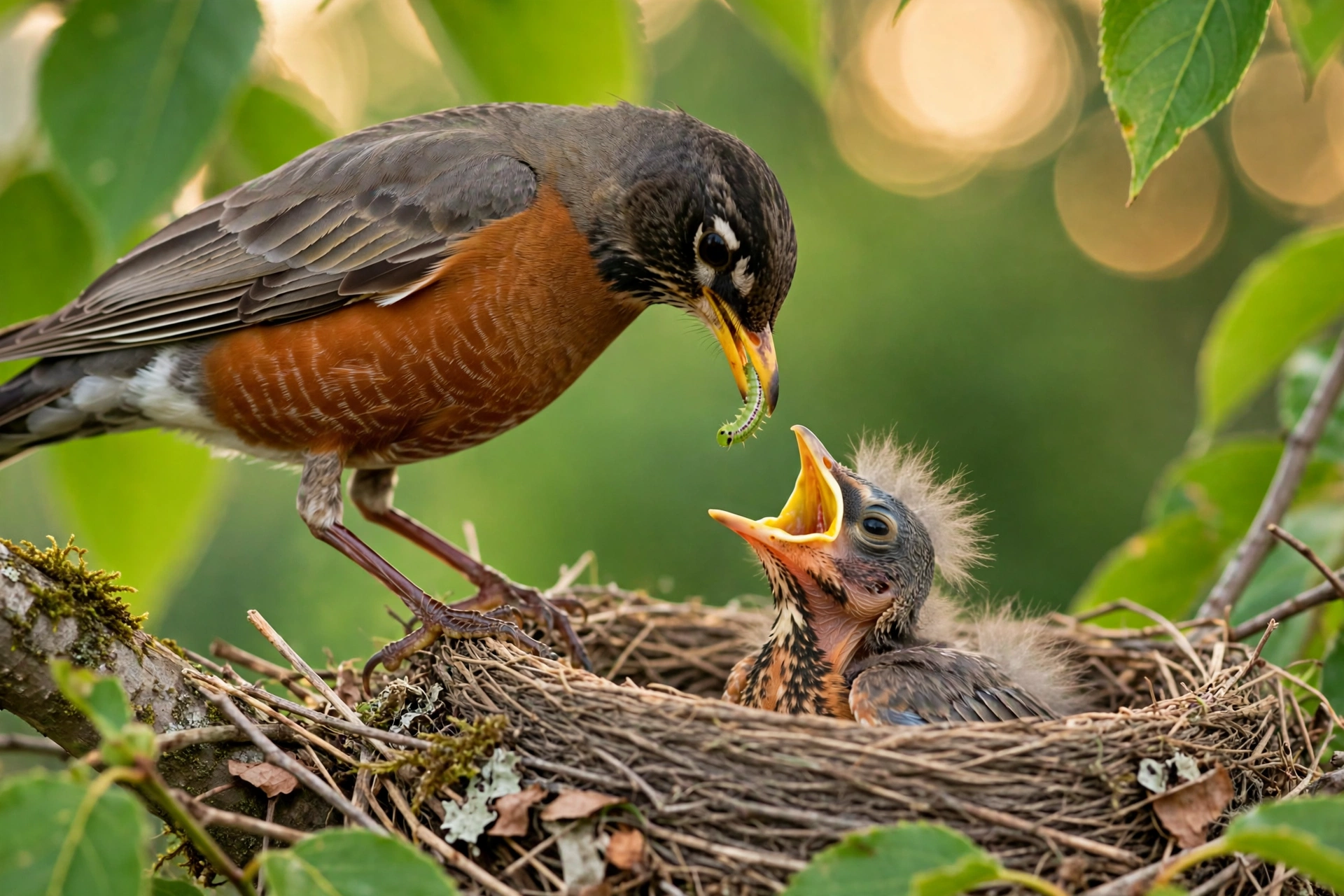
If you have just found a tiny, open-beaked bird in your yard, your first instinct is probably to feed it. Before you reach for bread, seeds, or milk, stop. Most baby birds eat a diet you cannot guess by looking at adult birds, and the wrong food can kill them faster than hunger. This guide explains what parent birds actually feed their young, how the diet changes by species, and what you should really do when you find a baby bird.
The short version: the vast majority of baby songbirds eat soft-bodied insects, caterpillars, spiders, and other small invertebrates that their parents bring them. These foods are rich in the protein a growing chick needs. Seeds, bread, and milk have almost no place in a baby bird’s diet. And in almost every case, the best thing you can do is leave the feeding to the parents and call a wildlife rehabilitator if the bird is truly in trouble.
The Short Answer: What Parent Birds Feed Their Babies
Parent birds feed their chicks a surprisingly narrow menu. For most of the species you will find in a North American backyard, that menu is insects first, insects second, and insects third. Robins arrive at the nest with beaks stuffed with earthworms and grubs. Chickadees, wrens, warblers, and vireos deliver caterpillars, spiders, beetles, and flies, often softened or partially chewed before the chick swallows.
How the food gets delivered depends on the species. Some parents carry each item in the beak and place it directly into the chick’s gaping mouth. Others eat the food first and regurgitate a softened mass into the nestling’s throat. Both methods turn hard-bodied prey into something a chick’s undeveloped digestive system can handle.
This all-insect menu lasts through the nestling period, which is usually just two to four weeks. Once the young leave the nest, the parents keep feeding them while gradually introducing the foods adults eat. A baby cardinal, for example, starts life on insects and only shifts toward seeds as it matures and its digestive system catches up.
There are important exceptions. Doves and pigeons feed their squabs a substance called crop milk. Hummingbird mothers feed tiny insects and spiders along with nectar. Raptors bring torn pieces of meat. But for the songbirds most people encounter, insects are the whole story of early life.
Why Most Baby Birds Eat Insects, Not Seeds
Growing a bird from a helpless hatchling to a flying fledgling in about two weeks is one of the fastest growth spurts in the animal kingdom. That speed demands protein. A chick’s body needs large amounts of amino acids to build muscle, feathers, and organs on a tight deadline, and insects deliver protein in a dense, digestible package that seeds simply cannot match.
Adult birds can afford to be seed eaters because they are no longer growing. A goldfinch may live on thistle seed quite happily, yet even goldfinches feed their nestlings insects and softened food in the first days of life. The digestive systems of chicks are not ready for hard seeds.
Quality matters as much as quantity. Cornell researchers found that diet quality matters more than quantity in tree swallow chicks: chicks fed small amounts of insect prey rich in long-chain omega-3 fatty acids grew faster and developed stronger immune responses than chicks fed larger amounts of lower-quality food. In the wild, aquatic insects are far richer in these fats than land insects, which is one reason wetland health affects songbird breeding success.
This is why a well-meaning person who stuffs a baby bird with bread or birdseed is doing real harm. The chick’s crop fills up with bulk that provides almost none of the protein and fats it actually needs. The bird can starve on a full stomach.

What Baby Birds Eat by Species Group
Not every bird family raises its young on the same menu. Knowing which group your baby bird belongs to explains why one-size-fits-all feeding advice fails.
Songbirds: The Insect Specialists
Songbirds, from robins and bluebirds to sparrows and wrens, make up most backyard nesting birds. Their nestlings are altricial, which means they hatch blind, featherless, and completely helpless. For the first days of life, they eat only what the parents bring: caterpillars, spiders, flies, beetles, aphids, and other soft invertebrates.
Parents feed relentlessly. A pair of chickadees may make hundreds of feeding trips per day during peak growth. As the nestlings feather out, some species begin mixing in softened seeds or berries, but protein remains the foundation until the young can forage on their own.
Doves and Pigeons: The Milk Makers
Doves and pigeons do something no songbird does. Both the male and the female produce a substance called crop milk in a pouch in the throat called the crop. Under the influence of the hormone prolactin, cells of the crop lining fill with protein and fat, then slough off to form a curd-like, nutrient-rich food that the parents regurgitate to their chicks, known as squabs.
Crop milk is astonishingly rich. According to Australian Geographic, it contains antioxidants and immune-boosting factors, and squabs fed on it can double their body weight in their first two days of life. For about the first week, squabs eat nothing else. After that, the parents gradually mix in softened seeds until the young are eating adult food by the second week.
Pigeons and doves are among the very few birds that produce this substance. The others are flamingos and male emperor penguins, which is a useful reminder of how unusual the strategy is.
Hummingbirds: Tiny Insects, Not Just Nectar
Adult hummingbirds are famous nectar drinkers, but their chicks need more than sugar water. A mother hummingbird feeds her nestlings a regurgitated mixture that includes tiny insects and spiders, which provide the protein required for growth. She may visit the nest dozens of times a day, hovering to push food into each chick’s open bill.
This is one reason hummingbird feeders, while helpful for adults, do nothing for babies. A nestling hummingbird fed only sugar water would fail to develop properly. The insects matter.
Raptors and Owls: Torn Meat
Hawks, owls, and other birds of prey raise carnivorous chicks. The parents hunt, then tear the prey into small, swallowable pieces at the nest. Very young raptor chicks cannot swallow large chunks, so the adults do the processing work with their beaks, feeding morsel by morsel.
As the chicks grow, they graduate to larger pieces and eventually to whole prey items that they tear apart themselves. A young owl’s diet looks nothing like a songbird’s, which is exactly why feeding advice must be species specific.
Ducks, Killdeer, and Other Self-Feeders
Some birds skip the helpless stage entirely. Ducklings, goslings, killdeer chicks, and grouse chicks are precocial: they hatch covered in down, with open eyes, and can walk within hours. Their parents lead them to food, but the chicks pick it up themselves.
Ducklings dabble for aquatic insects, tiny crustaceans, and soft vegetation under their mother’s guidance. Killdeer chicks run across lawns and mudflats pecking at small insects on their own. These babies do not need to be fed by anyone, human or bird, which is why a lone duckling’s best chance is always to be reunited with its family rather than taken indoors.
Nestlings vs Fledglings: Why the Difference Matters
People often ask what baby birds eat without realizing that the answer depends on the bird’s age and stage. Before you do anything with a baby bird you found, you need to know which stage you are looking at.
| Feature | Nestling | Fledgling |
|---|---|---|
| Appearance | Featherless or sparse down, eyes may be closed | Fully or mostly feathered, short tail, can hop |
| Location | Belongs in the nest | Normally on the ground or low branches |
| Mobility | Cannot move or regulate body heat | Can hop, flutter, and hide |
| Diet | 100 percent parent-delivered food | Still fed by parents, learning to peck and forage |
| What to do | Return to the nest if possible, or call a rehabilitator | Leave alone unless injured or in immediate danger |
A nestling on the ground is an emergency. It cannot keep itself warm, cannot feed itself, and is an easy target for predators. A fledgling on the ground is usually exactly where it is supposed to be. Fledglings spend several days hopping around under bushes while their parents continue to deliver food and teach them to fly.
Many well-meaning rescues are fledglings that never needed rescuing. If the bird is feathered, hopping, and alert, its parents are almost certainly nearby and still feeding it. Removing it cuts off its real food supply and its flight lessons at the same time.

If You Find a Baby Bird, Do Not Feed It
This is the most important section of this guide. If you have found a baby bird and your question is what to feed it, the correct answer is almost always nothing. Wildlife agencies are blunt on this point: do not give the bird any food or water while you figure out what to do next.
The reasons are practical, not just cautious. You probably do not know the species, and each species needs a different diet at a different stage. Food forced into a bird’s mouth can go down the wrong way; birds have an air opening just behind the tongue, and liquid or food placed incorrectly can be inhaled, causing aspiration. A cold, stressed, or injured bird often cannot digest food at all, so feeding can make its condition worse.
What you should do instead depends on the stage. If it is a nestling and you can see the nest, gently put the bird back. Birds have a poor sense of smell, so the old story about parents rejecting a touched chick is a myth. If the nest is destroyed or out of reach, you can fashion a small replacement nest from a berry basket or tub lined with paper towels, secure it in a nearby tree, and place the chick inside so the parents can find it.
If the bird is a fledgling, feathered and hopping, leave it where it is. Keep cats, dogs, and curious children away, and give the parents space to keep feeding it. Only intervene if the bird is in immediate danger, such as in the middle of a road, and then just move it a short distance to cover.
If the bird is injured, caught by a cat, or clearly orphaned, your job is to keep it warm, quiet, and dark in a ventilated box, and then call a licensed wildlife rehabilitator immediately. For the full step-by-step process, see our guide on what to do if you find a baby bird.
The Legal Side: Why You Cannot Raise It Yourself
In the United States, the Migratory Bird Treaty Act makes it illegal to possess a native migratory bird, its nest, or its eggs without a federal permit. That law covers nearly all native backyard songbirds. Trying to raise a baby bird yourself is not just risky for the bird, it is against the law, and only permitted rehabilitators have the training, diet formulas, and facilities to do it properly.
The law does not cover a few non-native species, such as House Sparrows, European Starlings, and rock pigeons. Even then, raising a wild bird correctly is extremely difficult, and a rehabilitator is still the right call.
What Not to Feed a Baby Bird
Good intentions cause most of the damage here. Keep these foods away from any baby bird you encounter:
- Bread: It fills the crop with bulk that has almost no nutritional value for a growing chick. The bird feels full while starving.
- Milk and dairy: Birds cannot digest lactose. Even small amounts can cause serious digestive problems.
- Dry birdseed: Nestlings cannot crack or digest hard seeds. Even adult seed eaters feed their youngest chicks soft foods first.
- Water in the beak: Forcing water into a bird’s mouth can send liquid into its airway. Never drip water into an open beak.
- Raw meat or hamburger: It can carry bacteria that a chick’s immune system cannot handle, and it is the wrong food for songbirds anyway.
- Worms from treated lawns: Earthworms are natural food for robins, but worms from lawns treated with pesticides or fertilizers can be toxic. Only the parents know which hunting grounds are safe.
You may read online that soaked cat kibble or hard-boiled egg can serve as emergency food. Some rehabilitators do use specialized formulas, but these are stopgap measures used by trained people who know the species and the technique. For an untrained finder, the Washington Department of Fish and Wildlife’s guidance is clear: while waiting for help, do not give the baby bird any food or water at all. Warmth, quiet, and a quick call to a rehabilitator save more lives than any kitchen remedy.
How to Help Baby Birds Get Enough Food
If you want to support the baby birds in your neighborhood, the most powerful thing you can do is feed the parents by feeding the landscape. Parent birds work hardest during nesting season, when a single brood can require thousands of insect deliveries before the chicks fledge. A yard rich in insects makes every one of those trips shorter and more successful.
Plant native trees, shrubs, and flowers. Native plants host the native caterpillars and insects that local birds evolved to feed their young. A single native oak, for example, can support hundreds of caterpillar species, while a non-native ornamental may support almost none.
Cut back on pesticides. Broad-spectrum insecticides remove the insects that baby birds depend on, and even weed killers can reduce the plant diversity that supports insect life. Tolerating a few chewed leaves is one of the kindest things a gardener can do for nesting birds.
Keep cats indoors during breeding season. Free-roaming cats kill enormous numbers of fledglings each year, many of them young birds that were being fed normally by their parents until the attack. Indoor life is safer for the cat too.
Finally, learn the timeline. Knowing how long baby birds stay in the nest helps you recognize when a grounded fledgling is developing normally and when a nestling truly needs help. Most songbirds fledge within two to four weeks of hatching, so a feathered hopper in June is usually a success story, not a rescue case.

Frequently Asked Questions
Can baby birds eat bread?
No. Bread has almost no nutritional value for a growing chick, and it fills the crop so the bird stops begging for the protein-rich food it actually needs. Never feed bread to a baby bird.
Can I feed a baby bird earthworms?
Earthworms are natural food for species like robins, but you should not feed them yourself. Worms from treated lawns can carry pesticides, and an untrained person can easily injure the bird while trying to feed it. Leave feeding to the parents or a licensed rehabilitator.
Do baby birds drink water?
Nestlings get all the moisture they need from the food their parents deliver. You should never drip water into a baby bird’s beak, because liquid can enter the airway just behind the tongue and cause the bird to aspirate. Offer no water; call a rehabilitator instead.
How often do parent birds feed their babies?
Very often. A featherless nestling may be fed every 15 to 20 minutes from sunrise until nightfall, which means hundreds of feeding visits per day at peak growth. This relentless schedule is another reason human stand-ins almost always fail: no person can match it.
Should I put a baby bird back in its nest?
If it is a nestling, meaning featherless or only partly feathered, and you can reach the nest safely, yes. Gently place it back. The parents will not reject it because you touched it; most birds have a poor sense of smell. If you cannot find or reach the nest, contact a wildlife rehabilitator.
Is it legal to raise a baby bird I found?
For native species in the United States, no. The Migratory Bird Treaty Act prohibits possessing native migratory birds without a federal permit, and raising a wild chick properly requires training most people do not have. A few non-native species, like House Sparrows and European Starlings, are not covered, but a rehabilitator remains the best option in every case.
Conclusion
What do baby birds eat? For most backyard species, the answer is a steady delivery of insects, spiders, and other small invertebrates, served by parents from dawn to dusk. Doves and pigeons use crop milk, hummingbirds add tiny insects to nectar, and raptors serve torn meat, but the principle is the same: baby birds need the exact food their species evolved to provide, on a schedule no human can match.
That is why the kindest response to a found baby bird is restraint. Identify whether it is a nestling or a fledgling, return nestlings to the nest when you can, leave healthy fledglings alone, and call a licensed wildlife rehabilitator for anything injured or truly orphaned. Do not feed it, do not water it, and do not try to raise it yourself.
For lasting impact, make your yard a place where parent birds find food easily. Native plants, fewer pesticides, and indoor cats add up to thousands of successful insect deliveries every nesting season. The baby birds will eat well, and you will get to watch it happen.





