 Skip to content

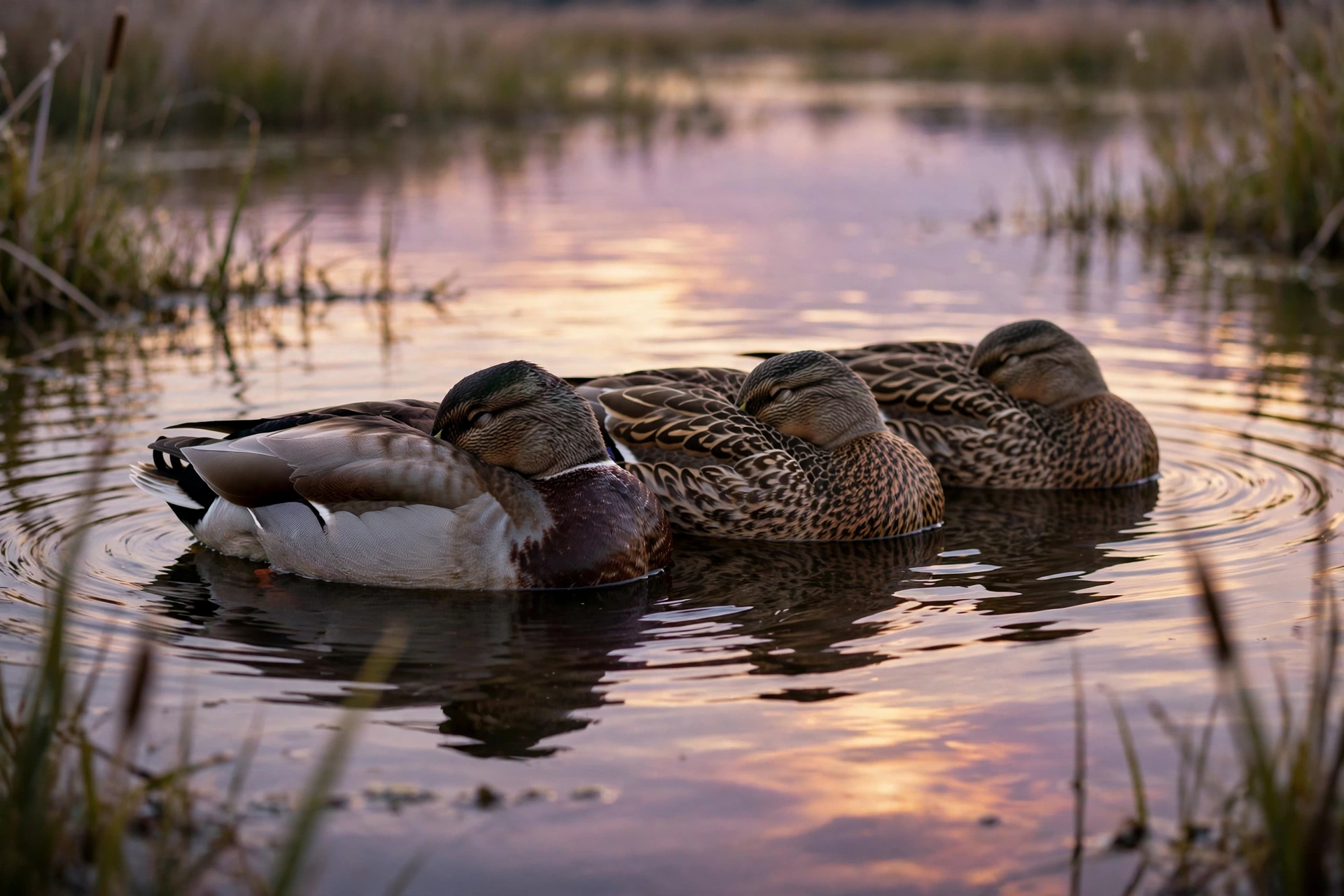
Most ducks sleep at night right on the water. They gather in floating groups, tuck their bills back under their wing feathers, and doze in stretches through the dark hours. Some settle instead on quiet shorelines, in dense reeds, or in sheltered wetlands, depending on the species and the weather.
Night is not one long, uninterrupted sleep for ducks. Many species feed, court, and preen after dark, resting in between. What makes their rest remarkable is how they stay safe while doing it: ducks can sleep with half of the brain awake and one eye open, scanning for predators. A waterproof down coat, a tucked bill, and a tucked-up leg keep them warm even in cold water.
In this guide, you will learn exactly where ducks sleep at night, how unihemispheric sleep keeps them alive, how they stay warm without blankets, how dabbling and diving ducks differ, and what changes when winter arrives.
Where Ducks Sleep at Night: Water, Shore, and Reeds
Ducks do not build special sleep nests, and most never perch in trees. Unlike songbirds, ducks lack the foot anatomy to grip a branch all night, so they stay at water level. That is a very different strategy from where other birds sleep at night, where perches and cavities dominate.
Floating Rafts on Open Water
The most common duck bedroom is the water itself. Dabbling ducks like mallards, teal, and pintails often sleep while floating in loose groups called rafts. Water puts distance between a dozing duck and land predators such as foxes, raccoons, and coyotes, which hunt along banks at night.
Sleeping ducks do not simply drift helplessly. They doze in short stretches, wake to check their surroundings, and settle again. Birds in the middle of a raft tend to sleep more deeply, while birds on the edges stay more alert.
Sheltered Shorelines and Reedy Beds
Many ducks leave open water for cover when they rest. Dense cattails, flooded brush, and quiet banks hide sleeping birds from both ground predators and owls. Research in the Mississippi River floodplain found that flooded willow thickets gave roosting ducks a warmer, more sheltered microclimate than open deep water or flooded corn, and the closed canopy also screened them from great horned owls.
Reeds offer a second advantage beyond concealment. Tall vegetation breaks the wind, and still air holds warmth better than moving air. A duck tucked into reeds on a cold night loses far less body heat than one sitting on open water in a breeze.
Night Feeding Breaks Up the Rest
Ducks do not sleep the whole night through. As described in Ducks Unlimited’s look at what ducks do after dark, many species spend much of the night feeding. Diving ducks on the Great Lakes take flight at dusk from open-water roosts and move to shallower near-shore areas to feed through the night. Mottled ducks spend more time feeding at night than during the day.
Patterns vary by species and place. Mallards in the Mississippi Alluvial Valley often feed in flooded timber during the day and roost somewhere else at night, while pintails in Texas and Louisiana feed largely at night in flooded rice fields. The general rule is that duck sleep comes in flexible stretches, fitted around feeding, preening, and courtship.
The Half-Awake Trick: One Eye Open, Half the Brain Asleep
Ducks possess one of the strangest sleep abilities in the animal kingdom. They can put one hemisphere of the brain to sleep while the other stays awake and alert. Scientists call this unihemispheric slow-wave sleep, and ducks may be its most famous practitioners.
The landmark evidence came in 1999, when sleep researcher Niels Rattenborg and his colleagues filmed rows of sleeping mallards. Birds resting at the ends of a row were about two and a half times more likely to keep one eye open than birds in the middle, and the open eye was almost always the outward-facing one. Brain recordings showed that the hemisphere opposite the open eye displayed slow-wave sleep while the other stayed alert. When the researchers showed the ducks a video of an approaching predator, the half-awake birds reacted within a fraction of a second.
Even more remarkably, edge ducks sometimes turned themselves around 180 degrees during the night and switched which eye stayed open. That rotation lets each hemisphere of the brain get its turn at genuine rest, while one side always keeps watch.
The Birds on the Edge Carry the Watch
Ducks in the center of a sleeping group typically shut both eyes and sleep more deeply. Ducks on the exposed edges take the lighter, one-eyed sleep, effectively serving as sentinels for the flock. As Scientific American’s report on animals that sleep with one eye open notes, researchers have observed mallard sentinels passing lookout duty to companions on other days, so the cost of lighter sleep gets shared around.
This arrangement is the flock’s early warning system. One startled edge bird erupts into motion and sound, and the whole raft wakes in an instant. The many-eyes principle means a group spots danger far faster than any lone duck could.
Do Ducks Dream?
Birds do experience rapid eye movement sleep, the stage associated with dreaming in humans, but in resting waterfowl the deep slow-wave stages dominate. Research summaries note that unihemispheric sleep in birds is sometimes combined with brief episodes of full-brain slow-wave sleep and REM. Ducks appear to get most of their restorative rest from slow-wave sleep, with REM playing a smaller, still poorly understood role.

How Ducks Stay Warm While They Sleep
A duck’s normal body temperature sits near 40 degrees Celsius, about 104 Fahrenheit. Holding that heat through a cold night on water demands serious insulation, and ducks carry it built in. They also run a set of clever tricks to plug every leak.
A Down Coat That Never Gets Wet
Ducks wear one of nature’s best sleeping bags. A dense layer of down feathers traps a pocket of still air against the skin, and still air is an excellent insulator. Over the down sits a layer of stiff outer contour feathers, which the duck waterproofs by spreading oil from the uropygial gland near the base of its tail.
Regular preening keeps this system working. A duck that skips maintenance ends up with wet, matted feathers and loses heat fast. That is why even dozing ducks pause their naps to preen: dry feathers are warm feathers.
Tucking the Bill Under the Wing
The classic sleeping-duck pose, with the bill buried in the back feathers, is a heat-saving move. The bill is bare skin with a rich blood supply, so it radiates heat quickly. Tucking it into warm plumage cuts that loss dramatically and lets the duck breathe air that its own body has already warmed.
Before tucking in, a sleeping duck fluffs its feathers. Fluffing thickens the trapped-air layer, boosting insulation exactly when the bird’s heat production drops during rest.
One Leg Up and a Built-In Heat Exchanger
A duck’s legs and feet are unfeathered and sit in cold water or on frozen ground all night, yet they rarely freeze. Two mechanisms explain why, and both are worth a closer look in our guide to why birds’ feet don’t freeze in winter. First, ducks often stand or rest with one leg tucked up into the warm belly feathers, halving the bare surface exposed to the cold.
Second, duck legs contain a countercurrent heat exchanger, a dense network of blood vessels where warm arterial blood flowing down passes right beside cold venous blood flowing back up. Heat jumps from the outgoing artery to the incoming vein, so warmth is recycled before it ever reaches the foot. The foot itself runs just above freezing, while the core stays toasty. It is an elegant plumbing solution that costs almost no extra energy.
Dabbling Ducks vs Diving Ducks: Night Roosts Compared
Not all ducks sleep alike. Dabblers feed at the surface by tipping up, while divers plunge deep for food, and their different bodies and diets lead to different nighttime habits.
| Night habit | Dabbling ducks (mallards, teal, pintails) | Diving ducks (canvasbacks, scaup, buffleheads) |
|---|---|---|
| Favorite roost | Shallow sheltered water, reedy shorelines, flooded timber | Open deep water, often far from shore |
| Night feeding | Many species feed heavily at night, such as pintails in flooded rice fields and mottled ducks in shallow marshes | Some fly at dusk from deep-water roosts to shallower feeding areas; others, like buffleheads and lesser scaup, feed more by day |
| Sleep posture on water | Float low in sheltered shallows, often near vegetation | Ride deeper swells in open water, sometimes in large rafts |
| Winter strategy | Commute nightly between feeding fields and sheltered roosts | Gather in big open-water rafts close to deep feeding grounds |
The pattern makes sense when you think about food. Dabblers eat seeds, grains, and shallow-water plants, which grow in the same sheltered shallows where they like to rest. Divers chase mollusks, fish, and deep-water invertebrates, so they roost over the deep water they will hunt again at dawn.
Winter Roosting: Surviving the Coldest Nights
Winter raises the stakes of every night’s rest. Waterfowl choose their roosting sites based on temperature, wind, humidity, and sky conditions, and at night they consistently pick sheltered habitats that conserve body heat. Clear, calm nights are actually the hardest, because open habitats lose the most heat to the sky.
Ducks meet the cold with a layered defense. They roost in flocks, which shares vigilance and lets each bird sleep a little deeper. They select coves, flooded timber, and leeward shores out of the wind. And they burn stored fat reserves, which is why a duck’s condition going into winter matters so much for surviving it.
Some ducks skip the worst of it entirely. If you are curious about the ones that leave, see our guide to where birds go in winter. The ducks that stay behind are the ones with the best insulation and the most reliable open water.
Sleeping Near Ice
Ducks do not usually sleep on ice if they can avoid it. Open water, even near-freezing water, is safer than ice because a sleeping duck on ice is fully exposed to wind and land predators. On bitter nights, ducks crowd into whatever open water remains: moving currents, spring-fed pockets, and outflows from dams or power plants.
That said, ducks are remarkably unfazed by ice underfoot when they must stand on it. The countercurrent system in their legs keeps their feet just above freezing, and they can tuck one leg away entirely. A duck asleep on a frozen bank looks uncomfortable to us, but its core is as warm as ever.

Why Ducks Sleep in Flocks: Safety in Numbers
A lone sleeping duck is vulnerable from every direction. A flock of fifty is a different proposition. Group sleeping works through simple math and shared senses.
- More eyes, less work: with dozens of birds scanning, each individual can afford deeper rest. Research on flocking birds has long shown that vigilance per bird drops as group size grows and as a bird moves toward the group’s center.
- The dilution effect: a predator that strikes a raft faces many possible targets, so any one duck’s chance of being the victim is small.
- Collective alarm: ducks react to each other’s alarm calls instantly. One bird’s panic becomes the whole flock’s takeoff within seconds.
- Predator confusion: a raft exploding into flight in every direction makes it hard for an owl or fox to fix on a single target.
This is also why roost sites stay traditional. Ducks return to the same safe waters night after night, and some roosts host thousands of birds for an entire season. A proven safe bedroom is worth defending, and in late winter you can watch competing flocks jostle for the best spots.
How City and Park Ducks Sleep Differently
Ducks that live around people bend the rules. Park mallards learn that joggers, dogs on leashes, and picnic blankets are not real threats, and they adjust their sleep accordingly. By day you will often see them dozing openly on lawns, paths, and pond edges, catching rest when the local danger feels low.
At night most city ducks still gather on the water, but their roosts reflect the urban landscape. Small islands in park ponds, fenced-off wetland corners, and quiet stretches of canal become prime real estate. Artificial light seems to stretch their active hours, with some urban flocks feeding and socializing later into the evening than their wild cousins.
One habit does not change: the need for safety. Even the boldest park duck keeps its bill tucked, one eye ready, and a flock around it. Habituation lowers their fear of people, but foxes, raccoons, and owls hunt in cities too, and ducks sleep as if they know it.

Frequently Asked Questions
Do ducks sleep in the water at night?
Yes, most do. Dabbling ducks like mallards and teal commonly doze while floating in groups on the water, and diving ducks sleep in rafts over deep open water. Water separates them from land predators, which makes it one of the safest places to rest. Some ducks prefer reedy shorelines or sheltered banks when the weather turns harsh.
Do ducks sleep with one eye open?
Often, yes. Ducks can sleep with one brain hemisphere at a time while the other stays alert, a state called unihemispheric slow-wave sleep. In a famous 1999 study of mallards, birds on the edges of a sleeping group kept their outward-facing eye open about 86 percent of the time. The open eye feeds the awake hemisphere, so the duck can react to a predator in a fraction of a second.
Why do ducks tuck their bills under their wings when they sleep?
To stay warm. The bill is unfeathered and loses heat quickly, so burying it in the warm back feathers cuts heat loss and lets the duck breathe pre-warmed air. The tucked pose also fluffs the surrounding feathers, thickening the insulating air layer around the bird’s body.
Why do ducks stand on one leg when they sleep?
To conserve heat. Duck legs and feet are bare and lose warmth fast, so tucking one leg into the belly feathers halves the exposed surface. A countercurrent heat exchanger in the leg recycles warmth from outgoing blood into incoming blood, keeping the core warm while the foot runs just above freezing.
Do ducks sleep at night or during the day?
Both. Ducks rest at night in flexible stretches, but many species also feed, court, and preen after dark, so night is not one solid block of sleep. They nap during the day too, especially in safe spots. Wild ducks tend to sleep more deeply at night, while city ducks often catch up on rest in daylight.
Where do ducks sleep in winter?
In the most sheltered open water they can find: coves, flooded timber, leeward shores, and unfrozen pockets near currents or outflows. They roost in larger flocks than in summer, burn fat reserves through the coldest nights, and avoid exposed ice when open water is available. Some species migrate south instead of toughing it out.
Conclusion
Ducks sleep at night wherever water and safety meet: floating in communal rafts on open water, tucked into reeds and flooded thickets, or gathered on sheltered shorelines. They rest in flexible stretches rather than one long slumber, fitting sleep around nighttime feeding, preening, and courtship. Their half-awake brain lets edge birds stand guard with one eye open while the flock rests, and researchers have watched them trade that watch duty so no bird bears the cost alone.
Staying warm is the other half of the story. Waterproofed down, a bill tucked into warm feathers, one leg folded away, and a countercurrent heat exchanger in the legs let a duck hold a body temperature near 40 degrees Celsius through freezing nights. Next time you see a pond full of motionless ducks at dusk, look closely. Half of those brains are still on duty, and every tucked bill and folded leg is doing quiet, precise work.






[…] day on the water, ducks tuck the bill and feet into this warm envelope to rest, which is part of where ducks sleep at night and how they stay comfortable doing […]