 Skip to content

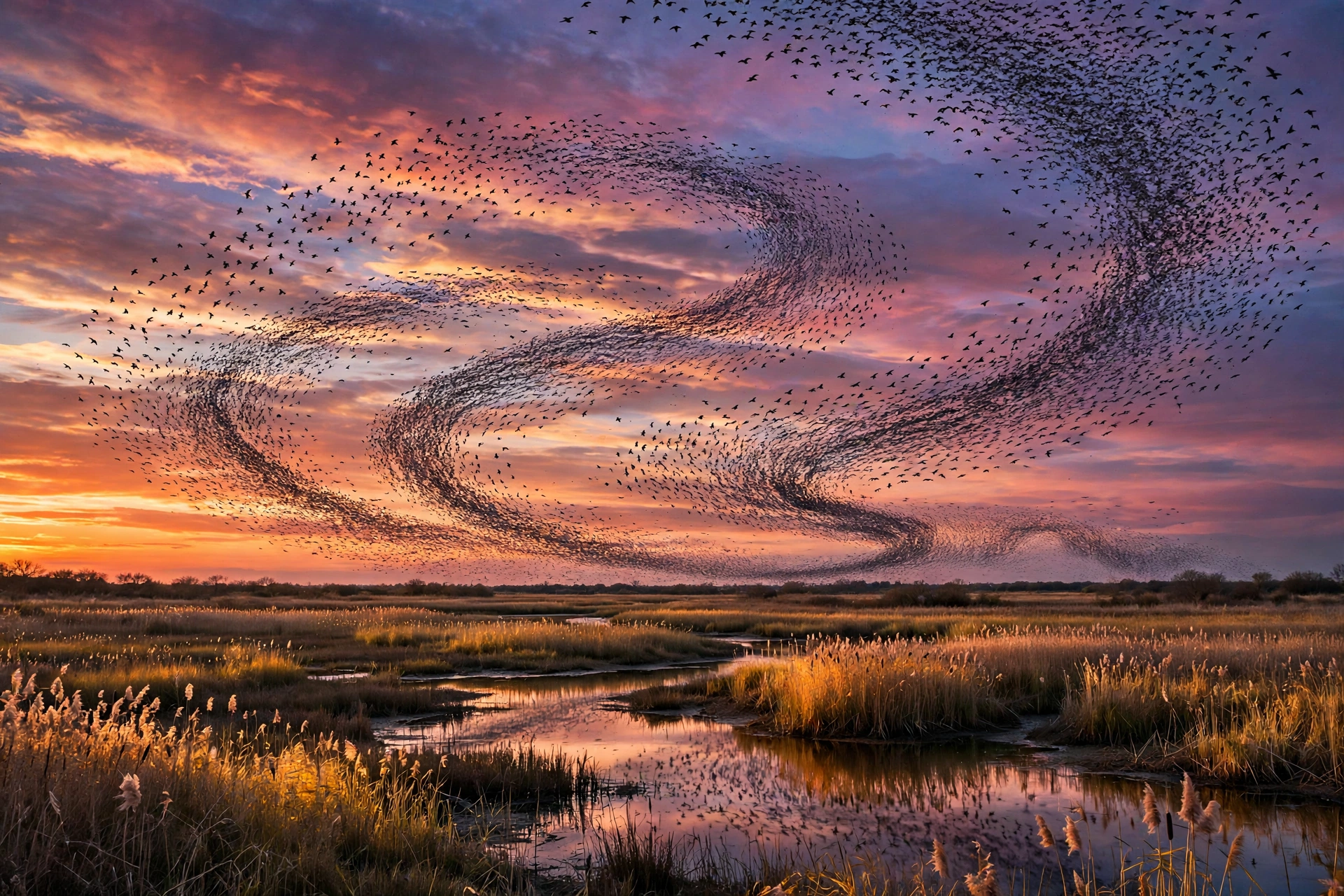
Right now, as October dusk settles, something extraordinary is starting over reedbeds, piers, and city rooftops across the US and UK. First a few dozen starlings stitch across the fading sky. Then hundreds. Then thousands, pouring in from every direction until the air itself seems to move. The flock thickens into a black river, and that river begins to dance: ribbons, waves, spirals, and sudden pulsing spheres that bloom and dissolve in seconds. Murmuration season has begun, and videos of these sky dances are spreading across social media again.
Beneath the beauty sits a harder question. Why do starlings burn precious evening energy wheeling around instead of simply dropping into the reeds to sleep? The answers come from physics, predator-prey ecology, and some of the most elegant field experiments in behavioral science. If you are new to the phenomenon, our companion piece explains what a murmuration is. This article goes deeper, into the why.
The Short Answer: Three Reasons Starlings Murmurate
Scientists have not settled on a single cause, and the honest answer is that several pressures push starlings toward the same spectacular behavior. Three explanations carry the most evidence, and they work together rather than competing.
- Predator confusion: A shifting, three-dimensional cloud is nearly impossible for a hawk or falcon to read. The constant motion breaks a predator’s ability to lock onto one bird, while the sheer number of bodies dilutes each individual’s risk. This explanation has the strongest direct evidence.
- Information sharing: The aerial gathering may help birds recruit each other to rich feeding grounds and coordinate the communal roost. This is a respected hypothesis, but the evidence is thinner and still debated.
- Warmth and safety at the roost: The dance ends with thousands of birds packed into one roost, and communal roosting offers vigilance and possibly shared warmth through the night. The warmth part of the idea has found only weak support in the data.
Keep those three in mind. Now we can unpack the mechanism that makes the whole thing possible, because the choreography itself is as fascinating as the reasons behind it.
How a Crowd Becomes Choreography: The Science of Self-Organization
A murmuration of 30,000 birds can change direction in a fraction of a second. No bird could shout instructions across that distance, and no leader steers the group. The coordination emerges from below, through a principle scientists call self-organization: complex global patterns arising from simple local rules repeated thousands of times.
No Leader in the Sky
Watch a murmuration closely and you will see turns begin at one edge of the flock, not at its center. Three-dimensional tracking studies have shown that direction-switching is spatially localized: the birds that turn first are clustered together, and the turn then propagates through the group by bird-to-bird information transfer, like a ripple crossing a pond.
Models of this process suggest a starling cruises through a murmuration at around 45 kilometres per hour, and that small variations in speed and direction among neighbors are what build the giant shapes. Nobody is choreographing the waves. Each bird is simply responding to the birds closest to it, and the waves are what thousands of those responses look like from the ground.
Each Bird Tracks About Seven Neighbors
The breakthrough in understanding this came from an unusual collaboration between physicists and ornithologists in Rome. The STARFLAG project photographed starling flocks of a few thousand birds above the city with multiple synchronized cameras, then reconstructed the three-dimensional position of every bird in the flock.
The results, published by Ballerini and colleagues in the journal Proceedings of the National Academy of Sciences in 2008, were striking. Each bird interacts on average with a fixed number of neighbors, six to seven, regardless of how crowded or spread out the flock is. The researchers called this a topological interaction, meaning it depends on the number of neighbors rather than on distance (Ballerini et al. 2008, PNAS).
The distinction matters. In a metric system, a bird would watch everything within, say, ten metres, so its number of contacts would rise and fall with density. In a topological system, a starling always tracks its six or seven nearest neighbors, even if they are far away. The researchers argued this keeps the flock cohesive through the wild density changes caused by a predator attack, exactly when unity matters most.
Scale-Free Correlations: One Bird Moves, Thousands Feel It
Later STARFLAG work pushed the finding further. Researchers measured how movement correlations travel through a flock and found they are effectively scale-free: the behavioral state of one bird can influence, and be influenced by, birds far away, no matter how large the flock grows (Cavagna et al. 2010, PNAS).
In plain terms, the flock behaves like a single responsive material. A falcon’s approach at one edge can reshape the entire cloud almost instantly. That is why a murmuration can fold, split, and rejoin with such eerie speed. The beauty you see is the visible edge of an information network running at the speed of reaction.

Predator Confusion in Action
Of all the proposed reasons for murmuration, protection from predators has the strongest support. Starlings are hunted on the wing by peregrine falcons, which strike at terrifying speed, and by sparrowhawks, which ambush from cover. A lone starling against either is in trouble. Ten thousand starlings moving as one are a different problem entirely.
Three overlapping effects do the work:
- The confusion effect: Most aerial predators hunt by targeting one specific bird. The constant shifting of a murmuration makes it hard to lock onto a single target, an effect researchers call target degeneracy. The predator’s visual system is overwhelmed by choice.
- The dilution effect: In a flock of N birds, any one bird’s chance of being the victim drops toward 1/N. Safety scales with numbers.
- The detection effect: Thousands of eyes beat two. More watchers mean earlier warnings, and each bird can afford to spend less time scanning and more time feeding.
There is also the selfish herd at play. Within the flock, birds on the exposed edge continually jostle toward the center, which is why murmurations pulse and contract into dense balls when a falcon closes in. Every bird is trying to put other birds between itself and the teeth.
The most convincing evidence comes from a remarkable citizen science project run over two winters by researchers at the University of Gloucestershire. More than 3,000 murmurations were logged by volunteers across 23 countries. Birds of prey were recorded at about 29% of the events, and their presence was strongly linked to bigger, longer displays: predator presence explained roughly 40% of the variation in flock size and about 26% of the variation in duration. When predators were actively engaging the flock, murmurations also tended to end with every bird dropping en masse into the roost rather than drifting away. The study’s overall conclusion was direct: murmurations look like an anti-predator adaptation first and foremost (Goodenough et al. 2017, PLOS ONE).
To put the scale in perspective, the average murmuration in that study held about 30,000 birds, the largest reached 750,000, and the average display lasted 26 minutes. When a peregrine cruises over a roost at dusk, it is watching a living system engineered, over millions of years, to defeat exactly its hunting style.

The Information Center Hypothesis: Roosts as Newsrooms
Not every explanation for murmuration is about fear. In 1973, researchers Ward and Zahavi proposed that communal roosts function as information centers: birds that found poor feeding that day could follow successful foragers out the next morning, and the evening gathering would be the mechanism that brings everyone together to exchange that information.
It is an elegant idea, and versions of it have been supported in some colonially roosting species. But for starlings it remains a hypothesis rather than a settled fact. The citizen science data did not show the patterns you would expect if the displays were mainly about recruitment, and researchers have been careful not to overstate the case.
That said, information exchange and predator defense are not mutually exclusive. A murmuration that gathers thousands of birds at one site inevitably creates opportunities for social learning, whether or not that was the original point. Evolution is thrifty: a behavior that starts for one reason often gets kept for several.
Warmth and Safety in Numbers
The display ends the same way almost every night: the sky dance collapses and the birds pour down into reeds, trees, or the ledges of a pier. Communal roosting itself is clearly valuable. Packed together, birds share vigilance through the night, and a larger roost may offer thermal benefits when temperatures drop.
But the specific claim that murmurations exist to build bigger, warmer roosts, the “warmer together” hypothesis, came up short when tested. In the citizen science study, temperature was negatively correlated with display duration, but the effect was much weaker than the effect of day length, and habitat had no association with murmuration size at all. The researchers concluded that attracting more birds for warmth is not the main driver.
The warmth story deserves one careful footnote. Communal roosting in general still conserves heat and energy for small birds on cold nights, and a bigger roost is plausibly a warmer one. What the data do not support is the idea that the aerial dance itself is an advertisement for warmth. The dance is about the sky; the warmth is a bonus of the bedtime that follows.

When and Where to See a Murmuration
If the science has you wanting to watch one in person, the timing is simple. Murmurations happen at dusk, typically in the 20 to 30 minutes before sunset, as birds gather before dropping to roost. The season runs through autumn and winter: continental starlings arrive in Britain every September and October, displays build from October into early February, then taper off as birds leave in February and March. You can read more about how fall migration timing works to understand why the season peaks when it does.
The UK is the classic destination. Well-known roost sites include Blackpool’s North Pier, Aberystwyth Royal Pier, Brighton Pier, Dorset’s Shell Bay, and Somerset’s Shapwick Heath, and the Natural History Museum’s guide to spotting a murmuration is an excellent starting point. Reedbeds, wetlands, woodlands, and even city centers and industrial structures can all host roosts.
In the US, European starlings form huge roosts too, often in urban areas, farmland, and marshes, though the displays are less famous than Britain’s. One identification tip for American watchers: the dark flocks wheeling over a city at dusk can be starlings, grackles, or mixed blackbird flocks, so check our starling vs grackle identification guide if you want to know what you are watching. Wherever you go, arrive early, stand where you can see the whole sky above the roost, and keep your distance from the birds themselves.
Murmuration vs Other Flock Shapes
Not every wheeling flock is a murmuration, and the differences reveal the purpose behind each shape. This comparison keeps them straight:
| Flock shape | Typical birds | Main purpose | What makes it different |
|---|---|---|---|
| Murmuration | European starlings | Predator defense before roosting | Shifting three-dimensional shapes; the flock stays near the roost rather than traveling |
| V formation | Geese, ducks, cranes, pelicans | Efficient long-distance migration | Steady, leader-following line; birds exploit the upwash from the bird ahead to save energy |
| Kettle | Hawks, vultures, eagles | Gaining altitude on rising thermals | Circular soaring with little flapping; a waiting room for lift, not a display |
| Loose flock | Many species, including blackbirds and waders | Feeding or traveling together | Grouped but uncoordinated; no rapid synchronized shape-shifting |
The key test is simple. If thousands of birds are morphing through waves and spheres above one spot at dusk, you are watching a murmuration. If they are holding a steady formation and going somewhere, it is something else.
Frequently Asked Questions
Do starlings murmurate every night?
Not quite. Displays are most frequent and largest from autumn through midwinter, and even in season they vary night to night. Weather, the number of birds at the roost, day length, and whether predators are around all influence whether a big display forms. Some evenings produce only a brief swirl; others deliver a half-hour spectacle.
How many birds are in a murmuration?
It ranges enormously, from a few hundred to hundreds of thousands. In the large citizen science study, the average murmuration held about 30,000 birds and the largest reached 750,000. Numbers tend to grow from October into early February as migrant starlings join resident birds, then shrink toward spring.
Do other birds murmurate?
The classic dusk murmuration is a starling specialty, but the underlying trick, thousands of birds coordinating through local rules, shows up elsewhere. Dunlin and other waders form similar shifting clouds over estuaries, and some blackbird roosts produce murmuration-like displays. Fish schools and even swarming insects run on closely related mathematics. Starlings just do it bigger and more visibly than almost anyone.
Are starlings invasive?
It depends where you stand. European starlings are native to Europe and Asia, but they were introduced to North America when about a hundred birds were released in New York’s Central Park in 1890 and 1891 by Eugene Schieffelin. They are now one of the continent’s most abundant birds and compete with native cavity-nesters such as bluebirds. In the UK, where they are native, the story is reversed: starling numbers have fallen 67% since the early 1970s, and the species sits on the UK Red List of birds of high conservation concern.
Why don’t the starlings collide with each other?
Each bird continuously tracks about six or seven neighbors and reacts to their movements in milliseconds, maintaining a small buffer zone around itself. Because every bird follows the same rule, the whole flock stays coordinated without anyone needing a map of the entire cloud. Mid-air collisions are remarkably rare, which is part of what makes the display so astonishing to watch.
Conclusion
So why do starlings murmurate? Because the dusk sky is dangerous, and the mathematics of the crowd defeats the danger. Each bird watches a handful of neighbors, those local rules scale into a single rippling organism, and that organism is nearly impossible for a falcon to read. The citizen science record backs it up: when predators show up, murmurations get bigger, last longer, and end with every bird crashing down to safety at once.
The information-sharing and warmth ideas still hover at the edges of the story, and researchers are honest that the full picture is not finished. That is part of the pleasure. This October, as the roosts fill and the videos spread, you can stand under a black river at dusk and know you are watching self-organization, predator-prey warfare, and millions of years of selection, all written across the sky in real time.




