 Skip to content

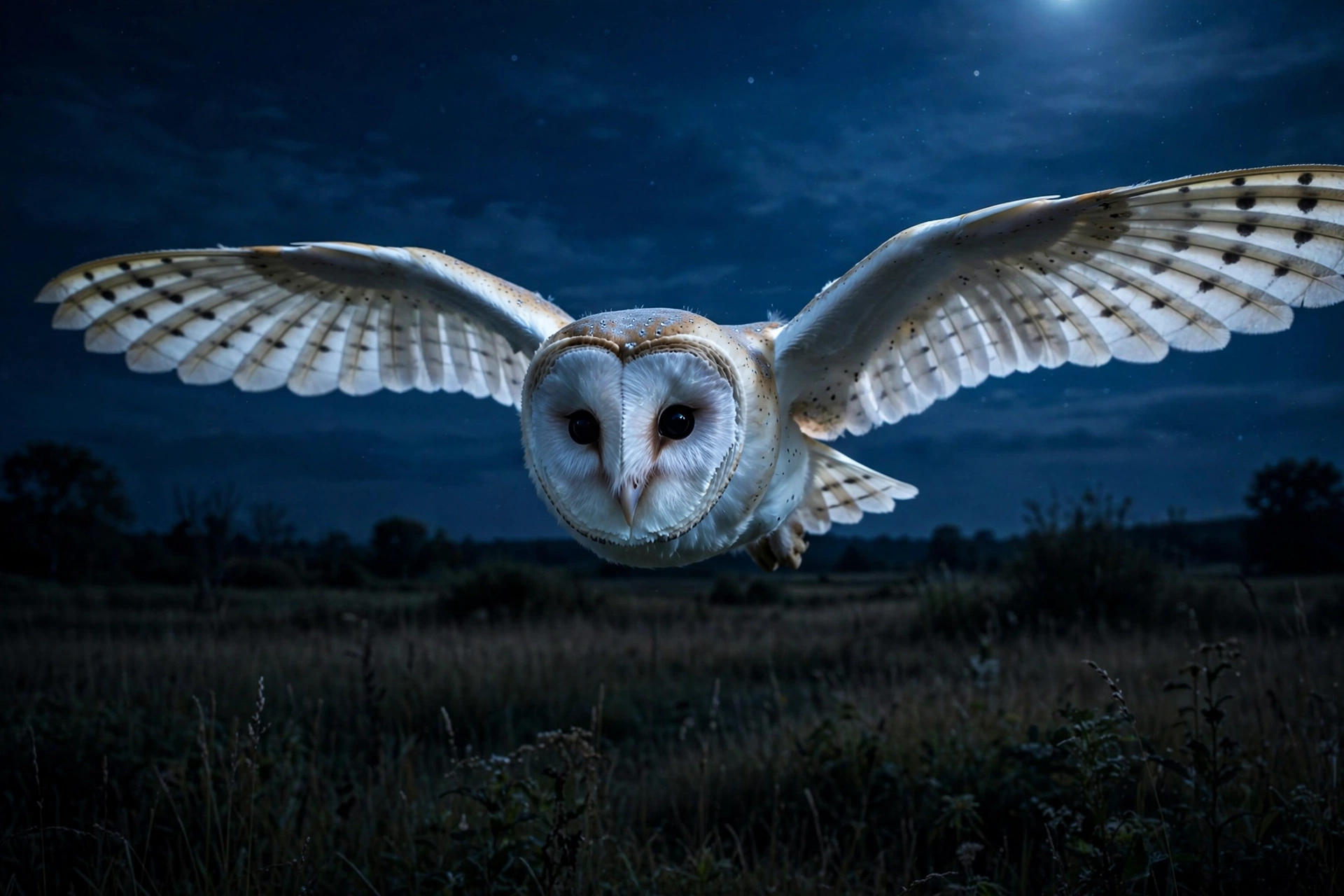
On a moonless night, a barn owl glides over a dark field and drops onto a mouse it spotted from twenty metres up, in light so dim that you would struggle to see your own hand. It is one of the most impressive feats in the animal kingdom, and it raises an obvious question: can birds see in the dark?
The honest answer is that it depends entirely on the bird. Owls and a small cast of other night specialists have eyes engineered for darkness. But the sparrows, robins and finches visiting your garden? Once the sun sets, their world goes almost black, and they behave accordingly.
In this guide we look at what science says about bird night vision: how rod and cone cells set the limits, why owls’ tubular eyes and tapetum lucidum give them an edge, what oil droplets and four-colour vision cost them, and why most birds are not nocturnal at all. We also explain how poor night vision drives a familiar behaviour: the evening rush to the roost.
What “Seeing in the Dark” Actually Means
Before comparing species, it helps to be precise about darkness, because scientists rarely mean total darkness when they talk about night vision. A moonlit night can be hundreds of times brighter than a moonless, overcast one, and a bird that hunts happily by moonlight may be helpless under thick cloud.
Researchers usually describe vision in terms of the dimmest light an animal can still use. Owls can operate in light levels far below what humans need, down to starlight on a clear night. But every eye ever studied, including an owl’s, needs at least some photons to work with. “Night vision” really means extreme low-light vision, not vision with zero light.
That distinction matters because it explains a lot of bird behaviour. Many owls hunt most successfully on moonlit nights and struggle on the darkest ones. And the reason nocturnal birds still have such large eyes is precisely that they are harvesting a tiny trickle of light, not seeing without any.
Rods, Cones and the Great Trade-Off
All vertebrate eyes detect light with two kinds of cells, and every bird eye is a compromise between them. Rods are exquisitely sensitive and work in dim light, but they only report shades of grey. Cones need plenty of light, but they deliver sharp detail and colour. You cannot maximise both in the same retina.
Most songbirds are cone-heavy. Their retinas pack in cones because daylight is their world: spotting a camouflaged caterpillar, judging whether a berry is ripe, reading the subtle plumage signals of a potential mate. That investment in daylight detail comes at a direct cost. When light fades, their rod-poor retinas cannot gather enough signal, and their vision collapses long before ours does.
The two cell types, in short:
- Rods: maximum sensitivity to dim light, no colour information, dominant in the retinas of nocturnal birds.
- Cones: colour and fine detail, need bright light, dominant in the retinas of diurnal birds.
Owls flipped the ratio. Their retinas are dominated by rods, which is why an owl’s night vision is superb and its colour vision is comparatively poor. Evolution rarely gives anything for free, and in vision the currency is always light.
Daylight’s Reward: Tetrachromacy and Oil Droplets
It is worth appreciating what diurnal birds bought with their daylight specialisation, because it is extraordinary. Most birds are tetrachromatic: they possess four types of cone cells to our three, which lets them see ultraviolet light that is completely invisible to humans. A “plain brown” sparrow may look anything but plain to another sparrow.
Each cone also contains a tiny oil droplet that acts as a microscopic colour filter, sharpening the boundaries between wavelengths and improving colour discrimination. The result is arguably the finest colour vision in the animal kingdom, tuned for finding food and choosing mates in bright light.
This daylight superpower helps explain why evolution pushed the great majority of birds toward the day shift rather than the night shift. A visual system this refined is wasted after dark, and maintaining both world-class colour vision and world-class night vision in one eye appears to be a trade-off no bird has fully solved.
The Owl Eye: Evolution’s Night-Vision Goggles
Owls took the opposite bet to songbirds, and their eyes show it in every detail. An owl’s eyes are enormous relative to its skull and face directly forward, giving owls the best stereoscopic vision of any bird. That forward placement is not decorative: a hunting owl must judge the exact distance to a rustling vole in grass it can barely see.
The shape of the eye is extraordinary too. Owl eyes are tubular, more like short telescopes than spheres, with huge corneas and pupils that open remarkably wide to drink in every available photon. Behind the retina sits the tapetum lucidum, a reflective layer that bounces incoming light back through the light-sensitive cells for a second pass. It is the same structure that makes a cat’s eyes glow in headlights, and it is what gives owls their famous eyeshine.
The owl’s night-vision toolkit, piece by piece:
- Huge tubular eyes: a large cornea and wide pupil maximise the light entering the eye.
- Rod-packed retinas: an overwhelming majority of rods trades colour detail for extreme dim-light sensitivity.
- Tapetum lucidum: a reflective backing behind the retina gives each photon a second chance of detection and causes eyeshine.
- Forward-facing placement: exceptional binocular overlap for judging strike distance in poor light.
- A single well-defined fovea: in the Great Horned Owl, researchers describe a predominantly rod retina built around one sharp central spot.
There is one famous catch. Those giant eyes are so large that they barely move in their sockets. Owls compensate with famously flexible necks, able to rotate up to 270 degrees, helped by extra neck vertebrae. They sacrificed eye movement for light-gathering power, and for a nocturnal hunter it was a good trade.

Even Owls Hit a Wall
Here is the part that surprises most people: owls cannot see in total darkness. In work summarised by the Cornell Lab of Ornithology, a Great Horned Owl homed in on a mouse under extremely dim light, but as the light fell further it could only find the mouse by searching at random, and in complete blackness it did not attempt to search at all.
That is where the second half of the owl’s toolkit takes over: hearing. Barn owls can locate and catch prey by sound alone, even in complete darkness, thanks to the facial disc of feathers that funnels sound toward their ears. Their acute hearing lets them strike at mammals hidden under vegetation or snow. Night vision gets the owl close; hearing finishes the job.
So the careful scientific answer is that owls see superbly in very dim light, far beyond what any songbird or human can manage, but they do not see where there is no light at all. Darkness still defeats them, which is one reason cloudy, moonless nights can make hunting measurably harder even for these supreme night hunters.
The Supporting Cast: Nightjars, Oilbirds and Kiwis
Owls are the headline act, but they are not the only birds with genuine night vision. Nightjars and nighthawks hawk insects on the wing at dusk and through the night, and their large eyes also carry a tapetum lucidum. If you have ever caught a pair of glowing eyes in your headlights on a country lane after sunset, there is a fair chance you were looking at a nightjar.
The oilbird of South America goes further still. It roosts and nests in pitch-black caves, navigating partly by echolocation clicks like a bat, and its enormous eyes are packed with rods for the dim world at the cave mouth. The kiwi of New Zealand took the opposite path: its eyes are tiny, and it finds food in the dark forest largely by smell and by probing with its long, sensitive bill.
A note of scientific caution is due here. Detailed rod and cone counts exist for only a handful of species. Owl retinas have been mapped in depth, but for many nocturnal birds the evidence is thinner, and confident-sounding claims about exactly how well a nightjar or oilbird sees should be read with that gap in mind.

Why Most Birds Clock Off at Sunset
For the great majority of birds, night is simply a write-off. Without a tapetum lucidum, with modest pupils and cone-dominated retinas, a robin at midnight sees little more than vague shapes. Flying would be reckless and foraging would be fruitless, so they do the sensible thing: they sleep.
That is the deep reason behind roosting behaviour. As dusk falls, birds hurry to sheltered, familiar perches while they can still see to reach them. Many species gather in communal roosts, from wheeling starling murmurations to noisy crow gatherings, because a sleeping bird is a vulnerable bird and there is safety in numbers. Our guide to where birds sleep at night walks through roosting spots species by species.
Poor night vision also explains why artificial light scrambles bird behaviour so badly. Streetlights and lit buildings can disorient nocturnal migrants that navigate by the stars, a marvel of dim-light navigation we cover in our piece on how birds navigate during migration. Bright lights can also prompt daytime songbirds to sing through the night; our explainer on birds that sing at night lists nine common reasons, with light pollution high among them.

Owl Eyes vs Songbird Eyes: Side by Side
The table below puts the two designs head to head. Neither is “better” in any absolute sense; each is superbly tuned to the light its owner lives in.
| Feature | Owl (nocturnal) | Songbird (diurnal) |
|---|---|---|
| Eye size and shape | Enormous and tubular, like a short telescope | Modest and spherical |
| Pupil | Opens extremely wide to gather dim light | Smaller maximum aperture |
| Retina | Dominated by rods, little colour information | Dominated by cones, rich colour detail |
| Tapetum lucidum | Present, producing the famous eyeshine | Absent in most species |
| Eye movement | Almost none; the neck rotates up to 270 degrees instead | Freely moving eyes |
| Colour vision | Limited, mostly monochrome in dim light | Tetrachromatic, including ultraviolet |
| Sees in total darkness | No, though hearing compensates | No, effectively blind after dark |
Watching Birds After Dark: Practical Tips
Understanding bird night vision makes you a better nocturnal birdwatcher. The single most important rule is to protect the darkness the birds depend on. Never shine a bright white torch directly at an owl or nightjar; a sudden blast of light can temporarily blind a dark-adapted bird and ruin a hunting attempt it may have spent an hour setting up.
Serious owlers use a red filter over their torch, because red light disrupts night-adapted eyes far less than white light. Scan with the beam rather than pinning it on the bird, listen more than you look, and learn the calls before you go: on most night walks your ears will find ten times more birds than your eyes.
Timing matters too. The hour after sunset and the hour before sunrise are the sweet spots, when nocturnal species are most active and there is still a trace of usable light. And if you want to help night-flying birds beyond your own outings, the simplest step is also the easiest: keep outdoor lighting low, shielded and pointed downward, especially during migration season.
Frequently Asked Questions
Can owls see in complete darkness?
No. Owls possess the best low-light vision of any bird, but experiments show they still need some light to hunt by sight. In total darkness they switch senses: a barn owl can catch a mouse it cannot see at all, guided entirely by its extraordinary hearing.
Do birds have night vision like cats?
Only the nocturnal specialists do. Owls and nightjars have a tapetum lucidum, the reflective layer behind the retina that also gives cats their glowing eyeshine. Most garden birds lack this layer entirely and see very poorly once the light fades.
Why do all the birds in my garden vanish at dusk?
Because their eyes are built for daylight. As light fades, songbirds head for safe, familiar roosting spots while they can still see well enough to get there. They sit out the night hours rather than risk flying blind, which is why the evening roosting rush is such a reliable daily spectacle.
Can birds see colour at night?
Almost certainly not in any useful way. Colour vision needs plenty of light to work, even in owls. At night, the birds that can see at all are seeing mostly in shades of grey, which is exactly why rods rather than cones dominate nocturnal retinas.
Conclusion
So, can birds see in the dark? A few can, brilliantly, and most cannot at all. Owls, nightjars and oilbirds carry specialised equipment: giant light-hungry eyes, rod-packed retinas and a reflective tapetum lucidum that gives every photon a second chance. Even they draw the line at total darkness, where hearing takes over the hunt.
For the rest of the bird world, night is downtime, and that single fact organises daily rhythms we all recognise: the dawn chorus, the dusk rush to the roost, and the vulnerability that makes communal roosting worthwhile. Next time you watch your garden empty as the light fades, you are watching vision, or the lack of it, shape an entire way of life. And if you would like to return the favour to night-flying birds, keep your outdoor lights low and pointed down, particularly during migration season.




