 Skip to content

Yes, birds have tongues. Every bird species, from the tiniest hummingbird to the largest ostrich, has a tongue inside its beak. If you have watched a parrot roll a seed in its mouth or seen slow-motion footage of a hummingbird drinking, you have seen one in action.
But a bird tongue is not a smaller version of yours. It is stiffer, drier, and often covered in hard keratin, the same material as your fingernails. It is driven by a bony framework called the hyoid apparatus rather than flexible muscle. And in some species it does things that sound like science fiction. A woodpecker’s tongue can be three times longer than its beak and wraps around the skull when not in use. A hummingbird’s tongue is forked at the tip and flicks in and out of flowers more than a dozen times per second.
This guide covers how bird tongues are built, how they work, what birds can taste, and how tongue shape reveals what a bird eats.
Yes, Birds Have Tongues, But They Are Built Differently
A human tongue is a thick, wet, highly muscular organ that can twist, curl, and press against the palate. A bird tongue is something else entirely. In most birds, it is a relatively stiff, dry structure with far less muscle tissue. Many are armored with keratin, which gives them a hard, almost beak-like texture.
This difference makes sense once you consider how birds eat. Birds have no teeth, so the tongue never needs to mash food against them the way a cow’s tongue works. Instead, the beak does the grabbing, crushing, and tearing. The tongue acts more like a conveyor belt and a sorting tool, positioning food so it can be swallowed quickly. Most of the time, a bird tilts its head back and lets gravity carry the food down its throat, and the tongue simply guides it into position.
There is one big exception to the low-muscle rule. Parrots have unusually thick, fleshy, muscular tongues that they use almost like a hand. A parrot can hold a seed against its upper beak with its tongue, rotate it into position, and crack it with precision. This dexterity is one reason parrots are such skilled manipulators, and some researchers believe the tongue’s fine movements even contribute to their talent for mimicking speech.
The Hyoid Apparatus: The Engine Behind Every Bird Tongue
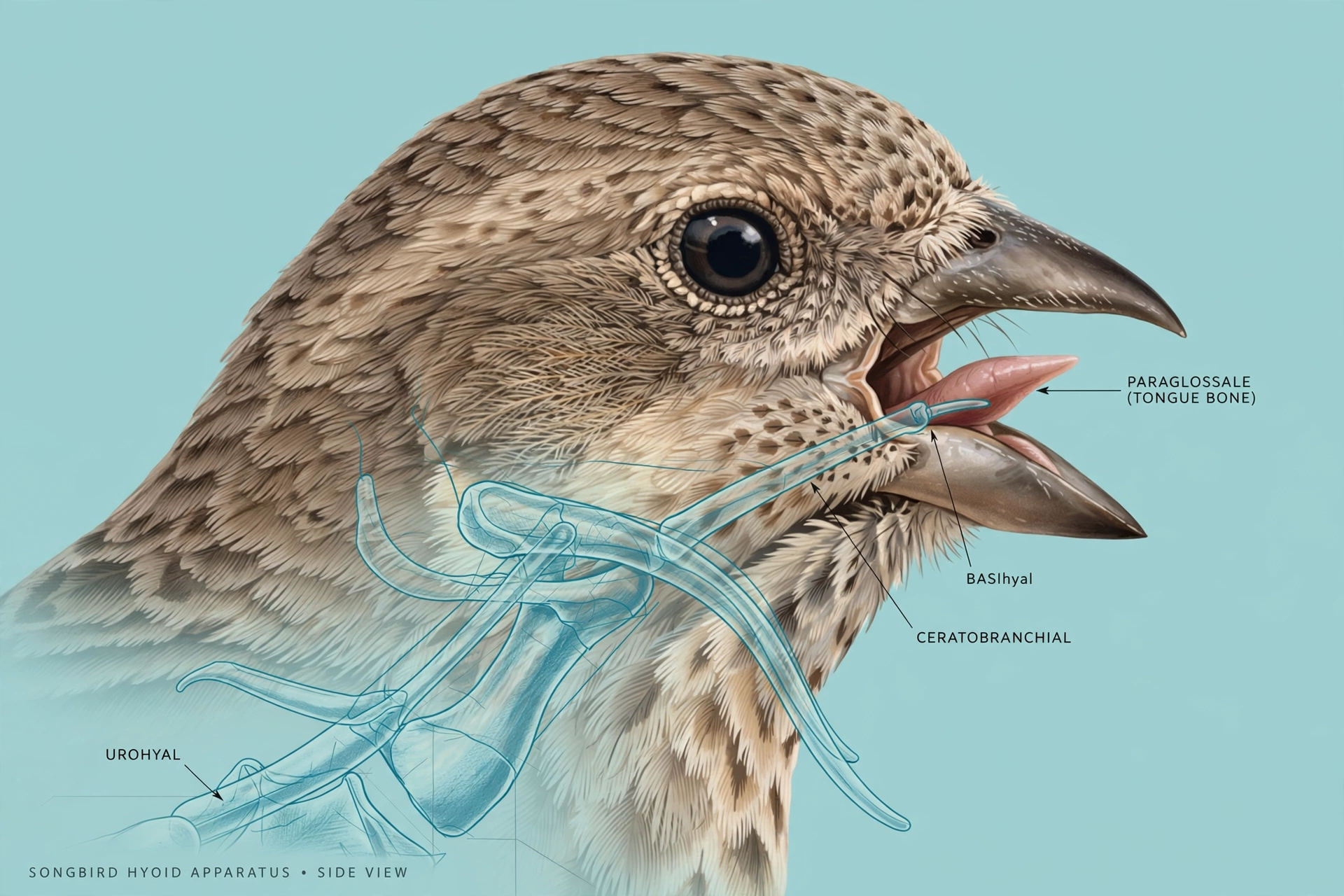
In mammals, the tongue is driven by muscles anchored to the jaw and throat. In birds, tongue movement depends on the hyoid apparatus, a chain of small bones, cartilage, muscles, and connective tissue that runs from the tongue back into the throat and neck. When the surrounding muscles contract, they slide this bony framework forward and backward, which extends and retracts the tongue like a piston.
This system matters because it explains the most extreme tongue anatomy in the bird world. The hyoid apparatus is not confined to the throat. In species with very long tongues, such as woodpeckers and hummingbirds, these slender bones extend far beyond the jaw. They fold, loop, and store themselves in empty spaces around the skull, then unfold to launch the tongue outward.
The hyoid also anchors the tongue during feeding. When a woodpecker drives its beak into wood at high speed, the hyoid stays put and keeps the tongue stable. Without that bony support, an extremely long tongue would be impossible to aim. The hyoid apparatus is the quiet piece of engineering that makes every specialized bird tongue possible.
The Woodpecker’s Tongue Wraps Around Its Skull
This is the single most astonishing fact about bird tongues. In many woodpecker species, the tongue is so long that it cannot fit inside the head in any normal way. A red-bellied woodpecker’s tongue can stretch to nearly three times the length of its beak. In the gray-faced woodpecker, researchers measured tongues around 171 millimeters long, longer than the bird’s entire body from beak tip to tail base.
So where does all that tongue go when the bird is not feeding? The hyoid apparatus splits into two slender horns near the throat, travels down and back, curves around the rear of the skull, runs over the top of the head, and anchors near the forehead. In some species, such as the northern flicker, the tongue’s support structure is so long that it reaches into the right nostril. The ultra-thin hyoid bones fold up like an accordion when the tongue is retracted, then straighten to shoot the tongue far beyond the bill.
This design is not just a storage trick. The long tongue is a precision insect trap. Its tip is often coated in sticky saliva and armed with tiny backward-facing barbs. The woodpecker drills or probes into bark, fires the tongue into tunnels and crevices the beak cannot reach, spears or glues a grub or ant, and hauls it back. Sapsuckers show how tongue design follows diet: they have shorter tongues with brush-like tips suited to lapping sap rather than deep probing for insects.
The skull-wrapping hyoid may also help protect the bird’s brain. When the woodpecker strikes wood, muscles around the hyoid tighten the whole structure, which acts like a tension band that distributes impact forces along the tongue’s length rather than through the braincase. It works alongside other adaptations, including spongy skull bone and very little cerebrospinal fluid, which is why a lifetime of hammering does not rattle a woodpecker’s brain. To learn more about this remarkable protection system, read how woodpeckers avoid concussions, and see biomechanical research on woodpecker skulls and tongue bones for the science behind it.

The Hummingbird’s Forked Tongue Is a Tiny Nectar Pump
Hummingbirds and woodpeckers share one strange trait: both have tongues so long that the hyoid apparatus wraps around the skull to store them. But the hummingbird’s tongue is built for an entirely different job. It is forked at the tip, splitting into two thin grooves lined with microscopic hair-like fringes called lamellae.
For nearly two centuries, scientists believed hummingbirds drank through capillary action, with nectar wicking up the tongue’s grooves the way liquid rises in a narrow straw. That idea, first proposed in 1833, went unchallenged until researchers filmed hummingbirds feeding with high-speed cameras and see-through artificial flowers. What they found rewrote the textbooks.
The tongue is not a static tube. When the tip enters nectar, the forked ends spread apart and the fringed edges open like tiny hands. As the bird pulls its tongue back, the fringes snap shut through surface tension, trapping droplets of nectar inside. Later research showed the mechanism is even more sophisticated: the bird squeezes its tongue flat as it pushes it through the bill, loading the groove walls with elastic energy, and when the tip touches nectar, the grooves spring open like tiny pumps that draw fluid in. High-speed camera research revealed the truth about this elastic micropump, which works far faster than capillary action ever could.
Speed matters enormously here. A hummingbird can flick its tongue in and out of a flower around 15 to 20 times per second, and it may visit more than a thousand flowers a day to fuel the most energy-hungry metabolism of any bird. The tongue, which can extend roughly the length of the bill, is the precision instrument that makes that lifestyle possible. If you want to support these aerial acrobats, check what hummingbirds eat beyond nectar, since insects and spiders supply the protein they need.
Tongue Shape Reveals Diet
Perhaps the most useful thing about bird tongues is what they tell you. Because the tongue is a feeding tool first and everything else second, its shape is a reliable clue to a bird’s diet. Ornithologists can often guess how a bird makes its living just by looking at its tongue.
| Bird group | Tongue shape | What it is for |
|---|---|---|
| Woodpeckers | Extremely long, barbed or sticky tip | Spearing grubs and ants from deep bark tunnels |
| Hummingbirds | Long, forked tip with fringed grooves | Trapping and pumping liquid nectar from flowers |
| Seed eaters (finches, cardinals) | Short, triangular, hardened | Positioning seeds against the beak for husking |
| Ducks and geese | Broad with bristled, comb-like edges | Straining small food from water while expelling mud |
| Flamingos | Large, fleshy, piston-like | Pumping water through the bill to filter algae and shrimp |
| Penguins | Covered in backward-pointing spines | Gripping slippery fish and squid so they cannot escape |
| Parrots | Thick, fleshy, highly muscular | Rotating and positioning seeds and nuts with precision |
| Raptors (hawks, owls) | Short, fleshy, relatively simple | Guiding torn meat to the throat; the beak does the work |
Seed-eating birds show the pattern clearly. A cardinal or finch has a short, tough, triangular tongue that shoves each seed into exactly the right spot between the upper and lower beak so the shell can be cracked and discarded. The tongue never tastes the seed in any meaningful way. It is a positioning device.
Filter feeders show the opposite extreme. A duck’s tongue has comb-like bristles along its edges that work with ridges inside the bill to strain tiny plants, seeds, and invertebrates from mouthfuls of muddy water. A flamingo’s large tongue works as a piston, pumping water in and out up to several times per second while its specialized bill filters out algae and tiny crustaceans. And a penguin’s tongue is lined with sharp, backward-facing papillae that act like a one-way ratchet, so a slippery fish sliding toward the throat can never slide back out.
What Can Birds Actually Taste?
Bird tongues carry taste buds, but far fewer than mammals have. A chicken has roughly 240 to 360 taste buds, a parrot has a few hundred, and most songbirds fall somewhere in that range. Compare that to about 10,000 in humans, and you might assume birds barely taste anything. The reality is more interesting.
Bird taste buds are not limited to the tongue. They are scattered across the roof and floor of the mouth, the palate, and the throat, so tasting happens throughout the swallowing process. Birds can detect sweet, sour, bitter, and salty flavors. Bitterness detection is especially well developed, which makes sense as a defense: many toxic seeds and spoiled foods taste bitter, and a bird that rejects them survives.
Sweet taste has a remarkable evolutionary story. Most birds lost the standard vertebrate sweet receptor long ago, but hummingbirds rebuilt the ability by modifying their umami receptor, a case of convergent evolution that lets them judge nectar quality. Research published in 2021 showed that songbirds pulled off a similar trick independently around 30 million years ago, which means most of the songbirds at your feeder can taste sugar too.
One famous gap in bird taste is heat. Birds are essentially insensitive to capsaicin, the compound that makes chili peppers burn. That is why a cardinal can happily devour hot peppers that would set a mammal’s mouth on fire. Chili plants likely evolved this trait on purpose: birds swallow the seeds whole and spread them widely, while mammals chew and destroy them. Read why birds can eat spicy food to see how this quirk even shapes the birdseed industry.

Surprising Facts About Bird Tongues
- Some tongues are longer than the bird’s body. The gray-faced woodpecker’s tongue measures about 171 millimeters, longer than its body length. No mammal tongue comes close to that ratio.
- A woodpecker tongue tip wears down and regrows. The tip is made of keratin, like a claw. It wears away with constant use against wood and insects, then grows back, similar to how a rodent’s teeth keep growing.
- Hummingbirds were misunderstood for 178 years. From 1833 until 2011, every textbook said hummingbirds drink by capillary action. High-speed video proved the tongue is actually a dynamic fluid trap and elastic pump.
- Penguin tongues are spiny traps. Backward-pointing papillae cover the tongue and palate, creating a surface like a bottle brush that only lets food move one direction: down.
- A flamingo tongue is a water pump. It pistons in and out several times per second, driving water through the bill’s filter while the bird feeds upside down.
- Vultures have grooved tongues. Deep channels in the tongue help funnel blood and torn tissue toward the throat when they feed on carrion.
- Some birds barely use their tongues at all. Ostriches and many raptors swallow large items whole or in chunks, so the tongue plays only a minor guiding role.
- Tongue spots can identify individual birds. In some species, the pattern of pigmentation on the tongue is unique enough that researchers have used it to tell individuals apart.

Frequently Asked Questions
Do birds have tongues like humans?
They have tongues, but the anatomy is quite different. A bird tongue is generally stiffer, drier, and less muscular than a human tongue, and it is moved by a bony framework called the hyoid apparatus rather than by muscle alone. Parrots are the notable exception, with thick, fleshy tongues that are remarkably dexterous.
Can birds taste their food?
Yes. Birds have a few hundred taste buds spread across the tongue, mouth, and throat, and they can detect sweet, sour, bitter, and salty flavors. Bitter detection is especially strong and helps them avoid toxins. Hummingbirds and most songbirds can taste sweetness thanks to independently evolved receptor modifications.
Do woodpeckers really wrap their tongues around their skulls?
Yes, this is real and well documented. The woodpecker’s hyoid apparatus splits into two horns that curve around the back of the skull and over the top of the head to store the extraordinarily long tongue. In some species the structure even reaches into a nostril. The same basic arrangement appears in hummingbirds, which also have exceptionally long tongues.
How do hummingbirds drink nectar?
The forked tongue tip spreads open inside the flower, and fringed edges trap nectar droplets as the tongue retracts. The grooves also work as elastic micropumps that spring open when they touch liquid, drawing nectar in far faster than capillary action could. The tongue can flick in and out around 15 to 20 times per second.
Why don’t birds chew if they have tongues?
Birds have no teeth, so there is nothing for a tongue to press food against. The beak handles grabbing and breaking food apart, the tongue positions it for swallowing, and the muscular gizzard grinds it up internally, often with the help of swallowed grit. The whole system replaces chewing without a single tooth.
Conclusion
Birds absolutely have tongues, and they are far more remarkable than most people imagine. From the woodpecker’s skull-wrapping hyoid apparatus to the hummingbird’s forked nectar pump, these organs show how evolution reshapes a simple structure into precision tools. A bird’s tongue is rarely about savoring flavor the way ours is. It is a conveyor, a trap, a filter, a pump, and a spear, sculpted by diet.
The next time you watch a bird at your feeder, pay attention to what its beak and throat are doing. That quick flicker of movement is the tongue doing its quiet work. And if you remember one thing from this guide, let it be this: in the bird world, the shape of the tongue is a window into the bird’s entire way of life.




