 Skip to content

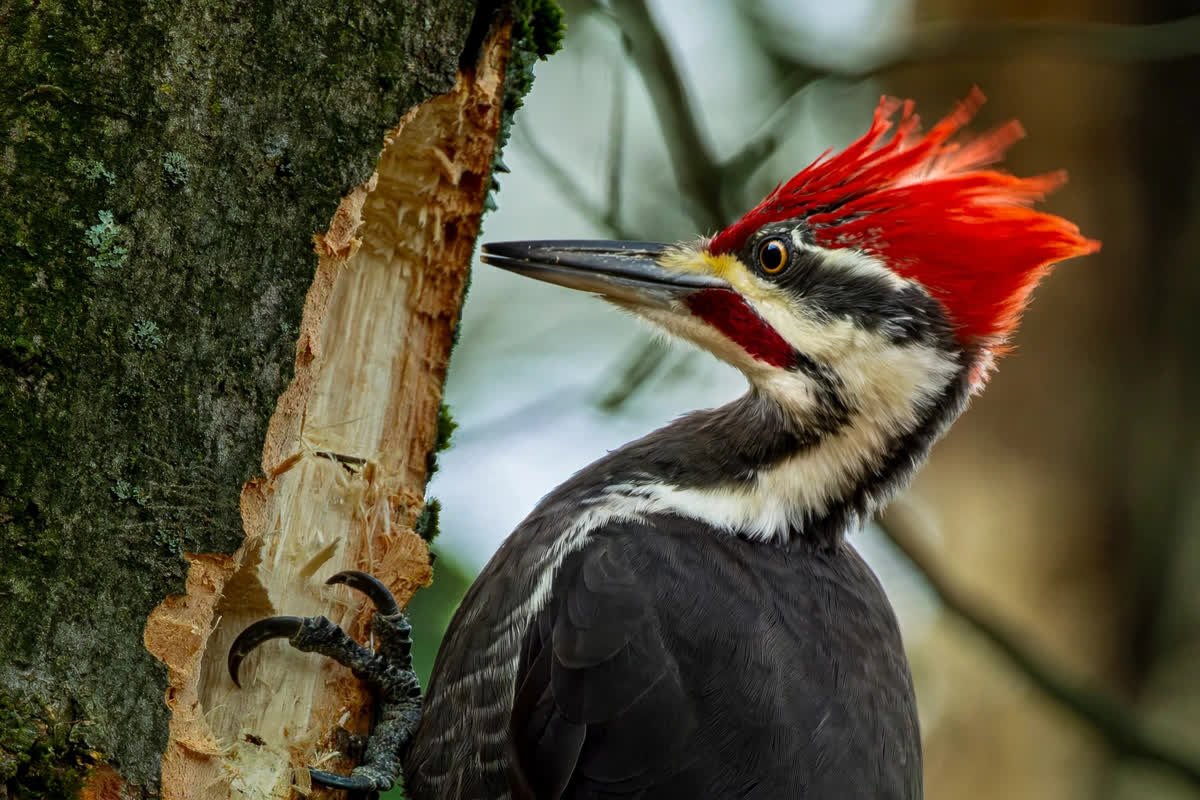
No, woodpeckers do not get concussions the way humans do. After a lifetime of slamming their faces into trees, they show none of the disorientation, clumsiness, or lasting brain damage that a single similar blow would cause in a person. That is remarkable, because a woodpecker’s head endures deceleration forces reported at about 1,200 times gravity with every strike, and a hard-drumming bird can hit wood up to 20 times per second.
For decades, scientists credited a set of built-in shock absorbers: spongy bone in the forehead, a springy beak, and a tongue that wraps around the skull like a seatbelt. Then newer research complicated that story, showing that the woodpecker skull behaves more like a stiff hammer than a padded helmet. The full answer to the question of whether woodpeckers get concussions is a mix of confirmed anatomy, clever physics, and one genuine scientific mystery that researchers are still trying to solve.

Do Woodpeckers Get Concussions? The Short Answer Is No
A woodpecker’s head strikes wood with decelerations reported at about 1,200 g, and some studies cite a range of 1,200 to 1,400 g. The beak can travel at speeds up to 7 meters per second and strike 18 to 22 times per second. On a busy day, a single bird may peck roughly 12,000 times.
Compare that with a human head. Researchers generally cite 80 to 100 g as the range where a single blow can cause a concussion in people, and some sources put the threshold at 60 to 100 g. A woodpecker routinely endures more than ten times that force, thousands of times a day, then flies off to find the next tree.
What makes this stranger is that engineers have studied the woodpecker head for practical reasons. Football helmets, car crumple zones, and aircraft black boxes all depend on impact physics, and the bird appeared to have solved the problem with bone, muscle, and geometry instead of padding. Understanding how it does this matters beyond curiosity, which is why the research keeps coming.
The Spongy Bone Shield
The classic explanation starts inside the forehead. CT scans of woodpecker skulls reveal a layer of spongy bone, porous and plate-like, sitting between the beak and the braincase. It is not uniform. It is thicker and unevenly distributed, with denser plates where the beak meets the skull, so impact force spreads across the structure instead of concentrating in one spot.
This finding emerged from work at the University of California, Berkeley, where researchers scanned the golden-fronted woodpecker and built mechanical models of its head. Their analysis identified four working parts: a hard but slightly elastic beak, the springy hyoid apparatus that supports the tongue, spongy bone in the skull, and the interaction between the skull and the cerebrospinal fluid, which helps suppress vibration.
The spongy bone idea also inspired real engineering. The Berkeley team used it to design a shock-absorbing material for protecting electronics, testing it by firing projectiles at circuits mounted inside a woodpecker-inspired housing. That is why you will see the woodpecker cited in articles about tougher gadgets and safer helmets. Inspiring a good design, though, is not the same as proving how the bird itself works, and later studies would challenge parts of this picture.
The Tongue That Wraps the Skull
A woodpecker’s tongue is famously long. In some species, such as the northern flicker, it can reach about three times the length of the beak. The reason it fits inside such a small head is the hyoid apparatus, a system of slender bones, cartilage, and muscle that supports the tongue. Instead of ending inside the mouth, it extends backward, splits into two bands, curves around the rear of the skull, passes over the top of the head, and anchors near the front, between the eyes.
This arrangement gave rise to the seatbelt description. The idea was that the wrapped hyoid acts like a spring, dampening vibration and bracing the brain during each strike. A detailed structural analysis of the tongue and hyoid apparatus found that it significantly reduced strain in modeled brain tissue compared with a model that had no hyoid, which kept the idea alive for years.
Here is where honesty matters. The hyoid’s clearest established job is feeding, not protection. It is a storage track that lets the bird shoot a long, barbed or sticky tongue deep into bark tunnels to extract insects, then retract it along the same path. Researchers who describe the tongue as a shock absorber are reporting a plausible secondary effect, not a proven primary function. The anatomy is remarkable either way.
Beak Design: Hard Outside, Springy Inside
The beak is the first thing to meet the wood, and it is built for the job. The outer layer is hard keratin, the same family of material as your fingernails, while the inner core is more elastic. That combination lets the beak resist cracking while flexing just enough to spread the impact across its structure.
Woodpeckers also have slightly uneven beak lengths: the upper beak is longer than the lower one. Modeling studies suggest this asymmetry helps flatten the curve of the impact force, spreading the blow over a fractionally longer moment instead of delivering it all at once. It is a small geometric trick, but at 20 strikes per second, small tricks compound.
Together, the beak’s hard shell, springy core, and uneven length act as the first stage of the system. By the time the impact reaches the skull, its sharpest peak has already been blunted. Whether the later stages deserve the shock absorber label is exactly what the newest research questions.
Small Brains, Tight Fit, and Timing
Size does most of the quiet work. A woodpecker’s brain weighs only a few grams, and the force a brain feels during a sudden stop scales with its mass. Less mass means less sloshing force on the tissue itself. Physics gives the bird a discount no helmet can match.
The fit helps too. Woodpeckers have very little cerebrospinal fluid between the brain and the skull compared with most birds and mammals, so the brain sits snug against the braincase. One often quoted comparison: shaking a hard-boiled egg leaves the yolk unmoved, while shaking a raw egg scrambles it. The woodpecker brain is closer to the hard-boiled version.
Duration matters as well. Each impact lasts only a fraction of a millisecond. Concussion injury in humans depends not just on peak force but on how the force is applied over time, and on whether the brain rotates inside the skull. A straight-on, millisecond strike on a tiny, tightly packed brain is a very different event from a human head snapping sideways in a crash. These scale arguments are among the best supported parts of the story, although the exact injury thresholds in birds remain estimated rather than measured directly.

What the Research Actually Debated
In 2022, a team led by Sam Van Wassenbergh at the University of Antwerp put the shock absorber story to a direct test. They recorded 109 pecks from six birds across three species, the black woodpecker, the pileated woodpecker, and the great spotted woodpecker, tracking points on the beak and head with high-speed video.
The result surprised many. The head did not cushion the blow at all. The skull and beak moved as one rigid body, decelerating together. The researchers concluded that absorbing shock would actually hurt the bird, because energy soaked up by the skull is energy that never reaches the wood. A cushioned woodpecker would be a hammer with a rubber face, forced to hit harder to dig the same hole.
Their models added a reassuring detail. Even the hardest pecks produced brain pressures well below the human concussion threshold, consistent with the small-brain argument. Wesley Hochachka, an ecologist at the Cornell Lab of Ornithology who was not involved in the study, noted that the impacts may simply be less severe for the bird than people had assumed.
Then came the wrinkle. In 2018, Boston University researchers examined preserved brains from ten woodpeckers and five red-winged blackbirds, a non-pecking control. They found tau protein deposits, the same protein associated with repeated head trauma in humans, in eight of the ten woodpecker brains and in none of the controls. Tau can stabilize brain cells in small amounts, and the researchers stressed they could not say whether the buildup indicated damage or a protective response. Nobody has yet shown that woodpeckers walk away completely untouched, and nobody has shown that they are harmed either.
A related point from concussion science: most human brain injuries involve rotation, the brain twisting inside the skull. A woodpecker’s strike is almost perfectly straight on, with neck muscles bracing the head along the line of impact. Some researchers argue that avoiding rotational forces may matter more than any cushion. The honest summary is that the crash helmet story is partly confirmed and partly challenged, and the final chapter is not written.
Why You Will Never See a Woodpecker With a Headache
Watch a woodpecker at a suet feeder and you will see the behavior that settles the question in practice. The bird hammers, pauses, listens, and hammers again, showing no sign of disorientation. A concussed animal would show clumsiness, lethargy, or loss of coordination. Woodpeckers show the opposite, drilling with precision thousands of times a day.
What looks like reckless head-banging is carefully managed. Woodpeckers peck in bursts with pauses in between, which some researchers suggest lets heat generated in the brain tissue dissipate. The neck and body absorb much of the energy too. One 2014 modeling study estimated that 99.7 percent of the impact energy is converted into strain energy stored in the body, with only a small fraction ever reaching the head.
If you want to watch this yourself, a suet cage is the easiest invitation. Downy and hairy woodpeckers visit suet feeders all winter, and our suet feeding guide covers which blends draw them and where to hang the feeder. Add a bird bath and a few native plantings, and you can watch the whole feeding routine, hammering included, from your window. For more ideas, see how to attract more woodpeckers to your yard with food, water, and shelter.

Frequently Asked Questions
Do woodpeckers feel pain when they peck?
There is no evidence that pecking hurts them. Their beaks have relatively few nerve endings at the tip, and the entire head structure evolved around this behavior. A woodpecker that associated pecking with pain would stop doing the one thing its survival depends on, so natural selection would have removed that trait long ago.
Why do woodpeckers peck metal gutters and houses?
That loud metallic drumming is communication, not feeding. Woodpeckers drum on resonant surfaces to claim territory and attract mates, and a metal gutter or chimney cap carries the sound much farther than bark. It looks alarming, but it is the bird equivalent of shouting. If a woodpecker is striking your windows instead, the cause may be its own reflection, which is a different behavior explained in our guide to why birds peck at windows.
How fast do woodpeckers peck?
During drumming, most species strike 18 to 22 times per second, and some studies have recorded bursts up to 25 strikes per second. Each strike can generate decelerations of 1,200 to 1,400 g. Foraging pecks are usually slower and more deliberate than territorial drumming.
Has a woodpecker ever been found with brain damage?
Not conclusively. The 2018 Boston University study found tau protein deposits in eight of ten preserved woodpecker brains, and tau is associated with head trauma in humans. But the researchers could not determine whether the buildup meant damage or a protective response, and the birds’ behavior shows no sign of impairment. It remains an open question rather than a verdict.
Do other birds survive head impacts this way?
No other bird hammers like a woodpecker, and no other bird has the same combination of adaptations. The reinforced skull, wrap-around hyoid, uneven beak, and tiny tightly packed brain appear together only in woodpeckers and their close relatives. That is why engineers study them specifically rather than birds in general.
Can a woodpecker break its beak?
Rarely, but it happens. Beaks can chip or crack from striking metal, and injuries from window collisions or predators are more common causes of beak damage than pecking itself. A healthy beak regrows continuously from the base, so minor damage usually repairs over time. A bird with a severely broken beak may struggle to feed and is a candidate for a licensed wildlife rehabilitator.
Conclusion
So, do woodpeckers get concussions? The evidence says no, at least not in any way that resembles a human concussion. They hammer wood at forces that would hospitalize a person, up to 1,400 g and thousands of strikes a day, yet they feed, drum, and raise young with complete coordination. The protection comes from an unusual stack of traits: spongy bone that spreads force, a tongue apparatus that may brace the skull, a hard-shelled springy beak, a tiny tightly packed brain with little fluid to slosh in, and impacts that are brutally brief and perfectly straight.
The newest science adds humility to the story. The 2022 finding that the skull acts as a stiff hammer, plus the unexplained tau deposits found in 2018, means researchers cannot yet claim the birds escape completely untouched. What is certain is that evolution built a system so effective that woodpeckers have thrived for some 25 million years doing what no human head could survive once. Next time you hear rapid drumming, you are listening to one of nature’s most extreme engineering solutions at work.




