 Skip to content

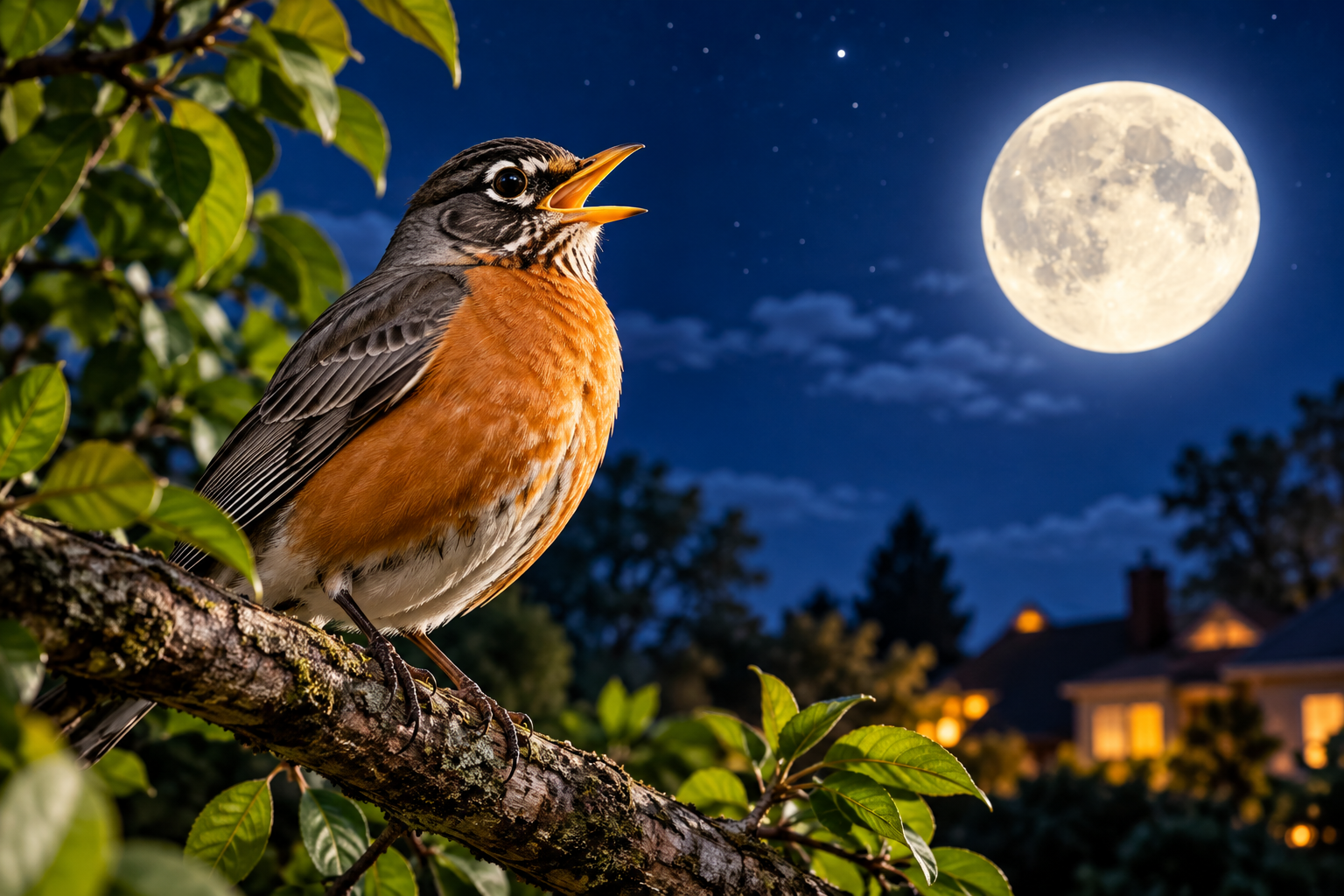
Have you ever wondered why do birds chirp at night when most birds appear to be sleeping? Hearing bird sounds after dark can seem unusual, but nighttime vocalizations are often linked to normal bird behavior.
Some birds sing at night to attract mates or defend their territory, especially during breeding season. Others may respond to predators, communicate with nearby birds, or make contact calls while migrating through the darkness.
Artificial light also plays a major role. Streetlights, porch lights, and city glow can disrupt a bird’s natural biological clock and cause it to become active earlier than normal.
Naturally nocturnal species, including owls and nightjars, also make sounds throughout the night. In this guide, we’ll explore 9 common reasons birds chirp at night and explain what their nighttime sounds may mean.
Why Do Birds Chirp at Night?

Birds are not breaking any rules when they sing in the dark. Nighttime vocalizing is ordinary avian behavior, and once you know what drives it, the sound outside the bedroom window stops being a nuisance and starts being information.
So, why do birds chirp at night? The short answer: a bird calling after sunset is doing one of several specific jobs.
- Attracting a mate — unpaired males often sing longest and loudest, including well past dusk.
- Defending territory — song functions as an audible boundary marker that works even when a rival can’t be seen.
- Communicating with the flock — soft contact calls keep roosting groups together in the dark.
- Reacting to predators — a cat, raccoon, or owl near a roost triggers sharp alarm calls.
- Migrating overhead — many songbirds travel at night and give short flight calls to stay oriented.
- Responding to artificial light — streetlights and porch fixtures can convince a bird that dawn has arrived.
- Being nocturnal by design — owls, nightjars, and a handful of other species are simply doing their day’s work.
The cause is usually identifiable from three clues: the hour, the pattern of the sound, and where it’s coming from.
9 Reasons Why Birds Chirp at Night
1. Attracting a Mate
Song is advertising. For most songbirds, males sing to announce their availability, their physical condition, and the quality of the territory they hold. An unmated male has the strongest incentive to keep broadcasting, and that incentive doesn’t switch off at sunset.
Birds singing at night during spring and early summer are frequently bachelors extending their working hours because the competition during daylight is fierce and the acoustic space after dark is comparatively empty. Sound also carries further in cool, still night air, which makes a late performance more efficient than the same effort at noon.
2. Defending Territory
A territory holder has to keep reminding neighbors where the line is. Song does this without the bird having to patrol every corner or risk a physical fight.
When territories are packed tightly common in suburbs with abundant food and cover boundary disputes simmer constantly, and a challenge from an adjacent male can provoke a response at any hour.
If you hear two birds trading nearly identical phrases back and forth from different directions, you are almost certainly listening to a property argument rather than courtship.
3. Artificial Light
Birds time much of their behavior by light levels. A streetlight, a floodlight triggered by passing cars, a lit parking lot, or a neighbor’s decorative landscape lighting can raise ambient brightness enough that a bird’s internal clock reads the signal as early morning.
The result is birds chirping after dark in a pattern that looks exactly like a normal dawn chorus, just hours ahead of schedule. This is one of the most common explanations for urban and suburban nighttime song, and it’s also the one homeowners have the most control over.
4. Predator Disturbance
Alarm calls sound different from song, and once you’ve noticed the difference you can’t unhear it. Alarms are short, harsh, repetitive, and often delivered by several birds at once. A cat crossing a yard, a raccoon climbing toward a nest, an owl landing in a nearby tree.
OR a snake near a low shrub can all set off a burst of frantic chatter. These episodes typically have a clear beginning and a clear end the noise spikes, continues while the threat is present, and stops once it moves on. Prolonged, panicked calling near a shrub or under an eave usually means something is stalking a nest.
5. Migration
A great many North American songbirds migrate at night, when the air is calmer, temperatures are lower, and daytime predators are inactive. As they fly, they give brief flight calls thin, high, single notes lasting a fraction of a second.
These are the most overlooked night bird calls because they are quiet, easily mistaken for insects, and come from a few hundred feet overhead rather than from a tree. During peak spring and fall migration, standing outside on a clear night can reveal a steady trickle of these notes passing across the sky.
6. Naturally Nocturnal Species
Some birds aren’t up late; they’re on schedule. Owls hunt by sound and low light, and their hoots, screeches, and whinnies are territorial and reproductive signals delivered during their active period.
Nightjars, whip-poor-wills, chuck-will’s-widows, common nighthawks, and their relatives feed on flying insects at dusk and through the night, and their repetitive, mechanical calls can run for hours.
Herons, rails, and certain shorebirds also vocalize freely after dark. If the sound is deep, rhythmic, or eerie rather than melodic, a nocturnal species is the likely source.
7. An Early Dawn Chorus
The dawn chorus normally begins in the dim period before sunrise, with earlier risers like robins starting first. In brightly lit areas, that starting gun fires earlier and earlier. A chorus that would naturally begin at first light may instead begin in genuine darkness.
Which is why complaints about 3 AM singing cluster in neighborhoods with strong outdoor lighting. Warm nights and long daylight seasons push the start time earlier as well, since birds gauge the season partly by day length.
8. Communication and Group Cohesion
Not every nighttime sound is a performance. Birds that roost communally starlings, house sparrows, blackbirds, crows exchange soft contact calls to maintain the group’s position and spacing. A bird that shifts on a branch may give a low note; another answers.
These exchanges are quiet, conversational, and lack the structure of true song. Flocks also grumble and rustle when disturbed by wind, a car door, or a shifting branch, producing short bursts of birds making noise at night that settle quickly.
9. Environmental Changes
Sudden shifts in conditions provoke vocal responses. A thunderstorm’s pressure drop, a gust of wind that rocks a roost, a sprinkler system switching on, a garbage truck at 4 AM, fireworks, or construction floodlights can all trigger calling.
Temperature matters too: unseasonably warm nights can stimulate breeding behavior earlier in the calendar than expected. Habitat disruption tree trimming, new fencing, a nest site lost — can leave displaced birds unsettled and vocal for several nights until they re-establish a routine.
What Time of Night Are You Hearing the Birds?
The clock narrows the possibilities faster than any other clue. Note the hour before you do anything else.
- Shortly after sunset (dusk to about 10 PM). This is settling time. Birds jostle for roosting positions, and the chatter is short, disorganized, and fades within an hour. Nightjars and owls also become active in this window, so a repetitive mechanical call or a hoot at dusk points to a nocturnal species.
- Around midnight. True nocturnal birds are at work, and during spring and fall this is prime migration time. Listen for single thin notes from overhead rather than sustained song from a tree.
- Between 2 and 4 AM. This is the classic complaint window and the one most often tied to artificial light. A bird delivering full, repeated song from a fixed perch at this hour is usually an unmated male responding to bright ambient conditions, and in many neighborhoods the culprit is a mockingbird.
- The hour before sunrise. Multiple species starting in sequence, building in volume, means the dawn chorus has begun — early, perhaps, but functioning normally.
Which Birds Commonly Make Sounds at Night?
If you’re wondering what bird chirps at night in your area, a handful of usual suspects account for most reports.
- Northern Mockingbird: the most frequent source of prolonged nighttime song in the United States. Unmated males run through long sequences of mimicked phrases, repeating each several times before switching.
- American Robin: often the first voice of the dawn chorus and easily triggered into pre-dawn singing by streetlights.
- Owls: barred, great horned, screech, and barn owls produce hoots, trills, whinnies, and harsh shrieks, mostly territorial.
- Nightjars: whip-poor-wills and chuck-will’s-widows repeat their names in tireless sequences; common nighthawks give a nasal peent overhead.
- Migrating songbirds: warblers, thrushes, and sparrows passing overhead, identifiable only by brief flight notes.
Herons, killdeer, and mourning doves also contribute occasional after-dark calls.
Why Do Birds Chirp at Night Near My House?
Residential yards concentrate nearly every trigger in one place, which is why the sound so often seems aimed at your window specifically.
- Lighting. Porch lights, motion sensors, security floods, pool lights, and string lights all raise local brightness. A bird perched within that glow experiences an artificial pre-dawn every night.
- Traffic and noise. Daytime road noise masks song in the frequency range many birds use. Shifting vocal effort to the quieter overnight hours is a practical workaround, particularly along busy streets.
- Pets and predators. Outdoor cats, dogs let out late, and raccoons working trash cans provoke alarm calling from birds roosting in nearby shrubs and eaves.
- Nesting proximity. A nest in a wreath, gutter, dryer vent, or dense hedge puts an adult bird within a few feet of your bedroom wall. Ordinary, low-volume nest chatter sounds much louder at that distance.
- Migration routes. Yards with mature trees serve as stopover habitat. Flight calls from birds descending to rest, and from those continuing overhead, pass directly over the property.
Yards with feeders, water, and dense planting attract more birds overall — and more birds means more voices after sunset.
How to Tell What Bird Is Chirping at Night
Identification is a process of elimination, and it takes about ten minutes of focused attention.
- Listen to the structure first. Is it a repeated musical phrase, a single note delivered at intervals, a harsh chatter, or a hoot? Mockingbirds repeat each phrase multiple times before moving on. Nightjars repeat one phrase indefinitely. Owls produce low, spaced hoots. Alarm calls are sharp and irregular.
- Note the location and height. Sound from a fixed perch in a tree or on a roofline is a singing bird. Sound moving across the sky is a migrant in flight. Sound low in a hedge, accompanied by rustling, suggests a disturbance at a nest.
- Record it. A cell phone held toward the source for thirty seconds captures enough for later comparison. Get closer if you can, and shield the microphone from wind.
- Use identification tools. Free sound-ID apps analyze recordings in real time, and online species libraries let you compare your recording against reference audio. Log the date, time, and weather — patterns across several nights often identify the bird faster than a single clip.
Is It Normal for Birds to Chirp at Night?
Yes. Nighttime vocalizing is well documented across many species and is not a sign of anything unusual in the bird itself. Some birds are nocturnal by nature, some migrate under cover of darkness, and many diurnal songbirds extend their singing into the night when conditions encourage it.
Treat the sound as data rather than a disturbance. The hour tells you whether to suspect roosting, migration, or light pollution. The sound’s structure tells you whether it’s song, alarm, or contact calling. The location tells you whether the bird is perched, nesting, or flying over.
Does Nighttime Chirping Mean Something Is Wrong?
Usually not. Steady, structured song is a healthy bird doing normal work. A few patterns, though, are worth a second look.
Signs that suggest genuine disturbance include harsh, repetitive alarm calls that persist for many minutes, multiple species calling at once from the same spot, calling paired with visible agitation — flapping, diving, hovering over one location — and a bird that returns to the same frantic behavior several nights running. These point to a predator working a nest site, often a cat, raccoon, or rat snake.
Also note distress calls from the ground, which can indicate an injured or grounded bird. If the cause is a predator you can control, bringing pets indoors overnight and removing easy access routes to nest sites resolves most cases. Otherwise, the noise is simply nature operating on its own schedule.
How Light Pollution Affects Birds at Night
Artificial light at night rewrites the cues birds rely on. Because light levels signal the start and end of the active day, constant illumination can shift singing earlier, extend it later, and disrupt the rest periods birds depend on.
Nocturnal migrants are also drawn toward bright sources, which pulls them off course and concentrates them over illuminated areas — one reason bird sounds at night are more noticeable in lit neighborhoods than in dark rural ones.
Reducing that influence is straightforward and inexpensive:
- Shield fixtures so light points down rather than sideways or up into tree canopy.
- Switch to warmer color temperatures. Amber and warm-white bulbs are less disruptive than cool blue-white ones.
- Add motion sensors and timers instead of leaving lights burning all night.
- Lower the wattage. Most residential security lighting is brighter than it needs to be.
- Close blinds and curtains so indoor light doesn’t spill into the yard.
- Turn off decorative lighting in trees and shrubs, especially during spring and fall migration.
Darker yards mean quieter nights and healthier birds.
Why Do Birds Chirp at Night During Breeding Season?
Breeding season concentrates every pressure a songbird faces. Males must secure a territory, hold it against rivals, and convince a female that they are the better option — all within a narrow window. Singing is the primary tool for all three tasks, and unmated males keep at it longest.
Night singing extends the available broadcast time at the point in the year when time matters most. Cool, still air carries song farther, and the absence of daytime competition means a late-night performance reaches farther with less effort. Expect the heaviest nighttime song from spring through midsummer.
Why Do Birds Chirp at Night in the City?
Cities stack the triggers. Constant low-frequency traffic noise masks song during the day, so urban birds shift vocal effort toward the quiet overnight hours when their signals actually get through. Streetlights, illuminated signage, and building lighting keep ambient brightness high enough to blur the boundary between night and dawn.
Urban habitat also concentrates birds. Buildings supply ledges and cavities, ornamental plantings supply cover, and food is abundant and reliable year-round. Dense populations mean tightly packed territories, more boundary disputes, and more reasons to sing — at any hour the noise permits.
Bird Chirping at Night vs. Bird Singing at Night
The two terms describe different things, and the distinction makes identification much easier.
- Song is a long, structured, often musical sequence used mainly for mate attraction and territory defense. It’s typically delivered from an exposed perch, repeated, and species-specific. Mockingbird performances and robin phrases are songs.
- Calls are shorter, simpler, and used for everyday business. Contact calls keep pairs and flocks connected. Feeding calls signal a food source. These are the sounds most people describe as chirping.
- Alarm calls are a subtype of call — harsh, urgent, rapid, and often contagious across species.
- Flight calls are the briefest of all: thin, high single notes given by migrants overhead, often less than a tenth of a second long.
Chirping at night usually means calls. Sustained melody usually means song, and that points to breeding behavior.
Frequently Asked Questions
Why do birds chirp at 3 AM?
Artificial light is the most common cause. Streetlights and security lighting raise ambient brightness enough that a bird’s internal clock reads it as pre-dawn, starting the chorus hours early. Unmated males singing for a mate account for most 3 AM performances.
Do all birds sleep at night?
No. Owls, nightjars, and several other groups are naturally nocturnal. Many songbirds that rest at night also migrate after dark during spring and fall.
What bird sings all night long?
The Northern Mockingbird is the usual answer in the United States. Unmated males can sing for hours without pause.
Is nighttime bird song a bad omen?
No. It’s a behavioral response to light, season, territory, or migration — nothing more.
Why do birds chirp outside my window specifically?
Proximity to a nest, a roost, a lit fixture, or a favored perch. Sound at close range simply seems louder and more targeted than it is.
Will removing a feeder stop the noise?
Rarely. Nighttime singing is driven by light and breeding, not feeding.
Meet the True Night Singers: Nightingales, Whip-poor-wills, Owls, and Nightjars
While most night sound comes from day birds thrown off schedule, a few species truly own the night. The common nightingale is the most famous, delivering more than 200 distinct phrases in rich, flute-like sequences. Unpaired males sing the longest, sometimes for hours, and they quieten noticeably around dawn.
The eastern whip-poor-will repeats its name in tireless loops at dusk and before dawn, singing most on moonlit nights. Owls are the night’s other true voices: great horned owls trade deep hooting duets, and eastern screech-owls give a haunting, horse-like whinny. They hunt on silent wings, so you will hear them long before you see them.
Common nighthawks are not hawks at all but nocturnal insect hunters. Their sharp peent calls carry from high overhead, and diving males make a deep booming sound with their wings. If your night soundtrack is rhythmic and comes from the sky, a nightjar is the likely singer.
What Science Says: The Field Sparrow Night Song Study
Night singing is not wasted effort. A 2016 study of field sparrows found that males who sang at night attracted more mates than those who stayed silent after dark. The extra broadcast time appears to give them a genuine reproductive edge.
This helps explain why the behaviour persists even though singing at night costs energy and can attract predators. For an unpaired male in breeding season, every extra hour of song is another chance to be heard by a prospecting female.
How to Listen to Night Singers Without Disturbing Them
Night listening is a delight, but the singers are vulnerable after dark. Never play recorded calls to lure a bird closer, as this can stress it or draw it toward danger. Keep your distance and let the bird come to you, acoustically at least.
Use a dim red torch rather than a white one if you need light, since red light disturbs birds less. Keep voices low, stay on paths, and avoid shining lights into roosts or nest sites. The best listening needs nothing more than patience and a quiet spot.
Final Takeaway
Nighttime bird sound has no single explanation, and that’s what makes it worth paying attention to. What sounds like one problem is really several distinct behaviors overlapping in the same few hours of darkness.
- Multiple causes, not one. Mate attraction, territory defense, migration, alarm, artificial light, and nocturnal biology all produce after-dark vocalizing.
- Note the time. Dusk, midnight, 2–4 AM, and pre-dawn each point to different explanations.
- Note the pattern. Repeated melody means song; sharp bursts mean alarm; thin single notes overhead mean migration.
- Note the location. Fixed perch, low hedge, or open sky narrows the list quickly.
- Check your lighting first. It’s the one variable most homeowners can actually change.




