 Skip to content

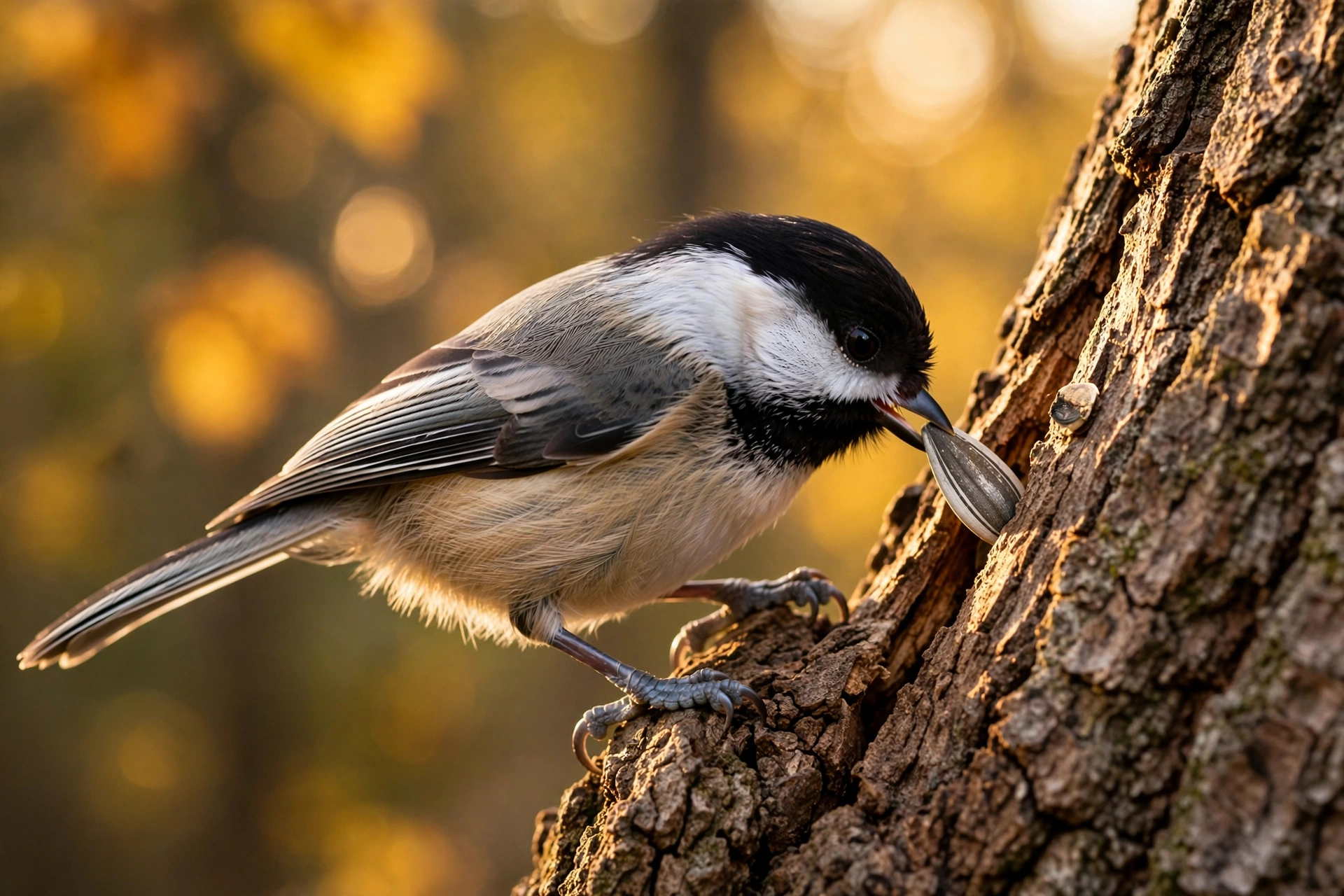
Watch a chickadee at your feeder this October and you will notice something odd. It grabs a single sunflower seed, darts off into the trees, and comes right back for another. It is not eating them. It is hiding them, one by one, in hundreds of secret spots across your yard.
So, do birds store food for winter? Yes, and they do it with a skill that borders on the miraculous. Chickadees, nuthatches, titmice, and jays spend the fall stashing thousands of seeds and nuts in bark crevices, under leaf litter, and in the soil. Then, in the depth of winter, they remember where almost every single one is hidden. Here is how caching works, why October is the peak season, and how you can help.
Why October Triggers the Caching Rush
Caching is not random. It is a survival strategy switched on by shortening days and cooling nights. As daylight shrinks in September and October, hormones shift in resident birds, and food gathering goes into overdrive. Trees are dropping a harvest of acorns, beechnuts, and seeds at the same moment insects are disappearing, so the timing is perfect.
Chickadees can stash several hundred items in a single busy day during the peak. Blue jays may carry off thousands of acorns over a few weeks. Every bird that stays through a northern winter faces the same math: it can burn more calories on a cold night than its tiny stomach can hold, so backup pantries hidden all over its territory are the difference between life and death.
Scatter Hoarding vs Larder Hoarding
Scientists divide food storage into two strategies. Scatter hoarders spread many small caches across a wide area, while larder hoarders pile large amounts of food into one defended spot. Both work, but they demand very different brains and bodies.

| Feature | Scatter Hoarding | Larder Hoarding |
|---|---|---|
| Bird examples | Chickadees, nuthatches, titmice, blue jays, Clark’s nutcrackers | Acorn woodpeckers, shrikes |
| Cache style | One seed or nut per hiding spot, spread over the whole territory | Thousands of items in one central location |
| Memory demand | Extreme: must remember hundreds or thousands of locations | Low: only one or a few places to defend and revisit |
| Theft risk | Low: a thief can only find a fraction of the scattered stash | High: a discovered larder can be raided completely |
| Ecological effect | Forgotten single seeds sprout into new trees | Concentrated food supports a whole woodpecker clan |
Most of the backyard birds you know are scatter hoarders. That is why a chickadee can hide more than a thousand seeds in bark cracks across its territory without losing track. The Acorn Woodpecker takes the opposite approach, drilling thousands of individual holes in a single dead tree or telephone pole and stuffing each one with an acorn to create a granary.
Meet the Master Cachers of Your Backyard
Not every bird caches, and the ones that do are specialists. Here are the four you are most likely to see stocking the pantry this month.
Black-Capped Chickadees
The chickadee is the champion of the backyard set. A single bird may hide seeds in more than a thousand separate spots in one season, each cache usually just one seed wedged into a crack in the bark or tucked under a flake of lichen. Watch your feeder and you will see the rhythm: grab, dash, hide, repeat, all day long.
Chickadees even judge what is worth storing. Research has shown they prefer seeds and foods with high fat content when building winter reserves. To draw more of them to your yard this caching season, see how to attract chickadees to your yard.
White-Breasted Nuthatches
Nuthatches cache too, and their upside-down lifestyle gives them access to hiding spots no other bird can reach. A nuthatch will wedge a seed into a bark crevice, then often plaster the entrance with lichen, moss, or a flake of bark to camouflage it. This is the bird famous for climbing headfirst down tree trunks, and that skill turns every inch of bark into a potential pantry; read why nuthatches climb down trees to understand the full trick.

Tufted Titmice
Titmice are close relatives of chickadees and share the scatter-hoarding habit, though they have been studied less. They ferry seeds from feeders into nearby trees and shrubs, tucking them into bark furrows and branch forks. In October, listen for their scolding calls near feeding stations; a titmouse making dozens of quick trips is almost certainly stocking up, not snacking.
Blue Jays and Other Corvids
Blue jays are the heavy lifters. A jay can carry up to five acorns at once, stashing two or three in a throat pouch called the gular pouch, holding another in its mouth, and gripping one more in the tip of its bill. Six radio-tagged jays each cached 3,000 to 5,000 acorns in a single autumn, according to published tracking studies. They are picky shoppers too, rejecting acorns infested with weevil larvae before flying off to bury the good ones.
Their western cousins take it further. Clark’s nutcrackers, which live in mountain pine forests, can cache tens of thousands of pine seeds in one season, burying them in the soil across huge areas. Few animals on Earth move more food per body weight than a working nutcracker in October.
What Foods Birds Cache and How They Choose
Birds do not cache everything. They target foods that are energy dense and keep well: acorns, beechnuts, hazelnuts, pine seeds, sunflower seeds, and peanuts. High fat is the point, because winter survival is a calorie-burning contest, and fatty seeds pack the most fuel per gram.
Quality control matters. Jays tap and shake acorns, listening for the rattle of an insect larva inside, and drop the bad ones. Chickadees prefer intact, full seeds over cracked ones. Perishable foods like berries are eaten on the spot instead of stored, because a cache that rots is wasted work.
- Acorns: the top choice of jays, preferred over almost everything else
- Black-oil sunflower seeds: high in fat, thin shells, loved by chickadees and titmice
- Peanuts: prized by jays, nuthatches, and woodpeckers for their fat content
- Beechnuts and hazelnuts: cached by jays and nuthatches where available
- Pine seeds: the specialty food of nutcrackers, crossbills, and nuthatches
How Birds Remember Thousands of Hiding Spots
This is the part that stuns scientists. A chickadee weighing less than half an ounce can remember the locations of hundreds of individual seeds for weeks or months. It does not smell them out or search randomly; experiments show caching birds use spatial memory, navigating by landmarks like a tiny surveyor.
The secret lives in the hippocampus, the brain region that handles spatial memory. Food-storing birds have a proportionally larger hippocampus than non-storing species, and in chickadees the region actually grows in autumn, by as much as 30 percent according to researchers, then shrinks back in spring when caching ends. New neurons are generated in fall to record fresh cache maps, and old memories from previous years are cleared out.
Retrieval is not perfect. Birds recover the large majority of their caches but lose some to rot, theft by other animals, or simple forgetting. That failure rate turns out to matter a great deal for forests, as we will see next.
The Caches They Forget: How Birds Plant Forests
Every cache a bird never returns to is a seed planted with fertilizer and a map. Blue jays bury acorns a few hundred yards from the parent tree, push them into the soil, and cover them; the ones they forget can sprout into oak seedlings far from any existing oak. Cornell Lab credits jays with helping spread oak trees after the last glacial period.

Clark’s nutcrackers play the same role for whitebark and limber pines in the mountains, burying seeds at exactly the shallow depth where pines germinate best. Entire forests owe their shape to forgetful birds. Next time you see an oak sapling growing in a strange spot, thank a jay that had a busy October and a slightly leaky memory.
How to Help Caching Birds This Fall
October is the best month to support your local cachers. What you offer now goes straight into winter pantries, and every stocked cache is one less cold night a bird has to go hungry.
Offer the Right Caching Foods
Black-oil sunflower seeds are the single best feeder food for caching chickadees, titmice, and nuthatches. They are high in fat, easy to carry, and wedge neatly into bark. Whole peanuts in the shell are jay magnets and give nuthatches and titmice a prized prize to hammer open later; just make sure they are unsalted, and read can birds eat peanuts for the full safety guide. Suet cakes supply concentrated fat for quick energy between caching trips.
Create a Cache-Friendly Habitat
A yard that stores food well looks a little wild. Rough-barked trees, dead snags, brush piles, and fallen logs give cachers endless hiding spots. Leave leaf litter in garden beds through winter; it hides buried caches from thieves and shelters the insects birds eat between seed meals. Platform and tray feeders suit jays and nuthatches better than tube feeders, and a ground-level feeding area mimics natural foraging.
Feeding Tips for the Caching Season
- Top up feeders early: caching peaks in the morning, when birds work hardest
- Offer more in October: birds are building reserves now, not in January
- Keep water open: a heated birdbath near feeders draws far more caching birds
- Don’t tidy too much: raking every fallen acorn removes the natural harvest
- Stay consistent: birds plan routes around reliable food sources
Caching vs Migrating: Two Ways to Survive Winter
Not all birds solve winter the same way. Migrants like warblers and orioles fly thousands of miles to where food stays abundant, spending enormous energy on the journey. Cachers like chickadees and jays stay put and invest that energy in thousands of tiny food deliveries instead.
Each strategy has risks. A migrant can run into storms or lose habitat along the way. A cacher bets everything on one territory and one winter; if caches rot or a deep freeze locks them away, there is no backup plan. That is why October matters so much. The birds that cache hardest in fall are the ones most likely to greet you at the feeder in February.
Frequently Asked Questions
Do all birds store food for winter?
No. Caching is a specialty, mostly of chickadees, titmice, nuthatches, jays, crows, woodpeckers, and a few others. Most songbirds either migrate or switch to whatever winter foods they can find day by day. Only birds with the right beak, brain, and instincts become serious cachers.
How many caches can a single chickadee remember?
Researchers have documented individual chickadees using more than a thousand separate cache sites in a season. Their enlarged autumn hippocampus records each location as a distinct spatial memory, and they can retrieve the large majority of them weeks or months later.
How long do birds remember where they hid food?
Most caches are recovered within weeks to a few months, through the winter season. As spring arrives and fresh food appears, the caching drive fades, the hippocampus shrinks back, and old cache memories are discarded to make room for the next autumn.
Can birds find caches buried under snow?
Yes, within limits. Because they navigate by landmarks and spatial memory rather than sight or smell, caching birds can dig through moderate snow to reach remembered spots. Extremely deep or ice-crusted snow can still defeat them, which is one reason they hide so many extras.
Do birds steal each other’s caches?
Constantly. Jays watch chickadees cache and will raid the spots later, and squirrels are expert cache thieves. This is exactly why scatter hoarding works: spreading food across a thousand sites means no thief can steal more than a small fraction. Some birds even wait until rivals look away before hiding food, and re-hide it later.
Should I stop feeding birds so they keep caching naturally?
No. Feeder food supplements natural caching rather than replacing it. Birds in October treat your sunflower seeds as part of the fall harvest and stash much of it in bark and soil. Consistent feeding supports the extra energy caching demands and helps more birds enter winter in good condition.
Do the seeds birds forget ever grow into trees?
Often. Forgotten caches are one of nature’s main tree-planting systems. Blue jays are credited with spreading oaks across eastern North America after the last ice age, and nutcrackers regenerate mountain pine forests. Your backyard oaks may have started as a jay’s lost lunch.
Final Thoughts
So the next time a chickadee snatches a seed and vanishes into the trees, you are watching one of the most impressive memory feats in the animal kingdom. That tiny bird is building a winter survival map with a thousand stops, powered by a brain that literally grows to hold it all.
October is your window to help. Fill the feeders, leave the leaf litter, plant an oak for the jays of the future, and let the cachers do what they have perfected over millions of years. Come February, when that same chickadee digs a seed out of the bark and eats it in a snowstorm, you will know exactly how it got there.




