 Skip to content

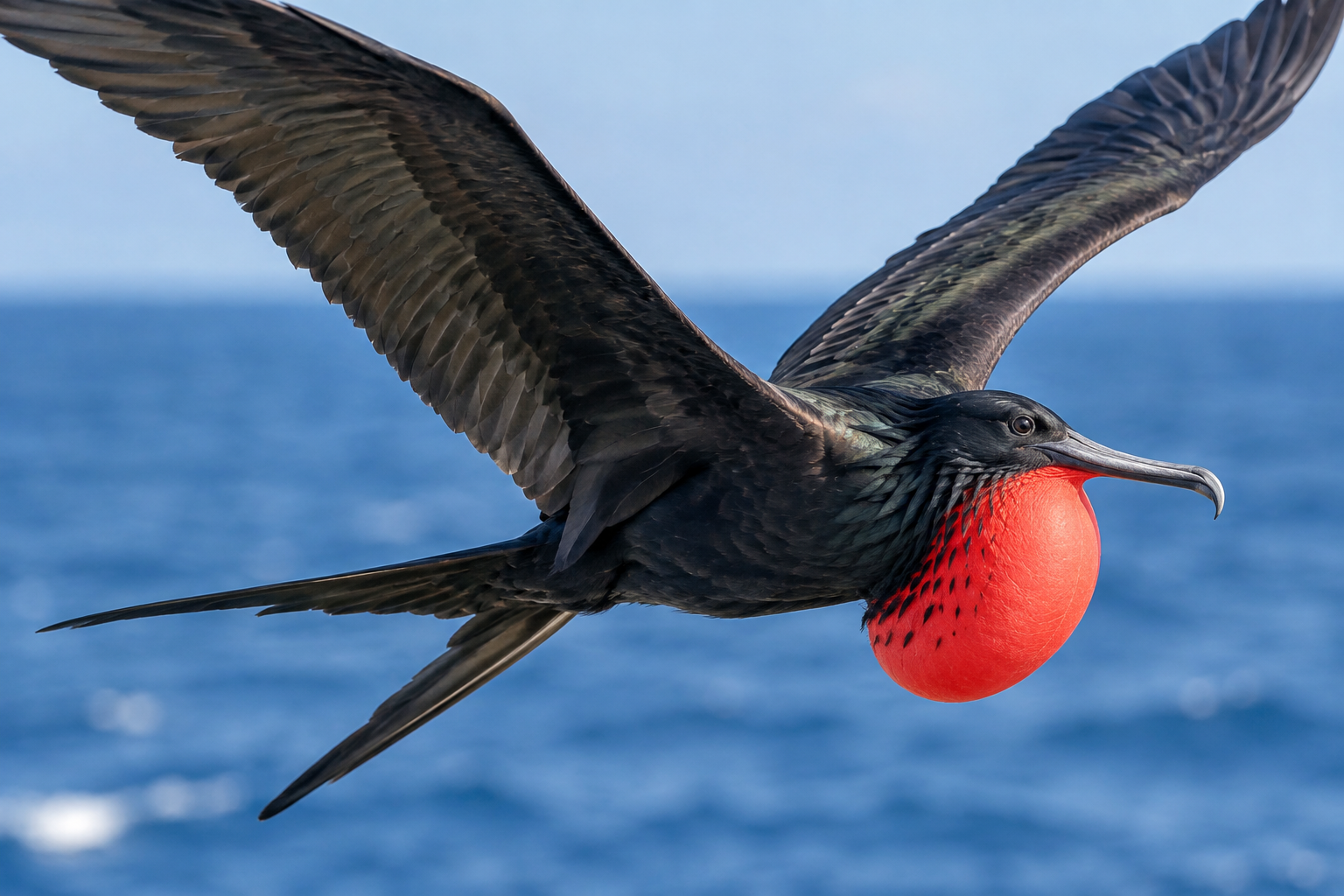
A frigate bird is a large tropical seabird built almost entirely around the demands of sustained flight, and this guide covers how to recognize one, where to find it, what it eats, and why it behaves so differently from every other seabird sharing its water.
Frigatebirds belong to the family Fregatidae, a small and highly distinctive group within the seabirds. All living members belong to a single genus, Fregata, which contains five species distributed across the world’s warm oceans.
The silhouette is unmistakable once learned: long, narrow, angular wings held in a shallow bow, a deeply forked tail that opens and closes like scissors, a long bill hooked sharply at the tip, and plumage that appears black from any distance.
What sets the group apart is a refusal to do what seabirds normally do. Frigatebirds do not plunge-dive, do not swim, and avoid settling on the ocean surface. They feed by snatching, skimming, and harassing other birds into surrendering their catch an aerial opportunist rather than a diver.
How to Identify a Frigatebird in the Field

Use this field procedure to confirm a frigatebird sighting from shore, a boat, or an island lookout. You need only binoculars and a clear view of open sky above coastal or offshore water.
- Scan the sky well above the waterline rather than the sea surface, since frigatebirds hunt from height and rarely sit on the water.
- Locate a dark, long-winged bird soaring without flapping; steady circling on motionless wings is the first filter.
- Check the wing shape for a sharp bend at the wrist and long, tapered tips forming a shallow W against the sky.
- Watch the tail through several turns. A deeply forked tail that opens into a scissor shape and closes to a single point confirms the family.
- Note the bill profile in profile view: long, slender, and hooked at the tip, never pouched or spear-straight.
- Look for a white breast or a white head, which separates females and juveniles from the all-dark adult male.
- Observe the bird’s feeding attempt. Chasing another seabird, or dipping to pluck prey without landing, settles the identification.
- Record the date, location, and plumage pattern before the bird drifts out of view.
Frigate Bird Quick Facts
The essential frigate bird facts, condensed for quick reference:
- Family: Fregatidae
- Genus: Fregata
- Living species: Five
- Habitat: Tropical and subtropical oceans
- Diet: Fish, squid, crustaceans, and flying fish taken at or just above the surface
- Flight style: Soaring and gliding on thermals and sea breezes, with minimal flapping
- Tail: Long and deeply forked, used as a steering surface
- Bill: Long, slender, and hooked at the tip for grabbing prey in passing
- Notable behavior: Kleptoparasitism — chasing other seabirds until they release their catch
- Male display: An inflatable red throat pouch expanded during courtship
What Does a Frigate Bird Look Like?

Size and Wingspan
The size of a frigate bird is deceptive. The birds look enormous overhead because the frigate bird wingspan is exceptionally wide relative to the body carrying it, yet the skeleton beneath those wings is extraordinarily light.
Bone, feather, and air sac together produce a bird that weighs far less than its outline suggests. Females run larger and heavier than males — a reversal of the usual pattern in birds — and the difference is often visible when a pair is seen together.
Feathers and Plumage
Adult males are uniformly black, with an iridescent green or purple sheen across the back and upperwing that flares in direct sunlight.
Females break that pattern with a white breast and, in several species, a pale collar or throat. Juveniles are the most conspicuous of all, carrying a white head and underparts that make young birds easy to pick out in a mixed colony. Full adult plumage arrives slowly, over a span of several molts.
Long Forked Tail
The tail is long and split deep into two streamers. Opened, it acts as a broad steering and braking surface; closed, it reduces drag to a single trailing point. That adjustment, made continuously in flight, gives frigatebirds their sharp, sudden turns during a chase.
Long Hooked Bill
The bill is slender, longer than the head, and hooked at the tip — a tool for seizing slippery prey from the water surface at speed without stopping.
The Male’s Red Throat Pouch
Males carry a bare throat sac that inflates into a brilliant scarlet balloon during courtship, held taut for hours while the bird advertises from the nest site.
Where Do Frigatebirds Live?
The frigate bird habitat is defined by warm water. All five species occupy tropical and subtropical oceans, favoring regions where sea temperatures stay high enough to support flying fish, surface-schooling baitfish, and the predatory tuna that drive prey upward within reach.
Birds range widely over open ocean and along coastlines, patrolling reef edges, lagoons, channels, and the boundary where shallow water drops into blue. Foraging trips can carry a bird far from land, but the species remain tied to islands for one reason: they must come ashore to breed.
Breeding colonies sit almost exclusively on small islands, cays, and offshore rocks, where mangroves, low shrubs, or bare ledges provide nest sites free of ground predators. Colonies are noisy, dense, and long-established, with birds returning to the same islets year after year.
Distribution varies by species. Some occupy the tropical Atlantic and eastern Pacific, others the Indian and western Pacific Oceans, and two are confined to single islands.
Do Frigatebirds Live Near Humans?
Frigatebirds tolerate human activity well and often exploit it. Ports, harbors, fish-cleaning stations, and busy beaches attract them because discarded catch and disturbed baitfish are easy meals. Coastal travelers frequently see their first frigatebird hanging motionless above a marina or a hotel roofline, riding updrafts without a wingbeat.
Fishing activity draws particular attention. Birds shadow boats returning with a catch, hover above nets, and take scraps thrown overboard. Working vessels sometimes carry a small escort of frigatebirds for miles.
The relationship remains one-sided. Frigatebirds approach for food, not company, and they do not nest in developed areas — colonies stay on undisturbed islands.
The Five Species of Frigatebird
Magnificent Frigatebird
The magnificent frigate bird is the species most travelers encounter in the Americas, ranging across the tropical Atlantic, the Caribbean, and the eastern Pacific coastline, with a well-known population in the Galápagos. Adult males are glossy black with a green sheen; females show a white breast and a black throat.
Great Frigatebird
Widely distributed across the tropical Pacific and Indian Oceans, the great frigatebird nests on islands from the Hawaiian chain to the western Indian Ocean. Females carry a white throat and breast, and males show a scapular sheen that leans green in good light.
Lesser Frigatebird
The most compact of the group, the lesser frigatebird breeds across the Indian and Pacific Oceans and disperses widely between breeding seasons. Both sexes show a white spur extending from the flanks onto the underwing — the most reliable field mark in the genus.
Ascension Frigatebird
Restricted to the South Atlantic, this species breeds on and around Ascension Island. Introduced predators once pushed the colony off the main island entirely, concentrating nesting onto an adjacent offshore rock until eradication work allowed a return.
Christmas Island Frigatebird
The rarest and most geographically confined of the five, breeding only on Christmas Island in the Indian Ocean. Adults show a white belly patch. A single breeding location leaves the population inherently vulnerable to habitat loss, storms, and disturbance, and the species is the focus of sustained conservation attention.
What Do Frigatebirds Eat and How Do They Catch Food?
Ask what do frigate birds eat and the list is narrower than the hunting method suggests: flying fish above all, plus small schooling fish, squid, jellyfish, crustaceans, and — at colonies — the eggs and chicks of other seabirds, including their own kind.
Surface Feeding
The standard technique is a snatch on the wing. The bird drops toward the surface, extends its neck, and plucks prey from the water or from the air with the hooked bill, then climbs away without breaking stride. Flying fish flushed by hunting tuna are taken mid-glide. Frigatebirds do not plunge, do not submerge, and do not paddle after prey.
Kleptoparasitism
The behavior that built the bird’s pirate reputation is theft. A frigatebird will single out a returning booby, tropicbird, or tern, chase it through tight turns, and grab at the tail or wingtip until the victim disgorges its catch. The frigatebird then drops, catches the falling meal in midair, and resumes soaring.
Stolen food supplements rather than replaces normal foraging. Most calories still come from the ocean surface, but harassment gives the bird a reliable fallback when fishing is poor — an opportunist working the effort of others instead of spending its own.
Flight Mechanics and Aerial Ability
How They Stay Airborne
A frigate bird in flight is a soaring machine. The wing is long, narrow, and carried on a skeleton so light that the bird can hold altitude on rising air alone. Birds climb inside thermals and cloud updrafts, glide down across miles of ocean, then find the next column of lift and repeat. Flapping is reserved for takeoff, chases, and calm air. That economy allows foraging trips lasting days, and birds may remain aloft continuously for extended stretches at sea.
Why They Avoid the Water
Frigatebird plumage lacks the waterproofing that other seabirds rely on, and the feet are only partly webbed. A soaked frigatebird struggles to get airborne again from a flat surface, so landing on water is effectively a last resort. Everything about the feeding strategy — snatching, skimming, stealing — follows from that constraint.
Speed
Frigatebirds are fast in a chase but they are not the fastest flying bird by any measure. Questions about the fastest bird in the world resolve to diving raptors, whose stoop speeds come from gravity rather than wingbeats. Compare like with like and the frigatebird’s distinction is different: agility and endurance, the ability to turn inside another bird and to stay up long after that bird has gone home.
Frigatebird vs Pelican: What’s the Difference?
Both are large coastal birds and both soar, which is where the resemblance ends.
Shape. A pelican bird is heavy-bodied with broad, straight wings and a short, square tail. The frigatebird is lean, with sharply angled wings and a long forked tail visible on every turn.
Bill. The pelican carries an unmistakable pouched bill built to scoop water and fish together. The frigatebird’s bill is thin and hooked, built to grab a single item and keep moving.
Feeding. A brown pelican hunts by plunge-diving, folding its wings and hitting the water hard, then floating while it drains the pouch. The frigatebird never enters the water at all.
Water behavior. Pelicans swim comfortably and rest on the surface between dives. Frigatebirds roost on branches, cliffs, and masts, and take to the air rather than the sea.
Seen overhead, the forked tail settles the question immediately.
Reproduction and Lifespan
Courtship
Males gather at colony sites and inflate the bare red throat pouch into a taut scarlet balloon, holding it for hours while clattering the bill, spreading the wings, and calling at females passing overhead. A female selects a displaying male, and the pair bond forms at that site.
Nesting
Nests are loose platforms of sticks built in mangroves, low shrubs, or on bare ground, packed close together within a colony. Neighboring birds steal nest material constantly, so one adult usually stays on site while the other collects.
Eggs and Chicks
The clutch is a single white egg. Both parents incubate in long shifts and both feed the chick, which grows slowly and remains dependent well past fledging. Extended juvenile care means most pairs cannot breed every year, which keeps reproductive output low.
Lifespan
Frigatebirds are long-lived seabirds, reaching breeding age only after several years. Longevity offsets the slow breeding rate, but it also makes colonies slow to recover from storms, predator introductions, and habitat loss.
Are Frigatebirds Dangerous?
Frigatebirds pose no threat to people. They do not attack humans, and encounters on beaches and boats are limited to birds looking for scraps.
Handle with care regardless. The bill is long and sharply hooked, and a distressed or injured bird will strike at a hand or face. Leave rescue and handling to wildlife authorities.
At colonies, keep well back. Disturbed adults abandon nests, exposing the single egg or chick to heat and to raiding neighbors. Observe from a distance with binoculars.
Frequently Asked Questions About Frigatebirds
What is a frigate bird?
A large tropical seabird in the family Fregatidae, recognized by long angular wings, a deeply forked tail, and a hooked bill.
Where are frigatebirds found?
Across tropical and subtropical oceans worldwide, foraging over open water and breeding in colonies on islands.
What do frigatebirds eat?
Flying fish, small schooling fish, squid, jellyfish, and crustaceans, plus food stolen from other seabirds.
Can frigatebirds swim?
No. Their plumage is not waterproof and their feet are only partly webbed, so they avoid landing on water.
How fast can a frigatebird fly?
Fast enough to run down a booby in a chase, though the species is built for endurance and maneuverability rather than top speed.
Key Takeaways
- Frigatebirds are tropical seabirds in the family Fregatidae, all placed in the genus Fregata, with five living species spread across the warm oceans of the Atlantic, Pacific, and Indian basins.
- The defining field marks are long, sharply angled wings, a deeply forked tail that opens and closes in flight, a long hooked bill, and dark plumage — with white on the breast in females and on the head in juveniles.
- Frigatebirds cannot swim and avoid landing on water because their feathers are not waterproof, so all feeding happens at or just above the surface, on the wing.
- Kleptoparasitism — harassing other seabirds until they release their catch, then catching the falling food midair — supplements normal foraging and gives the group its pirate reputation.
- Males inflate a bare scarlet throat pouch during courtship; pairs raise a single chick with prolonged parental care, which keeps breeding output low and makes island colonies slow to recover from disturbance.
- Overhead confusion with pelicans is resolved by two features: the forked tail and the absence of a throat pouch on the bill.
Frigate Bird Identification Guide
Confirm a frigatebird by working through four cues in order:
- Flight — prolonged soaring with almost no flapping, high above the water.
- Wings — long and narrow, bent sharply at the wrist, forming a shallow W.
- Tail — deeply forked, scissoring open and shut through turns.
- Bill — slender and hooked, never pouched.
Frigatebird or pelican: a forked tail, angular wings, and a bird that never touches the water means frigatebird. A square tail, broad straight wings, a pouched bill, plunge-diving, and resting on the surface means pelican. Plumage helps too white breast indicates a female frigatebird, white head a juvenile.
Final Thoughts
Frigate birds are among the most remarkable seabirds, combining unusual anatomy with impressive aerial skills. Their long, narrow wings, deeply forked tails, and hooked bills make them easy to recognize, while their lightweight bodies help them soar efficiently over tropical and subtropical oceans.
The five living frigatebird species, including the magnificent frigatebird and great frigatebird, occupy coastal and offshore environments across warm regions worldwide. Their diet includes fish, squid, and other marine prey, and they are also known for stealing food from other seabirds.
Although frigatebirds are excellent fliers, they are not the fastest birds in the world. Their real advantage is endurance and maneuverability. From their distinctive courtship displays to their specialized feeding behavior, frigatebirds remain fascinating examples of adaptation to life above the ocean.





