Skip to content

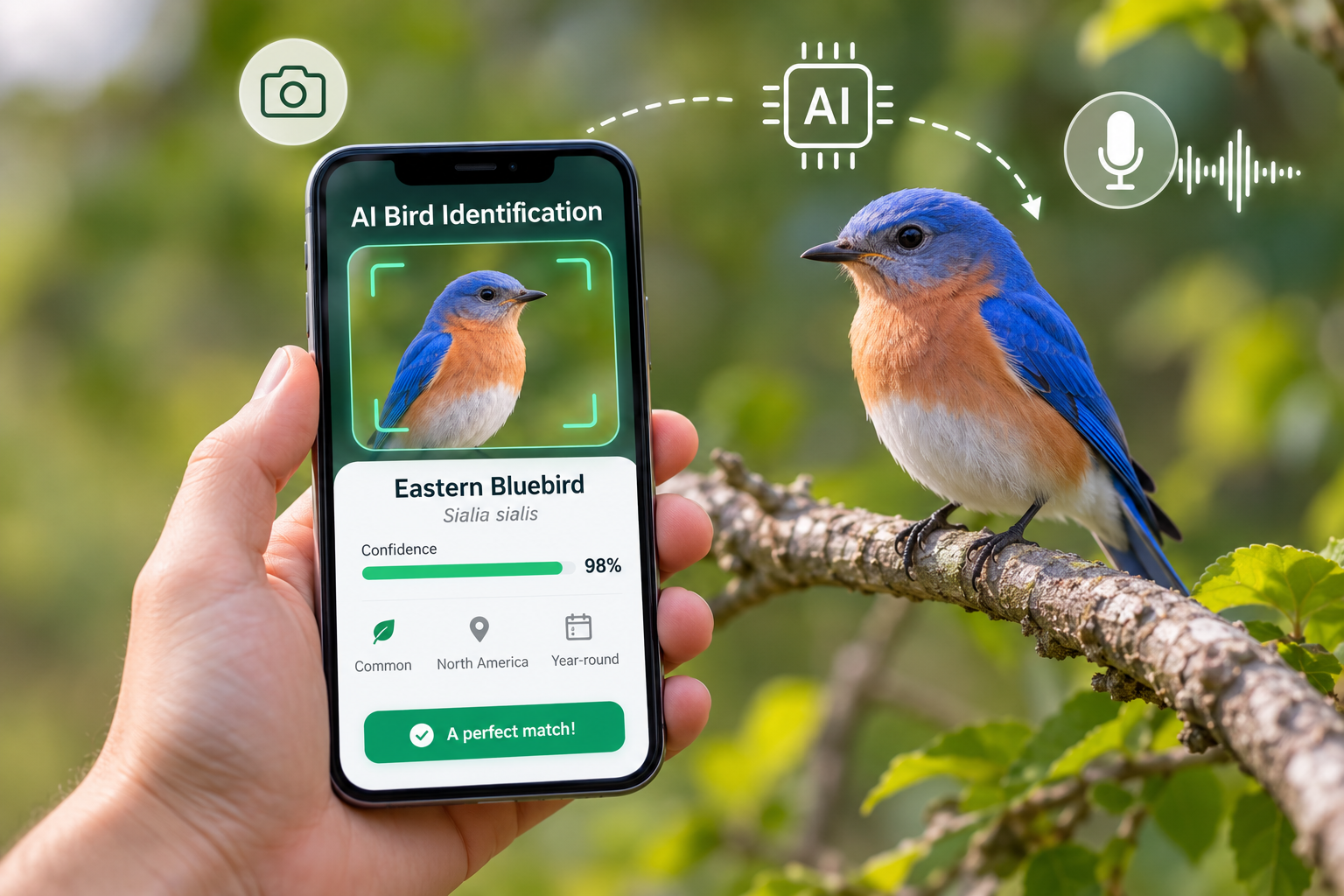
Have you ever spotted a bird in your backyard, on a hiking trail, or during a morning walk and wondered, “What bird is this?” You may notice its colors, shape, or unusual behavior, but identifying the exact species can be surprisingly difficult, especially when several birds look almost identical. That is where AI bird identification can help.
Modern artificial intelligence can analyze photographs and bird sounds to suggest possible species within seconds. Instead of flipping through dozens of pages in a field guide, birdwatchers can use an AI-powered identification tool to upload a picture or record a bird call and receive potential matches.
But how reliable is this technology? Can AI really identify a bird from a blurry photograph or a sound recording? And should you trust the first result it gives you?
This guide explains how AI bird identification works, how to identify birds from photos and sounds, what can affect accuracy, and how to verify an AI result before adding a new species to your birding list.
Table of Contents
- What Is AI Bird Identification?
- How AI Recognizes a Bird From a Photo?
- How AI Identifies Birds From Sounds
- How to Identify a Bird From a Picture Using AI
- How to Identify a Bird by Its Sound With AI
- Best AI Bird Identification Apps in 2026
- AI Bird Identification Apps vs. Traditional Bird Identification
- What Makes AI Bird Identification Accurate?
- When AI Bird Identification Gets It Wrong
- Can You Identify a Bird for Free With AI?
- How to Get Better Results From an AI Bird Identifier
- AI Bird Identification for Backyard Birdwatchers
- AI Bird Identification for Bird Photographers
- The Future of AI Bird Identification in 2026 and Beyond
- Frequently Asked Questions About AI Bird Identification
- What is the best AI bird identification tool?
- Can AI identify a bird from a picture?
- Can AI identify a bird by its sound?
- Is there a free bird identification app?
- Can I identify a bird online without downloading an app?
- How accurate are AI bird identification apps?
- What should I do if the AI gives me the wrong bird?
- Can AI identify birds from blurry pictures?
- Can AI identify birds that I cannot see?
- Final Thoughts
What Is AI Bird Identification?

AI bird identification is technology that uses artificial intelligence and machine learning to recognize bird species from information such as photographs, recordings, and sometimes location or habitat data.
Traditional bird identification depends heavily on human observation. You might compare a bird’s beak, feathers, wings, tail, size, and behavior with a field guide. With AI, software performs much of this comparison automatically.
For example, you can take a photograph of an unfamiliar bird and upload it to a bird recognition app. The system analyzes visible characteristics and compares them with patterns learned from large collections of bird images. It then provides one or more possible species.
Sound-based identification works differently. Instead of examining feathers and body shape, an AI system analyzes characteristics of a bird’s song or call, such as pitch, frequency, rhythm, duration, and repeated patterns.
The result is not magic. AI is essentially looking for patterns that match known examples.
How AI Recognizes a Bird From a Photo?
When you use an AI bird identification tool with an image, the software may analyze several visual characteristics, including:
- Feather colors and markings
- Head patterns
- Beak shape and size
- Body proportions
- Wing patterns
- Tail shape
- Leg and foot characteristics
- Overall posture
Some identification systems can also benefit from information about where the photograph was taken.
This matters because two species can look extremely similar but have completely different geographic ranges. Location and habitat can therefore provide useful additional clues.
How AI Identifies Birds From Sounds
A bird does not have to be visible for AI to help identify it.
A bird sound identifier analyzes a recording of a bird’s vocalization and compares its acoustic pattern with known bird sounds. This can be particularly useful when a bird is hiding inside dense vegetation, sitting high in a tree, or calling from somewhere outside your field of view.
Depending on the technology, it may recognize songs, calls, chirps, or other vocalizations.
However, sound identification has its own challenges. Wind, traffic, insects, people, and other birds can interfere with recordings. This is why a clear recording usually produces better results.
How to Identify a Bird From a Picture Using AI
One of the easiest ways to use AI for bird identification is through a photograph.
You do not necessarily need professional photography equipment. A smartphone photo can be enough if the bird is reasonably clear and visible.
Here is a simple process to follow.
Step 1: Take the Clearest Bird Photo Possible
The quality of your photograph can make a major difference.
Try to capture the bird in good natural light and keep the camera steady. If possible, photograph the entire bird rather than only part of its body.
A useful bird photograph may show:
- The bird’s head
- Beak
- Chest and belly
- Wings
- Tail
- Legs
- Distinctive feather markings
You can also take several photographs from different angles. One image might show the wing pattern clearly, while another reveals the shape of the tail or beak.
Do not get too close if doing so would disturb the bird. Good birding practice means observing wildlife without causing unnecessary stress.
Step 2: Upload the Photo to an AI Bird Identifier
Once you have a suitable photograph, upload it to an AI-powered identification service or bird identification app.
This is where terms such as “bird identifier by picture,” “picture bird identifier,” and “bird identifier online” become useful. These tools are designed to turn a photograph into a potential species identification.
The AI examines the image and searches for visual patterns that resemble known bird species.
Step 3: Review the Suggested Species
Do not automatically assume the first result is correct.
Look at the suggested species and compare it with your photograph. Some tools may provide several possibilities rather than one definitive answer.
Pay attention to:
- Similar species
- Confidence scores, if provided
- Geographic range
- Habitat
- Physical characteristics
If the AI suggests a bird that does not normally occur in your region, that should immediately encourage you to investigate further.
Step 4: Confirm the Identification
The best approach is to use AI as an identification assistant rather than your only source.
Compare the AI result with a reliable bird reference or field guide. Look carefully at the features that separate the suggested species from similar birds.
This extra step is especially important when two species have nearly identical colors or markings.
How to Identify a Bird by Its Sound With AI
Sometimes the biggest problem is not taking a photograph—it is finding the bird.
You may hear a distinctive song coming from a tree but have no idea where the bird is hiding. In this situation, a bird sound identifier can be extremely useful.
Record the Bird Call or Song
Start by making a clean recording.
Move away from obvious sources of noise if you can. Avoid talking while recording and try to capture several seconds of the bird’s vocalization.
If the bird repeats its song, record multiple examples. A longer recording can provide more information than a very short clip.
You do not need to disturb the bird or approach it closely. In many cases, simply recording from your existing position is enough.
Analyze the Recording
After recording the sound, use a bird identification app or sound-recognition tool that supports bird calls.
The AI examines the acoustic characteristics of the recording and compares them with known vocalizations.
A useful system may return a likely species or several possible matches.
This can be especially helpful for beginners who have not yet learned how to distinguish bird songs by ear.
Why Bird Sounds Can Be Difficult to Identify
Sound identification is powerful, but it is not always straightforward.
Imagine recording a bird in a busy city park. The audio might contain:
- Traffic
- Wind
- Dogs
- People talking
- Insects
- Multiple birds
All of these sounds can make identification more difficult.
Birds can also produce different vocalizations depending on their age, sex, behavior, and situation. Some species have calls that sound surprisingly similar to those of other birds.
For these reasons, treat an AI result as a useful clue rather than absolute proof.
Best AI Bird Identification Apps in 2026
If you’re ready to start identifying birds, here are the top bird identification app choices for 2026, compared side by side:
Merlin Bird ID — Best Overall Free Choice
Developed by the Cornell Lab of Ornithology, Merlin Bird ID is widely considered the gold standard. It offers both photo and sound identification completely free, works offline (perfect for remote birding trips), and taps into one of the largest bird databases in the world. If you’re only going to download one app, this is it.
Picture Bird — Best for Photo-Based Identification
Picture Bird is a popular commercial app focused on quick, accurate photo identification. It’s praised for its clean interface and detailed species information. While the basic version is free, premium features require a subscription. It’s an excellent choice if you primarily rely on photos rather than audio.
Audubon Bird Guide — Best for Learning
The Audubon Bird Guide combines AI identification with a rich library of educational content. It’s a fantastic free bird identification app for beginners who want to not only identify birds but also learn about their behavior, habitat, and conservation status.
BirdNET — Best for Sound Only
If you’re specifically hunting for a bird sound identifier, BirdNET (from Cornell and Chemnitz University) is a standout. It focuses entirely on acoustic recognition and is superb at identifying birds by their songs and calls, even with some background noise.
When choosing a bird recognition app, consider whether you need photo ID, sound ID, offline access, or a combination of all three.
AI Bird Identification Apps vs. Traditional Bird Identification
AI does not have to replace traditional birding skills. In fact, the two approaches work particularly well together.
| Method | Best For | Main Advantage | Main Limitation |
|---|---|---|---|
| AI photo identification | Unfamiliar birds in photographs | Fast and convenient | Similar species can cause confusion |
| AI sound identification | Hidden or unseen birds | Works without seeing the bird | Noise can affect results |
| Field guide | Detailed verification | Provides identification details | Takes more time |
| Binoculars and observation | Live birding | Helps study real behavior | Requires practice |
| Human expert | Difficult identifications | Experienced judgment | Expert help may not be available |
For beginners, an AI bird identification app can provide a useful starting point.
Over time, however, you may notice that you rely less on technology because you begin recognizing birds yourself.
That is one of the most valuable parts of birding: learning to notice the small details.
What Makes AI Bird Identification Accurate?
Not every identification has the same level of reliability. Several factors influence how well an AI system can recognize a bird.
Photo Quality
A sharp, well-lit photograph gives the AI more information to work with.
A distant, blurry bird may hide the exact features needed to distinguish one species from another.
Species Similarity
Some birds are naturally difficult to distinguish.
Two closely related species might have similar body shapes and colors, with only subtle differences in markings, beak shape, or habitat.
Geographic Location
Location can be extremely useful.
If an AI system knows where a bird was observed, it may be easier to narrow down the possibilities. A species that is common in one region may be extremely unlikely in another.
Habitat and Environment
Where you found the bird can provide another important clue.
A bird near a wetland, forest, coastline, grassland, or suburban backyard may have a different set of likely species.
Quality of the AI Database
AI identification is only as useful as the information and training behind the system.
A tool may perform differently depending on its coverage, training data, geographic focus, and ability to recognize uncommon species.
Audio Quality
The same principle applies to sound.
A clean recording with a strong bird vocalization generally gives an AI system more useful information than a short, noisy recording.
When AI Bird Identification Gets It Wrong
One of the biggest mistakes a beginner can make is assuming that artificial intelligence is always correct.
It is not.
AI can make incorrect identifications for many reasons. A photograph may be blurry, the bird may be partially hidden, or two species may look almost identical.
Young birds can also be challenging because their plumage may differ significantly from adult birds.
Other difficult cases include unusual coloration, hybrid birds, birds photographed from unusual angles, and species that are rarely represented in the system’s available data.
Sound recognition can face similar problems.
A noisy recording or overlapping songs from several species can produce an incorrect result.
How to Double-Check an AI Identification
Before accepting an identification, ask yourself:
- Does the bird’s appearance match the suggested species?
- Does the species normally live in this geographic area?
- Does the habitat make sense?
- Does the bird’s behavior fit?
- Does its call or song match?
- Are there similar species I should compare?
This process turns AI from a simple guessing tool into part of a more reliable identification method.
Can You Identify a Bird for Free With AI?
Yes, there are free bird identification options available, although the features and limitations can vary between services.
Some free bird identification apps may allow users to analyze photographs, while others focus on sounds. Certain tools may also offer additional features through paid plans.
If you are just beginning birdwatching, a free bird identification app can be a convenient way to experiment with AI without immediately investing in specialized equipment or software.
However, do not choose a tool solely because it is free.
Look at how it handles both common and unusual species, whether it supports sound identification, and whether it provides enough information to help you verify its results.
How to Get Better Results From an AI Bird Identifier
You can improve your results by giving the AI better information.
Photograph Distinctive Features
Instead of taking only a distant full-body photograph, try to capture details that help distinguish species.
The head, beak, wings, tail, and chest can all provide important clues.
Capture More Than One Photo
If the bird remains in the area, take several photographs.
Different angles may reveal features that are invisible in the first image.
Include Location Information
If the identification tool allows it, provide the location where the bird was observed.
Geography can significantly narrow down the possible species.
Record Multiple Calls
If you are using a bird sound identifier, record several vocalizations whenever possible.
Multiple examples may provide a stronger basis for identification.
Pay Attention to Behavior
Do not focus exclusively on appearance.
Watch what the bird does.
Does it forage on the ground? Hover around flowers? Climb tree trunks? Dive into water? Feed at a bird feeder?
Behavior can provide another useful identification clue.
AI Bird Identification for Backyard Birdwatchers
You do not have to travel to a national park or remote forest to benefit from AI bird identification.
Your backyard can become an excellent place to practice.
Birds visiting feeders, gardens, trees, ponds, and shrubs can provide dozens of identification opportunities throughout the year.
When an unfamiliar bird appears, take a photograph and use an AI bird identifier to generate a potential match.
Then compare the result with the bird’s actual appearance and behavior.
Over time, you may begin recognizing recurring visitors without using technology at all.
This makes AI particularly useful for beginners: it can help transform curiosity into knowledge.
Instead of simply thinking, “There is a bird in my yard,” you can begin asking more specific questions:
What species is it?
Why is it visiting?
What does it eat?
Is it migrating?
Does it normally live here year-round?
Those questions can lead to a much deeper interest in birdwatching.
AI Bird Identification for Bird Photographers
Bird photographers can also benefit from AI.
Imagine returning home from a morning of photography with hundreds of bird photographs. You may recognize some species immediately but struggle with others.
An AI identification tool can help narrow down the possibilities.
It can be especially useful when:
- You photographed an unfamiliar species.
- The bird appeared only briefly.
- Several similar species were present.
- You took photographs faster than you could identify them.
- You want to organize a personal bird photography collection.
AI can therefore become part of a photographer’s workflow rather than simply an emergency identification tool.
Still, photographers should verify unusual or important identifications before publishing them as confirmed species records.
The Future of AI Bird Identification in 2026 and Beyond
AI bird identification is likely to become more useful as image and sound recognition technology continues to improve.
Future tools may increasingly combine several forms of information rather than relying on a single photograph or recording.
Imagine pointing your phone toward a bird and having an AI system consider:
- What the bird looks like
- Where you are
- What habitat surrounds you
- What the bird sounds like
- What season it is
- Which species are likely to occur nearby
Combining these clues could make identification more sophisticated.
Real-time identification may also become more practical, allowing birdwatchers to receive potential species matches while observing birds in the field.
The biggest development may not be AI simply naming birds faster. It may be AI helping people understand why a bird is likely to be a particular species.
That educational element could make technology much more valuable to new birdwatchers.
Frequently Asked Questions About AI Bird Identification
What is the best AI bird identification tool?
The best tool depends on what you want to identify. Some are particularly useful for photographs, while others specialize in bird songs and calls. Look for a service with strong species coverage, useful identification details, and a way to compare similar species.
Can AI identify a bird from a picture?
Yes. AI-powered bird recognition systems can analyze photographs and suggest potential species based on visible characteristics. Results are generally better when the photograph is clear and shows distinctive features.
Can AI identify a bird by its sound?
Yes. Bird sound identification technology can analyze songs and calls and compare them with known vocalizations. Clear recordings usually provide better results.
Is there a free bird identification app?
Yes, free options exist, although available features can vary. Some may provide basic photo or sound identification while reserving advanced features for paid users.
Can I identify a bird online without downloading an app?
Some bird identifier online tools allow users to submit information or images through a web browser. Availability and features vary, so check the specific service before relying on it.
How accurate are AI bird identification apps?
Accuracy varies depending on image or audio quality, species similarity, location, database coverage, and other factors. AI should be treated as an identification aid rather than an infallible authority.
What should I do if the AI gives me the wrong bird?
Compare the result with similar species using a reliable field guide or bird database. Check the bird’s geographic range, habitat, appearance, and behavior. If possible, use additional photographs or recordings.
Can AI identify birds from blurry pictures?
It may sometimes produce a useful suggestion, but blurry photographs contain less identifying information. If possible, take another photograph with better focus and lighting.
Can AI identify birds that I cannot see?
Yes. Sound-based identification can potentially identify a bird from its song or call even when the bird is hidden from view.
Final Thoughts
AI bird identification has made identifying unfamiliar birds faster and more accessible than ever.
A photograph can provide enough information for an AI system to suggest a species, while a sound recording can help identify a bird hidden somewhere in the trees. For beginners, this can remove some of the frustration that comes with learning dozens or even hundreds—of bird species.
But the smartest approach is not to let AI do all the work.
Use technology to generate possibilities, then observe the bird yourself. Look at its colors, shape, behavior, habitat, and vocalizations. Compare the result with a trusted reference before accepting an unusual identification.
In other words, AI should be your bird identification assistant, not your final judge.
The real reward comes when you eventually look at a bird, hear its call, and recognize it yourself.
That is when AI stops being the answer and becomes part of how you learned to find it.