 Skip to content

Most people who go looking for a sage-grouse bird fail on the first attempt, and the reason is almost always the same: they search for a bird when they should be searching for a plant community. This species does not merely prefer sagebrush country.
It is built around it, feeding on sagebrush leaves, nesting beneath sagebrush canopies, and wintering in stands tall enough to stay exposed above deep snow. Find the right sagebrush, and the bird becomes findable. Stand in the wrong vegetation, and no amount of patience will produce one.
In everyday usage, “sage grouse” refers to the greater sage-grouse, the widespread species of the sagebrush steppe. A second, separate species, the Gunnison sage-grouse, is recognized in a much smaller area of the southern Rockies. Older ranchers, hunters, and field guides often use the folk name “sagehen,” which still appears in local place names across the Interior West.
Several traits make these birds worth study: exceptional size for a grouse, a diet built on a shrub most animals avoid, communal breeding grounds where males display together each spring, and a distribution stretching across the sagebrush basins and foothills of western North America.
Sage-Grouse Quick Facts
Use the summary below as a reference point before working through habitat, diet, and identification in detail.
| Attribute | Detail |
|---|---|
| Common names | Greater sage-grouse, sage grouse, sagehen |
| Scientific name | Centrocercus urophasianus |
| Family | Phasianidae (pheasants, grouse, and allies) |
| Size class | Largest grouse in North America |
| Core habitat | Sagebrush shrub-steppe, sagebrush basins, foothill sagebrush |
| Range | Western North America, from the Great Basin and Wyoming Basin north into the Canadian prairie provinces |
| Primary diet | Sagebrush leaves year-round; forbs and insects seasonally |
| Breeding system | Lek-based; males display communally, females select mates |
| Nesting | Ground nest concealed under shrub canopy |
| Movement | Seasonal shifts between breeding, brood-rearing, and winter range |
| Conservation profile | Sagebrush-obligate species of range-wide conservation concern |
| Best viewing season | Early spring, at dawn, from established viewing areas |
What Does a Greater Sage-Grouse Look Like?

The greater sage-grouse stands apart from every other grouse on the continent by sheer bulk. It carries the heavy, barrel-chested build of a ground bird that spends its life walking, flushing only when pressed, and flying in low, powerful bursts.
On the ground it looks less like a game bird and more like a small domestic hen with a spike-shaped tail an impression that explains the durability of the old “sagehen” name.
The body is chunky through the breast and shoulders, tapering to a long, sharply pointed tail made up of stiff, narrow feathers. The legs are feathered to the toes, the head is small relative to the body, and the overall plumage is a mottled mix of gray-brown, buff, and black that dissolves against sagebrush and bare soil.
Males
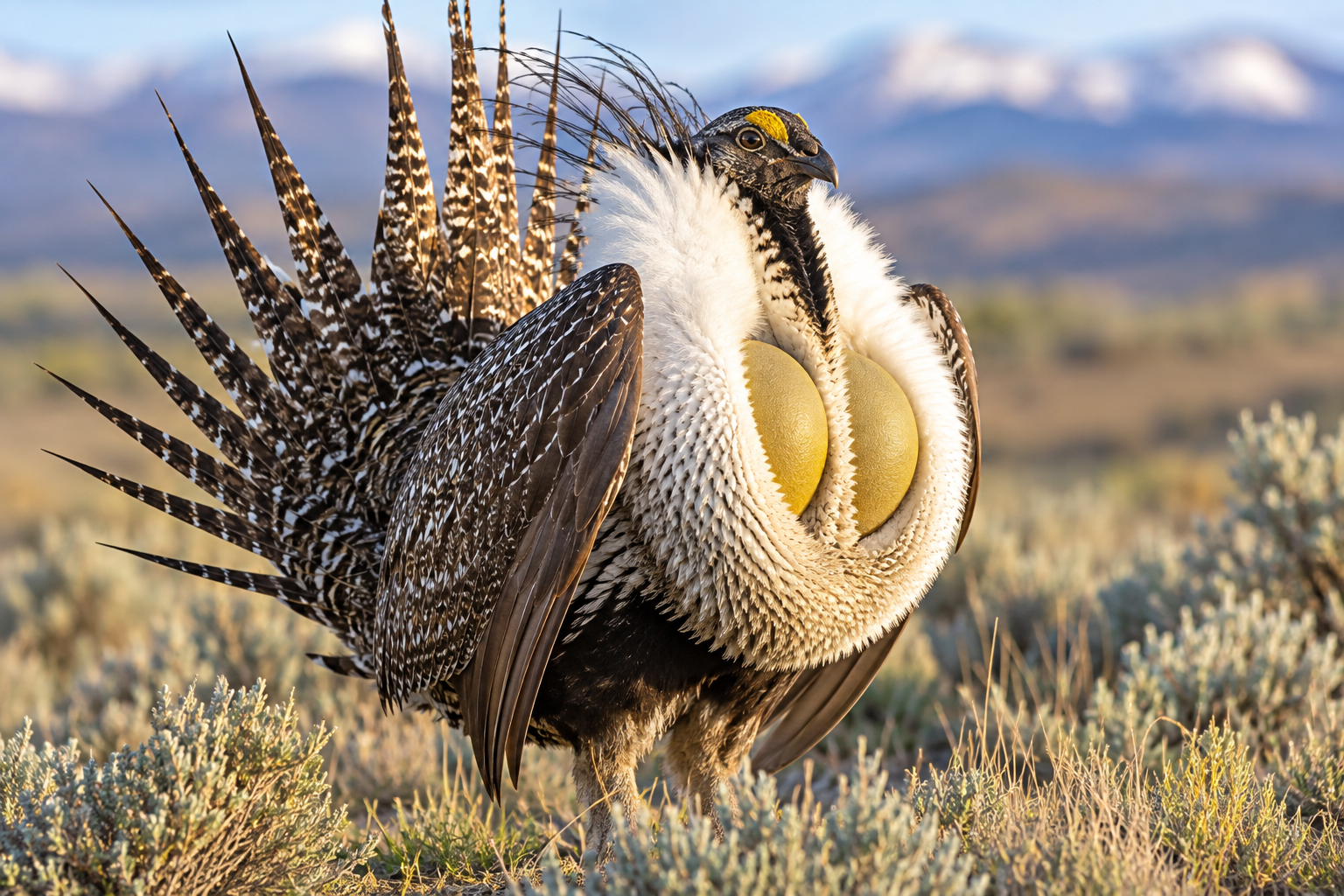
Males are noticeably larger and far more ornate. A display-ready male shows a broad white breast ruff, a black throat and bib bordered by a white collar, and two bare patches of olive-yellow skin on the chest — the air sacs that inflate during courtship. Fleshy yellow combs sit above the eyes. When the tail fans, it opens into a spiked half-circle of pointed feathers.
Females
Females are smaller, plainer, and built for concealment. They lack the white ruff, black bib, air sacs, and eye combs, showing instead finely barred brown, gray, and cream plumage with a mottled throat. That camouflage matters: a female greater sage-grouse incubating a ground nest depends entirely on not being seen.
Seen side by side in sage grouse pictures, the size and pattern difference between the sexes is unmistakable; seen alone in the field, a female is best identified by habitat, bulk, and the long pointed tail.
Where Do Sage-Grouse Live?

Sagebrush country is the whole story. These birds occupy the cold desert shrublands and shrub-steppe of the Interior West — the Great Basin, the Wyoming Basin, the Columbia Plateau, the Snake River Plain, high mountain valleys, and the sagebrush foothills that fringe them. They occur from sea-level-scale basins up into subalpine sagebrush parks, and they are absent from forest, cropland, and open grassland that lacks shrub cover.
Historically the species ranged across a much larger sweep of western North America, from the northern Great Plains and the Canadian prairie provinces south into the Great Basin and the Colorado Plateau. Today the occupied range is patchier and smaller, concentrated in areas where large, unbroken sagebrush remains.
Movement within that range is seasonal rather than strictly migratory. Birds gather on open breeding grounds in early spring, then disperse to nesting cover nearby, shift again in summer toward wetter sites with green forbs and insects for chicks, and concentrate in winter on wind-swept slopes and tall sagebrush stands that stay above the snowpack. Some populations move only a short distance between these seasonal ranges; others travel many miles.
Sage-Grouse Habitat: Why Sagebrush Matters
Sage grouse habitat is not simply a place the birds happen to live it is the food supply, the nursery, and the shelter in a single vegetation type. Sagebrush leaves remain available and nutritious through winter, when almost nothing else in the landscape is. Sagebrush canopies hide nests from ravens, crows, and coyotes. Sagebrush stands break the wind and hold snow-free feeding ground in the coldest months.
That dependence is what makes greater sage grouse habitat so vulnerable. Because the birds need large, connected expanses of shrubland with a healthy understory of grasses and flowering forbs, they respond badly to fragmentation.
Roads, fences, power lines, well pads, and conifer encroachment carve continuous sagebrush into pieces, add perches for avian predators, and open ground to invasive annual grasses that carry fire through stands that do not regenerate quickly after burning.
Effective management therefore works at landscape scale: maintaining unbroken sagebrush blocks, removing encroaching conifers, restoring understory grasses and forbs after fire, and limiting new surface disturbance near breeding grounds and winter concentration areas.
What Do Sage-Grouse Eat?
Sagebrush leaves form the foundation of the diet and the only reliable food through late fall, winter, and early spring. Few birds can process the bitter, resinous foliage; sage-grouse do it year-round, which is precisely why they cannot survive outside shrubland.
The diet broadens with the growing season. Adults take advantage of green leaves, buds, and flowers of forbs such as dandelion, legumes, and other broad-leaved plants, along with whatever insects they encounter.
Chicks have different requirements entirely. In their first weeks of life they depend heavily on insects — ants, beetles, and grasshoppers — for the protein needed to grow, then shift gradually to forbs and finally to sagebrush. Brood survival is tightly linked to wet meadows, spring seeps, and other sites where succulent plants and insects persist into summer.
The Sage-Grouse Mating Dance Explained
The sage grouse mating dance is the most theatrical courtship performance of any bird in the American West, and it happens in the open, at dawn, in cold spring air. Males gather at traditional display grounds before first light and perform in view of each other and of visiting females, repeating the routine dozens of times an hour through the morning.
The display follows a strict sequence. A male draws himself upright, raises and fans the spiked tail into a stiff rosette, and rotates the wings forward so the stiff feather shafts brush against the breast plumage. He then pumps his chest, drawing air into the esophageal sac and pushing two bare olive-yellow patches of skin out through the white breast ruff. The sacs swell, collapse suddenly, and the whole cycle takes only a few seconds before it repeats.
Sound carries the display across the flat. The wings produce a dry swishing note against the feathers, and the collapsing air sacs generate a pair of hollow, liquid pops — a bubbling, plunking sound audible far across open sagebrush, often heard long before the birds are seen.
Females walk through the display ground, observe multiple males, and choose. Selection is highly skewed: a small number of males occupying prime central positions account for most matings, while peripheral birds display all season with little success. After mating, the female leaves; the male provides no further care.
What Is a Sage-Grouse Lek?
A sage grouse lek is the traditional communal display ground where males gather each spring to court females. Leks are typically open, low-vegetation sites — a bare ridge, a dry lakebed, an old two-track, a grazed flat — surrounded by taller sagebrush that provides escape cover and nesting habitat.
Individual males defend small territories within the lek, returning to the same patch of ground morning after morning and year after year. Central territories are contested most aggressively because they attract the most female attention.
Lek fidelity makes these sites the backbone of conservation work. Birds return to the same ground across generations, so counts of displaying males at known leks serve as the standard population monitoring tool, and protecting leks along with the surrounding nesting and winter habitat protects the population that depends on them. Disturbance at a lek during the display season can push birds off the site entirely.
Greater Sage-Grouse vs Gunnison Sage-Grouse
The two species were long treated as one bird. They are now recognized as distinct, and the differences are consistent enough to separate in the field where ranges do not overlap.
- Scientific identity. The greater sage-grouse is Centrocercus urophasianus. The Gunnison sage-grouse is Centrocercus minimus, described as a separate species after work on its display behavior, plumage, and genetics.
- Range. The greater sage-grouse occupies the broad sagebrush country of the Interior West and north into Canada. The Gunnison sage-grouse is restricted to a small area of southwestern Colorado and immediately adjacent southeastern Utah — one of the most limited distributions of any North American bird.
- Size. Gunnison sage-grouse are smaller and more lightly built, which is reflected in the species name.
- Appearance and display. Displaying male Gunnison sage-grouse show dramatically longer, thicker filoplumes — the fine hair-like feathers on the back of the neck — which they toss over the head and shoulders during courtship. Their tail feathers show stronger white banding, and their display routine differs in rhythm and sound from that of their larger relative.
Sage-Grouse in Colorado
Colorado is unusual because both species occur within the state. Greater sage-grouse occupy sagebrush country in the northwest — the Moffat, Routt, and North Park areas — where large basins of big sagebrush still support active leks. Gunnison sage-grouse occur separately in the southwest, centered on the Gunnison Basin, with several small satellite populations nearby.
The two do not overlap, so location alone usually settles the identification. A displaying male in the Gunnison Basin with heavy, flowing neck plumes is a Gunnison sage-grouse; a bird in North Park is a greater sage-grouse.
Plan viewing for early spring at dawn, when lek activity peaks. Use designated viewing sites and stay in the vehicle where required, and expect birds to disperse into surrounding shrubland as the morning warms.
How Do Sage-Grouse Reproduce?
Breeding begins with lek attendance in early spring, often while snow still covers much of the range, and continues for several weeks as females arrive to select mates. Males take no part in anything that follows.
After mating, the female moves away from the lek to nest, usually within the surrounding sagebrush and frequently within a few miles of the display ground. She scrapes a shallow depression on the ground and lines it sparsely, placing it beneath a shrub canopy with enough residual grass and forb cover to break up the outline of the nest. Nest success depends heavily on that understory: thin, overgrazed, or fire-scarred cover leaves eggs and incubating hens exposed to predators.
The female incubates the clutch alone for several weeks. Chicks hatch downy and leave the nest almost immediately, following the hen and feeding themselves on insects from the first day. They can make short flights well before reaching adult size, remain with the hen through summer, and gradually transition onto forbs and then sagebrush as fall approaches. Broods often join into larger flocks before winter.
How Long Do Sage-Grouse Live?
Survival is hardest in the first year. Most losses happen at the egg and chick stage, through nest predation, exposure during cold wet weather, and shortage of insect-rich brood habitat. Birds that reach their first winter commonly live several years, and some individuals persist considerably longer.
Adult survival varies with drought, winter severity, predator abundance, disease, collision with fences and power lines, and the condition of local sagebrush. Because so few chicks reach adulthood, populations depend on good nesting and brood-rearing conditions repeating across multiple years.
Why Are Sage-Grouse Important?
Sage-grouse birds function as an indicator for the entire sagebrush biome. Because they need large, connected, structurally intact shrubland across every season of the year, their presence signals a functioning system and their disappearance signals one that has been fragmented, burned, invaded, or degraded.
That makes them an umbrella species as well. Management that keeps sagebrush intact for grouse also supports pronghorn, mule deer, pygmy rabbits, Brewer’s sparrows, sage thrashers, and the pollinators tied to sagebrush forbs. Conservation planning across the West is routinely organized around this single bird for exactly that reason.
Are Sage-Grouse Endangered or Threatened?
Both species are treated as conservation priorities, but their situations differ sharply. The greater sage-grouse remains relatively widespread and is legally hunted under regulated seasons in parts of its range, yet long-term monitoring at leks shows range-wide decline.
And it is managed across state and federal lands as a species of significant conservation concern. The Gunnison sage-grouse, with its tiny range and small population, carries a far higher extinction risk and is managed under formal protection.
The pressures are well documented and mostly cumulative: conversion of sagebrush to cropland and development, invasion by cheatgrass and other annual grasses, altered fire cycles that destroy shrub stands faster than they regrow, conifer encroachment, energy and infrastructure development, fence and power line collisions, drought, and West Nile virus. No single threat drives the trend; the combination does.
Interesting Sage-Grouse Facts
- The species is the largest grouse in North America, heavy-bodied with a long spiked tail.
- Sagebrush leaves make up the bulk of the year-round diet — a food almost no other bird can use.
- Males inflate paired air sacs on the chest to produce hollow popping notes that carry across open country.
- Chicks eat insects before anything else and cannot survive on sagebrush alone.
- Display grounds are used by the same population for generations, making lek counts the standard monitoring method.
- The old regional name “sagehen” survives in western creek, valley, and ranch names.
- Males contribute nothing to nesting or chick rearing.
Sage-Grouse Identification Guide
- Check the vegetation first. Confirm you are standing in sagebrush shrub-steppe, not grassland, forest, or farmland — habitat rules out most lookalikes immediately.
- Judge the size. Look for a bird noticeably larger and heavier than a sharp-tailed or ruffed grouse, with a deep chest and small head.
- Look at the tail. Confirm a long tail of stiff, narrow, sharply pointed feathers, obvious in flight and at rest.
- Scan the underparts. Find the dark belly patch contrasting with paler, mottled gray-brown upperparts.
- Inspect the breast and throat on any large individual. Note a white ruff, black bib, yellow eye combs, and bare chest skin to confirm a male.
- Identify females by pattern. Expect finely barred brown and cream plumage, a mottled throat, no ruff, and smaller overall bulk.
- Note the flight style. Watch for low, strong, direct flight with alternating wingbeats and glides.
- Pin down the species by location. Assume greater sage-grouse everywhere except southwestern Colorado and adjacent southeastern Utah.
Frequently Asked Questions About Sage-Grouse
What is a sage-grouse?
A large ground-dwelling grouse of western North America that depends on sagebrush for food, nesting cover, and winter survival.
What is a sagehen?
A traditional regional name for the same bird, still common in local speech and western place names.
Which species does “sage grouse” usually mean?
The greater sage-grouse, the widespread species; the Gunnison sage-grouse is a separate, far more localized species.
How big is a sage-grouse?
Larger than any other grouse on the continent — a heavy, chunky bird with a long pointed tail.
How do you tell males from females?
Males show a white breast ruff, black throat, yellow eye combs, and bare chest air sacs. Females are smaller, barred brown, and lack all of those features.
Conclusion
Everything distinctive about this bird traces back to one shrub. The bulk, the pointed tail, the bitter winter diet, the concealed ground nest, the dawn display on open flats surrounded by cover — each trait is an adaptation to sagebrush country, and none of it works anywhere else.
That is also the conservation problem in a single sentence. A species built for large, unbroken shrubland cannot absorb fragmentation indefinitely. Protecting leks, restoring burned and invaded stands, and keeping sagebrush connected across seasonal ranges keeps this flagship bird of the American West on the landscape.





