 Skip to content

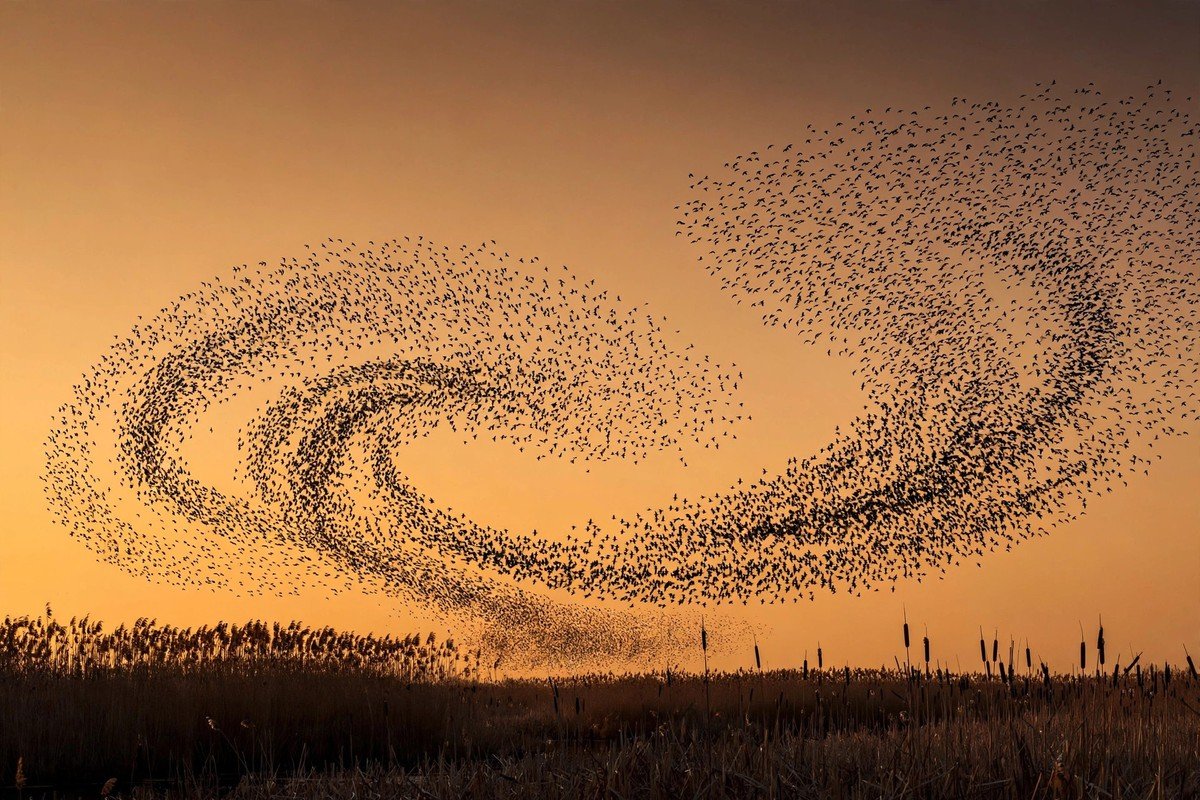
If you have ever looked up at dusk and watched the sky turn into a living, rippling wave of birds, you have seen a murmuration. So what is a murmuration, exactly? It is a huge flock of starlings moving together as one fluid shape, twisting, swelling, and splitting across the evening sky before settling into a roost for the night.
The strange part is that nobody is in charge. There is no leader calling the turns and no rehearsal behind the shapes. Each bird simply follows a few simple rules about its nearest neighbors, and from thousands of tiny local decisions comes one of the most spectacular sights in nature. Scientists study these flocks to understand collective behavior, from fish schools to crowds of people, and their findings are as fascinating as the display itself.

What Is a Murmuration, Exactly?
A murmuration is the name given to a large flock of starlings flying in coordinated, swirling patterns. The word describes both the birds and the sound their wings make: a low, rushing murmur that can be surprisingly loud when tens of thousands of birds wheel overhead. The term comes from one of the old collective nouns for starlings, the way we say a “murder of crows” or a “parliament of owls.”
These displays almost always happen at dusk, and they almost always happen near the birds’ chosen roost. From late afternoon on, starlings stream in from feeding grounds miles away. They gather in the air, chattering and wheeling, and the longer the light fades, the denser and more dramatic the flock becomes. Then, quite suddenly, ribbons of birds peel away and pour down into reeds, trees, or onto structures to sleep.
Flock sizes vary enormously. A small murmuration might involve a few hundred birds. A big one at a major roost can hold tens of thousands, and at famous sites the numbers can run into the millions. Whatever the size, the defining feature is the same: the flock behaves like a single shifting organism rather than a crowd of individual birds.
How Does It Work? The Science of a Starling Murmuration
For a long time, nobody could explain how thousands of birds turn in near-perfect unison without crashing into each other. An early idea, proposed by the British ornithologist Edmund Selous in the early 1900s, was that the birds must share some kind of telepathy. Modern research has replaced telepathy with something even more interesting: physics, local rules, and lightning-fast information flow.
No Leader, No Plan
The key insight comes from computer simulations and high-speed camera studies of real flocks. In 1986, Craig Reynolds wrote a program called Boids that produced flocking behavior from just three simple rules: move toward neighbors, steer clear of collisions, and match the speed and direction of nearby birds. It looked like birds on a screen, even though no bird in the program could see the whole flock.
Real starlings work on a similar principle. A landmark 2008 study by Italian physicists Andrea Cavagna, Irene Giardina, and colleagues tracked thousands of starlings with stereoscopic cameras and found that each bird pays attention to a fixed number of neighbors, typically six or seven, no matter how crowded the flock gets. That matters more than it sounds: because the rule is about a number of neighbors rather than a distance, the flock stays connected whether it is loose or packed tight.
Waves of Information Move Faster Than Birds
When one bird on the edge of the flock shifts direction, its neighbors adjust almost instantly, and their neighbors do the same. The signal races across the flock as a wave, traveling far faster than any individual bird could fly. A follow-up study on information flow in turning flocks found that direction changes propagate linearly through the group with almost no loss, something the researchers compared mathematically to superfluid flow in liquid helium.
This wave effect explains the visuals. Models suggest starlings fly at around 45 kilometers per hour during a murmuration, and tiny variations in each bird’s speed and heading add up to the ribbons, clouds, and vortex shapes we see. When the flock tightens, it looks almost black against the sunset. When it stretches thin, it seems to dissolve and reform in seconds. The famous dark bands that ripple through the mass happen when birds suddenly tilt their V-shaped wings at once, like a school of fish flashing sideways.
Why Nobody Crashes
Collision avoidance turns out to be a side effect of the same rules. Each bird constantly adjusts its position relative to its nearest neighbors, so collisions are prevented not by predicting the whole flock’s movement but by rapid, small-scale corrections. Mario Pesendorfer, a research associate with the Smithsonian Migratory Bird Center, has described the result as something like a “super-sensory organism”: if a predator is detected at one end of the flock, the information spreads across the whole group so quickly that a bird dozens of meters away can act on it.
None of this requires any bird to understand what the flock is doing. Thousands of local decisions, each one simple, add up to behavior that looks choreographed. Physicists call this emergence, and murmurations are one of the clearest examples of it in the natural world.

Why Do Starlings Flock Together?
The science explains how a murmuration holds together, but why do starlings gather in such enormous numbers at all? Researchers have tested several explanations, and the evidence points to a mix of them.
- Predator protection: This is the best-supported explanation. A giant, fast-moving, shape-shifting flock is a confusing target for a peregrine falcon or sparrowhawk. In a citizen-science project run through the Natural History Museum, volunteers recorded details of 3,000 murmurations over one winter and found birds of prey present at nearly 30 percent of them. Murmurations also tended to be bigger when sparrowhawks were flying nearby, exactly what you would expect if the flock is a defensive formation.
- Staying warm: Roosting together helps starlings conserve heat on cold winter nights. Thousands of bodies packed into a reed bed or tree share warmth through the coldest months, which is one reason murmurations peak in winter.
- Sharing information: Large roosts may help birds exchange knowledge about good feeding areas. A bird that found rich foraging ground during the day returns to the same roost, and others may follow it out the next morning. This idea is harder to prove than predator defense, but it fits with how social starlings are year-round.
- The roost itself: In a practical sense, the murmuration is the waiting room for bedtime. The aerial display is what happens while birds arriving from all directions join up and sort themselves before dropping into the roost.
The honest answer is that scientists have not settled on a single reason, and it is likely a combination. What recent evidence does show is that safety from predators is a major driver: the same Natural History Museum study concluded that predator defense is the most likely main purpose of the swirling displays.
Where to See a Starling Murmuration
Murmurations happen wherever large numbers of starlings spend the winter, which means they can show up on several continents. Timing matters more than the exact address: the season runs roughly from October through March, with the biggest, most dramatic displays usually in December and January when numbers are highest. Knowing when birds migrate in spring and fall also helps you plan birding trips around peak seasonal activity. Show up 30 to 45 minutes before sunset and pick a spot with an open view of the sky.
The Best UK Spots
Britain is the world capital of murmuration watching, and its roost sites are legendary. The giant of them all sits on the Somerset Levels: the combined roost around Shapwick Heath and Ham Wall, which by some distance is the largest in the UK and has at times held well over a million birds. Its popularity even spawned an RSPB starling hotline telling visitors where the flock had settled the night before.
Other celebrated locations include Brighton Palace Pier, where tens of thousands of birds arrive from as far as Scandinavia to roost beneath the seafront; Aberystwyth Pier in Wales; the RSPB reserves at Leighton Moss in Lancashire and Minsmere in Suffolk; and RSPB Fen Drayton Lakes near Cambridge. In Denmark, the same phenomenon in the Wadden Sea is known as the “sort sol,” or black sun, when the flock is thick enough to blot out the light.
Watching Murmurations in the US
American readers sometimes assume murmurations are a European-only event. They are not. With starling populations estimated in the tens of millions across the continent, impressive displays happen all over the United States from autumn into early winter, they just attract less attention than the UK’s famous roosts.
Sites where birders report murmurations include Central Park in New York City, Saguaro National Park in Arizona, Merritt Island National Wildlife Refuge and the Indian River Lagoon in Florida, Higbee Beach in New Jersey, Hennepin Canal Parkway in Illinois, the Rio Grande Valley in Texas, Bosque del Apache in New Mexico, Sax-Zim Bog in Minnesota, and the Yolo Bypass Wildlife Area near Sacramento, California. Because the birds are so widespread, a good display can turn up over open farmland, wetlands, marshes, and even city parks almost anywhere in the country.
How to Get the Best View
- Arrive early: Be in position 30 to 45 minutes before sunset. The build-up is part of the show, and roost sites can draw crowds on clear evenings.
- Pick calm, clear weather: The most spectacular displays tend to happen on still evenings. Wind and rain flatten the performance.
- Look near roost habitat: Reed beds, wetlands, dense trees, piers, and quiet woodland edges are the usual gathering points. Birds may stream in from feeding grounds many miles away.
- Bring binoculars, but do not rely on them: The full shape of the flock only reads with the naked eye. Use optics for close looks at individual starlings once the flock settles.
- Check the best time of day to see birds: Late afternoon and the last hour of light consistently deliver the most activity, for starlings and for most other species too.
The 100 Birds That Started It All
Starlings are not native to North America. In 1890, a New York drug manufacturer and bird enthusiast named Eugene Schieffelin, a member of the American Acclimatization Society, released about 60 European starlings in Central Park, followed by 40 more in 1891. Within a few decades the descendants of those birds had spread coast to coast, and continental populations are now estimated in the tens of millions, with some estimates at peak running as high as 200 million.
Legend says Schieffelin wanted to introduce every bird mentioned in the works of Shakespeare, and the starling gets one mention in Henry IV, Part 1. The story is widely told, but historians note the details are debated: accounts differ on the exact numbers and dates, and Schieffelin’s own obituary apparently never mentioned Shakespeare at all. What is certain is that the release succeeded where earlier attempts failed, and that one small act reshaped a continent’s bird life, not always for the better, since starlings now compete with native cavity-nesters and cost agriculture hundreds of millions of dollars a year.
It is a strange bit of irony. The same 100 birds that became one of North America’s most argued-about invasive species also gave the country its murmurations. Love them or not, starlings put on a show no native flock quite matches.

Frequently Asked Questions
What is a murmuration in simple terms?
A murmuration is a giant flock of starlings flying together in coordinated, swirling patterns at dusk. Thousands of birds move as if they are one fluid creature, forming ribbons, clouds, and waves in the sky before they settle into a communal roost for the night. The name also describes the low rushing sound of all those wings.
How many birds does it take to make a murmuration?
There is no minimum. A few hundred starlings wheeling together will show the same wave-like patterns, just on a smaller scale. At famous roosts like the Somerset Levels in England, murmurations have numbered in the millions, while a typical good display might involve a few thousand to tens of thousands of birds.
Do only starlings form murmurations?
The word murmuration is used almost exclusively for starlings, though other species flock in impressive synchronized groups, from shorebirds over tidal flats to swallows before migration. Starlings are simply the masters of the art, and their autumn and winter roost gatherings are the displays that earned the name.
Why do murmurations happen at sunset?
The display is the prelude to bedtime. Starlings spend the day foraging in small groups, then converge on a communal roost as light fades. The aerial gathering is how birds arriving from many directions join up, and it may also help confuse predators during the vulnerable moment when the whole flock settles for the night. Once the flock drops in, the sky usually goes quiet, so if you are still hearing birds late at night, something else is happening: here is why some birds chirp after dark.
When is the best time to see a murmuration?
The season runs roughly from October through March, with peak numbers usually in December and January in the UK and similar winter months in the US. On any given day, arrive 30 to 45 minutes before sunset and look toward likely roost sites such as reed beds, wetlands, or dense stands of trees.
Are murmurations dangerous for the birds?
Not usually. Despite the density of the flock, collisions are rare because each bird tracks only its nearest neighbors and adjusts constantly. The bigger risk comes from predators: falcons and hawks hunt the edges of murmurations, which is exactly why the confusing, ever-shifting shapes are useful. Researchers have found that predators were present at nearly a third of recorded murmurations, and flocks grew larger when hawks were near.
Where can I see a murmuration in the United States?
Look over open country, wetlands, and large parks at dusk from autumn into winter. Birders report displays at places like Central Park in New York, Saguaro National Park in Arizona, Merritt Island National Wildlife Refuge in Florida, and Bosque del Apache in New Mexico, but starlings are so widespread that a murmuration can appear almost anywhere. Check recent roundups of reported US locations for ideas near you.
Conclusion
So what is a murmuration? It is thousands of starlings turning a winter sunset into a living sculpture, with no leader and no plan, just simple rules followed perfectly by every bird in the flock. The science behind it, from six-neighbor tracking to wave-like information flow, explains how order emerges from thousands of tiny local decisions.
It is also one of the easiest natural wonders to witness for yourself. You do not need a passport to the Somerset Levels or expensive equipment: you need a clear winter evening, a spot with a wide view of the sky, and patience in the last half hour of light. Starlings are common almost everywhere, and identifying small birds in your yard by day can make watching them swarm by night even more satisfying. Find a roost, look up, and watch the sky start to move.




