 Skip to content

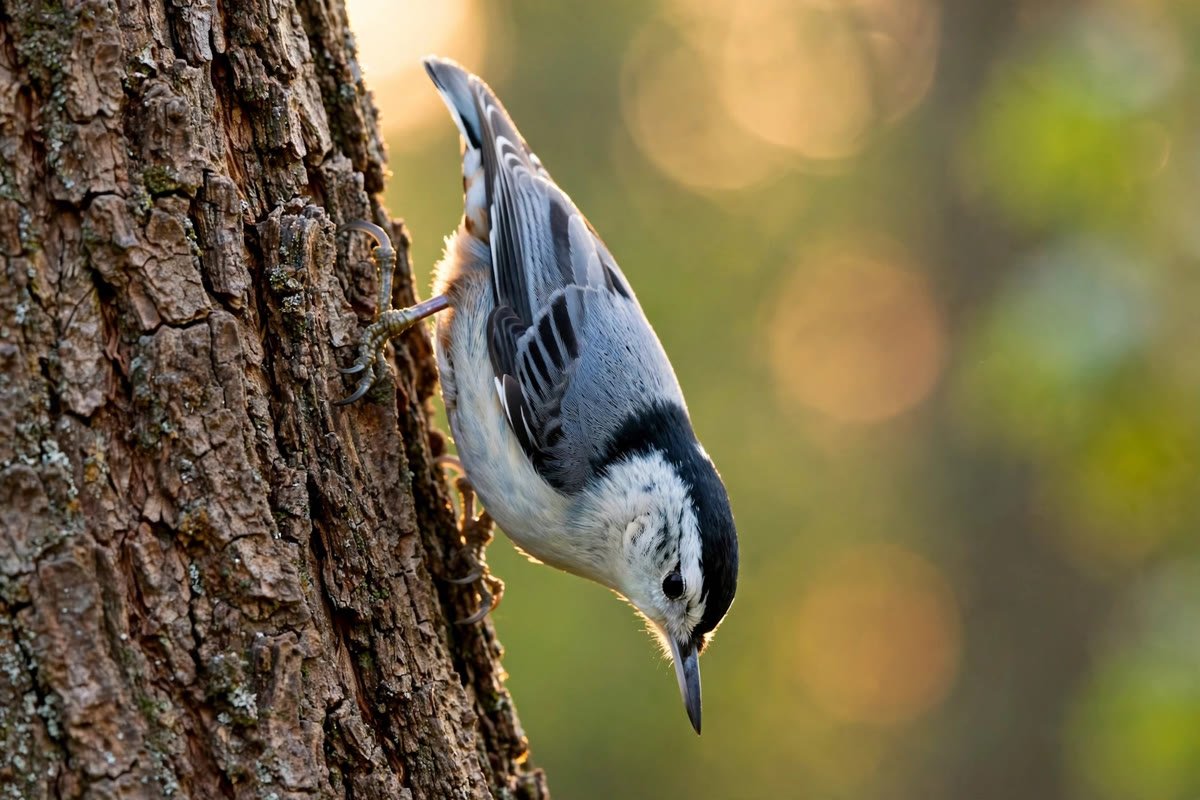
You have seen the bird. A small gray acrobat inching down a tree trunk, head pointing at the ground, tail toward the sky, moving with total confidence. Most people who ask why do nuthatches climb down trees expect a strange or complicated answer, but the real one is refreshingly practical. They go down headfirst because the food is there.
Bark grows in overlapping flakes and curls, and many of those flakes point downward. Insects, spiders, eggs, and cached seeds hide on the undersides of those flakes, invisible to any bird that only climbs up. Nuthatches are unusual among songbirds for descending headfirst, and that single trick gives them access to meals that woodpeckers and creepers working the same trunk never see. This article explains the behavior from every angle: the food advantage behind it, the anatomy that makes it possible, the four nuthatch species of North America, and how to bring the upside-down bird to your own yard.

The Short Answer: Food Nobody Else Can Reach
The fastest explanation for why nuthatches climb down trees headfirst is a simple one. Going down gives them a different view of the same tree. A woodpecker spiraling upward stares into the tops of bark flakes. A nuthatch coming down stares into the bottoms of those same flakes. Each direction reveals food the other misses, so descending is not a stunt. It is a feeding strategy.
Researchers describe this as an unexploited niche. Biologist Cameron Ghalambor explained it plainly in a Northern Woodlands interview: a creeper or woodpecker faces the bark and looks up into crevices for food, but there is an unexploited niche you could access if you were working your way down the tree. Millions of years of competition with upward-climbing birds pushed nuthatches in the opposite direction, and the payoff is a private buffet.
The strategy matters most in winter. When insects die back and most songbirds depend on feeders or berries, nuthatches keep working bark, probing downward-facing crevices for dormant insects, larvae, and seeds they cached in the fall. The headfirst descent turns an ordinary trunk into a season-long food source that barely competes with anyone else’s.
The Only Songbird That Goes Down Headfirst
Almost every bird that forages on bark climbs upward. Woodpeckers hitch up trunks using stiff tail feathers as a brace, like a third leg pressed against the wood. Brown creepers do the same, spiraling up one trunk and flying to the base of the next. Their bodies are built for one direction only, and they rarely reverse it.
Nuthatches break the rule completely. They fly to the top of a tree and work their way down, hopping or tripping downward with the head leading, often dropping from one trunk to the base of the next tree and starting again. They also climb up when they feel like it, and they can move sideways along limbs at any angle, but the headfirst descent is their signature move. Biologists describe it as a unique way of walking down the side of a tree, and among songbirds no other group descends trunks headfirst as a routine habit.
The difference is visible the moment you watch one. A creeper looks like it is climbing a ladder, tail braced and body rigid. A nuthatch looks like it is strolling downhill, body loose and quick, pausing to hammer a crevice open or yank an insect from its hiding place. That casual ease hides some remarkable engineering.
The Food Advantage: Niche Partitioning in Action
Ecologists have a name for what the nuthatch is doing: niche partitioning. Two species can share the same tree without starving each other if they take food from different parts of it. Woodpeckers and creepers take the upward-facing crevices. Nuthatches take the downward-facing ones. The same trunk feeds both groups because they read it from opposite directions.
This division also shapes winter flocks. Nuthatches often join mixed-species flocks with chickadees, titmice, brown creepers, and downy woodpeckers, and the flock works precisely because nobody is stealing anyone’s lunch. The chickadees glean twigs and leaves, the creepers spiral upward, and the nuthatches patrol downward. Each bird gets the food the others miss, and everyone benefits from the flock’s extra eyes watching for hawks.
Caching adds another layer. Starting in fall, nuthatches wedge seeds and nuts into bark crevices and cover some caches with moss or lichen, then retrieve them through winter. Caching seeds so they can be found while traveling down the tree may keep them hidden from upward-climbing birds, Ghalambor noted. The nuthatch’s winter pantry sits in plain sight on the trunk, protected by the simple fact that its competitors travel the wrong way.
To see how these winter flocks form around your own feeders, read our guide on how to attract chickadees to your yard, since chickadees are the nuthatch’s most frequent flocking partner.

How Their Bodies Make It Possible
A nuthatch climbing down headfirst looks like it should topple off the trunk, but its feet are built for exactly this job. The toes are long and strong, ending in sharp curved claws that dig into bark like climbing spikes. Most of the nuthatch’s weight hangs from the hallux, the backward-pointing rear toe, which works like an anchor while the front toes grip ahead. Because the grip comes from the feet alone, the bird can let its body swing freely at any angle.
The tail tells the other half of the story. A woodpecker’s tail is stiff, with reinforced central feathers that brace against the trunk during upward climbing. A nuthatch tail is short, soft, and square, and it never touches the bark at all. With no prop to manage, the bird can pivot, spin, and drop downward quickly, moving with the loose agility of a gymnast rather than the rigid posture of a ladder climber.
The rest of the body follows the same compact design. Nuthatches have chunky, almost neckless bodies with large heads, which keeps their center of gravity low and close to the bark. Their powerful legs supply the force to push off and re-grip in rapid steps. Their long, straight, slightly upturned bills work as both probes and chisels, reaching into crevices and hammering seeds open. Every feature points toward the same job: gripping, probing, and extracting food from bark in any orientation.
Meet the Nuthatches: Four North American Species
Four nuthatch species live in North America, and each one climbs headfirst. They split the continent by forest type, so the nuthatch on your trunk depends on the trees around you.
White-breasted Nuthatch
The largest and most widespread nuthatch, about five to five and a half inches long, found across most of the United States and southern Canada. It favors mature deciduous woods, parks, and wooded suburbs, and it is a year-round resident almost everywhere it lives. Look for the crisp black cap, white face, and blue-gray back, plus rusty patches near the tail. The Cornell Lab of Ornithology notes that its nasal calls are loud enough to lead you straight to the bird, and that it readily visits feeders for sunflower seeds, peanuts, and suet.
Red-breasted Nuthatch
A tiny conifer specialist, breeding across Canada’s boreal forest from the Pacific coast of British Columbia to the Atlantic coast of Nova Scotia, and south through the mountains of the American West and the Appalachians. It prefers spruce and fir woods and often irrupts far south in winters when cone crops fail. Smaller than its white-breasted cousin, it shows a bold black eyeline and rusty underparts. Its high, nasal yank-yank call sounds like a tiny tin trumpet, and pairs smear sticky conifer resin around their nest cavity entrance, a trick scientists believe deters predators while the birds dive straight through it.
Brown-headed Nuthatch
The Southeast’s nuthatch, restricted to mature pine forests from Virginia to eastern Texas, with a small declining population in the Bahamas. At under four inches it is one of North America’s smallest songbirds, recognized by its brown cap and squeaky call that sounds like a rubber duck toy. It is famous for simple tool use: it holds a flake of bark in its bill and uses it as a lever to pry up other bark while hunting insects. Brown-headed nuthatches also breed cooperatively, with young males from previous broods staying to help raise the next nest.
Pygmy Nuthatch
The West’s pine-forest nuthatch, common in the ponderosa and mixed pine forests of the Sierra Nevada, the Rockies, and parts of the coastal West. It is barely larger than the brown-headed, with a gray-brown cap and a busy, social personality. Pygmy nuthatches travel in noisy family groups, cling to pine cones high in the canopy, and excavate their own nest holes in soft dead pine. Like the brown-headed, they use cooperative breeding, with helpers from earlier broods joining in to feed chicks and defend the territory.
The Yank-Yank Call and Other Nuthatch Habits
You will usually hear a nuthatch before you see one. White-breasted nuthatches give a rapid series of nasal yank-yank notes, repeated insistently from the trunk. Red-breasted nuthatches sound higher and thinner, like a tiny horn. Both species call through the winter, which makes cold-weather birding easier: follow the nasal chatter and you will find the bird working a trunk upside down.
The bird’s name comes from one of its most visible habits. Nuthatches wedge large seeds and nuts into bark crevices, then hammer them open with their sharp bills. The Cornell Lab describes the white-breasted nuthatch jamming large nuts and acorns into tree bark, then whacking them with its sharp bill to “hatch” out the seed from the inside. Old English speakers called these birds “nuthacks” for their hacking, and over the centuries the word softened into “nuthatch.”
Caching is the quieter half of the same habit. Through fall, nuthatches stash individual seeds in bark furrows all across their territory, sometimes tucking moss over a cache to hide it. They remember many of these sites through winter, and each retrieved seed is one less trip to a feeder. Combined with insect probing, caching lets nuthatches stay put through months when other songbirds have migrated or grown desperate.
Their nesting habits are just as distinctive. Red-breasted nuthatches excavate their own cavities in dead wood and guard the entrance with conifer resin. White-breasted nuthatches prefer natural cavities or old woodpecker holes, and they smear the entrance with fur, crushed insects, and mud, materials researchers think may mask the nest’s scent from predators. A pair often stays on the same territory year-round, so the nuthatch you see in January may be the same bird you heard in July.
How to Attract Nuthatches to Your Yard
Nuthatches are among the most reliable feeder visitors once you offer what they want. These tips work for all four species, with adjustments for your region.
- Offer suet: Suet is the single best nuthatch food in winter, and nuthatches cling to suet cages upside down without any trouble. Plain suet or peanut-flavored cakes both work. See our winter suet feeding guide for choosing and placing suet feeders.
- Serve the right seeds: Black-oil sunflower seeds and shelled peanuts are nuthatch favorites, and they will carry seeds to a nearby trunk to wedge and hammer them open. Our guide to the best bird seeds covers which seed types suit nuthatches and their flock mates.
- Add a nest box: Nuthatches use nest boxes, especially white-breasted and brown-headed species. Use a box about four inches square and ten inches deep with a one-and-a-quarter-inch entrance hole, mounted on a tree trunk five to ten feet up, facing away from prevailing wind and rain.
- Keep mature trees: Nuthatches need bark to make a living, so leave dead limbs and snags standing where it is safe. Rough-barked trees like oaks, hickories, and pines hold the most insects and the best seed-wedging crevices.
- Provide water: A heated birdbath in winter draws nuthatches and their whole mixed flock, and moving water attracts them even faster. For general winter support, see how to help birds in winter.
- Skip the pesticides: Nuthatches are insect specialists for much of the year, so a yard sprayed for insects is a yard without nuthatch food. Let them handle the beetle larvae and caterpillars themselves.

Frequently Asked Questions
Why do nuthatches climb down trees headfirst?
They do it for food. Bark flakes curl downward, hiding insects, spiders, and cached seeds on their undersides where upward-climbing birds cannot see them. Descending headfirst lets nuthatches spot and reach food that woodpeckers and creepers on the same trunk miss. Biologists view it as a niche strategy that splits the tree’s food supply between upward and downward foragers.
Are nuthatches the only birds that climb down trees headfirst?
Nuthatches are the most famous headfirst descenders and the only songbird group that treats descending as its normal way of traveling down trunks. Woodpeckers and creepers almost always climb up, bracing with stiff tails, and come down by flying rather than walking. Some other birds, like the Eurasian nuthatch’s relatives overseas, share the talent, but in North America the headfirst descent belongs to the four nuthatch species.
What is the difference between a nuthatch and a brown creeper?
Direction and equipment. Brown creepers spiral upward with stiff tail feathers braced against the bark, then fly to the base of the next tree. Nuthatches travel downward headfirst with short, soft tails that never touch the bark, gripping only with their feet. Creepers are slender, brown, and camouflaged like bark. Nuthatches are chunky and blue-gray with bold caps, and their nasal calls are much louder.
Do nuthatches migrate?
Mostly, no. White-breasted, brown-headed, and pygmy nuthatches are year-round residents on their territories. Red-breasted nuthatches are partial migrants: they breed in northern conifer forests and irrupt southward in large numbers during winters when cone crops fail. That is why some winters bring red-breasted nuthatches to feeders far south of their usual range, and other winters bring none at all.
Why do nuthatches wedge seeds into bark?
Two reasons, and both are clever. Wedging a seed into a crevice holds it still so the nuthatch can hammer the shell open with its bill, which is the “hatching” behavior behind the bird’s name. The same wedging stores food: nuthatches cache single seeds in bark furrows across their territory in fall and retrieve them through winter. Some even cover caches with moss or lichen to hide them.
Are nuthatches a type of woodpecker?
No, though the confusion is understandable since both work tree trunks. Nuthatches are songbirds in the family Sittidae, while woodpeckers belong to the family Picidae. Nuthatches are much smaller, lack stiff tail feathers, never drum on wood, and have the nasal yank-yank call that no woodpecker makes. Their climbing styles are opposites: woodpeckers brace upward, nuthatches grip downward.
What does a nuthatch sound like?
White-breasted nuthatches give loud, nasal yank-yank notes that sound like a tiny toy horn, often repeated in quick series. Red-breasted nuthatches sound higher and thinner, like a miniature tin trumpet. Brown-headed nuthatches squeak like a rubber duck toy, and pygmy nuthatches chatter in rapid, restless notes. Learning the white-breasted’s yank is the fastest way to start finding these birds, since you will hear them long before you see them.
Conclusion
The next time you watch a nuthatch descend a trunk headfirst, you will know you are seeing one of the smartest feeding strategies in the songbird world. Instead of competing with woodpeckers and creepers for the upward-facing crevices, nuthatches flipped the problem over and claimed the downward-facing ones, unlocking a food supply hidden in plain sight. That choice shaped their whole body, from the anchoring rear toe and soft short tail to the chisel bill that wedges and hatches seeds.
Understanding why nuthatches climb down trees also makes them easier to find and enjoy. Listen for the nasal yank-yank on winter mornings, watch the trunks of mature trees, and put out suet and sunflower seeds to invite them closer. The upside-down bird is not defying gravity. It is simply reading the tree from the direction nobody else bothered to try.





