 Skip to content

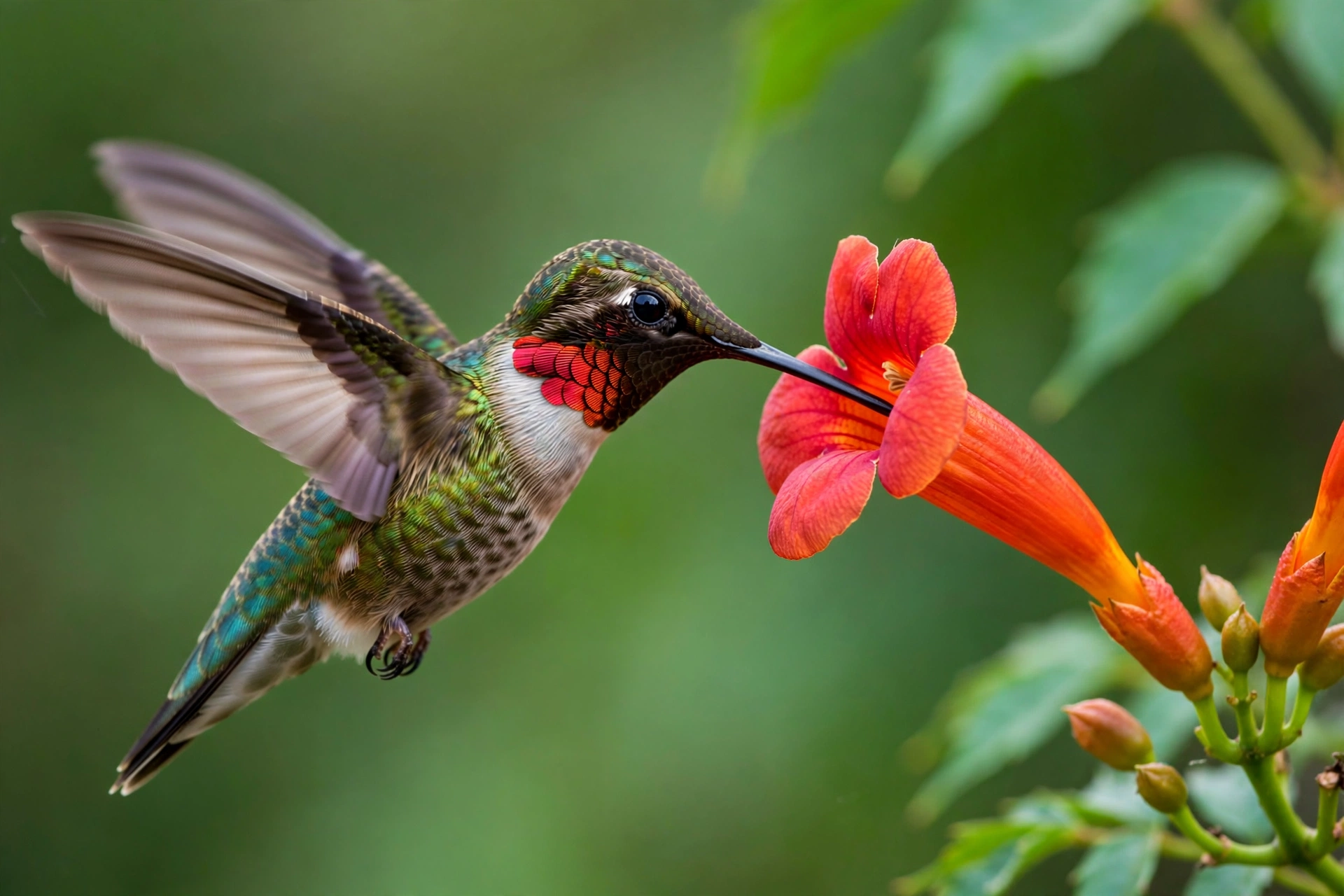
Ask what hummingbirds eat and most people answer with one word: nectar. It is a reasonable answer, but it is only half the story. The full answer to what hummingbirds eat is far more interesting, and it changes how you should think about your feeder, your garden, and these tiny birds themselves.
Nectar is the fuel that powers a hummingbird’s impossible metabolism. But sugar alone cannot build feathers, form eggs, or raise chicks. For that, hummingbirds hunt. They snatch insects out of midair, pluck spiders from webs, sip tree sap, and steal juice from split fruit.
This guide covers the full hummingbird diet: the nectar, the insects, the hunting techniques, the seasonal shifts, and what baby hummingbirds eat. You will also learn what feeders can and cannot do, and which foods you should never offer.
The Short Answer: Nectar Is Fuel, Insects Are Food
Think of the hummingbird diet as two separate jobs. Nectar supplies carbohydrates, the quick-burning energy that keeps wings beating dozens of times per second. Insects and spiders supply protein, fats, and minerals, the building materials for muscle, feathers, and eggs.
Exactly how the two halves divide is genuinely debated. Published estimates put the insect share anywhere from about 20 percent to as high as 80 percent during breeding season, depending on the species, the season, and how the measurement was made. A 1986 study in The Auk found arthropod remains in 79 percent of more than 1,600 tropical hummingbirds examined. Entomologist Doug Tallamy of the University of Delaware has estimated that insects and spiders make up roughly 80 percent of the diet.
The honest way to read those numbers: nectar dominates by volume and by feeding visits, while insects dominate the protein budget. A female feeding nestlings hunts far more than a male defending a flower patch in midsummer. The National Audubon Society puts it simply: hummingbirds sometimes eat small insects and spiders, but their favorite food by far is plant nectar.
Part of the confusion comes from how scientists measure a diet. Counting feeding visits makes nectar look dominant, because a bird sips flowers hundreds of times a day. Measuring protein intake flips the picture, because nearly all of the protein comes from insects. Both views are true at once, which is why honest sources give ranges instead of a single tidy number.
| Food source | Main nutritional role | Estimated share of diet |
|---|---|---|
| Flower nectar | Carbohydrates, hydration | 60 to 80 percent |
| Small insects and spiders | Protein, fats, minerals | 20 to 40 percent, higher when nesting |
| Tree sap, fruit juice, honeydew | Quick sugars | Small and seasonal |
| Water from dew, rain, and misters | Hydration | Small supplement |
| Pollen and minerals | Trace nutrients | Incidental |
These shares are estimates compiled from published sources, not exact measurements. They shift with the season, the species, and even the sex of the bird.
Nectar: The High-Octane Fuel
Flower nectar is mostly sucrose dissolved in water, often around 20 percent sugar. That concentration is no accident. It is roughly what a backyard feeder imitates with the standard one part sugar to four parts water mix.
The Cornell Lab of Ornithology notes that ruby-throated hummingbirds favor red or orange tubular flowers such as trumpet creeper, cardinal flower, honeysuckle, jewelweed, and bee balm. The tube shape suits a long bill and keeps many competing insects out. Hummingbirds are also important pollinators, carrying pollen from bloom to bloom as they feed.
A hummingbird feeds every 10 to 15 minutes through the daylight hours and may visit 1,000 to 2,000 blossoms in a single day. The tongue flicks in and out up to 20 times per second, its forked tip trapping liquid as tiny grooves zip shut. Nectar is also the bird’s main water source, and a hummingbird can drink a remarkable share of its body weight in nectar each day.
Insects and Spiders: The Protein Half of the Menu
The insect menu is small and soft: gnats, mosquitoes, fruit flies, aphids, tiny caterpillars, insect eggs, and small spiders. Ruby-throated hummingbirds generally avoid anything that can sting back, so bees and wasps are usually off the menu, though some western species tackle small wasps.
Protein matters because feathers are protein, eggs are protein, and growing chicks build their bodies almost entirely from it. During nesting season, when the demand for protein and fats peaks, insects can make up as much as 80 percent of the diet. Females, who do all of the chick feeding, hunt the hardest.
Here is the part most feeder watchers miss. A hummingbird that visits your feeder ten times a day may also hunt insects dozens of times a day. You rarely notice because the hunting happens in the foliage, not at the feeder.
How Hummingbirds Hunt: Hawking and Gleaning
Hummingbirds hunt in two distinct ways. Hawking means snatching insects in midair. That erratic dart-and-return flight you see near the garden is often hunting, not confusion. Gleaning means plucking aphids and caterpillars from leaves and bark, pulling insects from spider webs, and picking at the insects gathered around sap wells.
A long, slender bill looks built only for flowers, yet high-speed video revealed a surprise. When a hummingbird strikes at an insect, the lower bill flexes downward by about 25 degrees and widens at the base, then snaps shut in less than a hundredth of a second. The finding came from a 2004 study in Nature by Gregor Yanega and Margaret Rubega, later modeled as a “controlled elastic snap” in the Journal of Theoretical Biology, as reported by ScienceDaily.
Yanega estimated that a hummingbird needs the equivalent of about 300 fruit flies a day to meet its protein needs. That number explains the constant motion. If you want to watch the hunt yourself, look near spiderwebs at dusk or low over the lawn where gnats gather. That “lost” hummingbird hovering by the grass is grocery shopping.
You can learn to recognize the hunt. Hawking looks like a sudden dash from a perch, a quick loop, and a return to the same spot, repeated every few minutes. Gleaning is slower: the bird hovers along a branch, tilting its head to inspect the undersides of leaves. Once you know the pattern, you will start seeing hunters everywhere, even in yards that seem to have no flowers at all.

Beyond Nectar and Bugs: Sap, Fruit, and Minerals
Tree sap is a legitimate backup fuel. Hummingbirds drink from sap wells drilled by sapsuckers and eat the insects those wells attract. In early spring, when flowers have not yet opened, sap and insects carry newly arrived migrants through the lean weeks.
Damaged or overripe fruit offers another bonus: sweet juice, plus the fruit flies the fruit attracts, which makes it a double meal. Hummingbirds also lick honeydew, the sugary excretion of aphids and other sap-feeding insects, straight from leaves.
Two more items round out the diet in tiny amounts. Pollen gets swallowed incidentally while working flowers, adding a minor protein bonus. And hummingbirds have been observed visiting clay deposits, apparently seeking salts such as sodium and calcium, though this behavior is far less studied than the rest of the diet.
Do Hummingbirds Drink Water?
Yes, though nectar covers most of their hydration. Hummingbirds also drink plain water whenever the opportunity appears: dew on leaves, raindrops, puddles, water pooled in tree cavities, and yard features such as misters and drippers. They seem to prefer moving or shallow water over deep birdbaths.
In hot, dry weather they seek water more actively. A mister does double duty in summer, offering drinking water plus a shower that keeps feathers clean. Clean feathers mean efficient flight, and for a hummingbird, flight efficiency is survival.
What Do Baby Hummingbirds Eat?
Only the mother feeds the chicks. The male takes no part in nesting, so one female does all the hunting for a family of three. For the first days of life, nestlings receive a regurgitated mix weighted heavily toward soft insects: spiders, aphids, insect eggs, and tiny flies. Protein builds the chick’s body while nectar supplies the energy to run it.
The pace is relentless. Published accounts describe mothers making around 200 hunting trips a day and feeding their nestlings roughly every 20 minutes from dawn to dusk. As the chicks grow, nectar takes a larger share until they fledge at about three weeks old and learn to feed themselves.
If you find a baby hummingbird on the ground, do not try to feed it yourself. A nestling’s natural diet is partially digested insects delivered deep into the throat, which is nearly impossible to replicate at home, and improper feeding can kill the chick. Contact a licensed wildlife rehabilitator instead.

How the Diet Shifts Through the Seasons
The hummingbird menu is not fixed. It changes with the calendar, and each season has its own strategy.
Spring arrival
Early migrants often arrive before the flowers open. Tree sap and insects bridge the gap until the first blooms appear, which is one reason hummingbirds follow sapsuckers north.
Breeding season
Insect hunting peaks, especially for females. This is when protein demand is highest and when a yard full of small insects matters more than a yard full of feeders.
Late summer and fall
Before migration, hummingbirds enter hyperphagia, a pre-migration feeding frenzy. Their bodies flip from burning sugar as fast as it arrives to converting it into fat. Ruby-throated hummingbirds nearly double their body weight, from about 3.25 grams to around 6 grams. Fat, not sugar, is the fuel that carries them across long stretches with no food, including the Gulf of Mexico crossing. To learn the timing, see when hummingbirds migrate.
Night, every night
On cold nights, hummingbirds drop into torpor, a hibernation-like state that slashes heart rate and metabolism. It lets them survive hours without food. At dawn they must feed immediately, which is why the first hour of daylight is the busiest at feeders and flowers.
The Feeder’s Real Role in the Diet
Think of a feeder as a snack stand, not a complete meal. Research from the National Audubon Society’s Hummingbirds at Home program found that feeders were the strongest single predictor of hummingbird visits, ahead of flower numbers. But calories are not nutrition. A feeder in a sterile, pesticide-heavy yard keeps birds alive. A feeder in a yard with native flowers and abundant insects helps them thrive.
That is why pesticide reduction matters so much. Aphids are hummingbird food, and broad-spectrum sprays can poison the birds directly. If you want to support the whole diet, plant flowers that attract hummingbirds fast and let a corner of the yard stay a little wild and buggy.
Placement matters too. Hang feeders near flower beds and shrubs rather than in the middle of a bare lawn. That way a visiting bird can top up on sugar water and then hunt insects in the foliage a few feet away, using your yard the way it uses a wildflower meadow: fuel stop and hunting ground in one.
Keep the feeder itself clean and the recipe simple: one part plain white sugar to four parts water, and follow our complete guide to choosing, filling, and cleaning hummingbird feeders for the full routine. Never use honey, brown sugar, or red dye. Moldy nectar can cause a fatal tongue infection, so freshness is a safety issue, not just a preference.
What Hummingbirds Don’t Eat
- Seeds: Hummingbirds do not eat seeds. Their slender bills cannot crack them, and their fast digestive tracts are built for liquids and soft insects. A hummingbird at your seed feeder is hunting the insects around it, or a female collecting fluffy seed down for nest material.
- Bees and wasps: Generally avoided. For a bird that weighs less than a nickel, a single sting can be deadly.
- Honey and raw sugars: Never put honey, molasses, brown sugar, or artificial sweeteners in a feeder. They can grow dangerous microbes or upset digestion. Plain white sugar and water only.
- Red dye: Unnecessary and potentially harmful. The red parts of the feeder attract birds on their own.

Frequently Asked Questions
Do hummingbirds eat bugs?
Yes. Small insects and spiders supply the protein, fats, and minerals that nectar cannot provide. Gnats, mosquitoes, fruit flies, aphids, and small spiders make up a large share of the diet, especially during nesting season.
Do hummingbirds eat seeds?
No. Hummingbirds do not normally eat seeds of any kind. Their bills and digestive systems are built for sipping nectar and swallowing tiny soft insects, not for cracking or digesting hard seeds.
What insects do hummingbirds eat?
Mostly tiny, soft-bodied prey: gnats, mosquitoes, fruit flies, aphids, small spiders, tiny caterpillars, and insect eggs. They catch them in midair by hawking or pick them from leaves, bark, and spider webs by gleaning.
Do hummingbirds drink water?
Yes, though most of their hydration comes from nectar. They also drink dew, raindrops, and water from misters, drippers, puddles, and tree cavities, especially in hot, dry weather.
What do baby hummingbirds eat?
Nestlings are fed by their mother alone, on a regurgitated mix of soft insects and nectar that is heavily weighted toward insects in the first days. Protein from spiders, aphids, and tiny flies builds their growing bodies.
Should I put insects out for my hummingbirds?
No. Hummingbirds hunt live prey and will not eat dead insects from a dish. The best help you can offer is a yard with native flowers, abundant small insects, and no broad-spectrum pesticides.
Conclusion
So what do hummingbirds eat? Nectar for fuel, insects and spiders for building, tree sap and fruit juice as seasonal bonuses, and plain water on the side. The feeder on your porch is one piece of that diet, not the whole thing.
The practical takeaway is simple. Keep the feeder clean and the sugar water fresh, plant tubular native flowers, tolerate the aphids and gnats, and skip the pesticides. Do that, and your yard offers the complete menu: quick energy, real protein, and the hunting grounds a hummingbird needs to raise its young. That is how you feed a hummingbird properly, not just the sweet tooth, but the hunter too.





