 Skip to content

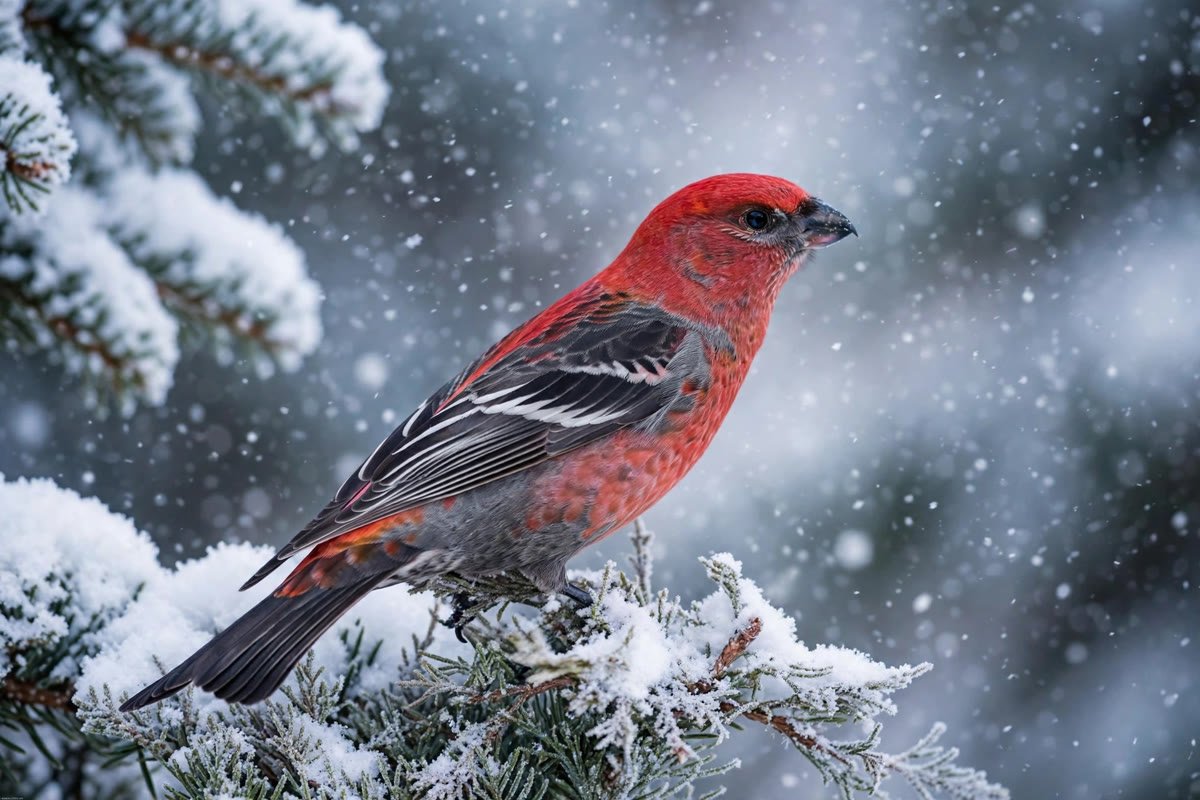
Some winters, the feeders fill with birds you have never seen before: raspberry-red finches, streaky little siskins, crossbills with their strange scissored beaks, grosbeaks the size of starlings. Then, just as suddenly, they vanish for years. If this has happened in your yard, you witnessed an irruption.
A winter finch irruption is a large-scale southward movement of boreal finches driven by food shortages in Canada’s northern forests. When cone and seed crops fail across the boreal, species like pine siskins, redpolls, crossbills, and grosbeaks pour south in numbers far beyond their normal winter range, sometimes reaching the southern United States. It is not migration on a schedule. It is hunger on the move.
In this guide, you will learn what causes irruptions, how the famous Winter Finch Forecast predicts them each fall, which species to watch for, what the current 2026-27 forecast says, how to attract irruptive finches to your feeders, and how your sightings help science.

What Is a Winter Finch Irruption?
Most bird migration runs on a timetable. Warblers leave in September, juncos arrive in October, and the calendar barely changes year to year. Irruption is different. It is irregular, unpredictable, and driven entirely by food.
The birds involved are boreal finches: species that breed in Canada’s vast northern coniferous forest and normally winter not far south of it. In most years they stay north, feeding on spruce, pine, tamarack, and birch seeds. But when those seed crops fail across large regions, the birds cannot stay. They move south in waves, sometimes by the thousands, searching for cone crops, ornamental plantings, and backyard feeders.
The key point is that irruptions are not about cold. A brutal winter with a good cone crop keeps finches north. A mild winter with a failed crop sends them south. Birders who understand this watch the trees, not the thermometer: the seed crop forecast, published each September, tells you more about your winter birds than any weather forecast.
Why Irruptions Happen: The Boreal Boom and Bust
The engine of irruption is the boom-and-bust cycle of the boreal forest. Understanding it explains both why irruptions happen and why they are so irregular.
The Setup: A Breeding Boom
Irruptions typically follow a specific sequence. First comes a year of abundant food in the boreal forest, often boosted by spruce budworm outbreaks. Budworm larvae are protein-rich food for nestlings, so finch species like evening grosbeaks, pine siskins, and purple finches raise more young than usual. The population swells.
Then comes the bust: a lean cone and seed crop year. The enlarged population now faces a shrunken food supply. As researchers describe it, when a lean crop year follows a year of high reproductive success, part of the population cannot be supported and is forced south. The birds do not choose to leave. They must.
Why Each Species Behaves Differently
Not all finches irrupt together, because each species depends on different seeds. Crossbills specialize in conifer cones, redpolls on birch and alder seeds, grosbeaks on larger seeds and fruits. A failed spruce crop may send crossbills south while leaving redpolls, whose birch seeds did fine, comfortably at home.
This is why forecasters assess about 15 key tree species individually, rating each crop as poor, fair, good, excellent, or bumper. The pattern of which trees failed predicts which birds will move. When many tree species fail at once across a huge area, several finch species irrupt simultaneously, creating what researchers call a flight year.
The Early Warning Birds
Some species move first and signal what is coming. The red-breasted nuthatch, a non-finch whose movements track the same cone crops, often pushes south in late summer ahead of the finches. When birders report nuthatches moving early and in numbers, forecasters take it as confirmation that the northern crops have failed. Watch the nuthatches in August, and you will know what November holds.
The Winter Finch Forecast: How Scientists Predict It
Every September, birders across eastern North America await one of the most beloved documents in the hobby: the Winter Finch Forecast. Its history is a great story.
About 35 years ago, Ontario forester and lifelong birder Ron Pittaway realized that boreal seed crops could predict winter finch movements. He built a system on three data sources: cone crop reports from natural resource managers across Canada and the northern US states, assessments from his network of foresters and citizen scientists rating crops for key tree species, and late-summer movements of indicator species like the red-breasted nuthatch.
Pittaway circulated the forecast privately for years before publishing it online in 1999, where it found an enormous audience. In 2020 he handed the project to the Finch Research Network, known as FiRN, which has published it each September since. Tyler Hoar now authors the forecast, drawing on nearly a hundred correspondents across the continent. Pittaway passed away in August 2023, but his method lives on in every edition.
The forecast covers nine core winter finch species plus irruptive non-finches, and it applies mainly to Ontario and adjacent regions, with implications for the northeastern US, the Great Lakes, and beyond. For the current edition, see the Finch Research Network’s Winter Finch Forecast 2026-2027.
What the 2026-27 Forecast Says
The 28th Winter Finch Forecast, posted September 27, 2026, paints a mixed picture for the coming winter. Seed crops are good in the east, from central Ontario through the Maritimes and the northeastern United States, and good from British Columbia to Alaska. But crops are largely poor across a vast area of the central boreal, from western Manitoba to Alberta.
The overall poor seed crops in the central boreal will likely push finches into eastern Canada, the Great Lakes region, and the northeastern United States. However, the forecast notes that birds may stay in the woods more than visit feeders, because seed resources in northeastern conifer forests are plentiful this year. No big irruptions are expected in the southeastern states.
For context, last winter was a solid flight year in the East for evening grosbeaks, pine grosbeaks, and purple finches, with a smaller flight of pine siskins. Whether this winter matches it depends on how the central-boreal birds distribute once they arrive. Keep feeders stocked and watch the woods: this is exactly the kind of year when a surprise grosbeak shows up.

Which Birds Irrupt? Meet the Winter Finches
Nine finch species form the core of the forecast, plus a few non-finch fellow travelers. Here are the ones backyard birders are most likely to encounter.
| Species | Field marks | Favorite feeder foods |
|---|---|---|
| Evening grosbeak | Large, starling-sized; males yellow, black, and white with a massive pale bill | Black oil sunflower, sunflower chips |
| Pine grosbeak | Large and plump; males rosy red, females gray with orange tints | Black oil sunflower, fruit |
| Purple finch | Male raspberry red, “dipped in wine”; female heavily streaked with bold face pattern | Black oil sunflower, sunflower chips |
| Common redpoll | Small, frosty streaked finch with a red cap and black chin | Nyjer, sunflower chips |
| Pine siskin | Heavily streaked brown finch with flashes of yellow in wings and tail | Nyjer in tube or sock feeders |
| Red crossbill | Crossed bill tips for prying cones; males brick red, females olive | Black oil sunflower, sunflower chips |
| White-winged crossbill | Crossed bill plus bold white wing bars | Sunflower chips, nyjer |
| Red-breasted nuthatch | Tiny, with a black eye stripe and rusty belly; creeps down trunks | Sunflower, suet, peanut pieces |
Two notes for feeder watchers. First, learn the difference between purple finches and house finches before the irruption arrives: males differ in the quality of red, raspberry versus brick, and females differ in face pattern strength. Second, pine siskins are notably tame and may feed alongside goldfinches at nyjer tubes; our guide to attracting goldfinches covers the feeder setup siskins like too.
Flight Years, Superflights, and What They Mean
Researchers use specific terms for different scales of irruption. A single species moving south in numbers is simply an irruption. When several finch species leave their normal ranges in the same winter, that is a flight year. When nearly every irruptive species moves at once, that is a superflight.
Documented superflights are rare and memorable: 1997-98, 2012-13, and most recently 2020-21. During a superflight, backyard birders from the Great Lakes to New England may see six or seven boreal species in a single winter, some for the first time in their lives. These are the winters that create lifelong birders.
The 2026-27 season is not forecast as a superflight, but flight years for individual species still deliver extraordinary birds. An evening grosbeak at your feeder is a thrill whether or not the redpolls came too. And because the forecast is probabilistic, not certain, the birds always get the final vote.
How to Attract Irruptive Finches to Your Yard
You cannot summon an irruption, but you can be ready when one arrives. Irruptive finches are hungry, tired travelers, and a well-stocked yard can hold them for days or weeks.
- Stock black oil sunflower seed: the single most important feeder food for grosbeaks, purple finches, and crossbills. For seed strategy, see our guide to the best bird seeds for different birds.
- Hang nyjer tubes or socks: essential for redpolls and pine siskins, which are nyjer specialists.
- Offer suet: red-breasted nuthatches and woodpeckers work suet feeders hard in irruption winters. See our suet feeding guide for the details.
- Keep feeders full and clean: irruptive flocks arrive in numbers and empty feeders fast; dirty feeders spread disease in crowded flocks, so clean regularly.
- Provide water: a heated birdbath in freezing weather is a powerful attractant when natural water is locked in ice.
- Plant for the future: native conifers, birches, and berrying shrubs like mountain ash and crabapple give irruptive birds natural food and may hold them in your yard longer.
- Watch the woods, not just the feeders: in years with good local cone crops, like this one in the Northeast, finches may feed in nearby conifers and visit feeders only occasionally. Scan the treetops.
For the complete cold-weather playbook, read what to feed birds in winter. And if you are new to the hobby, our bird watching for beginners guide will help you make the most of an irruption winter.
How Your Sightings Help Science
Irruptions are one of the phenomena birders themselves document best. Professional ornithologists cannot be everywhere, but thousands of feeder watchers can. Your observations of unusual finches feed directly into the science of irruption.
The most valuable contribution is reporting to eBird, the Cornell Lab’s global bird observation database. A checklist noting 40 pine siskins at your feeder on a December morning becomes a data point in the continental map of the irruption. Project FeederWatch, which runs November through April, is another purpose-built channel for exactly this kind of winter feeder data.
Reports also sharpen future forecasts. The Winter Finch Forecast depends on correspondents reporting crop conditions and early movements; the network that Pittaway built runs on volunteer eyes. When you notice red-breasted nuthatches pushing south in August or redpolls arriving weeks early, you are seeing the raw material of next September’s forecast.

Frequently Asked Questions
What is the difference between migration and irruption?
Migration is regular, seasonal, and scheduled: the same species move at roughly the same times every year. Irruption is irregular and driven by food supply rather than the calendar. A species may irrupt one winter, stay north for three years, then irrupt again. Migration is a commute; irruption is an evacuation.
Will the finches come to my feeder or stay in the woods?
It depends on local food. In the 2026-27 forecast, FiRN notes that birds moving into the Northeast may stay in the woods more than visit feeders because northeastern conifer seed crops are plentiful. Keep feeders stocked anyway: hungry travelers check feeders opportunistically, and a yard with food and water can pull birds out of the treetops.
How long do irruptive finches stay?
It varies enormously. Some flocks pass through in days; others settle for the whole winter if food holds out. Pine siskins are famously nomadic and may vanish overnight. Evening grosbeaks, once they find a reliable food source, can become daily visitors for months. There is no schedule, which is part of the excitement.
Are evening grosbeaks endangered?
They are not classified as endangered, but the decline is severe: evening grosbeak populations have fallen about 92 percent since 1970, and the species is listed as a conservation concern. FiRN runs a dedicated Evening Grosbeak Project studying the decline. An irruption winter is a good reminder of what is at stake, and a good reason to report every sighting.
Do irruptions happen in summer too?
Summer irruptions are rare but not unheard of; some crossbill movements follow cone crops year-round since crossbills can breed whenever cones are abundant, even in winter. But the classic, feeder-visible irruption is a fall and winter phenomenon, which is why the forecast comes out each September.
Where can I read the current Winter Finch Forecast?
The Finch Research Network publishes it each year in the second half of September at finchnetwork.org. The 2026-27 edition, the 28th, was posted September 27, 2026. It covers nine finch species plus irruptive non-finches, with species-by-species predictions focused on Ontario and adjacent regions.
Conclusion
A winter finch irruption is hunger made visible: a failed seed crop in the boreal forest, a population boom with nothing to eat, and thousands of beautiful birds pouring south in search of food. It is irregular, unpredictable, and utterly thrilling, the closest thing backyard birding has to a surprise party.
The science behind it, from Pittaway’s forester network to the modern Finch Research Network forecast, turns that surprise into something you can prepare for. Read the September forecast, stock black oil sunflower and nyjer, keep the water open, and watch the treetops as well as the feeders. In a year like 2026-27, with the central boreal crops poor and birds on the move, readiness is everything.
And when the raspberry-red finch or the yellow-flashed siskin finally lands in your yard, report it. Your checklist becomes part of the continental record, the same record that makes next year’s forecast possible. Irruptions belong to everyone who watches, and the watchers are what make the science work.





