 Skip to content

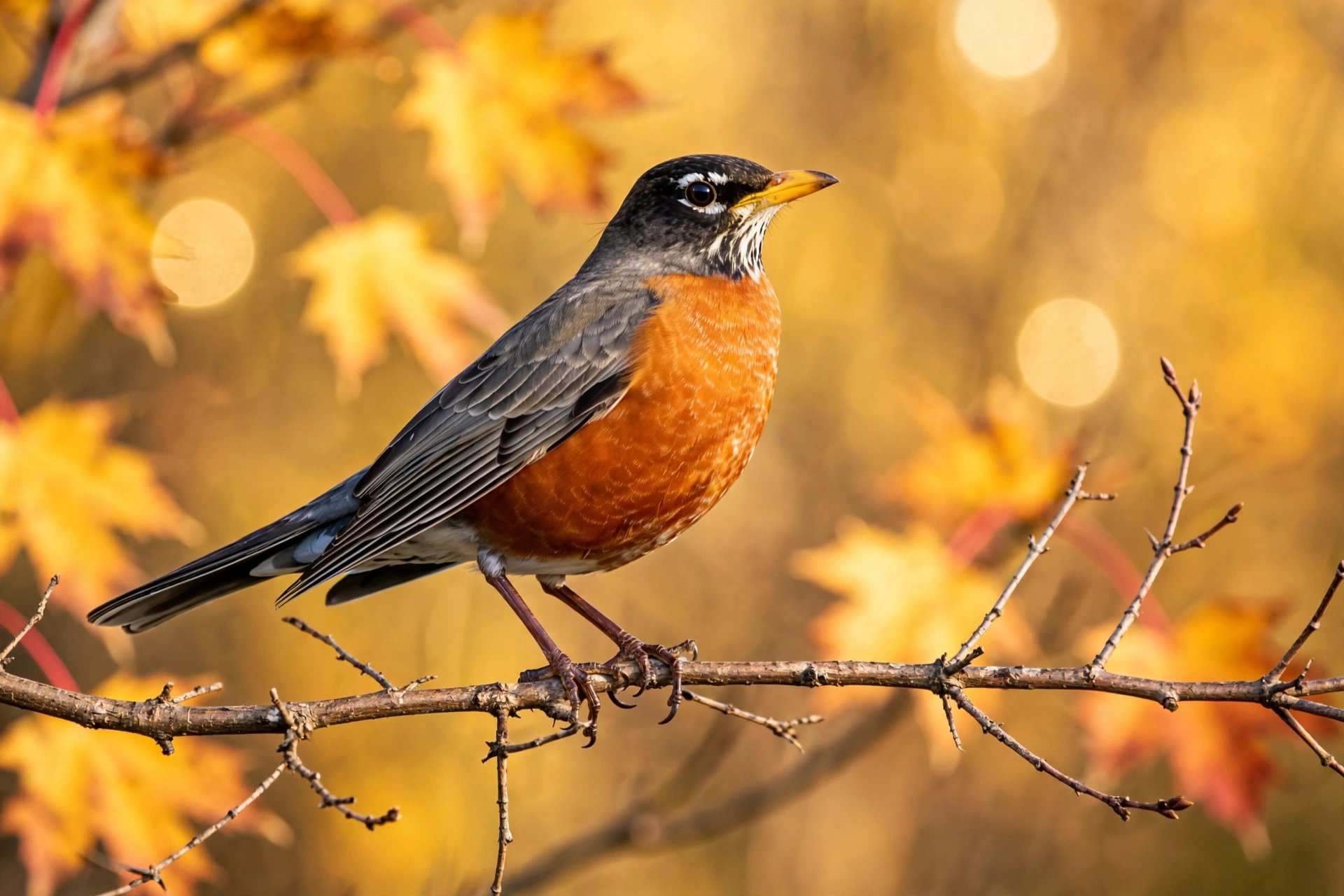
One October morning, the lawn that hosted a family of robins all summer sits empty. The cheerful songs have stopped, the worm-hunting patrols have ended, and the red-breasted regulars seem to have vanished overnight. Every autumn, this disappearing act prompts the same question from backyard birdwatchers across North America: do robins migrate?
The answer is more interesting than a simple yes or no. American robins are partial migrants, which means some populations travel hundreds of kilometres south for winter while others stay put all year. Even more surprising, cold is not what drives them away. Food is. When autumn frosts lock earthworms beneath frozen soil, robins switch to a berry diet and head for places where fruit is plentiful, sometimes just a few towns away.
In this guide, you will learn exactly where American robins go in winter, why they leave, how their behaviour transforms between spring and winter, and when to expect their return.
The Short Answer: Yes, Robins Migrate, But Only Some of Them
Most field guides classify the American robin as a partial migrant. Populations that breed in Canada and the northern United States generally move south for winter, while many robins across the southern and central United States stay on their breeding grounds year-round. This mixed strategy explains why “do robins migrate” has such a confusing answer: it depends entirely on where the robin lives.
Partial migration is actually common in the bird world. Species like robins sit in the middle of a spectrum. At one end are true long-distance migrants such as Arctic terns; at the other are year-round residents like northern cardinals. Robins occupy the flexible middle, shifting their range with the seasons rather than abandoning it completely. If you want the broader picture of why different species make different choices, our guide to why birds migrate explains the forces at work.
The result is that robins can be found somewhere in North America in every month of the year. Winter simply reshuffles them. Northern birds pour into the southern states, swelling local populations, while southern residents hold their ground. The robin you see on a January lawn in Texas may have hatched in Manitoba.
Why Robins Migrate: Food Drives the Journey, Not Cold
It is natural to assume robins flee freezing temperatures, but cold alone does not push them south. A robin’s feathers provide remarkable insulation, and the bird can fluff its plumage to trap warm air against its body. Healthy robins survive sub-zero nights without difficulty. What they cannot survive is an empty pantry.
The real problem is the ground. Earthworms and soil invertebrates, the robin’s summer staples, retreat deep below the frost line or become unreachable when the soil freezes solid. A robin can endure cold, but it cannot dig through frozen earth. Migration, then, is a search for accessible food rather than an escape from low temperatures.
This food-first logic also explains why robin migration looks so untidy compared with, say, geese. Robins do not need to reach the tropics. They only need to travel as far south as unfrozen ground and abundant winter fruit. Some stop a few hundred kilometres away; others cross half a continent. Each bird effectively follows the food.
The Great Autumn Diet Switch: From Worms to Berries
Long before the first hard frost, robins begin a dietary transformation that makes winter survival possible. Through spring and summer, animal protein dominates the menu: earthworms, beetles, caterpillars and other invertebrates fuel breeding and chick rearing. If you have ever wondered how robins find worms, the technique is remarkably precise. As autumn progresses, the menu flips. Fruit and berries take over, eventually making up the vast majority of the winter diet.
Winter berries that robins rely on include:
- Hawthorn: dense clusters of red berries that persist into deep winter.
- Dogwood: high-fat fruits that provide concentrated energy.
- Sumac: upright seed heads that stand above the snow.
- Juniper: blue “berries” (actually cones) rich in oils.
- Holly: classic winter fruit, often stripped by late-season flocks.
- Crabapple: ornamental varieties hold fruit for months.
This switch explains the October vanishing act. Your lawn may have nothing left to offer, but a berry-loaded thicket a mile away is a feast. Local breeding robins do not necessarily leave the region; they simply relocate from manicured lawns to wilder, fruit-rich habitat. To human eyes, they have disappeared. To the robins, they have just changed restaurants.

Where Do Robins Go in Winter? Regional Patterns
American robin winter distribution forms a broad gradient across the continent. Northern birds move the furthest, southern birds barely move at all, and the middle of the range hosts a lively mix of stayers and newcomers. The following table summarises how different populations behave.
| Region | Typical winter behaviour |
|---|---|
| Northern Canada and Alaska | Almost entirely migratory; birds move south before the deep freeze |
| Northern US (Minnesota, Maine, the Dakotas) | Mostly migratory; small numbers overwinter where fruit is abundant |
| Central US (Ohio, Missouri, Kansas) | Mixed; many residents stay, numbers boosted by northern arrivals |
| Southern US (Texas, Florida, the Gulf Coast) | Year-round residents joined by large wintering flocks from the north |
| Mexico and southern California | Wintering grounds for some northern breeders; few breed there |
A few details deserve emphasis. First, wintering robins concentrate where fruit crops are heavy, so their distribution shifts from year to year with berry abundance. A town crawling with robins one January may see few the next. Second, some robins spend the entire winter surprisingly far north. If a sheltered valley holds a bumper crop of crabapples, robins will stay, enduring cold that would send their cousins south. Third, the birds arriving in southern states in November are often not the same individuals that bred there; they are northern migrants passing through or settling in for the season.
Range maps from Cornell Lab’s All About Birds show this seasonal reshuffling clearly, with the breeding range emptying out of the far north each winter while the year-round range holds steady across the southern half of the continent.

Winter Flocks vs Spring Territories: A Complete Behaviour Flip
The robin you watch in April and the robin you glimpse in January behave like different species. Spring robins are fiercely territorial. Males sing from prominent perches, chase rivals off the lawn, and defend nesting areas with surprising aggression. Winter robins abandon all of that. They gather in large, sociable, nomadic flocks that roam the landscape in search of fruit.
These winter flocks can number in the hundreds, and communal roosts sometimes hold thousands of birds. Flocking brings clear advantages:
- Safety in numbers: many eyes spot hawks and owls sooner than one pair could.
- Foraging efficiency: a flock strips a berry bush quickly and moves on, and birds cue in on each other’s finds.
- Shared warmth: dense roosts offer slightly milder microclimates on bitter nights.
The flocks are also remarkably quiet compared with the dawn chorus of spring. Winter robins communicate with soft contact calls rather than full song, keeping the group together without advertising their location to predators. If you hear a gentle, low “tut-tut” from a thicket in December, a robin flock is likely feeding nearby.
Come late winter, the transformation reverses. Lengthening days trigger hormonal changes, males grow restless, and the flocks break apart as birds head back toward breeding grounds. The first full songs of the year often come from these returning males, staking claims weeks before females arrive in numbers. The American Bird Conservancy’s robin migration guide describes this seasonal rhythm in detail.

When Do Robins Return in Spring?
There is no single homecoming date; it depends on latitude. In the southern states, “returning” robins may simply be local residents resuming territorial behaviour. In the central states, males typically reappear and start singing in March. In the northern states and Canada, the main return happens in April and May, timed to the thaw that unlocks earthworms again.
Males generally arrive before females, sometimes by a week or more. The early males claim the best territories, and their dawn singing is the classic soundtrack people associate with spring. This pattern also busts a popular myth: the “first robin of spring” you celebrate may never have left. In many regions, wintering robins were there all along, quietly feeding in flocks until the season turned.
If you want to catch the movement in action, autumn is the perfect time to start watching. Robins are among the many birds that migrate in October, and the flocks forming now are the opening act of the whole cycle. Audubon’s field guide is a handy reference for identifying robins at every stage of the journey.
How to Support Robins Through Autumn and Winter
You can make your garden genuinely useful to migrating and wintering robins with a few targeted steps. The goal is simple: provide the two things robins need most in the cold months, which are fruit and water.
- Plant native berry shrubs: hawthorn, dogwood, serviceberry, winterberry holly and sumac give robins the high-energy fruit they depend on from autumn through late winter.
- Leave fruit on the branch: resist the urge to tidy every berry cluster; stripped bushes in January mean hungry birds.
- Offer fresh water: a heated birdbath or a daily refresh of an unfrozen dish matters enormously, because natural water sources freeze.
- Keep leaf litter in garden beds: a layer of fallen leaves shelters the invertebrates robins probe for during mild spells.
- Skip the pesticides: berry crops and soil invertebrates stay healthier without chemicals, and robins feed their spring chicks almost entirely on invertebrates.
One caution: avoid planting nandina, also called heavenly bamboo, in areas where birds feed. Its berries are toxic to birds, and fruit-eating species have died after gorging on them. Native berry shrubs are always the safer choice.
Frequently Asked Questions
Do robins migrate at night or during the day?
Both. Robins travel in loose, visible flocks during daylight hours, which is why autumn movements are so easy to watch, and they also continue moving after dark like many songbirds. They migrate in stages rather than in one heroic flight, stopping frequently to feed at berry-rich stopovers along the way.
Do all robins leave in winter, or do some stay behind?
Many stay. American robins are partial migrants, so while northern breeders generally head south, robins across the central and southern United States often remain all winter. Even in northern states, small numbers overwinter wherever fruit crops are heavy. A robin on a snowy lawn in January is not lost; it has simply found enough food to stay.
Why did the robins suddenly disappear from my garden in autumn?
They probably did not go far. When lawns stop yielding worms and nearby thickets ripen with berries, local robins shift habitat rather than starting a long migration. They trade your garden for woodland edges, hedgerows and berry-laden parks, often joining large flocks. The birds seem to vanish overnight because the whole local population moves at once.
Do male and female robins migrate differently?
There is some evidence that males winter slightly further north on average than females, which would let them reclaim breeding territories earlier in spring. The pattern is not absolute and varies between populations and years, so treat it as a tendency rather than a rule. In spring, males reliably return to breeding areas ahead of females.
What do robins eat in winter?
Fruit dominates the winter diet. Robins feast on hawthorn, dogwood, sumac, juniper, holly, mountain ash and crabapples, switching almost entirely away from the earthworms and insects of summer. They still snap up invertebrates when mild weather exposes them, but berries provide the calories that carry them through the cold months.
How far do robins migrate?
It varies enormously. Some robins shift only a few hundred kilometres south, or simply move from countryside to town, while northern breeders may travel well over a thousand kilometres. Because migration is driven by food rather than a fixed destination, each population travels exactly as far as it needs to find unfrozen ground and abundant fruit.
The October Mystery, Solved
So, do robins migrate? Yes, but on their own flexible terms. Northern populations travel south each autumn while southern birds stay home, and every one of them follows food rather than fleeing the cold. The October disappearance that puzzles so many gardeners is usually a short hop from lawn to berry thicket, not an epic departure.
Through winter, robins trade spring’s fierce territoriality for the safety and sociability of the flock, roaming in search of fruit and gathering in great communal roosts. Then, as days lengthen, males push north again, reclaiming territories with the dawn songs that announce spring. Understanding this cycle turns a backyard mystery into one of autumn’s most satisfying spectacles. Plant a few berry shrubs, keep water available, and you may find that the robins never truly leave you at all; they were simply waiting, in the thickets, for spring.





