 Skip to content

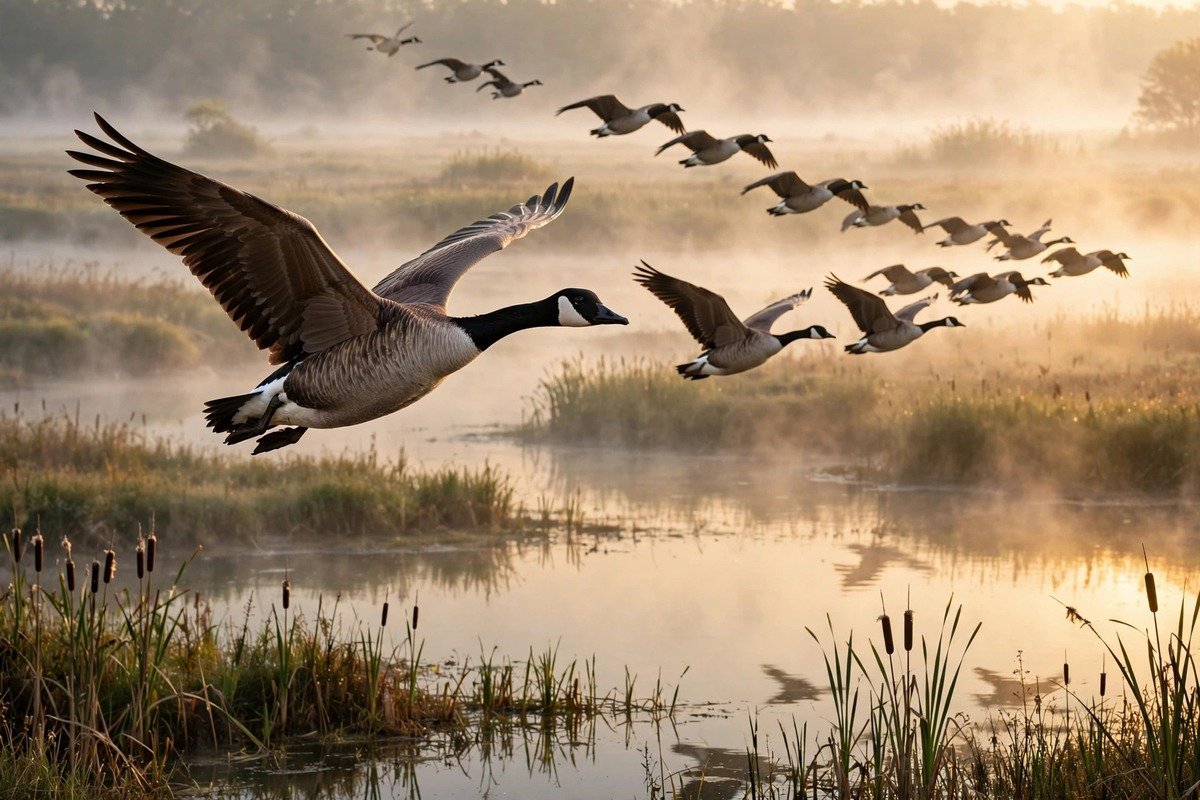
Every fall, billions of birds leave the northern United States and Canada and head south. Every spring, they make the trip in reverse. The question of why birds migrate has a short answer, plus some fascinating details behind it.
Birds migrate to stay near food. They leave when their food supply fades in autumn, and they return when spring brings insects, fruit, seeds, and long daylight hours back to the north. Surprisingly, cold alone does not drive them away. Many species could survive freezing temperatures if they could still find enough to eat.
Learning why do birds migrate reveals how food, daylight, breeding habitat, and competition shape one of the longest journeys any animal makes. Here are the real reasons behind the journey, and how birds manage to survive it.

The Short Answer on Why Birds Migrate
Migration is a survival strategy, not a vacation. Birds move between places that each offer good conditions at different times of the year. The Cornell Lab of Ornithology’s overview of bird migration breaks the reasons down to three resources birds chase: food, breeding sites, and daylight.
Food comes first. Birds that depend on insects face a hard deadline each autumn. When temperatures drop, insects die or go dormant, and the birds that eat them must leave or starve. Breeding sites come next. The boreal forests and Arctic tundra of the north offer enormous stretches of open nesting habitat that simply do not exist in the crowded tropics. Daylight rounds out the list. Long northern summer days give parents more hours to feed hungry chicks, which can mean larger broods.
Perhaps the most surprising part: weather is not on the list. Escaping cold temperatures is not itself a major factor that drives birds to migrate, since many species can withstand freezing temperatures as long as an adequate supply of food is available. That distinction matters, because it explains why some birds stay put through the coldest winters while others fly thousands of miles away.
Reason 1: Their Food Disappears
Food availability is the primary engine of migration. In spring and summer, the northern forests, wetlands, and grasslands overflow with insects, spiders, worms, and fruit. By late autumn, that feast collapses. Aerial insectivores such as swallows and nighthawks feel the pinch first, because flying insects vanish quickly once nights turn cold.
Compare a yellow warbler with a northern cardinal. The warbler eats mostly insects and caterpillars, so when the caterpillar season ends, it has no choice but to head for Central or South America, where insects stay active year-round. The cardinal eats seeds and berries, which remain on the landscape through winter, so it can stay behind. Audubon’s migration explainer puts it simply: birds travel to where there is plenty of food to feed their families.
Some birds split the difference by switching menus. American robins hunt earthworms and insects in summer, then pivot to fruit in winter. That flexibility lets them stay farther north than strict insectivores, which is why you can still spot robins in some northern states on a January day. When the ground freezes solid and the fruit runs out, though, even they retreat south.
Reason 2: Daylight Pulls Them Back North
Spring migration is driven by opportunity, not by escape. Near the equator, days stay close to 12 hours long all year. Near the poles, summer days stretch toward 18 or 20 hours. A parent bird with twice as many daylight hours can make twice as many feeding trips to the nest. That extra time is a huge advantage when chicks grow fast and need constant food.
The northern breeding grounds add a second advantage: space. The vast boreal forests and open tundra of Canada and Alaska provide enormous expanses for shorebirds and songbirds to nest in, with far less crowding than tropical forests. Less crowding means more available territory, and it generally means fewer competitors for each nesting site.
There may also be fewer predators watching for eggs and chicks in some northern habitats than in the tropics, where predator density stays high year-round. The combination is hard to beat: abundant food, long feeding days, open territory, and relatively fewer threats. That is why billions of birds fly north each spring instead of simply staying where they are.
Reason 3: Competition and Predators Push Them Out of the Tropics
If the tropics have food year-round, why do birds not just stay there? The answer is competition. Tropical forests already have full-time resident birds that defend territories and eat insects, fruit, and nectar in every season. A migrant arriving from the north would have to compete with birds that know the territory and never left.
Predators add another pressure. Tropical regions hold dense populations of snakes, monkeys, raptors, and other nest predators that stay active all year. In spring and summer, the north offers a relative bonanza of food and breeding opportunity, and in many northern habitats the predator pressure is more seasonal and less constant. The benefits of migrating north to breed can outweigh the real costs and dangers of the journey.
This trade-off is the heart of the whole system. Migration is dangerous and exhausting. Birds do it because the payoff is large: the chance to raise young where food is richest, days are longest, and nesting space is wide open.
How Birds Prepare for the Journey
Birds do not simply wake up one morning and start flying. Weeks before departure, many species enter a feeding frenzy called hyperphagia, eating far more than usual and storing the surplus as fat. Fat is the ideal migration fuel: it is lightweight, energy-dense, and easy to carry. In some species, migrating birds can nearly double their body weight before they leave.
Ruby-throated hummingbirds are a dramatic example. A bird that weighs about as much as a penny can fatten up enough to cross the Gulf of Mexico, a nonstop flight of around 500 miles over open water. For more on their timing, see our guide to when hummingbirds migrate. Shorebirds and songbirds follow the same principle on a larger scale, layering on fat until their bodies look noticeably plump.
Timing matters in other ways too. Many songbirds replace their worn feathers in a full molt after breeding and before fall migration, since fresh feathers fly better. Some species take the opposite approach and delay the molt until they reach the wintering grounds, where food is plentiful and there is no breeding to rush back for. Either way, the sequence of breeding, molting, and migrating is carefully tuned so no two energy-hungry events collide.

How Birds Survive the Trip
The journey itself is a relay, not a sprint. Most migratory birds do not fly the whole way in one push. Instead, they hop from one stopover site to the next, resting and refueling at wetlands, coastlines, and forests along the route. Researchers tracking gray-cheeked thrushes found the birds spent roughly 70 to 80 percent of their migration time on the ground at stopover sites, fueling up for only a few days of actual flight at a time.
That makes stopover habitat one of the most important parts of the whole system. A wetland drained for development, or a coastal resting spot that loses its insect hatch, can break the chain for an entire flyway. Conservation groups work to protect these links across continents, including the U.S. Fish and Wildlife Service’s Migratory Bird Program, which coordinates conservation of more than a thousand migratory species and their habitats.
Navigation is the other half of the story. Birds steer by the sun during the day and by the stars at night, and many species can also sense Earth’s magnetic field as a built-in compass. Landmarks, coastlines, and even smells help fine-tune the route. Most small songbirds travel at night, when the air is cooler and steadier and fewer predators are hunting, while hawks and eagles migrate by day and ride rising thermals. For the seasonal timing of these movements, see our guide to when birds migrate in spring and fall.
Bad weather is one of the biggest killers during migration. Storms can blow small birds far off course or force them down over water. Birds cope by waiting out fronts at stopovers, flying around storms, and sometimes grounding themselves until conditions improve. The same sheltering instincts apply year-round; see our article on where birds go when it rains.
Why Some Birds Do Not Migrate
Not every bird makes the trip. Resident birds are species that find enough food year-round in one place and never need to leave. Northern cardinals, black-capped chickadees, and tufted titmice are classic examples. They eat seeds, nuts, and suet through winter, and they have clever tricks for staying warm, such as the way birds puff up their feathers to trap insulating air.
Then there are the partial migrants, species where some individuals migrate and others stay, depending on age, sex, or how harsh the winter gets. American robins and blue jays are familiar partial migrants. In mild winters, many stay north; in severe ones, they drift south. This flexibility lets a species hedge its bets instead of committing the whole population to one strategy.
A third pattern is the irruption. In some years, seed-eating finches such as redpolls, pine siskins, and crossbills pour south in huge numbers when the cone and seed crops fail in the far north. In good seed years, they barely leave the boreal forest. Irruptions are migration driven purely by food, with no fixed calendar at all.
The table below summarizes the main strategies.
| Strategy | What happens | Examples |
|---|---|---|
| Long-distance migrant | Flies between continents each year | Arctic tern, blackpoll warbler, ruby-throated hummingbird |
| Short-distance migrant | Moves a few hundred miles or shifts elevation | Dark-eyed junco, American robin (southern shift) |
| Partial migrant | Some individuals migrate, others stay | Blue jay, American robin, cedar waxwing |
| Resident | Stays year-round where it breeds | Northern cardinal, black-capped chickadee, tufted titmouse |
| Irruptive migrant | Moves south in unpredictable years when food fails | Common redpoll, pine siskin, red crossbill |

Frequently Asked Questions
Do birds migrate because of the cold?
Not directly. Cold itself is rarely the main driver, because most birds can survive freezing temperatures if they have enough to eat. A chickadee can endure a subzero night; what kills birds in winter is starvation, not chill. Birds migrate because the cold shuts down their food supply, especially insects. Seed-eaters that can still find food in winter stay behind, which is the clearest proof that food, not temperature, calls the shots.
Which bird migrates the farthest?
The arctic tern holds the record for the longest migration of any animal in the world, according to National Geographic’s arctic tern profile. These seabirds breed in the Arctic and winter in Antarctic waters, chasing summer from one pole to the other. Tracking studies have recorded round trips averaging around 44,000 miles, with some individual birds logging even more by riding winds across the oceans. Over a long life, one tern may fly the equivalent of several trips to the moon and back.
Do birds migrate back to the same place every year?
Many do, and often with remarkable precision. Banding studies have shown that individual songbirds frequently return to the same breeding territory and the same wintering site year after year. Site fidelity makes sense: a bird that already knows where the food, water, and safe roosts are has a head start over one exploring a new area. Young birds on their first trip are less precise, but once a bird finds a good spot, it tends to come back.
How do young birds know where to go?
In many species, first-time migrants fly the route alone, guided by an inherited program rather than by following their parents. Young birds appear to be born with a compass sense and a rough timetable: fly in this direction for this many nights, then look for the right habitat. They calibrate using the stars, the sun’s position, and Earth’s magnetic field, with coastlines and mountain ranges as visual guides. The first trip is the riskiest; survivors learn the route and the best stopovers, and they improve with experience.
Conclusion
Why do birds migrate? The answer comes down to resources that move with the seasons. Food disappears from the north each autumn, so birds follow it south. Daylight, open breeding space, and rich insect hatches pull them north again each spring. Competition and predators in the tropics tip the balance, making the long trip worth the risk.
Every piece of the journey is tuned to this logic, from the pre-migration feeding frenzy to the stopover sites where birds spend most of their travel time. Watching a V of geese pass overhead in October is not just a sign of changing weather. It is a reminder that birds are among the most committed travelers on Earth, flying thousands of miles for one simple reason: survival, and the chance to raise the next generation where food is richest.





