Skip to content

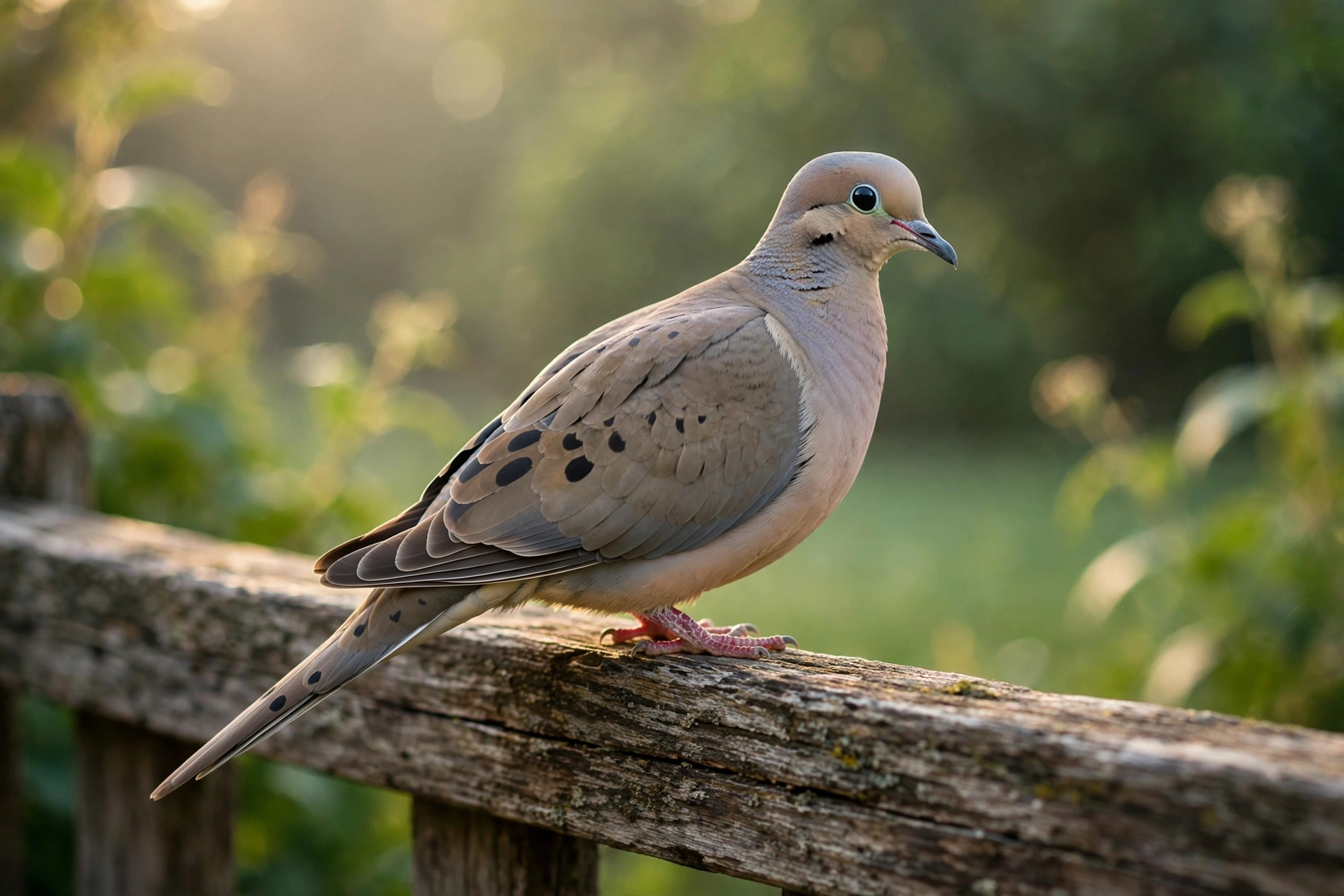
A soft brown bird lands on your fence, and you wonder: is that a mourning dove or a pigeon? At first glance the two look like cousins, and in a way they are. Both belong to the same bird family, and both are common sights across North America. But once you know what to look for, telling a mourning dove from a pigeon takes only seconds.
Here is the short answer. A mourning dove is slender and tan, with a long pointed tail, black spots on its wings, and a gentle cooing call that sounds like it is sighing. A rock pigeon is stockier and usually gray, with a rounded fan shaped tail, iridescent green and purple feathers on its neck, and a throaty bubbling coo. Mourning doves are native wild birds. Rock pigeons are the feral descendants of domestic birds, which is why they rule the cities.
In this mourning dove vs pigeon guide, you will learn the seven key differences that separate these two birds, plus a quick comparison table, tips for identifying each one in your yard, and answers to the most common questions birders ask. By the end, you will never mix them up again.
The Family Connection: Why They Look Alike
Mourning doves and rock pigeons are both members of the Columbidae family, the group that includes every pigeon and dove on the planet. Scientifically speaking, there is no hard dividing line between a “pigeon” and a “dove.” The words are a matter of tradition: smaller members of the family tend to be called doves, while larger ones tend to be called pigeons. That is a naming habit, not a biological rule.
The mourning dove is Zenaida macroura, a native North American species. The rock pigeon is Columba livia, a bird originally from the cliffs of Europe, North Africa, and western Asia. Thousands of years ago, people domesticated wild rock doves, and the birds we see in cities today are the feral descendants of those domestic flocks. So when you compare a mourning dove and a pigeon, you are really comparing a wild native with a city bird that went back to the wild.
Because they are relatives, the two share some classic family traits. Both drink water by sucking, without tipping their heads back the way other birds do. Both feed their chicks a special substance called crop milk, a nutritious liquid produced in the lining of the parent’s crop. And both are almost entirely devoted to seeds and grain. The differences below show how evolution and history shaped them in different directions.
7 Key Differences Between Mourning Doves and Pigeons
1. Size and Body Shape
The easiest difference to see is the overall build. A mourning dove is about 12 inches long and weighs roughly 112 to 170 grams, which is around 4 to 6 ounces. Its body is slim and streamlined, with a small rounded head, a short thin bill, and delicate reddish legs. Everything about it looks graceful and light.
A rock pigeon is noticeably bulkier. It measures 29 to 37 centimeters (about 11.5 to 14.5 inches) and can weigh twice as much as a dove, with a broad chest, a thick neck, and a sturdier bill topped by a pale cere. Its wingspan reaches 62 to 72 centimeters, compared with the dove’s 37 to 45 centimeters.
Think of it this way: a mourning dove looks like an athlete built for distance, while a rock pigeon looks like a heavyweight built for power. If the bird on your feeder looks soft, slim, and elegant, it is probably a dove. If it looks chunky and broad chested, it is probably a pigeon.
2. Tail Shape
The tail is the single best field mark for a quick identification. A mourning dove has a long, tapering, pointed tail. When it flies, the tail stretches out behind the bird like the tip of a paintbrush. The outer tail feathers are tipped with white, which flashes in a neat pattern every time the bird lands or takes off.
A rock pigeon’s tail is much shorter and rounded, fanning out like a paper fan. It lacks the white tips that make a dove’s tail so distinctive. In flight, a pigeon’s silhouette looks compact and broad winged, while a dove’s silhouette looks narrow and long tailed.
This is the field mark experienced birders check first. Long and pointed with white edges means mourning dove. Short and rounded means pigeon. You can often make the call from across a parking lot.
3. Plumage and Field Marks
Mourning doves wear soft, muted colors. Their backs are light grayish brown, their undersides are a pale pinkish tan, and their wings carry neat rows of black spots. Below each eye sits a dark crescent shaped mark, and the male shows a bluish gray crown with faint iridescent pink and green on the sides of the neck.
Rock pigeons are famously variable. The wild type is pale gray with two bold black bars across each wing and an iridescent green and purple sheen on the neck, but city pigeons can be blue gray, checkered, rusty brown, almost white, or a patchwork of all of them. That variety is a legacy of domestic breeding, and no two feral flocks look exactly alike.
Two details never lie. Black spots on the wings point to a mourning dove, because pigeons have bars or mottling instead. Bright iridescent green and purple on the neck points to a rock pigeon, because a dove’s neck iridescence is faint by comparison. If the bird’s color pattern changes from bird to bird in the flock, you are watching pigeons.

4. Voice and Call
The mourning dove’s call is one of the most recognizable sounds in North America. It is a low, mournful cooing: “coo-ah, coo, coo, coo,” with the second note rising higher than the rest. Many people mistake it for an owl at a distance, especially at dawn. The bird’s name comes straight from this sorrowful sounding song, which males sing to attract mates.
Rock pigeons coo too, but their version is throatier and more bubbling. A pigeon’s call is a series of guttural, rolling notes, often described as “coo, coo-roo,” with a raspy, almost growling quality. You will hear it from rooftops, ledges, and underpasses all day long, mixed with the soft fluttering of wings.
There is also a sound that is not a call at all. When a mourning dove takes off, its wings make a sharp whistling flutter, much louder than a pigeon’s quieter wingbeats. If you hear a burst of wing whistle and then a long pointed tail flashes past, that is a dove leaving in a hurry.
5. Habitat
Mourning doves are birds of open and semi open country. They thrive on farms, in suburbs, along roadsides, in grasslands, and in lightly wooded areas. They need open ground for foraging and scattered trees or shrubs for cover, but they avoid deep forest, swamps, and the far north. They are common visitors to backyard feeders, usually feeding on the ground underneath.
Rock pigeons are birds of concrete. Their wild ancestors nested on sea cliffs and rocky ledges, and modern cities are the perfect substitute: building ledges, bridge girders, windowsills, and parking garages stand in for cliffs. Wherever people gather in large numbers, pigeons gather too, and some flocks rarely leave the downtown core.
Both birds have adapted to humans, but they chose different parts of our world. A dove wants the quiet edge of town with open fields. A pigeon wants the busy middle of town with tall structures. If the bird is strutting across a plaza in a crowd of shoppers, it is a pigeon. If it is sitting on a fence above a meadow, it is a dove.
6. Nesting
Mourning dove nests are famously flimsy. The female builds a loose platform of twigs, pine needles, or grass, often in a tree, a shrub, or even on the ground. Some nests are so thin that the two white eggs can be seen through the sticks from below. Both parents share incubation duties for about 14 days, and a single pair may raise five or six broods in a year in warm regions.
Rock pigeons nest on flat, sheltered ledges that mimic cliff shelves. Building eaves, bridge supports, barn rafters, and abandoned structures all work. Their nests are also simple platforms of sticks, but they are usually tucked into a crevice rather than balanced on a branch. Like doves, they lay two white eggs and both parents incubate.
The biggest nesting difference is placement, not design. Doves choose vegetation: trees, shrubs, hanging baskets, and the occasional bare patch of ground. Pigeons choose architecture: anything flat, high, and sheltered. To learn more about when these birds get down to business each year, read our guide on when birds lay eggs and the nesting season.
Both species feed their young in the same remarkable way. Parent doves and pigeons produce crop milk, a rich liquid from the lining of the crop, and feed it to their chicks for the first days of life. If you are curious about what young birds eat as they grow, our article on what baby birds eat covers the full story.

7. Behavior and Diet
Mourning doves are gentle and a little skittish. They usually travel in pairs during the breeding season and gather in loose flocks in winter. When startled, they burst into the air with that signature wing whistle and fly fast on strong, pointed wingbeats. They are frequent at feeders but prefer to pick up spilled seed from the ground rather than perch on a crowded feeder tray.
Rock pigeons are bolder and far more social. They walk through crowds with a confident head bob, gather in dense flocks, and barely flinch when people pass close by. Centuries of living alongside humans made them tame in a way that wild doves never became. Their flight is strong and direct, built on broad wings that carry them between roosts and feeding spots all day.
Diet separates them too. A mourning dove’s diet is about 99 percent seeds, favoring cultivated grains, grasses, and ragweed, with the occasional snail for grit. Pigeons eat seeds and grain as well, but city pigeons are opportunists: they will take bread crusts, discarded fries, and just about anything edible they find on the pavement. If you feed backyard birds and wonder whether leftover grains are safe, see our guide on whether birds can eat rice.
Quick ID Comparison Table
Use this table when you want a side by side answer at a glance.
| Feature | Mourning Dove | Rock Pigeon |
|---|---|---|
| Scientific name | Zenaida macroura | Columba livia |
| Length | About 12 inches (31 cm) | 11.5 to 14.5 inches (29 to 37 cm) |
| Weight | 112 to 170 grams | Roughly double, around 238 to 380 grams |
| Body shape | Slender, small head, delicate | Stocky, broad chest, thick neck |
| Tail | Long, pointed, white tipped outer feathers | Short, rounded, fan shaped |
| Plumage | Soft tan and gray with black wing spots | Usually gray with black wing bars, highly variable |
| Neck | Faint pink and green iridescence in males | Bold green and purple iridescence |
| Call | Mournful “coo-ah, coo, coo, coo” | Throaty, bubbling coos |
| Flight sound | Sharp wing whistle on takeoff | Quieter, softer wingbeats |
| Habitat | Open country, farms, suburbs, fields | Cities, plazas, bridges, buildings |
| Nesting | Flimsy twig platforms in trees and shrubs | Ledges, eaves, bridges, and structures |
| Diet | Almost entirely seeds | Seeds, grain, and urban scraps |
| Origin | Native wild North American bird | Feral descendant of domesticated rock doves |
Which One Is in Your Yard?
If you have a bird feeder, you may see both species, but they behave differently enough that you can usually tell them apart without binoculars. Watch how the bird arrives and how it feeds. A mourning dove lands softly, often alone or in a pair, and pecks quietly at the ground beneath the feeder. It startles easily and leaves with a burst of whistling wings.
A rock pigeon arrives with confidence, often in a group, and marches straight to the richest patch of seed. It may chase other birds away, bob its head as it walks, and coo throatily while it eats. Pigeons are more likely to perch on your roof, your gutters, or your balcony railing than doves are.
Location is a strong clue. Suburban and rural yards with trees and open lawns favor mourning doves. Dense urban neighborhoods with tall buildings and busy sidewalks favor rock pigeons. In a city park you might see both at once, which is the perfect chance to compare the pointed tail of the dove against the rounded tail of the pigeon side by side.

Frequently Asked Questions
Is a mourning dove a pigeon?
Not exactly, but they are close relatives. Both belong to the Columbidae family, which includes all pigeons and doves. There is no scientific difference between the words “pigeon” and “dove.” They are naming traditions, with smaller members of the family usually called doves and larger ones usually called pigeons.
Are mourning doves and rock pigeons in the same family?
Yes. Both are in the family Columbidae and the order Columbiformes. They share classic family traits, including crop milk feeding for their chicks and the unusual ability to drink water by sucking without lifting their heads. They belong to different genera, though: Zenaida for the mourning dove and Columba for the rock pigeon.
Which is bigger, a mourning dove or a pigeon?
A rock pigeon is bigger and heavier. Mourning doves are about 12 inches long and weigh 112 to 170 grams. Rock pigeons range from about 11.5 to 14.5 inches but weigh roughly twice as much, with a much stockier build and a wingspan of 62 to 72 centimeters. The pigeon looks chunky next to the dove’s slim profile.
How can you tell a mourning dove from a pigeon in flight?
Check the tail first. A mourning dove’s tail is long and pointed, stretching behind the bird with white tips flashing on the outer feathers. A rock pigeon’s tail is short and rounded. Doves also fly on narrower, more pointed wings and make a sharp whistling sound on takeoff, while pigeons fly on broader wings with quieter wingbeats.
Do mourning doves live in cities like pigeons do?
Mourning doves do visit suburbs and city parks, but they are not city birds in the way pigeons are. Doves prefer open and semi open habitats with trees, lawns, and fields. Rock pigeons thrive in dense urban cores, nesting on buildings and bridges the way their wild ancestors nested on cliffs. If you are downtown among skyscrapers, almost every dove shaped bird you see is a pigeon.
Which one makes the mournful cooing sound at dawn?
That is the mourning dove. Its low, sorrowful “coo-ah, coo, coo, coo” is often heard at dawn and dusk, and beginners sometimes mistake it for an owl. Rock pigeons make a throatier, bubbling coo that sounds guttural rather than musical. If the sound gives you a peaceful, slightly melancholy feeling, you are hearing a dove.
Are pigeons wild birds or domestic animals?
City pigeons are feral, meaning they are domestic animals gone wild. All rock pigeons descend from wild rock doves of Europe, North Africa, and western Asia that people domesticated thousands of years ago. Escaped and released birds formed the free living flocks we see today. Mourning doves, by contrast, are fully wild native birds that were never domesticated.
Can mourning doves and rock pigeons mate with each other?
No. Although both are in the Columbidae family, they belong to different genera and cannot produce offspring together. They also have different courtship behaviors and calls, so they rarely even attempt to pair up. If you see a dove and a pigeon together at a feeder, they are just sharing the seed, not starting a family.
The Bottom Line
Mourning doves and rock pigeons are family, but they are not twins. Remember three things and you will always get the identification right. First, look at the tail: long and pointed with white tips means mourning dove, short and rounded means pigeon. Second, look at the build: slim and delicate means dove, chunky and broad chested means pigeon. Third, listen: a mournful musical coo means dove, a throaty bubbling coo means pigeon.
Both birds are worth watching. The mourning dove is a graceful native that fills quiet mornings with its soft song, and the rock pigeon is a tough survivor that turned our cities into cliffs. Next time one lands near you, take a second look. You will know exactly which cousin you are looking at.
Sources: Audubon Field Guide: Mourning Dove; Sacramento Audubon Society: Meet the Mourning Dove; Wikipedia: Mourning Dove.