Skip to content

A flash of black and white lands on your feeder and vanishes into the branches. It happened fast, and now you want a name for what you saw. This guide gives you one. Four of the most common black and white backyard birds in North America each have a small set of field marks you can learn in seconds, and once you know them, you will recognize these birds on sight.
The lineup: the tiny Downy Woodpecker and its lookalike, the Hairy Woodpecker, the cheerful Black-capped Chickadee, the upside-down White-breasted Nuthatch, and the bold Northern Mockingbird. Below you will find a quick-ID system, species-by-species profiles, side-by-side comparisons, and practical tips for telling even the trickiest pairs apart.
How to Identify a Black and White Bird in 30 Seconds
Experienced birders identify birds with a simple routine, and you can use the same one. Run through four questions in order: size, shape, behavior, and field marks.
- Size: Compare the bird to something you know. Is it sparrow-sized (chickadee), robin-sized (woodpecker, nuthatch), or larger and long-tailed (mockingbird)?
- Shape: Look at the bill and tail. A short chisel bill on a tree trunk says woodpecker. A long straight bill on a bird walking headfirst down bark says nuthatch. A slim bill on a long-tailed perched songbird says mockingbird.
- Behavior: Where and how is it feeding? Chickadees dart between feeder and branch. Woodpeckers hitch upward on trunks. Nuthatches creep downward. Mockingbirds run and hop on lawns.
- Field marks: Note the three or four strongest color features. Black cap plus white cheeks means chickadee or nuthatch. White wing patches in flight mean mockingbird. A white stripe down the back means one of the two lookalike woodpeckers.
Answer these in order and you will land on the right species nearly every time. Now let us meet the candidates.
Downy Woodpecker vs Hairy Woodpecker: The Classic ID Challenge
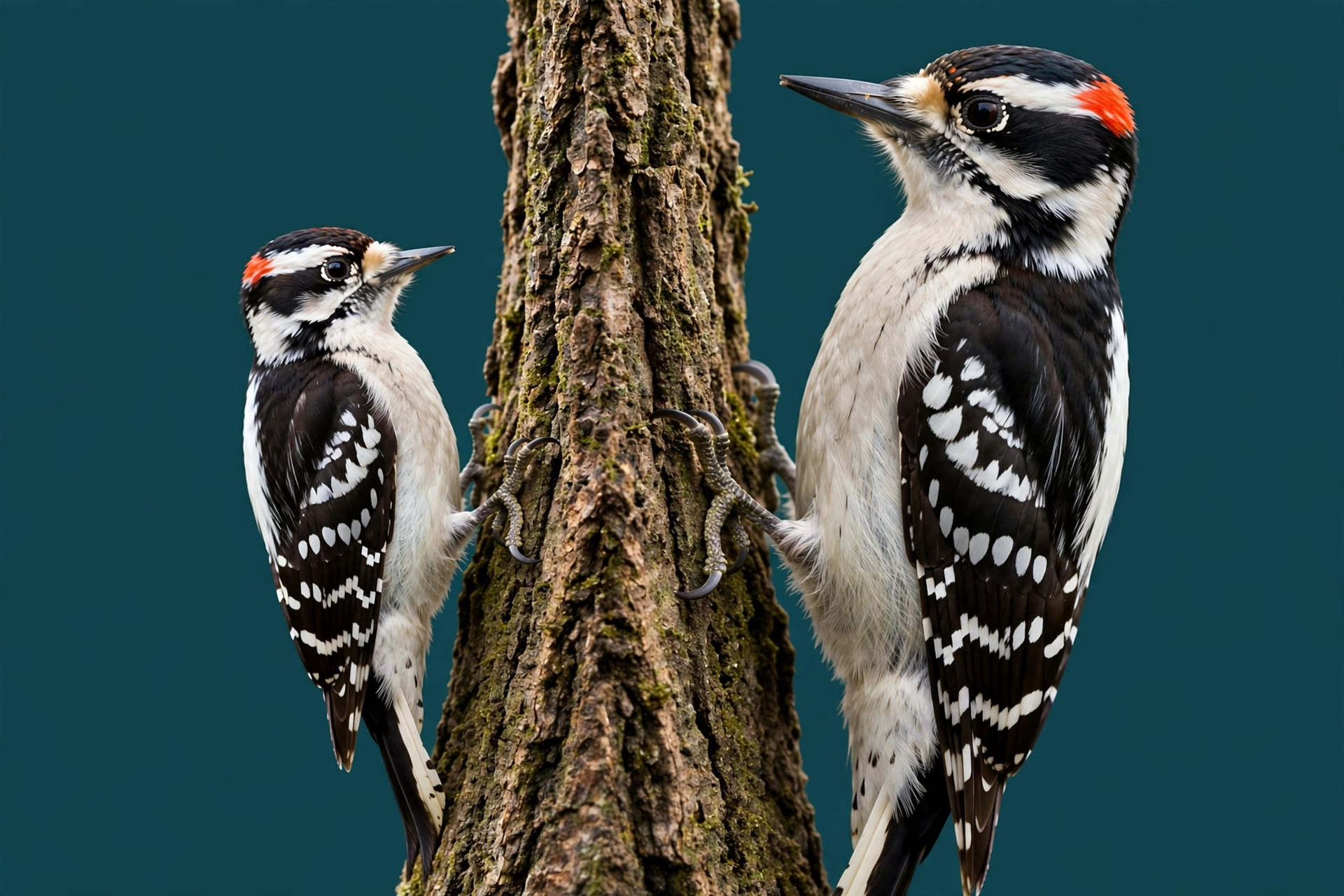
The two woodpeckers are the hardest pair in this guide. They look like the same bird printed at two sizes, and that is nearly the truth. The Downy Woodpecker is North America’s smallest woodpecker at about 6 inches, while the Hairy Woodpecker reaches about 9 inches. In many yards, both visit the same suet feeder, which makes a direct side-by-side comparison possible.
Start with the bill, which is the single most reliable field mark. A Downy’s bill is short, noticeably shorter than its head. A Hairy’s bill is long, thick, and about as long as its head. When you are unsure, imagine pressing the bill backward across the face: on a Downy it barely reaches the eye, while on a Hairy it reaches past it. This one clue settles most uncertain sightings.
Next, check the tail and overall bulk. Hairy Woodpeckers look front-heavy and chunky with clean white outer tail feathers. Downy Woodpeckers show small black spots on their white outer tail feathers, a detail visible when the bird fans its tail while climbing. Hairies also drum and call less often, with a sharper, louder pik call, while Downies give a softer pik and a descending whinny.
Both males wear a small red patch on the back of the head, so that mark does not separate them. Both have the same black wings with white spots and the same white stripe down the center of the back. Size helps when the birds are alone, but it deceives when you misjudge distance. Trust the bill first, the tail spots second, and the call third. For a deeper treatment of this famous pair, see our dedicated downy vs hairy woodpecker identification guide.
Downy vs Hairy Woodpecker Quick Comparison
| Feature | Downy Woodpecker | Hairy Woodpecker |
|---|---|---|
| Length | About 6 inches | About 9 inches |
| Bill | Short, clearly shorter than head | Long, thick, as long as head |
| Outer tail feathers | White with black spots | Pure white, unspotted |
| Body feel | Small, round, delicate | Chunky, front-heavy |
| Call | Softer pik, descending whinny | Louder, sharper pik |
| Feeder style | Frequent, perches on suet easily | Frequent, dominates smaller birds |
Black-capped Chickadee: The Black Cap and White Cheeks
If the bird is tiny, round, and wearing what looks like a black hood with glowing white cheeks, you are looking at a Black-capped Chickadee. No other common backyard bird pairs a solid black cap and bib with such clean, bright white cheek patches. The back is soft gray, the belly is white with buffy sides, and the whole bird is about the size of a large sparrow.
Behavior confirms it fast. Chickadees are restless acrobats. They grab one sunflower seed from the feeder, dart to a nearby branch, hammer the seed open with their feet braced around it, and return for more. Their flight is quick and undulating, and they often hang upside down from branch tips without a second thought.
Voice is another gift. The namesake chick-a-dee-dee-dee call and the clear two or three note fee-bee song carry across the yard. In the northern states, note the lookalike Carolina Chickadee, which has a thinner bib edge and a faster four note song, but the two species rarely overlap; they divide the country roughly along a line through the Mid-Atlantic. For more ways to keep these favorites coming back, read how to attract chickadees to your yard.

White-breasted Nuthatch: The Upside-Down Bird
A nuthatch announces itself by doing something no other songbird does: walking headfirst straight down a tree trunk. Woodpeckers brace with stiff tails and climb up. Nuthatches pivot on strong feet and creep down, probing bark crevices for insects that upward-foraging birds miss.
The plumage matches the attitude. A White-breasted Nuthatch has a sleek black cap and nape that frame a bright white face, a blue-gray back, and a white breast and belly with chestnut tones under the tail. The bill is long, straight, and dagger-like, built for prying. At about 5 to 6 inches, it looks like a plump, short-tailed chickadee with a nuthatch’s posture.
Listen for the nasal yank-yank calls, often given in a fast series. Nuthatches are also enthusiastic suet and peanut visitors and famous seed cachers, wedging seeds into bark cracks to eat later. Their habit of foraging upside down is so distinctive that behavior alone is nearly diagnostic: if it is going down the trunk headfirst, it is a nuthatch.

Northern Mockingbird: The Gray Singer With White Flashes
The Northern Mockingbird is the largest bird on this list and the only one you will usually spot singing from the highest exposed perch in the yard. It is a slim, long-tailed gray songbird, roughly robin-sized, with a pale belly and two bold white patches that flash when it flies. Those white wing patches and white outer tail feathers are the key black and white field marks.
At rest, the mockingbird’s gray looks plain, but the wings tell the story. Dark gray wings carry a broad white patch near the base of the primaries, and the long dark tail shows white outer feathers. The eye is pale yellow, a subtle but reliable mark at close range. In flight, the bird looks like a gray dart stitched with white.
Behavior seals the ID. Mockingbirds sing loudly and endlessly, repeating each phrase two to six times, and they copy car alarms, cell phones, and other birds with eerie accuracy. On the ground, they perform a strange wing-flashing dance, spreading their wings to show the white patches while hunting insects. They also defend winter berry bushes with remarkable aggression, chasing off birds twice their size. If you want a full species profile, the Cornell Lab’s Northern Mockingbird guide covers range, sounds, and behavior in depth.

At-a-Glance ID Chart
Bookmark this table. Run your sighting through it and the answer usually pops out.
| Bird | Size | Key Field Marks | Telltale Behavior | Key Sound |
|---|---|---|---|---|
| Downy Woodpecker | 6 in | White back stripe, short bill, spotted outer tail | Hitches up trunks, visits suet | Soft pik, descending whinny |
| Hairy Woodpecker | 9 in | White back stripe, long thick bill, clean white outer tail | Same as Downy but bulkier | Loud sharp pik |
| Black-capped Chickadee | 5 in | Black cap and bib, bright white cheeks | Darts feeder to branch, hangs upside down | chick-a-dee-dee-dee, fee-bee song |
| White-breasted Nuthatch | 5 to 6 in | Black cap, white face, blue-gray back | Climbs headfirst down trunks | Nasal yank-yank |
| Northern Mockingbird | 9 to 11 in | Gray body, bold white wing patches in flight | Sings from high perches, wing-flashing dance | Repeated phrases, mimicry |
Common Lookalikes Worth Ruling Out
A few other black and white birds can crash your identification party. The Black-and-white Warbler creeps along branches like a nuthatch but is much smaller, streakier, and appears mostly during migration. The Eastern Kingbird perches in the open like a mockingbird but wears a dark head with a white-tipped tail and shows no wing patches.
In the West, the Loggerhead Shrike looks mockingbird-like but sports a bold black mask. Juvenile birds also muddy the picture: young mockingbirds show spotted breasts, and young woodpeckers may show a red wash on the crown instead of the neat nape patch. When in doubt, record the bird or snap a photo and run it through the Merlin Bird ID app, which identifies birds from photos and sounds with impressive accuracy.
How to Attract More Black and White Birds
Once you can name them, you will want more of them. Each species has a favorite offering. Woodpeckers and nuthatches both love suet, especially peanut-based suet in winter. Chickadees go wild for black-oil sunflower seeds and shelled peanuts. Mockingbirds prefer fruit, mealworms, and dense berry shrubs, and they rarely visit seed feeders.
Habitat matters as much as food. Leave dead branches and snags standing where safe, since woodpeckers forage and nest in them. Plant native berry bushes like serviceberry, dogwood, and winterberry for mockingbirds. Offer a clean water source year-round, because birds that skip seed feeders still need to drink. For complete setups, see our guides on suet feeding and chickadee-friendly yards linked above, and compare notes with the Cornell Lab’s species accounts, such as the Downy Woodpecker and White-breasted Nuthatch profiles.
Frequently Asked Questions
What is the most common black and white bird in backyards?
Across most of North America, the Black-capped Chickadee is the most frequently seen black and white backyard bird, followed closely by the Downy Woodpecker and the White-breasted Nuthatch. The Northern Mockingbird dominates southern and suburban yards, where it is often the largest and loudest of the group.
How can I tell a Downy Woodpecker from a Hairy Woodpecker?
Check the bill first. A Downy Woodpecker’s bill is clearly shorter than its head, while a Hairy Woodpecker’s bill is as long as its head. Second, look at the white outer tail feathers: Downies show small black spots there, while Hairies have clean white tail feathers. Size and call volume help, but the bill and tail are the reliable marks.
What small black and white bird hangs upside down?
Two birds fit this description. Chickadees hang upside down from branch tips while feeding, and nuthatches famously climb headfirst down tree trunks. If the bird is creeping down the trunk itself, it is a White-breasted Nuthatch. If it is dangling from twigs and feeder edges, it is most likely a chickadee.
Is a Northern Mockingbird black and white?
Mostly it is gray and white rather than true black and white. Its upperparts are gray, its belly is pale, and its wings and tail show bold white patches that flash dramatically in flight. From a distance, those flashes read as black and white, which is why mockingbirds make every list of backyard black and white birds.
What does it mean when a black and white bird visits your yard?
It means your yard is offering something the bird needs: food, water, shelter, or nesting habitat. Chickadees and nuthatches cache seeds for winter, woodpeckers probe your trees for insects, and mockingbirds defend berry bushes. A visit is simply a sign of a healthy, bird-friendly yard, nothing more mysterious than that.
Do black and white backyard birds migrate?
Most of the birds in this guide stay put. Chickadees, nuthatches, and both woodpeckers are year-round residents across their ranges, though northern populations may shift south in harsh winters. Northern Mockingbirds are also largely non-migratory. This means the identification skills in this guide pay off in every season.
Conclusion
Identifying a black and white bird in your backyard comes down to four quick questions: how big is it, what is its shape, what is it doing, and which three or four marks stand out? With those answered, the Downy and Hairy Woodpeckers separate on bill length and tail spots, the Black-capped Chickadee announces itself with its black hood and white cheeks, the White-breasted Nuthatch gives itself away by climbing headfirst down the trunk, and the Northern Mockingbird flashes its white wing patches from the tallest perch in the yard.
Keep a feeder stocked with black-oil sunflower seeds and suet, add a clean water source, and leave some natural cover standing. Then watch. Within a week, you will be naming these birds before they finish their first call, and the next black and white flash through your yard will be an old friend instead of a mystery.