 Skip to content

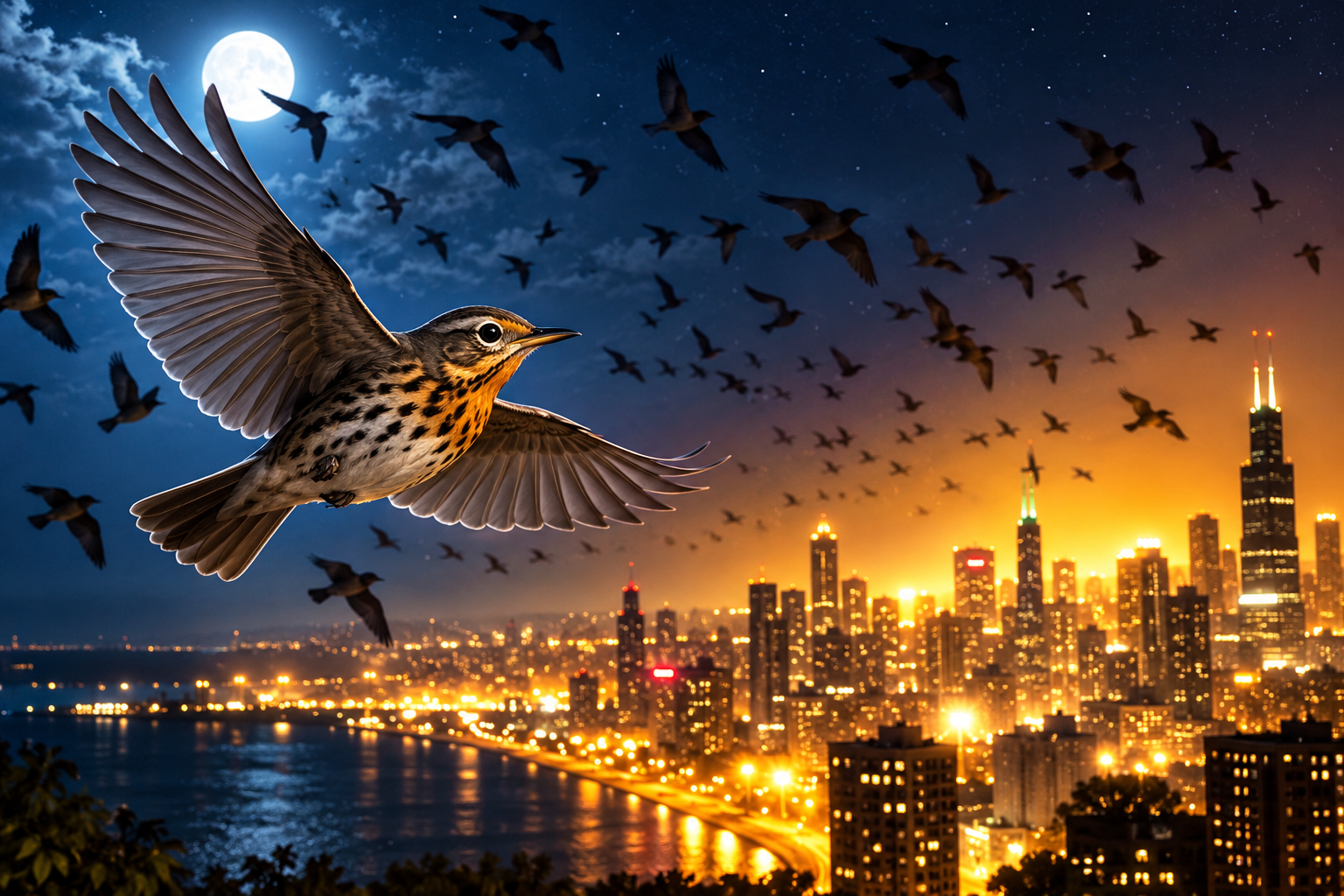
Step outside on a clear October night and look up. The sky looks empty, but it is anything but. High overhead, far beyond the reach of your eyes, a silent river of life is streaming south.
On the biggest nights of fall migration, hundreds of millions of birds cross the United States in the dark, navigating by stars, moonlight, and the Earth’s magnetic field.
October is the peak of this journey. BirdCast, the Cornell Lab of Ornithology’s migration tracking project, has recorded nights when more than a billion birds were aloft over the country at the same time. Most of this traffic passes between sunset and sunrise, completely unseen by the people sleeping below it.
That darkness is exactly what the birds need, and it is disappearing. City lights create a glow that can disorient night-flying birds, draw them off course, and pull them toward buildings and windows where hundreds of millions die in collisions every year.
The good news is that the fix is simple, free, and proven. It is called Lights Out, and this guide explains how it works and how you can join it.

Why October Is the Peak of Fall Migration
Fall migration is a marathon that runs from early August through mid-November, but it is not spread evenly. BirdCast defines peak migration as the window when roughly half of all nighttime migration traffic passes through an area, and for most of the United States that wave crests in September and October.
October nights are when the biggest pushes happen. A strong cold front sweeping down from Canada can launch enormous flights, with birds riding the tailwinds south.
On September 26, 2026, BirdCast estimated more than 600 million birds were in flight across the US in a single night. On an average peak-season night, about 400 million birds are detected aloft at the same time.
Birds usually begin moving about 30 to 45 minutes after sunset, with the heaviest traffic a few hours later. They cruise at surprising altitudes, often around 2,000 feet and sometimes much higher, moving at roughly 22 miles per hour.
By dawn they drop out of the sky to rest and refuel in parks, backyards, and woodlands. If you woke up one October morning to unfamiliar birds in your trees, there is a good chance they flew in over your roof while you slept.
The scale is hard to grasp until you see it on radar. That is what makes BirdCast’s live migration maps so powerful: they turn an invisible phenomenon into something you can watch in near real time. Later in this guide, we will show you how to use those maps to pick your Lights Out nights.
Why Most Migrating Birds Fly at Night
Daytime flying seems more natural, so the nighttime habit surprises many people. For small songbirds like warblers, thrushes, and tanagers, the night shift is a survival strategy. Darkness hides them from daytime predators such as hawks and falcons that would love to pick off a tired traveler.
The night air also works in their favor. It is cooler and calmer than daytime air, which means less energy spent fighting turbulence and less water lost to heat. A bird that flies all night can then spend the day foraging and resting in unfamiliar habitat.
To stay on course, night migrants use a remarkable toolkit: the position of the stars, the glow of the setting sun, polarized light patterns, and the Earth’s magnetic field. It is a system tuned to a dark sky. Flood it with artificial light, and the whole compass starts to spin.
How City Lights Hijack a Bird’s Navigation
The trap: sky glow and fatal attraction
Artificial light at night creates a dome of brightness over every city, a phenomenon called sky glow. To a bird flying high overhead, that glow can look like a false horizon or a beacon. Instead of passing over the city, birds are drawn toward it, descend, and begin circling lit buildings.
Once trapped in the light, birds waste the energy they need for the journey. Researchers have watched migrants circle illuminated towers and skyscrapers until they die of exhaustion. Those that survive the circling face the glass itself: lit windows reveal indoor plants or reflect the sky, and birds fly straight into them at full speed.
Which birds are most at risk
The victims are overwhelmingly small night-migrating songbirds. Warblers, thrushes, vireos, tanagers, sparrows, and buntings make up the bulk of collision casualties, and most North American migratory songbirds do the bulk of their traveling after dark.
This matters because many of these species are already declining. A single lit building can kill hundreds of birds in one night during a heavy flight. Multiply that by thousands of cities along four major flyways, and you get one of the largest sources of direct human-caused bird mortality on the continent.
The Collision Toll, by the Numbers
The numbers behind window collisions are staggering. A landmark 2014 review in the journal The Condor estimated that collisions with buildings kill between 365 million and 988 million birds every year in the United States alone.
The Cornell Lab of Ornithology puts the toll at up to a billion birds annually, which works out to roughly 30 birds dying from window collisions every second.
Here is the detail most people get wrong: skyscrapers are not the main killer. The same review found that 44 percent of collision deaths happen at houses one to three stories tall, and 56 percent at low-rise buildings.
Fewer than 1 percent occur at high-rises. That means the risk sits at house height, in ordinary neighborhoods, which is exactly where your Lights Out effort matters most.
BirdCast’s radar record shows just how much life is at stake on peak nights:
| Night | Birds aloft over the US | Notes |
|---|---|---|
| October 6, 2023 | About 1 billion | First billion-bird night ever recorded by BirdCast |
| September 25, 2025 | About 1.23 billion | Record at the time; roughly 10 percent of the continent’s birds in flight at once |
| October 8, 2025 | About 1.25 billion | New record, driven by a strong cold front along the East Coast |
| September 26, 2026 | Over 600 million | A massive single-night wave, mostly after dark |
These figures are estimates from weather radar, but the trend is unmistakable. On peak October nights, the sky is crowded, and every unshielded light is a hazard.
What the Lights Out Program Asks You to Do
Lights Out is a simple idea run as a network of local programs, many led by Audubon chapters and conservation groups. The concept started in cities like Chicago and Toronto in the late 1990s after researchers linked nighttime lighting to mass collision events, and it has since spread to dozens of cities and several statewide campaigns.
The ask is refreshingly small. There are two core rules that nearly every program shares.
The two core rules
First, turn off non-essential lights between 11 p.m. and 6 a.m. during migration season. For fall, that window generally runs from August 15 through October 31, with several programs extending through November 30 to cover late migrants. If you can go dark earlier in the evening, even better, since heavy flights often start within an hour of sunset.
Second, for anything taller than three stories, treat decorative and lobby lighting as the priority: dim or shut down floodlights, atrium lights, vacant-floor lighting, and exterior decorative lights. Where lights must stay on for safety, aim them downward, add shields, and switch to warm-colored bulbs.
A movement, not a mandate
Lights Out Texas, launched by Audubon Texas in 2017, asks Texans to go dark from 11 p.m. to 6 a.m. across the full fall season, August 15 through November 30, with peak emphasis from early September through late October.
New York State directs its own buildings to turn off non-essential outdoor lighting from 11 p.m. to dawn during peak fall migration, August 15 through November 15. Similar programs run in Philadelphia, Atlanta, Louisiana, Colorado, Cincinnati, and many other cities.

Does Going Lights Out Actually Work?
This is the question that matters, and the answer is a clear yes. Collision monitoring at a site participating in Lights Out Philly found a 70 percent decline in collisions, according to Audubon. That is not a marginal improvement. It is most of the problem disappearing because the lights went off.
Long-term research at Chicago’s McCormick Place, one of the most studied collision sites in the country, found a strong relationship between nighttime lighting and fatal bird collisions. Researchers estimated that reducing illuminated window area to minimum levels could cut bird mortality at the site by about 60 percent.
The mechanism is straightforward. Less light means fewer birds drawn off course, fewer birds circling buildings, and fewer exhausted birds colliding with glass at dawn. It is one of the rare conservation actions that costs nothing, saves on electricity, and shows results within a single migration season.
What Homeowners Can Do Tonight
You do not need new equipment or a big project to help. Here is the homeowner checklist that Lights Out programs recommend, starting with the easiest wins.
- Lights Out Window: Turn off non-essential outdoor lights from 11 p.m. to 6 a.m. during migration season. On nights when BirdCast shows heavy traffic overhead, go dark from dusk to dawn if you can.
- Aim and Shield: For lights that stay on, point fixtures straight down and add shields or hoods so light lands on the ground, not in the sky or your neighbor’s yard.
- Go Warm: When you replace bulbs, choose warm LEDs of 3,000 Kelvin or less. BirdCast and Lights Out programs recommend warm color temperatures, and amber LEDs attract fewer insects too.
- Use Motion Sensors: Put security and pathway lights on motion sensors so they are only on when someone actually needs them.
- Close the Blinds: Indoor light spilling from windows adds to the glow. Draw curtains or blinds at night, especially in rooms with big glass.
- Skip the Landscape Lighting: Avoid uplighting trees and garden beds during migration season. Lit trees can lure resting migrants into the exact spot where collisions happen.
Light is only half the battle. Glass kills by day as well as by night, so treat your riskiest windows while you are at it. Apply decals, dots, or tape to the outside of the glass with markers spaced no more than two inches apart in a grid.
A single hawk silhouette in the middle of a big window does not work; birds try to fly through the unmarked gaps. For the full treatment plan, see our window collision prevention guide.

What Building Managers and Offices Can Do
If you manage a commercial building, an office, or a school, your impact is outsized because of the glass area involved. Start with a lighting audit after dark and look at the building the way a migrating bird would.
Dim or schedule off all decorative, lobby, atrium, and facade lighting between 11 p.m. and 6 a.m. during the fall migration window. Turn off lighting on vacant floors entirely. Where staff work late, switch from overhead lighting to desk and task lighting and draw the blinds.
For lights that must remain on, retrofit to warm LEDs at or below 3,000 Kelvin, aim fixtures downward, and add shielding. Many Lights Out programs offer free toolkits and pledge forms for buildings, which also make good material for a sustainability report.
If your building has a history of strikes, consider bird-friendly glass treatments on the worst facades and join your local Audubon chapter’s monitoring program.
How to Use BirdCast Migration Alerts
Not every October night is equal. Some nights see a trickle of migrants, while a cold front can send hundreds of millions south in a few hours. BirdCast lets you tell the difference, so you can be extra vigilant on the nights that matter most.
BirdCast offers migration forecast maps that predict nocturnal migration about three hours after local sunset, updated every six hours and looking three days ahead.
Its live migration maps show actual bird movement detected by the US weather radar network, refreshing roughly every ten minutes through the night. Brighter colors mean more intense migration.
The migration dashboard goes one step further and tells you how many birds flew over your county the previous night. You can also sign up for local migration alerts so you get a heads-up before a big flight.
Check the forecast each evening in October, and treat high-traffic nights as all-hands Lights Out nights: lights off at dusk, blinds drawn, glass treated. Visit BirdCast to explore the tools, and read our BirdCast guide for a full walkthrough.

Frequently Asked Questions
When exactly is peak fall migration?
Fall migration runs from early August through mid-November, but the peak for most of the United States falls between mid-September and late October. The single biggest nights usually follow cold fronts with clear skies and north winds. October is the month when the largest numbers of birds are moving on any given night, which is why Lights Out efforts focus there.
Do I have to turn off all my lights?
No. Lights Out targets non-essential lighting only. Safety and security lighting stays on. The goal is to eliminate decorative, landscape, and unnecessary indoor spill light between 11 p.m. and 6 a.m. If a light needs to stay on, shield it, aim it down, put it on a motion sensor, and use a warm bulb.
Will going dark make my home less safe?
Not if you do it thoughtfully. Keep motion-sensor security lights active, since they only switch on when triggered. Shielded, downward-aimed lighting actually improves visibility by reducing glare, and it lets you see more clearly than a blinding unshielded floodlight. Darkness between 11 p.m. and 6 a.m., when most people are asleep, is the safest window to cut decorative light.
Does the color of my light bulbs really matter?
Yes. BirdCast and Lights Out programs recommend warm-colored bulbs of 3,000 Kelvin or less, and amber LEDs are even better. Cooler, blue-white light scatters more in the atmosphere, contributes more to sky glow, and attracts more insects, which in turn can attract birds. Swapping a cool white porch bulb for a warm one is a two-minute job with real benefits.
Will one hawk decal stop birds from hitting my window?
Unfortunately not. A single decal leaves most of the glass unmarked, and birds will try to fly through the gaps. Effective window treatments cover the whole surface with markers spaced no more than two inches apart, both vertically and horizontally. Dots, strips of tape, and exterior screens all work when they follow this spacing rule.
Does one house going dark really make a difference?
It does, because houses cause nearly half of all collision deaths. Remember the breakdown: 44 percent of US collision fatalities happen at one-to-three-story residences. Your home is exactly the scale where most collisions occur. And Lights Out works street by street: when whole neighborhoods participate, the local sky glow drops and migrants pass overhead safely.
What should I do if a bird hits my window?
Not every strike is fatal, and a stunned bird can recover with quiet care. Gently place the bird in a small box lined with a soft towel, put the box in a warm, dark, quiet place, and check after one hour. If the bird is alert and able to fly, release it immediately. If it is still struggling, contact a local wildlife rehabilitator. Do not give food or water, and keep cats and children away.
Your Part in the Night Sky
Every October, one of the great wildlife spectacles on Earth passes over your roof in the dark. Billions of birds, most weighing less than an ounce, navigate by starlight on journeys of thousands of miles. They ask nothing of us except the darkness they evolved with.
Going Lights Out is the simplest way to give it back. Flip the switch between 11 p.m. and 6 a.m., shield the lights that must stay on, treat your glass, and check BirdCast before the big flight nights.
Then, on a crisp October morning, step outside and enjoy the new arrivals: the warblers, thrushes, and sparrows that made it through the night because the sky stayed dark. If you want to celebrate the season’s birds in daylight too, join the October Big Day and see how many migrants you can spot.





