 Skip to content

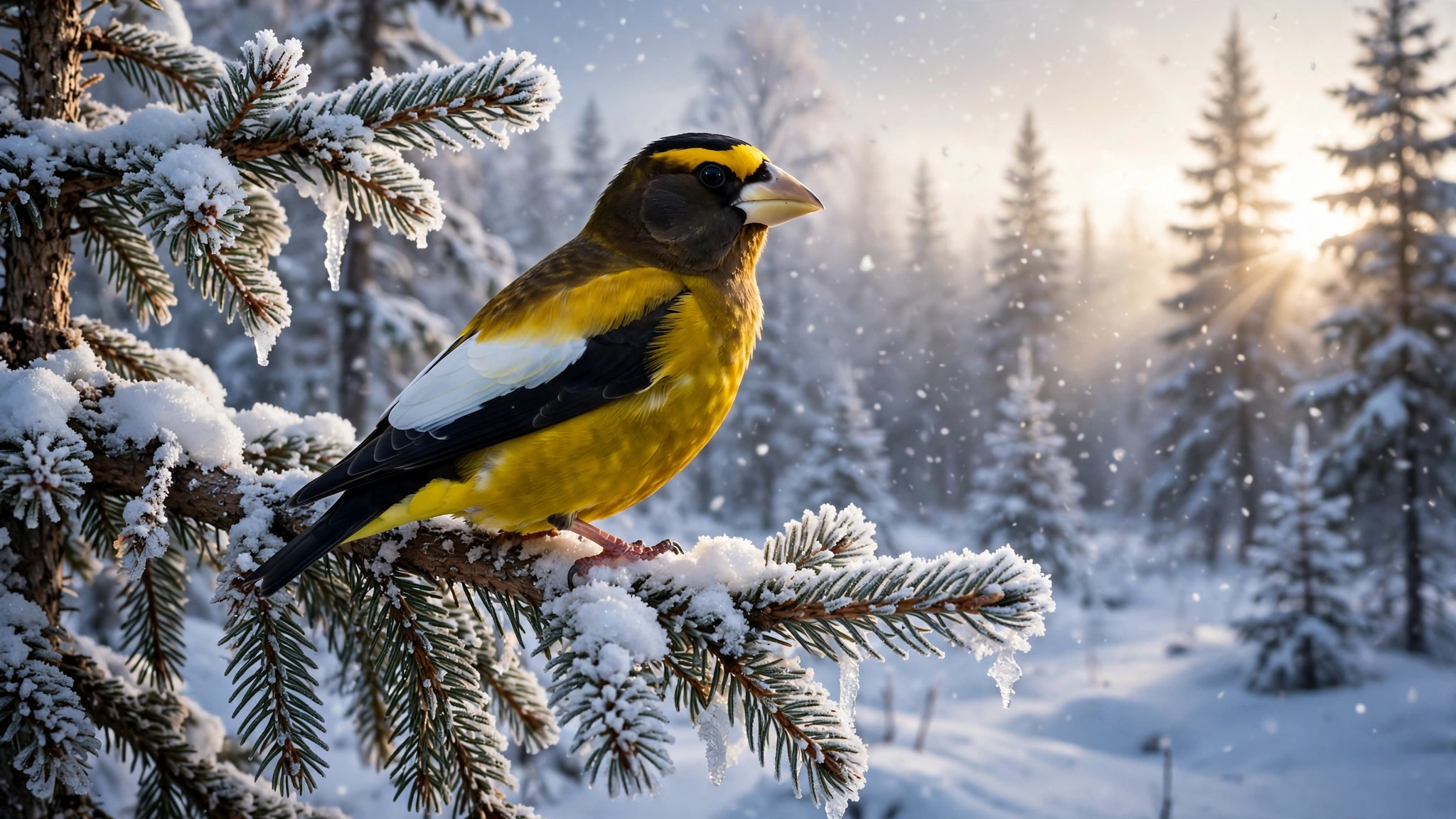
Some birds announce themselves with song. The Evening Grosbeak announces itself with spectacle. One cold morning a flock descends on a backyard feeder, flashing yellow, black, and white, cracking sunflower seeds like popcorn, and the whole street stops to watch. For decades those mornings were common across much of North America. Then, quietly, they stopped happening.
The Evening Grosbeak has declined by 83 percent since the 1970s, according to the Breeding Bird Survey figures cited by Birds Canada. That is why Birds Canada chose this vanishing winter showstopper as its 2026 Avian Ambassador, a designation meant to rally attention, research, and habitat protection for one of the continent’s most dramatic finches. And the timing could not be better: irruption activity is picking up, and the 2026-27 winter finch season is giving birders fresh chances to see them.
This guide covers everything you need to know: how to identify males and females, why their fate is tied to a forest caterpillar, where to look for them this winter, and exactly how to set up a feeder that might bring them to your own yard.
Why the Evening Grosbeak Is the 2026 Bird of the Year
In February 2026, Birds Canada named the Evening Grosbeak its 2026 Avian Ambassador, an annual spotlight the organization gives to one species each year to drive public awareness and conservation. The choice was no accident: the species is both wildly charismatic and seriously troubled.
Evening Grosbeaks are widely distributed in Canada, occurring as far west as the Pacific Coast, north to the Yukon border, and east to the Atlantic Coast, according to Birds Canada’s announcement. Yet for much of the last few decades, their winter incursions into populated areas have grown rarer, sometimes arriving only every two, five, or even ten years. Many birders describe it as a sense of loss, like being robbed of something special that used to show up for free.
The ambassador designation aims to turn that loss into action. It encourages backyard birders to report sightings, support boreal forest conservation, and learn the ecology behind the bird’s boom-and-bust cycles. When a species is this eye-catching, attention itself becomes a conservation tool.
Evening Grosbeak Identification: Male vs Female
The Evening Grosbeak is a robin-sized finch, roughly 7 to 8 inches long, with a chunky body and a bill so large it looks almost oversized. That bill, thick, conical, and pale greenish-yellow, is the first thing to look for. No other North American finch combines that bill with this color scheme.
Learning the difference between the sexes matters because females are far easier to overlook. Here is how to sort them out.
The Male: Yellow, Black, and White
The adult male is impossible to mistake once seen well. His head is black with a bold yellow stripe sweeping above and behind the eye like a racing stripe. His body glows golden-yellow, and his black wings carry a large, bright white patch that flashes in flight.
In winter light the male can look almost tropical, an effect that catches new birders completely off guard. The contrast of black, gold, and white is unique among North American finches. If you see that pattern, you have your bird.
The Female: Subtle but Distinctive
The female trades the male’s blazing gold for a much quieter palette of grayish-brown with a soft yellowish-green wash on the neck and sides. Her wings are black and white with streaky, mottled patterning rather than the male’s clean blocks of color.
She shares the male’s massive pale bill, and that is the key field mark that separates her from look-alikes such as female Pine Grosbeaks or large sparrows. Look for the bill first, the wing pattern second, and the faint yellow tinge third, and you will not confuse her.
Young Birds and Seasonal Variation
Juvenile Evening Grosbeaks resemble the adult female, so a grayish young bird with a huge pale bill in late summer is worth a second look. By fall, young males begin to show hints of yellow on the body and the darkening head pattern. Plumage changes little between seasons, so winter birds look essentially like summer birds, just often seen in flocks rather than pairs.

Size, Shape, and Field Marks at a Glance
Evening Grosbeaks are big, bold, and noisy, but they can be confused with a few other large finches at a quick glance. This comparison table sorts out the most common mix-ups.
| Feature | Evening Grosbeak | Pine Grosbeak | Rose-breasted Grosbeak |
|---|---|---|---|
| Length | 7 to 8 inches | 8 to 10 inches | 7 to 8.5 inches |
| Male plumage | Golden-yellow body, black head with yellow eyebrow stripe, black-and-white wings | Rosy red body and head, gray wings with white wing bars | Black head and back, white belly, rose-red breast patch |
| Female plumage | Gray-brown with yellowish wash, black-and-white streaked wings | Gray with yellowish-olive head and rump | Brown streaked, buffy eyebrow stripe, no red |
| Bill | Huge, pale greenish-yellow, conical | Large, dark, hooked | Large, pale pinkish, conical |
| Typical season | Winter irruptions at feeders | Winter irruptions at feeders | Spring and summer migrant |
| Call note | Harsh, ringing “cha-chur” | Musical whistled phrases | Squeaky, robin-like “chink” |
The single fastest way to confirm an Evening Grosbeak is the combination of the giant pale bill and the white wing patch. No other bird in the backyard puts those two marks together. If you are still sorting out finch identification in general, our guide on House Finch vs Purple Finch identification is a good next read, since those two species confuse far more birders than the grosbeaks ever will.
The Spruce Budworm Connection: Why They Came and Went
The Evening Grosbeak’s story is really the story of a caterpillar. During outbreaks of the spruce budworm, a moth larva that defoliates spruce and fir, grosbeaks gorge on the pupae and larvae, which researchers report can make up the overwhelming majority of their food intake in outbreak years. Outbreaks are linked to summer and winter minimum temperatures and to forest composition, especially the presence of balsam fir and white spruce.
When budworm numbers crash, the grosbeaks lose their protein-rich nursery food. Breeding success falls, and the population contracts. This is the leading explanation for the historic boom of the mid-20th century, when huge budworm outbreaks across the boreal forest fueled an Evening Grosbeak population explosion, and for the long bust that followed as outbreaks subsided. Birds that once bred in northern New England and eastern Canada retreated, and winter flocks thinned to a trickle.
Modern forestry practices and a changing climate have altered budworm dynamics further, and researchers continue to study how these shifts affect the birds. What is clear is that the grosbeak is a forest bird first and a feeder bird second: its fate is written in the boreal canopy, not at our feeders.
Where Evening Grosbeaks Live: Range and Habitat
Evening Grosbeaks breed in coniferous and mixed forests across the boreal zone, from the Pacific Coast through the Canadian interior to the Atlantic provinces, reaching north toward the Yukon border. They favor forests rich in white spruce and balsam fir, the same trees that host their beloved budworm, and they build open cup nests high in conifers.
In winter they become wanderers. Rather than migrating on a fixed schedule, they irrupt: when northern food crops fail, whole flocks spill southward into the Great Lakes region, the Northeast, and sometimes much farther. When food is abundant up north, they may barely appear at all. That unpredictability is part of their mystique, and part of why a sighting feels like winning a small lottery.
Listen before you look. Flocks announce themselves with loud, harsh, ringing calls that carry a long way through winter woods. Scan the tops of conifers and the edges of clearings, and check any feeder station with sunflower seed, because a grosbeak flock rarely stays silent for long.

The 2026-27 Winter Finch Forecast: Where Are They Headed?
The annual Winter Finch Forecast from the Finch Research Network is the closest thing birders have to a weather report for irruptive species, and the 2026-27 edition carries encouraging news for Evening Grosbeak fans. The eastern spruce budworm outbreak has now persisted in many areas for a decade or more, and the forecast notes that this budworm-loving finch has increased locally as a result, with parents raising families successfully on the abundant food.
Post-budworm foods are a mixed bag this year. Cherry species, which the birds turn to after the budworm season, are poor in many areas, but the mountain-ash crop is good, and the forecast expects mountain-ash berries to hold up some Evening Grosbeaks through the winter, along with Purple Finches and most Pine Grosbeaks. The result is shaping up as a mixed flight year rather than a massive all-out irruption: real chances for feeder visitors across the Great Lakes and the Northeast, but not the continent-wide invasion of legend.
What does that mean for you? Keep feeders stocked from late fall through early spring, learn the flight call, and report what you see. Irruption years are when citizen science data matters most, and this winter is setting up to be worth watching. For a deeper explainer on how these boom-and-bust movements work, see our winter finch irruption guide.
How to Attract Evening Grosbeaks to Your Feeder
You cannot summon an irruption, but you can make your yard the place grosbeaks choose when they pass through. The formula is simple: the right seed, the right feeder, and patience. Evening Grosbeaks are flock birds, so when one finds your setup, a dozen may follow within days.
The Right Feeder
Platform feeders are the gold standard for Evening Grosbeaks. These big, social birds like to land in groups and feed side by side, and a roomy tray gives them the space they want. Large hopper feeders work well too. Tube feeders are less ideal because the birds cannot comfortably cluster on small perches.
Place the feeder near conifer cover so nervous newcomers have a quick escape route. Keep it clean, because a flock of grosbeaks goes through seed fast and wet, moldy seed can harbor disease. A ground tray underneath catches spillover and is often where the shyer birds feed.
The Right Seed
Black-oil sunflower seed is the undisputed favorite. Its thin shells suit the grosbeak’s crushing bill perfectly, and birds in the 2026-27 forecast region are expected to hit sunflower hard at feeders. Striped sunflower is a second choice, while safflower and millet are generally ignored. Suet and peanuts may draw a curious bird or two, but sunflower is what holds a flock.
Offer seed consistently once cold weather arrives, since irruptive birds scout widely and remember reliable stops. Fresh water helps too: a heated birdbath in freezing weather is a powerful magnet for every winter bird, grosbeaks included. Our detailed sunflower seed guide breaks down which seed types suit which backyard birds.

Evening Grosbeak Sounds: What to Listen For
The Evening Grosbeak’s name comes from early accounts suggesting the birds sang mostly in the evening, though modern birders hear them at all hours. What you will actually hear is less a song and more a broadcast: a loud, harsh, descending “cha-chur” or “clee-ip” call, often given in bursts as the flock moves.
A feeding flock sounds like a small, argumentative crowd, with constant chatter, sharp contact notes, and the audible crunch of seeds being cracked. In flight the calls ring out well ahead of the birds, so hearing them first is the norm. Learn that descending trill and you will detect grosbeaks long before you see them, which is exactly how most irruption sightings begin.
Conservation Outlook: A Comeback Story in Progress?
The long view is sobering: an 83 percent decline since the 1970s puts the Evening Grosbeak among North America’s steepest songbird losses. But the short view offers genuine hope. The persistent eastern budworm outbreak has allowed local populations to rebound, breeding success has improved, and the current irruption across central and eastern Canada shows the species can still move in force when conditions align.
Conservationists point to a clear to-do list. Protecting large tracts of boreal forest, especially spruce-fir stands, safeguards both the budworm cycle and the birds that depend on it. Reducing window collisions, keeping cats indoors, and maintaining clean feeders all cut the everyday mortality that hits flocking species hard. And every eBird checklist with a grosbeak on it sharpens the population data that drives policy.
The 2026 Avian Ambassador spotlight is part of that strategy: a famous, photogenic bird drawing eyes and funding toward the forest it needs. Whether this becomes a true comeback depends on the boreal forest’s future, but for now the trend lines, and the feeders, are moving in the right direction.
Evening Grosbeak FAQs
Are Evening Grosbeaks related to Rose-breasted Grosbeaks?
Only distantly. Despite the shared name, they belong to different branches of the finch and cardinal families. The Evening Grosbeak is a true finch of the boreal forest, while the Rose-breasted Grosbeak is a cardinal-family bird of eastern deciduous woods. The “grosbeak” in both names simply describes the big bill.
Why are they called Evening Grosbeaks?
Early naturalists believed the birds sang mainly in the evening, and the name stuck. Modern observation shows they vocalize throughout the day, especially when feeding in flocks. It is one of birding’s charming misnomers, like the nighthawk, which is neither a hawk nor strictly nocturnal.
What do Evening Grosbeaks eat besides sunflower seeds?
In the wild they eat spruce budworm larvae and pupae, box elder and maple seeds, ash seeds, mountain-ash berries, and cherry pits. At feeders they strongly prefer black-oil sunflower seeds but will sample peanuts and suet. In spring they have even been seen sipping maple sap.
How big is an Evening Grosbeak?
About 7 to 8 inches long with a wingspan near 13 inches, roughly the size of an American Robin but noticeably stockier. They are among the largest finches in North America, second in bulk to the Pine Grosbeak in most comparisons.
When is the best time to see Evening Grosbeaks?
Late fall through early spring during irruption years, with December through February often the peak window at feeders. Mornings are best, when flocks move from roosts to feeding areas. In non-irruption years they may be absent entirely from southern areas, which is why the 2026-27 forecast is worth following.
Do Evening Grosbeaks migrate or irrupt?
They irrupt rather than migrate on a fixed route. Movements are driven by food availability, especially budworm numbers and winter seed and berry crops. In good food years many birds stay north; when crops fail, flocks push south into the Great Lakes, the Northeast, and beyond.
Are Evening Grosbeaks endangered?
They are not currently listed as endangered, but the scale of the decline is alarming: 83 percent lost since the 1970s per Breeding Bird Survey data. Conservation groups treat the species as a high-priority concern, which is exactly why Birds Canada made it the 2026 Avian Ambassador.
How can I help Evening Grosbeaks?
Report sightings to eBird or Project FeederWatch, keep feeders clean and stocked with black-oil sunflower in winter, make windows bird-safe, and support boreal forest conservation. If a flock visits your yard, enjoy it, document it, and share the sighting: every data point helps researchers track this unpredictable species.





