 Skip to content

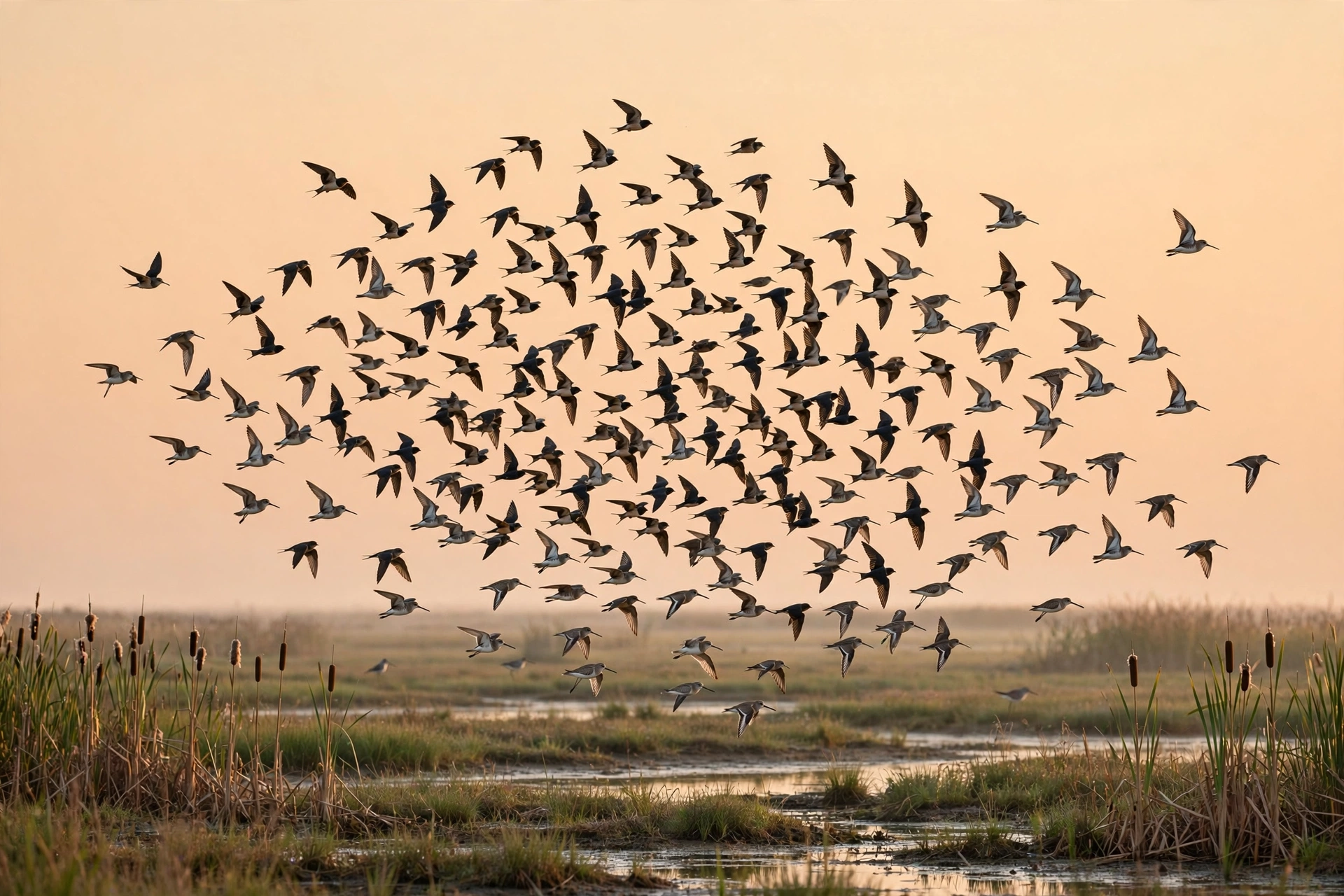
Stand outside this October and you might hear them: faint chips and calls raining down from the darkness overhead. Millions of birds are on the move right now, riding the autumn cold fronts south, and the season is at its very peak. October Big Day just passed, the single biggest day of the fall birding calendar.
It is easy to look up and wonder a simple question: how long does bird migration take? The answer is one of the most surprising facts in birding. Some birds finish their entire migration in a single night. Others take two full months, stopping to rest and refuel along the way. And a few champions cross whole oceans without stopping once.
This guide breaks migration down into its true shape: a timeline of night flights, stopover days, and record-breaking journeys. You will learn how long each type of trip really lasts, what makes one migration take weeks and another only hours, and which species hold the records. For the geography side, our companion guide explains how far birds travel on migration.
The Short Answer: Hours to Months
There is no single migration time, because birds migrate in completely different ways. But every migration falls somewhere on a spectrum that looks roughly like this:
- Hours: some songbirds finish short hops between nearby stopovers in a single night, and ruby-throated hummingbirds cross the Gulf of Mexico in about 18 to 22 hours nonstop.
- Days: hardy shorebirds like the bar-tailed godwit fly across entire oceans for 8 to 11 days without landing, the longest known nonstop flights in the bird world.
- Weeks: most North American songbirds complete fall migration in roughly 2 to 6 weeks, flying at night and resting by day.
- Months: some arctic terns and other long-haul species spread their journey over many weeks or months, with long stopovers that can last several weeks each.
Notice the pattern. Short-distance migrants are done quickly. Long-distance specialists either sprint across barriers in astonishing single flights or take the slow road with generous rest stops. Both strategies work, and each is tuned to the bird’s body, route, and fuel supply.
The Night Shift: How Most Songbirds Actually Travel
Here is the first surprise for many birders: most songbirds migrate at night. Warblers, thrushes, sparrows, and vireos lift off roughly 30 to 45 minutes after local sunset and fly through the cool, stable air of darkness. Cool night air helps them avoid overheating and dehydration, and darkness lowers the risk from daytime predators.
This night schedule shapes the whole timetable. A typical songbird flies one night, covering tens to hundreds of kilometres depending on winds and its fuel load, then lands just before dawn in habitat it has never seen. It then spends the daylight hours resting and feeding hard, rebuilding the fat reserves it burned overnight. Research using weather radar shows birds lifting off from stopover sites shortly after sunset, with the highest numbers of birds aloft in the first half of the night.
Night migration also explains one of the great spectacles of fall. Systems like BirdCast, which tracks nocturnal migration with weather radar, reveal nights when hundreds of millions of birds move across the continent, all invisible to us except as blips on a screen. That is the traffic behind the calls you hear on an October evening.
Why Stopovers Dominate the Calendar
Flight time is only a fraction of most migrations. The real calendar of a songbird’s journey is dominated by stopovers: the days, and sometimes weeks, spent resting and refuelling between flight nights.
At a stopover, a bird’s job is simple but urgent. It must find rich food quickly, in unfamiliar habitat, while dodging local predators. Some birds stop only a single day before continuing. Others linger for a week or more, particularly if the weather is bad or their fat reserves are low. One study of European songbirds crossing the Sahara found birds spending about a month at a pre-desert staging site, fattening up before the barrier, because no food would be available beyond it.
This is why migration takes weeks for most songbirds. The flights themselves are fast. The feeding between flights is slow, and it is where the calendar is spent. Protecting stopover habitat matters enormously, because a bird that arrives at a rich stopover can refuel in days, while one that finds only poor habitat may be stuck for weeks. Recent radar-based research has mapped millions of hectares of key stopover hotspots across the eastern United States, work reported by Phys.org, giving conservationists their first accurate picture of where migrating land birds rest.

How Fast Do Migrating Birds Actually Fly?
Speed is only half of the duration story, but it is worth knowing, because birds are faster than most people expect:
- Typical songbirds: roughly 30 to 50 kilometres per hour in still air.
- Waterfowl and shorebirds: roughly 50 to 80 kilometres per hour.
- Bar-tailed godwits: averaged about 56 kilometres per hour on their Pacific crossing, aided by strong tailwinds.
Wind is the great modifier. A strong tailwind can add dramatically to a bird’s ground speed, while a headwind can slow it to a crawl. This is one reason migration timing varies so much year to year. Birds that catch good winds arrive early. Birds that fight headwinds, or wait out storms, arrive late. Autumn cold fronts with clearing skies and northerly winds behind them are the triggers that launch the biggest migration nights of the fall.
Altitude matters too. Most night-migrating songbirds fly below 2,000 feet, though some climb higher to catch favourable winds. Geese and ducks fly higher, and some species have been recorded at extraordinary heights when crossing mountain ranges.

Record Journeys: The Marathon Champions
Now for the champions. These are the birds that compressed journeys of weeks into single, staggering flights, and they reset what scientists thought possible.
The bar-tailed godwit: 8 to 11 days without stopping
The bar-tailed godwit holds the record for the longest nonstop flight ever documented in a bird. In 2007, researchers fitted satellite transmitters to godwits in Alaska and tracked one female, nicknamed E7, as she flew 11,680 kilometres from western Alaska to New Zealand. She landed after just over eight days, without food, water, or rest.
E7’s record has since been broken twice by birds of the same species. In 2020, a male godwit tagged 4BBRW flew more than 12,000 kilometres from Alaska to New Zealand in 11 days. In 2022, a juvenile just five months old, tagged 234684, flew more than 13,500 kilometres from Alaska to Tasmania in 11 days and one hour. Before these flights, the godwits shrink their digestive organs to almost nothing and load fat until it makes up more than half their body weight.
The ruby-throated hummingbird: a night and a day over water
At the other end of the size scale, the ruby-throated hummingbird weighs about 3 grams, less than a nickel, yet many individuals cross the Gulf of Mexico in a single nonstop flight of up to 800 kilometres. The USDA Forest Service reports this crossing takes 18 to 22 hours under favourable conditions, with no rest, food, or water. Before departure, the birds nearly double their body weight through intensive feeding. Not every hummingbird takes the Gulf route, some fly the longer coastal path, but those that cross the water are done before the second sunrise.
The arctic tern: the long way round
Not all records are about speed. Arctic terns undertake the longest known total migrations of any bird, with some populations covering tens of thousands of kilometres each year between Arctic breeding grounds and Antarctic waters. They do it the slow way, with long stopover periods lasting several weeks, so the full journey stretches across months. Duration and distance both sit at the extreme, but they are separate records, and the terns win the calendar.
The Champions Compared
This table puts the main strategies side by side. Notice that duration and distance do not move together, which is exactly why the two deserve separate guides.
| Species | Typical Distance | Typical Duration | Flight Strategy |
|---|---|---|---|
| Bar-tailed godwit | Up to 13,500 km (nonstop record) | 8 to 11 days, one flight | Single nonstop ocean crossing, organs shrink, fat over half of body weight |
| Ruby-throated hummingbird | Up to ~800 km (Gulf crossing) | 18 to 22 hours, one flight | Single nonstop water crossing after doubling body weight |
| Arctic tern | Tens of thousands of km per year | Weeks to months | Long hops with multi-week stopovers |
| Typical songbird (warbler, thrush) | 2,000 to 5,000 km | 2 to 6 weeks | Night flights with daytime stopovers |
| Short-distance migrant (robin, blackbird) | A few hundred km | Days to a few weeks | Short hops, brief stopovers |

What Makes One Migration Longer Than Another
Four factors stretch or compress the migration calendar more than any others:
- Weather: storms can ground birds for days, while cold fronts with tailwinds launch the fastest, busiest nights of the season.
- Barriers: open water and deserts cannot be crossed in hops, so birds either wait until they are fully fuelled or, like godwits and hummingbirds, cross in one push.
- Body condition: a fat, healthy bird refuels quickly and leaves sooner. A lean bird may spend extra days feeding at every stopover.
- Experience: older, more experienced birds generally depart earlier and migrate more efficiently than young birds making their first journey.
Navigation skill plays a supporting role. Birds that can read the stars, the sun, and the Earth’s magnetic field hold their course in poor visibility and waste less time being blown off track. Our guide on how birds navigate migration explains those internal compasses in detail.
The deepest driver of all, though, is purpose. Birds migrate because the payoff at the destination is worth the cost of the journey, richer food, safer breeding grounds, a climate they can survive. That logic, the why behind the schedule, is covered in our guide on why birds migrate.
Frequently Asked Questions
Do birds fly nonstop during migration?
Most do not. The great majority of songbirds fly in nightly hops and rest by day, so their migration is mostly stopover time. Only a few specialists, like bar-tailed godwits, hummingbirds crossing the Gulf, and some seabirds, make long nonstop flights. Even among these champions, nonstop flying is the exception, not the rule.
How long does it take a hummingbird to migrate?
The Gulf crossing itself takes about 18 to 22 hours nonstop. But the full fall migration of a ruby-throated hummingbird, from northern breeding grounds to wintering areas in Mexico and Central America, takes several weeks, because birds spend days or weeks feeding and fattening up before the crossing and stopping along the way.
Do all birds migrate at night?
No. Most songbirds are night migrants, but raptors, swallows, and cranes migrate by day, often riding thermals and updrafts. Shorebirds and waterfowl fly both day and night. The night-shift habit is a songbird strategy for cool, stable air and freedom to feed during the day.
How long does fall migration last overall?
As a season, fall migration in North America runs roughly from August through November, with different species peaking at different times. The migration of any single bird, though, typically lasts from a few days to about six weeks, depending on species, route, and conditions.
Can bad weather really delay migration?
Yes, substantially. Headwinds, storms, and heavy rain can keep birds grounded for days at a time, while favourable winds can cut flight times dramatically. This is why migration arrival dates vary from year to year, and why a big cold front can trigger one of the season’s heaviest migration nights.
Conclusion
Bird migration takes anywhere from a single night to several months, and the true answer depends on the bird’s strategy. Night-flying songbirds measure their journeys in weeks, most of them spent feeding at stopovers rather than flying. Godwits and hummingbirds measure theirs in hours and days, compressing ocean and gulf crossings into single, astonishing flights. Arctic terns measure theirs in months, the longest calendar in the bird world.
The key insight is that flying is only part of the story. For most migrants, the journey is won or lost on the ground, in the quality of stopover habitat and the fat built before each departure. So the next time you hear faint calls from the October darkness, picture the timetable behind them: a warbler resting until sunset, a godwit days into an ocean crossing, a hummingbird fuelling up for one big night over the Gulf. Each is on its own schedule, and each schedule is a marvel of timing.




