Skip to content

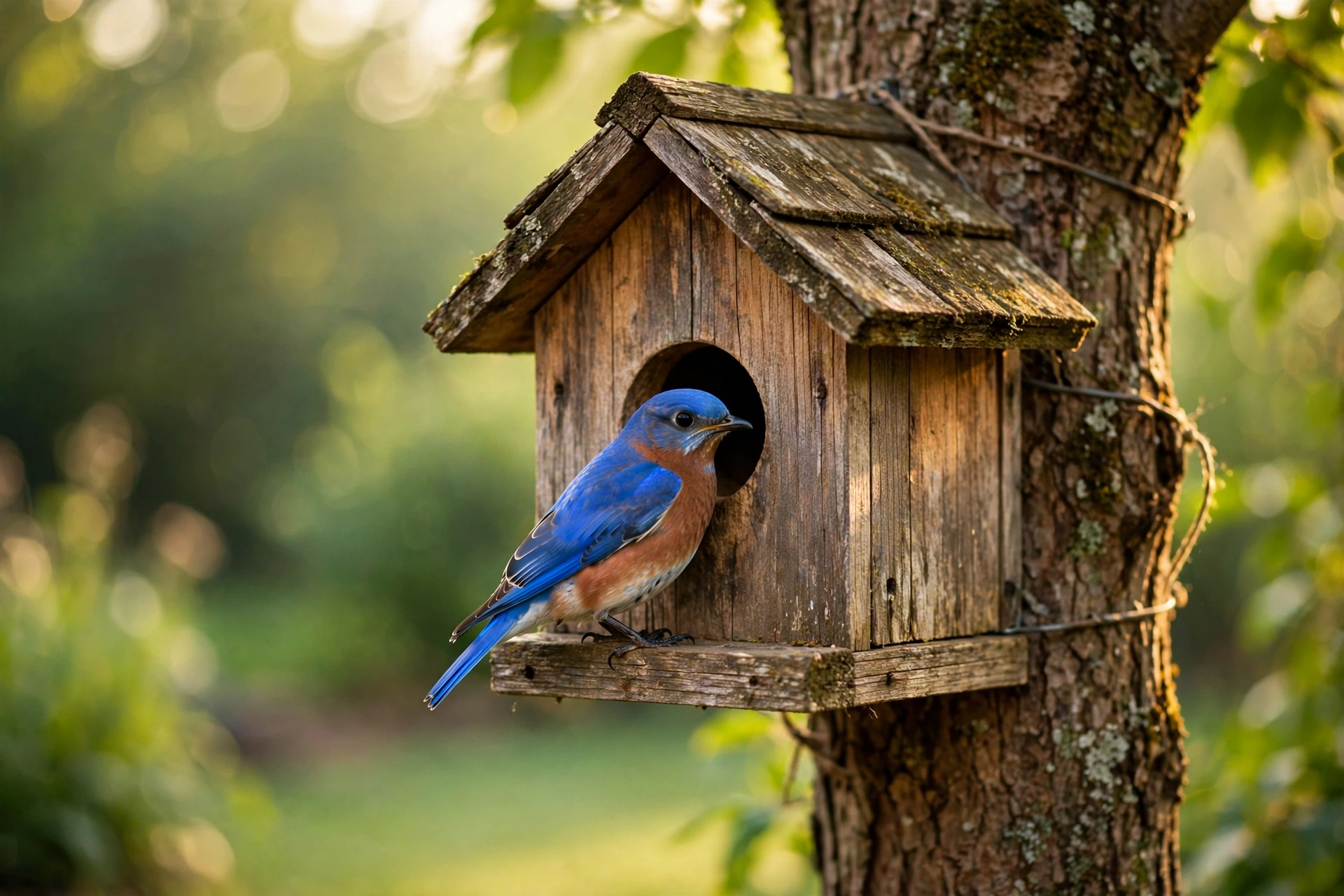
Building or buying a birdhouse feels like a simple project. Pick a nice design, hang it on a post, and wait for tenants. But one measurement decides which birds can actually move in: the diameter of the entrance hole.
Drill it too small, and your target bird cannot squeeze through. Drill it too big, and house sparrows, starlings, or predators will claim the box first. Decades of nest box research, from Cornell’s NestWatch program to state wildlife agencies, have worked out exactly which hole size suits which species.
If you are in a hurry, here is the short version of this birdhouse hole size chart:
- Chickadees and house wrens: 1.125 to 1.25 inches
- Bluebirds, tree swallows, and titmice: 1.5 inches (titmice do fine at 1.25)
- Purple martins: 2.125 inches, or a crescent starling-resistant entrance
- Flickers: 2.5 inches
- Wood ducks, screech-owls, and kestrels: 3 inches
Keep reading for the full chart, the reasoning behind each number, and practical tips for drilling, enlarging, or reducing an entrance hole.
Why the Entrance Hole Size Matters So Much
Think of the entrance hole as a filter, not just a door. Every extra eighth of an inch admits a wider cast of birds, and some of those guests are ones you would rather keep out.
House sparrows are the classic troublemakers. These non-native birds harass native songbirds and take over their boxes. They prefer wider openings, which is why many bluebird landlords fit 1.25-inch hole reducers on chickadee and titmouse boxes. A snug hole keeps the bullies out and the intended tenants in.
European starlings are another problem. A starling needs roughly 1.5 inches to enter a box, so small-box designs with 1.125 or 1.25-inch holes exclude them automatically. Purple martin housing needs a smarter solution, since martins themselves need a 2.125-inch opening, which brings us to crescent-shaped starling-resistant entrances later in this guide.
Predators read the same numbers. A hole sized exactly for your target species denies easy access to jays, grackles, and squirrels, all of which chew or reach through oversized entrances. Metal hole guards add a second layer of defense, but the correct diameter is always the first one.
The Master Birdhouse Hole Size Chart
This chart brings the key dimensions together in one place: entrance diameter, the distance from the box floor to the bottom of the hole, and the interior floor size. Measurements come from Cornell NestWatch plans and state wildlife agency guidelines, and small variations between sources are normal.
| Species | Entrance Diameter | Floor to Hole | Box Floor Size |
|---|---|---|---|
| House Wren | 1 in | 5-6 in | 4 x 4 in |
| Carolina Wren | 1.375 in | 5 in | 4 x 4 in |
| Chickadee (all species) | 1.125 in | 6-7 in | 4 x 4 in |
| Tufted Titmouse | 1.25 in | 6-7 in | 4 x 4 in |
| White-breasted Nuthatch | 1.25 in | 6-7 in | 4 x 4 in |
| Downy Woodpecker | 1.25 in | 7 in | 4 x 4 in |
| Eastern / Western Bluebird | 1.5 in | 6-8 in | 5 x 5 in |
| Tree Swallow | 1.5 in | 5 in | 5 x 5 in |
| Hairy Woodpecker | 1.5-2 in | 10 in | 6 x 6 in |
| Great Crested Flycatcher | 1.75-2 in | 6-10 in | 6 x 6 in |
| Purple Martin | 2.125 in round, or crescent SREH | 1-2 in | 6 x 6 in per compartment |
| Northern Flicker | 2.5 in | 14-16 in | 7 x 7 in |
| American Kestrel | 3 in | 12-14 in | 8 x 8 in |
| Eastern Screech-Owl | 3 in | 12-14 in | 8 x 8 in |
| Wood Duck | 3 x 4 in oval | 16-18 in | 10 x 12 in |
Bookmark this chart before you start drilling. A few minutes with a ruler beats rebuilding a box that the wrong birds moved into.
Species-by-Species Notes
The chart above gives you numbers. This section gives you context: why each species gets its number, and the quirks worth knowing before you build.
Tiny cavity nesters: wrens, chickadees, and titmice
House wrens are the smallest regular birdhouse users in most backyards, and a 1-inch entrance is all they need. Anything larger invites house sparrows, which can squeeze through wider holes and evict wrens from their nests.
Chickadees, including black-capped, mountain, and chestnut-backed species, are standardized at 1.125 inches in Cornell NestWatch plans. That exact size is famous among bird landlords because it admits chickadees while excluding almost everything else, including house sparrows.
Tufted titmice and white-breasted nuthatches take a 1.25-inch hole. These birds are slightly larger than chickadees and share the same small-box dimensions. A 1.25-inch reducer over a 1.5-inch hole is a common trick for converting a bluebird box into a titmouse or nuthatch box.
Mid-size songbirds: bluebirds, swallows, and flycatchers
Eastern and western bluebirds are the poster birds of the nest box world, and their standard entrance is 1.5 inches. Mountain bluebirds sometimes get 1.5625 inches (1 and 9/16), but 1.5 works for them too. A bluebird box is also the right size for tree swallows, which is why experienced landlords often mount two boxes about 15 to 20 feet apart: one for the bluebirds, one for the swallows.
Tree swallows use the same 1.5-inch hole but prefer the hole closer to the floor, about 5 inches up, since their nests are shallow cups of grass and feathers. Adding shallow grooves or a strip of hardware cloth inside the front panel gives nestlings a ladder to climb out at fledging time.
Great crested flycatchers need a bigger box and a 1.75 to 2-inch entrance. They nest later in the season than bluebirds, so a flycatcher-sized box put up in May can still attract tenants after the bluebird rush has settled.
Bigger cavity nesters: woodpeckers, martins, and flickers
Downy woodpeckers fit a 1.25-inch hole in a small box filled with wood chips, since they excavate their own cavity feel by digging into the chips. Hairy woodpeckers need 1.5 to 2 inches and a 6 x 6 inch floor. If you want to welcome woodpeckers generally, read our guide on how to attract woodpeckers to your yard for habitat tips beyond the box itself.
Purple martins are a special case. Their traditional entrance is a 2.125-inch round hole, but round holes admit European starlings, which destroy martin eggs and kill nestlings. Modern martin housing uses crescent-shaped starling-resistant entrance holes (SREH), typically 2.125 inches wide and 1.375 inches tall. Martins learn to enter the crescent shape easily, while starlings cannot fit through it.
Northern flickers need a 2.5-inch entrance in a deep box, with the hole 14 to 16 inches above the floor. The depth matters: flicker nestlings climb the rough interior walls to reach the entrance at fledging time, so leave the inside front panel unplaned or add horizontal grooves.
Large boxes: owls, kestrels, and wood ducks
Eastern screech-owls and American kestrels both use a 3-inch round entrance in an 8 x 8 inch box. These are nocturnal and crepuscular hunters that appreciate a box mounted 10 to 30 feet up at a woodland edge. Add 3 inches of wood shavings to the floor, since neither species builds a nest.
Wood ducks need the biggest common backyard box: a 3 x 4 inch oval entrance, set 16 to 18 inches above the floor in a 10 x 12 inch box. The oval shape suits the duck’s body, and the deep box keeps the ducklings safe until jump day, when they climb to the entrance and leap to the ground. Mount wood duck boxes near water, 6 to 20 feet up, with a predator baffle on the post.

How to Measure and Drill the Entrance Hole
Accuracy matters more than fancy tools. A hole that is an eighth of an inch too large can admit a species you meant to exclude, so measure twice and drill once.
Start by marking the center of the hole on the front panel. Measure from the inside floor of the box up to the bottom edge of the hole, using the floor-to-hole distances in the chart above. Marking from the floor, rather than from the top of the panel, keeps the depth consistent no matter how tall you cut the front board.
For round holes, use a spade bit, Forstner bit, or hole saw matched to the target diameter. A Forstner bit gives the cleanest edge in softwood like cedar or pine. Drill from the outside face in, and place a scrap board behind the panel to prevent splintering on the exit side.
For oval entrances, such as the 3 x 4 inch wood duck hole, drill two overlapping round holes and clean the shape with a rasp or jigsaw. Sand every edge smooth. Rough edges can injure birds squeezing through, and splinters catch feathers.
After drilling, double-check the finished diameter with a tape measure or calipers, not the bit label. Bits wear, wood compresses, and the number on the shank is a promise, not a measurement.
Enlarging or Reducing an Entrance Hole
Made a hole too big, or want one box to serve different species in different years? You do not need to rebuild the box. Metal hole guards and reducers solve both problems.
Hole guards are metal plates, usually copper or aluminum, that screw over the entrance. They come in standard diameters from 1.125 to 1.5 inches. Their first job is predator defense: squirrels and woodpeckers chew wooden holes larger, and a metal ring stops that cold. Their second job is resizing: a 1.25-inch guard over a 1.5-inch hole converts a bluebird box into a chickadee or titmouse box in seconds.
To enlarge a hole that is too small, clamp the front panel firmly and step up one bit size at a time. Never try to widen a hole with the box assembled and occupied. Do this work in the off season, when no birds are nesting, and remember that disturbing an active nest is illegal under the Migratory Bird Treaty Act.
One caution about reducing: a reducer only works if it is centered and firmly attached. A loose plate rattles, admits rain behind it, and can trap a bird’s foot. Four small screws, one in each corner, hold it flat and quiet.

Oval and Slot Entrances
Round holes suit most species, but ovals and slots solve specific problems. The wood duck’s 3 x 4 inch oval matches the duck’s broad body and lets ducklings climb out on jump day. Some bluebird landlords use a horizontal slot, 1.375 inches tall by 2.25 inches wide, which bluebirds and tree swallows enter readily while starlings find it awkward.
The purple martin’s crescent entrance is the most engineered shape of all. The crescent SREH, 2.125 inches wide and 1.375 inches tall, is the standard on modern martin gourds and houses because starlings cannot compress their bodies through the low arch. Martins, with practice, slip through without trouble.
If you buy rather than build, check the entrance shape before you hang the box. Many decorative birdhouses sold in gift shops have oversized round holes, perches, and no drainage. They are garden ornaments, not homes. A real nest box has a species-correct entrance, ventilation, drainage, and a way to open it for cleaning.
Hole Height Above the Floor
The distance from the floor to the bottom of the entrance hole is the most overlooked dimension in birdhouse building, and it matters for two reasons: safety and fledging.
A deep hole placement keeps nestlings out of a predator’s reach. A raccoon or cat reaching through the entrance cannot touch chicks huddled 8 or more inches below in a bluebird box, or 14 inches below in a flicker box. Shallow boxes with the hole just above the floor are easy targets.
Depth also has an upper limit set by the nestlings themselves. Young birds must climb the interior wall to reach the entrance at fledging time. That is why plans specify rough, unplaned wood or carved grooves on the inside of the front panel, and why tree swallow boxes keep the hole just 5 inches up: shallow nests, short climb.
Follow the floor-to-hole column in the chart rather than guessing. The numbers look oddly specific because they come from thousands of monitored nests: 6 to 8 inches for bluebirds, 14 to 16 for flickers, 16 to 18 for wood ducks. Evolution tuned these depths, and the plans simply copy them.
The No-Perch Rule
If your birdhouse came with a little wooden dowel under the entrance, remove it. Nesting birds do not need perches. They land directly on the entrance edge and slip inside.
Perches help the wrong visitors. Jays, grackles, and house sparrows use perches as landing platforms to harass the tenants, and predators use them as a brace while reaching into the box. Every major nest box plan, from NestWatch to state wildlife agencies, specifies no perch.
Unscrew the dowel, fill the hole with a dab of exterior wood glue, and sand it flush. Your tenants will never miss it, and your nestlings will be safer for its absence.
Once the young hatch, the box becomes a busy nursery. If you are curious about what the parents are carrying in, see what baby birds eat, and time your box maintenance around nesting season so you never disturb an active nest.

Frequently Asked Questions
What is the most versatile birdhouse hole size?
A 1.5-inch entrance is the most versatile single size. It suits eastern and western bluebirds, tree swallows, house finches, and downy or hairy woodpeckers, covering the most popular backyard tenants in one box. Keep a few 1.25-inch reducers on hand and the same box can serve chickadees and titmice too.
Will a 1.25-inch hole keep house sparrows out of a chickadee box?
A 1.125-inch hole is the safest bet for chickadees and house wrens, since house sparrows struggle to enter openings that small. A 1.25-inch hole discourages sparrows and fully excludes starlings, which is why it is the standard for titmouse and nuthatch boxes. If sparrows are persistent in your area, drop to 1.125 inches and monitor the box.
Can I make a birdhouse entrance hole bigger or smaller?
Yes to both. Enlarge a too-small hole by drilling with the next bit size up, working in the off season when the box is empty. Reduce a too-large hole with a metal hole guard or reducer plate screwed centered over the entrance. Reducers come in 1.125, 1.25, and 1.5-inch sizes and double as chew protection against squirrels.
What size hole do bluebirds need?
Eastern and western bluebirds need a 1.5-inch round entrance, placed 6 to 8 inches above the floor of a 5 x 5 inch box. Mountain bluebirds sometimes get 1.5625 inches, but 1.5 inches works for them as well. Do not go larger: anything above 1.5 inches invites starlings.
What size hole keeps starlings out of a purple martin house?
Use crescent-shaped starling-resistant entrance holes (SREH), 2.125 inches wide and 1.375 inches tall. Martins learn the crescent quickly, while starlings cannot fit through the low arch. Round 2.125-inch holes admit starlings, so the crescent shape is the standard on all modern martin housing.
Should a birdhouse entrance have a perch?
No. Perches are one of the most common birdhouse mistakes. Nesting birds do not need them, and perches give predators and aggressive birds a convenient platform at the entrance. Remove any dowel perch, plug the hole, and sand it smooth.
How far above the floor should the entrance hole be?
It depends on the species: 5 to 7 inches for wrens, chickadees, titmice, and swallows; 6 to 8 inches for bluebirds; 14 to 16 inches for flickers; and 16 to 18 inches for wood ducks. Deeper placement protects nestlings from reaching predators, so follow the chart rather than guessing.
Do I need to clean out the birdhouse between seasons?
Yes. Remove old nests after the breeding season ends, typically in late fall, so parasites do not overwinter in the box. Open the box, scrape it out, and rinse with a weak bleach solution if needed. Leave a thin layer of fresh wood shavings in boxes for woodpeckers, owls, and ducks, which do not build their own nests.
Conclusion
The entrance hole is the single most important measurement on any birdhouse. Get the diameter right and the box selects its own tenants, filtering out sparrows, starlings, and predators while welcoming the species you built it for. Get it wrong and even a beautiful box sits empty or, worse, becomes a trap for the wrong birds.
Save this birdhouse hole size chart, measure twice before you drill, and skip the perch. Your future tenants, from the first spring chickadee to a family of wood ducks, will thank you by moving in.
Sources: Cornell Lab of Ornithology NestWatch nest box plans (nestwatch.org); Massachusetts Audubon birdhouse and nesting chart (massaudubon.org); BirdNote on the perfect nest box (loe.org).