 Skip to content

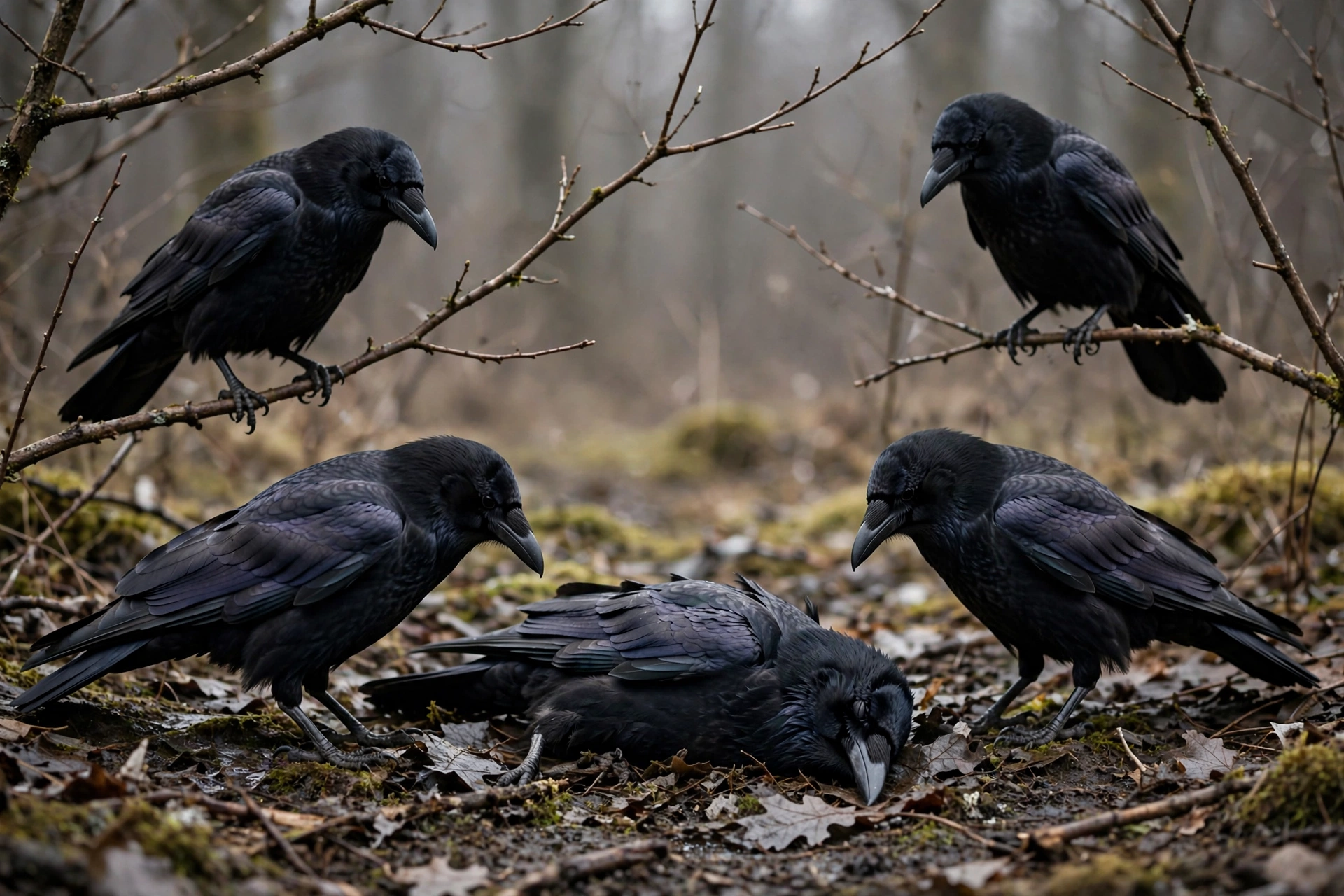
You may have seen it yourself: a crow lies still on a lawn or a footpath, and within minutes black birds drop out of the sky. They perch in a ring, they caw in harsh bursts, and they stare at the body. So do crows hold funerals? The short answer is that they do gather around their dead in a way that looks like a funeral, but scientists say it is more like a crime scene investigation than a memorial service.
The long answer is far more interesting. Researchers at the University of Washington spent years staging crow funerals with taxidermy birds and masks, and what they found rewrites the story. The gathering is not mourning. It is a lesson about danger, taught in real time, remembered for years. This is the science behind one of the strangest behaviours in the bird world.
In this article you will learn what a crow funeral actually looks like, what John Marzluff and Kaeli Swift discovered about danger learning, whether grief plays any part at all, how long these gatherings last, and what to do if you ever witness one yourself.
What Crow “Funerals” Look Like
A crow funeral usually starts with a single bird. One crow spots a dead crow on the ground and does something dramatic: it lands nearby and starts cawing loudly, a harsh scolding call that carries far. Within minutes, other crows arrive. They perch in trees, on fences, on rooftops, all facing the body.
The mood is hard to describe without using human words, but witnesses often call it solemn at first and furious later. Some birds sit in silence and simply look down at the dead bird. Then the noise starts. The crows take turns cawing and flying low over the body, sometimes for many minutes. Very few of them touch the dead bird. Most keep their distance and watch.
If you see a gathering like this, check the bird is actually a crow before you draw conclusions. Ravens are bigger, shaggier, and travel in pairs rather than crowds, so the bird in the middle matters. Our guide to crow vs raven identification will help you tell them apart in seconds.
The Science: How Crows Use Death to Learn About Danger
The person who knows the most about crow funerals is Dr. John Marzluff, a wildlife scientist at the University of Washington, working with his graduate student Kaeli Swift. In the mid-2010s, Swift ran a series of clever experiments across Seattle. She placed a taxidermy crow on the ground, sometimes alone and sometimes next to a person wearing a mask, or next to a stuffed red-tailed hawk, and filmed what the wild crows did.
The results were striking. Wild crows responded to a dead crow almost exactly as they respond to a live predator. They mobbed the scene, scolded loudly, and afterwards avoided food placed in that spot for up to three days. When Swift paired a completely unfamiliar masked volunteer with a dead crow, the crows mobbed the volunteer too. After just one such experience, they learned to recognise and scold that masked person, and the grudge lasted up to six weeks. The full findings were published in the journal Animal Behaviour in 2015 as “Wild American crows gather around their dead to learn about danger,” and the thesis is archived in the University of Washington library.
Here is the detail that makes the study so convincing. Swift also ran the same setup with a dead pigeon, and with a red-tailed hawk on its own. The crows did not treat the dead pigeon as a threat signal at all. A dead member of their own species, though, worked like a warning beacon: danger has been here, learn the faces and the places, and stay sharp. The strongest response of all came from a hawk displayed with a dead crow, the crow equivalent of a predator caught in the act.
Swift and Marzluff followed this up with stranger research in 2018, published in Philosophical Transactions of the Royal Society B. Across hundreds of trials with breeding pairs of crows, they watched what happened when a live crow physically interacted with a dead one. Contact was rare, happening in roughly a quarter of trials. Sexual contact was rarer still, under five percent of the time, and mostly early in the breeding season when hormones run high. It seems that even in crows, death scrambles the instincts. Scientific American covered the oddity in detail.
The Brain Behind the Behaviour: Crows Remember Faces for Years
Crow funerals make much more sense once you know what crow memory can do. In a famous earlier experiment, Marzluff and his team wore masks while trapping crows on the university campus. Years later, researchers wearing the same masks walked the campus and were mobbed and scolded, even by young crows that had never met the original trappers. The 2010 paper in Animal Behaviour documented the lasting recognition, and a follow-up showed the knowledge spreading socially through the flock, like a rumour passed from bird to bird.
Marzluff has even looked inside crow brains. When crows were shown a person holding a dead crow, the hippocampus, the part of the brain involved in learning and memory, lit up. National Geographic reported the finding as part of its coverage of the funeral research. Put simply, a dead crow switches a crow’s brain into learning mode: memorise the place, memorise the faces, and do not forget.
This is why a funeral is so valuable to a crow. A long-lived, social bird cannot afford to learn about every danger the hard way. Watching a dead flockmate and linking it to whatever is nearby is a fast, cheap lesson, and the whole neighbourhood gets the message at once.
Is It Grief, or Something Else?
This is where scientists disagree, and the honest answer is that both things might be true at once. The field that studies how animals respond to death is called thanatology, and its experts are split on crow funerals.
The “something else” camp, led by Swift and Marzluff’s data, says the gathering is risk assessment, not grief. The birds are not crying for their friend. They are asking, in crow terms: what killed it, who was nearby, and should I avoid this spot? Everything in the experiments supports this. The mobbing, the food avoidance, the face learning, and the way a dead pigeon provokes no reaction all point to a practical, survival-driven behaviour.
The “maybe it is a kind of grief” camp points to quieter observations that are harder to test. Crows have been seen sitting silently near a dead bird, nudging it, standing guard over it, and returning to the spot days later. Elephants, dolphins, and chimpanzees show grief-like behaviours too, and they are all, like crows, long-lived and deeply social. Sceptics reply that silence and staring are also exactly what careful observation looks like.
Where does that leave us? The safest reading of the evidence is this: crow funerals are real gatherings with real emotional weight behind them, but their primary function, the reason evolution kept them, is learning about danger. Grief may or may not colour the experience. Science can measure the learning. It cannot yet measure the feeling.
What Crows Actually Do at a Gathering, Step by Step
Not every gathering follows the same script, but wildlife watchers and researchers describe a familiar sequence:
- Discovery: one crow finds the body and begins loud scolding calls, which act as a summons to every crow in earshot.
- Assembly: crows arrive over the next few minutes and take up positions in trees, on wires, and on the ground, forming a loose ring around the body.
- Inspection: birds take turns flying low over the body or hopping closer, stretching their necks to look. Most keep a cautious distance.
- Vocal peak: the calling intensifies as more birds join in, and the noise can be startling if you are standing nearby.
- Settling: the scolding eases into quieter calls, and individual birds begin to drift away.
- Departure: the group breaks up, often all at once, leaving the body where it lay.
Notice what is missing from this list. There is no burial, no touching ceremony, and no lasting vigil in the human sense. The crows investigate, broadcast, learn, and leave.

The Scolding Chorus: Alarm Calls and Mobbing Explained
The loud cawing at a crow funeral is the same machinery crows use for mobbing, their standard response to predators. When a crow finds an owl dozing in a tree or a hawk perched nearby, it calls in reinforcements. Dozens of crows surround the predator, dive at it, and scream until it leaves. The funeral version simply substitutes a dead crow for a live predator as the trigger.
This behaviour has a neat logic. Calling loudly is dangerous, because it reveals your position, but the shared risk buys shared knowledge. Every crow that shows up gets to study the scene. Every crow that hears the call learns that this place, this face, or this situation is linked to death. The crows that scold hardest may be the ones with the most to protect, such as breeding birds guarding a nearby nest.
Interestingly, the funeral call and the mobbing call overlap with another famous crow behaviour: the way crows gang up on roosting owls by day. If that sounds familiar, our deep dive into owl and crow behaviour explains how the two species use daylight and darkness against each other.
How Long Do Crow Funerals Last?
Shorter than you might expect. Most documented gatherings wrap up within minutes to tens of minutes. The assembly is quick because the alarm call travels far, the inspection and scolding phase is intense but brief, and then the birds lose interest and move on. Some gatherings linger closer to an hour, especially when many birds keep arriving in waves, but an all-day vigil is not the norm.
Afterwards, crows avoid the area for a while. Swift’s experiments showed reduced feeding at food placed near the scene for up to three days. In the wild, a flock may give a wide berth to a lawn or a stretch of pavement where a crow died, then gradually resume normal activity as the memory fades.
Do Other Birds Hold Funerals?
Crows are not alone. Magpies, also members of the crow family, have been observed gathering around a dead magpie in similar fashion. Western scrub jays do something comparable: when they find a dead jay, they call loudly and assemble, a behaviour researchers also interpret as danger learning rather than mourning.
Ravens, the crow’s close cousins, show their own intense responses to death, including cautious approaches and alarm calling. But the best-studied case by far remains the American crow, thanks to the Seattle research. What unites these species is a pattern: big-brained, long-lived, social birds treat a dead flockmate as information, not just a loss.

Crow Funerals vs Mobbing vs Roosting: Do Not Mix Them Up
Three different crow gatherings get confused with each other all the time. Here is how to tell them apart at a glance:
| Feature | Crow “funeral” | Mobbing | Night roosting |
|---|---|---|---|
| Trigger | A dead crow | A live predator, such as an owl or hawk | Sundown; safety in numbers |
| Typical size | A handful to a few dozen birds | A few to dozens of birds | Hundreds to tens of thousands |
| Duration | Minutes to tens of minutes | Until the predator leaves | All night, every night in season |
| Sound | Harsh scolding, then quiet | Continuous loud harassment | Noisy settling, then near silence |
| Purpose | Learn about danger | Drive the threat away | Warmth, safety, information sharing |
The huge evening gatherings you see in winter, with rivers of crows pouring into the same trees night after night, are roosts, not funerals. They are a different behaviour entirely. If that spectacle fascinates you, read why crows gather in roosts for the full story.
What to Do If You See a Crow Funeral
Witnessing one is a privilege, and how you behave matters, because the whole point of the gathering is that the crows are studying what is nearby. That includes you.
- Keep your distance: watch from at least 15 to 20 metres away so you do not become part of their danger lesson.
- Stay quiet: loud voices and sudden movements add you to the list of things worth remembering.
- Do not touch the dead bird: apart from disease risk, handling the body disrupts the behaviour the crows came to perform.
- Keep dogs on a lead: a dog sniffing the body will draw mobbing, and possibly a scolding aimed at you by association.
- Take notes, not selfies: time how long the gathering lasts, count the birds, and notice whether any touch the body. Citizen observations like these have real value.
- Leave when it winds down: once the crows disperse, move on quietly and let the area settle.
One caution from the research is worth remembering. Crows can link a human face to a dead crow after a single encounter. If you stand over the body handling it, the local crows may file your face under “danger” for weeks. Watch, learn, and stay out of the lesson.
Crow Funeral Myths vs Facts
| Myth | Fact |
|---|---|
| Crows hold funerals to grieve like humans do. | Experiments show the gathering is mainly danger learning, not mourning. Any grief is unproven. |
| They bury their dead. | Crows do not bury, cover, or carry away the body. They inspect it and leave. |
| Only close family members attend. | Any crow within earshot of the alarm call may show up, including strangers. |
| The gathering means a predator is nearby right now. | Not necessarily. The danger may be a place or a remembered face rather than a present threat. |
| Every crow funeral looks the same. | Swift’s team documented wide variation, from silent vigils to noisy mobs to rare physical contact. |
| Crows always touch or move the dead bird. | Physical contact happens in only about a quarter of trials, and sexual contact in under five percent. |

Frequently Asked Questions
Do crows mourn their dead?
There is no scientific proof that crows experience grief the way humans do. What research does prove is that they gather around dead crows to learn about danger, remembering the place, the circumstances, and any threatening faces. Some observers describe behaviour that looks like quiet respect, but scientists read it as careful investigation.
Why do crows gather around a dead crow?
The gathering is an alarm response. One crow’s scolding call summons others to the scene, where each bird studies the body and its surroundings. University of Washington experiments showed that crows treat a dead crow like a predator sighting: they mob, they learn, and they avoid the area afterwards. It is social learning in action.
How long do crow funerals last?
Most last from a few minutes to tens of minutes. The birds assemble quickly, inspect the body, scold, and then disperse. Gatherings that stretch toward an hour are the exception rather than the rule, and crows do not hold all-day vigils.
Do crows remember who killed one of their own?
They can remember a human face linked to a dead crow after a single encounter, and the association can last six weeks or longer. Separate mask experiments showed crows recognising dangerous people for years and passing the knowledge to young birds socially. So yes, in practical terms, they remember.
Do crows touch their dead?
Rarely. In controlled trials, physical contact happened in roughly a quarter of cases, and most birds kept their distance. Sexual contact with dead crows was documented but occurred in under five percent of trials, mostly early in the breeding season when hormones peak.
Is it bad luck to see a crow funeral?
There is no scientific basis for bad luck, though crows carry heavy folklore in many cultures. In reality, you are watching one of the most sophisticated learning behaviours in the bird world. Consider it good luck: few people get to see it.
Should I move a dead crow if crows are gathering around it?
It is best to leave the body alone while the gathering is happening and observe from a distance. Once the crows have dispersed, you can move it with gloves if it is in a hazardous spot, such as a road. Crows are not protected from humane handling in this way, but check your local wildlife regulations first.
Conclusion
So do crows hold funerals? They gather, they call, and they pay a kind of attention that looks a lot like respect. But the science tells a sharper story: the gathering is a classroom, the dead crow is the lesson, and every bird in earshot walks away knowing a little more about staying alive. Grief may play a part we cannot measure yet. What we can measure is extraordinary enough: a bird that learns from death, remembers faces for years, and teaches the whole neighbourhood in a single noisy afternoon.





