 Skip to content

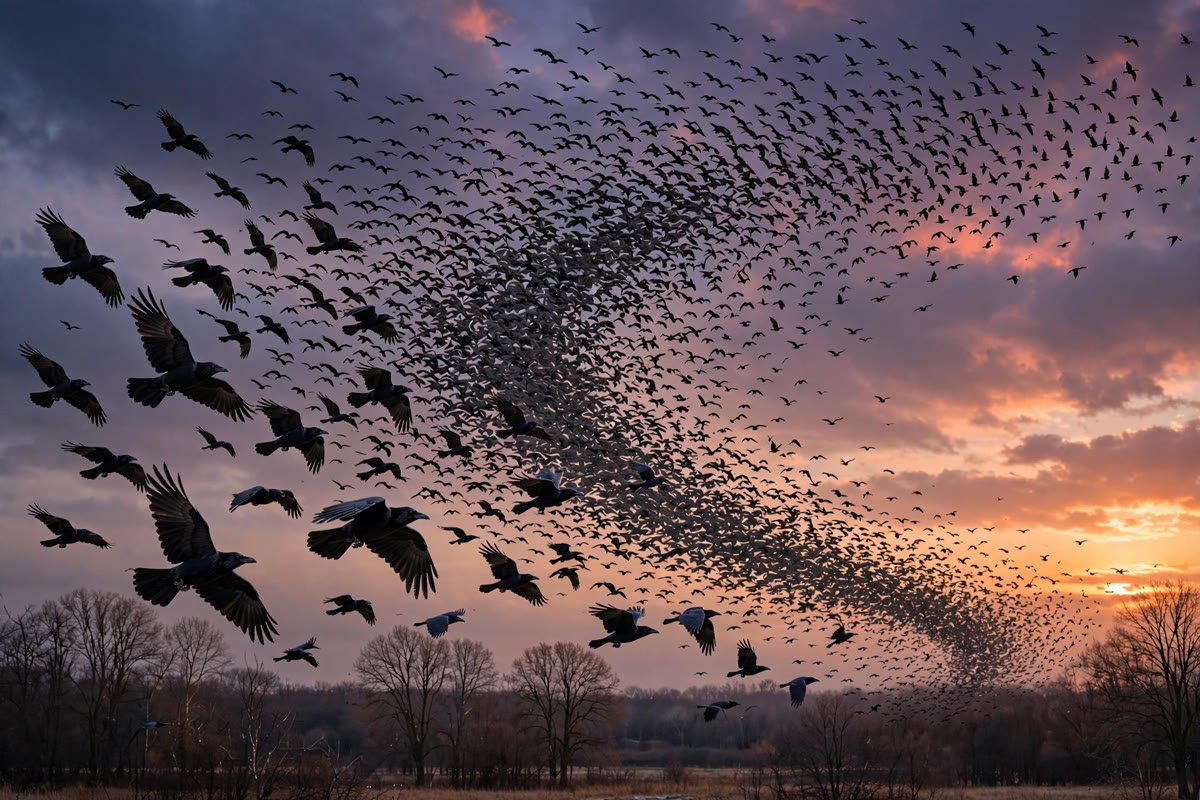
On a cold October evening, the sky over a small city begins to move. Thousands of crows stream in from every direction, cawing as they converge on a cluster of downtown trees. The noise builds for an hour. Then, almost as one, the flock settles, and the city goes quiet under a living blanket of crows.
If you have ever watched this and asked why do crows gather in such numbers, you are asking one of the oldest questions in bird behavior. The short answer: crows gather in communal winter roosts for warmth, safety, and information. The Cornell Lab of Ornithology notes that winter roosts of American Crows sometimes number in the hundreds of thousands, making them among the largest bird gatherings in North America.
Scientists have studied these roosts for more than a century, and while no single explanation covers everything, the leading theories are well supported. Below, we look at how big roosts get, what crows gain from packing together, what happens when roosts collide with city life, and how to watch one respectfully.

The Short Answer: Why Do Crows Gather in Roosts
Crows gather for several overlapping reasons, and researchers generally agree on three main benefits. First, warmth. A crowd of birds packed into trees generates shared body heat, and cities add their own warmth through buildings, pavement, and streetlights. Second, safety. A lone crow asleep in a tree is an easy target, but tens of thousands of crows are a different problem for any predator. Third, information. The roost works like a nightly meeting place where birds can pick up cues about where food was found that day.
There are social reasons too. Crows are family birds, and young crows stay with their parents for years. A winter roost lets extended families stay connected through the hard season, and it gives unpaired birds a place to meet potential mates. None of these explanations excludes the others. Warmth, safety, information, and social bonds probably all play a part, with their importance shifting from night to night and place to place.
How Big Crow Roosts Get
The numbers attached to famous crow roosts can sound unbelievable until you see the birds arrive. Auburn, New York, may be the most documented crow city in America. Crow expert Kevin McGowan of the Cornell Lab notes written evidence of crows congregating in the Auburn area since at least 1913, and a 1930s study by John Emlen found about 25,000 crows roosting near the town in the winter of 1932 to 1933. In the mid-2000s, biologists counted roughly 63,000 crows in downtown Auburn, and local coverage has reported peaks of 50,000 to 75,000 birds between late October and early March.
Portland, Oregon, hosts a newer but fast-growing roost. Volunteer counter Gary Granger has spent nearly a decade walking the streets at night counting crows block by block, and his censuses documented a fourfold increase peaking at more than 22,000 birds in January 2024. Every fall, more than 20,000 crows pour into the downtown waterfront area, filling trees, rooftops, and power lines each night.
In Bothell, Washington, as many as 16,000 crows fly in at dusk to roost in the wetlands behind the University of Washington Bothell campus, perching on buildings and sports fields before moving into the trees. And the largest roost ever reported, a widely cited figure from Fort Cobb, Oklahoma, in 1972, was estimated at 2 million crows. Roost sizes vary enormously from year to year, so treat every figure as a reported snapshot rather than a fixed fact.
Before the birds settle, they put on the show that draws the crowds. Crows gather in smaller groups an hour or two before sunset, then stream toward the roost in long flight lines that can stretch for miles. These evening rivers of birds are cousins to the swirling flocks of starling murmurations, though crows travel with more purpose and less shape-shifting. Researchers estimate that crows commonly fly six to twelve miles from a roost each day to feed, so the evening flight can draw birds from across an entire county.
| Roost location | Reported size | How it was counted |
|---|---|---|
| Auburn, New York | About 63,000; up to 75,000 reported | Biologist counts in the mid-2000s; local reporting |
| Portland, Oregon | More than 22,000 at peak | Volunteer block-by-block census, January 2024 |
| Bothell, Washington | Up to 16,000 | University and community reporting |
| Fort Cobb, Oklahoma | 2 million (1972) | Widely cited historical estimate |
Staying Warm Together
Winter nights are expensive for a bird. A crow must burn energy all night just to keep its body temperature up, and every calorie saved is a calorie it does not have to find the next day. Huddling close to thousands of other warm bodies seems like an obvious strategy, and studies of communal roosting in birds generally credit shared body heat with real energy savings.
That said, the evidence for crows specifically is mixed, and honest science says so. When researchers compared nighttime temperatures with roost sizes, they did not find that crows form bigger roosts on colder nights, which is what you would expect if huddling were the main driver. So while a packed roost is almost certainly warmer than a lone branch, warmth alone probably does not explain why crows gather.
What does hold up well is the urban heat effect. McGowan points out that cities are warmer than the surrounding countryside, and that warmth is one reason crow roosts have moved into town centers in recent decades. Concrete and asphalt absorb heat during winter days and release it at night, and downtown trees sit in that warmer bubble. For a crow choosing where to spend a January night, a few extra degrees from the city itself may matter more than the body heat of its neighbors.
Safety in Numbers
The safety argument is the most intuitive reason crows gather, and it has strong logic behind it. A predator that finds one sleeping crow gets a meal. A predator that finds 20,000 crows gets noticed. With thousands of eyes and ears on watch, the chance that danger goes undetected drops sharply, and any alarm call can ripple through the roost in seconds.
Crows are also famous for refusing to be passive. They work together to harass and drive off predators, a behavior called mobbing that the Cornell Lab lists among the American Crow’s signature traits. The main nighttime threat is the great horned owl, which can swoop silently through a roost after dark. Crows know this, and at dusk they often mob owls they spot near the roost, screaming and diving until the owl leaves. This is also why fewer owls in cities, plus the ambient light that lets crows see whatever owls are around, is one of McGowan’s leading explanations for the move of roosts into urban areas.
There is another layer to crow safety: memory. Crows can recognize individual human faces and remember who has threatened them, and they pass that knowledge to other crows. A roost full of birds that share information about local dangers is a neighborhood watch with wings. And if you hear owls hooting near a roost at dusk, you are hearing the reason the crows chose safety in numbers in the first place.
The Information Center Hypothesis
In 1973, biologists Peter Ward and Amotz Zahavi proposed a bold idea: birds gather in communal roosts mainly to share information about food. Their information center hypothesis held that unsuccessful foragers could watch their roost mates, pick out the birds that had eaten well, and follow them to productive feeding spots the next morning. For a crow facing a patchy winter landscape, that kind of tip could mean the difference between eating and going hungry.
The idea caught on fast. By the early 1980s it was widely accepted as the explanation for communal roosting, and it has experimental support. In a three-year study of Hooded Crows, researchers set out a rich food patch for two days running and radio-tagged 34 birds. A crow that had missed the food on day one was more likely to find it on day two if it had roosted overnight with a crow that knew about the patch and returned to it. That is exactly the kind of information transfer Ward and Zahavi predicted.
But the hypothesis has taken real criticism too, and it should be presented as a hypothesis, not a proven fact. Critics argue that it rests on several assumptions, such as that birds can reliably tell which roost mates fed well, and that it only explains food information while ignoring safety and warmth. Some researchers also question whether the strategy is evolutionarily stable, since a bird could cheat by following others without ever sharing its own finds. The fair summary is that roosts probably do spread useful information, but whether that is the main reason crows gather remains an open scientific question.

Why Roosts Peak in Fall and Winter
If you want to know why do crows gather most dramatically in the cold months, look at their calendar. In spring, breeding pairs split away from the winter flocks to claim territories, build nests, and raise young. Through the summer, crows live in smaller family groups scattered across the landscape. There is simply no need for a giant roost when the birds are busy nesting.
Everything changes in the fall. This year’s juveniles, now flying well, join the larger community. Migrant crows drift in from farther north. Family groups merge into bigger flocks, and the flocks merge again. October is when roosts visibly build up in most of the northern United States, which is why a sudden river of crows over your neighborhood this month is a seasonal signal, not a mystery. By December or January the roost hits its peak, then breaks apart again in March as breeding season approaches.
The seasonal rhythm also explains why the same trees host roosts year after year. Crows show strong fidelity to roost sites, and a New York survey found six roosts that had been used for more than 40 years, plus one in use for over 125 years. When October comes, the crows come back to the same branches their grandparents used.
When Roosts and People Collide
A roost of 60,000 crows is a wonder of nature and a maintenance nightmare. The noise at dusk can drown out conversation, and the droppings accumulate on sidewalks, cars, storefronts, and anyone unlucky enough to walk underneath. In Auburn, the mayor once described trying to attract businesses while visitors tracked droppings into City Hall, and the city hired the U.S. Department of Agriculture’s Wildlife Services program to move the birds.
Cities have tried many dispersal methods, all aimed at making the roost site uncomfortable rather than harming the birds. Auburn’s public works crews have used flares, whistlers, lasers, and recorded predator calls at dusk to push crows from downtown neighborhoods toward less populated areas along the river. Researchers have tested low-power handheld lasers, which are most effective at dusk and after dark when the beam is visible to the birds. Portland took a different approach, hiring teams of falconers whose hawks patrol a 72-block downtown radius each evening. The crows see a predator and move along, while the hawks simply fly, perch, and return to their handlers for a reward.
Dispersal has real limits. Studies of Portland’s roost found that harassment efforts produced only short-term, localized effects, and the crows often returned or shifted a few blocks away. Lethal control is far more controversial. Portland banned the use of bird poison on public property in 2019, yet dead crows have still been found with the neurotoxin Avitrol in their systems, a reminder of how heated the conflict can get. Most wildlife agencies now favor nonlethal management and public education over eradication, since the roost usually wins in the end.
How to Watch a Roost Respectfully
A crow roost at dusk is one of the great free wildlife shows in North America, and it deserves the same respect you would give any wild animal gathering. Arrive 30 to 60 minutes before sunset and look for the staging areas, the scattered trees or rooftops where crows gather in noisy groups before the final flight to the roost. This pre-roost period is the most entertaining part, full of calling, chasing, and aerial maneuvers.
Keep your distance and stay quiet. Watch from a sidewalk or parking area rather than walking under the roost trees, which protects both you and the birds. Never shine lights or lasers at roosting crows yourself, and leave flash photography off; a sudden bright flash can panic thousands of birds into the dark. If the crows start shifting uneasily or flushing from trees, you are too close, so back off.
Timing matters. Late fall through midwinter offers the biggest roosts, and clear, calm evenings give the best views. For general guidance on when birds are most active, see our guide to the best time of day to see birds. Bring binoculars, dress warmly, and let the river of wings come to you.

Frequently Asked Questions
Where do crows go during the day?
At dawn the roost explodes outward as crows fan across the landscape to forage. They spend the day in much smaller groups, walking farm fields, picking through landfills, working shorelines, and raiding whatever the neighborhood offers. Each evening they reverse the trip, gathering in staging areas before streaming back to the same roost trees.
Do crows return to the same roost every night?
Yes, and they return to the same roost sites year after year. Roost fidelity in crows is remarkable: surveys have documented sites used for more than 40 years, with one New York roost occupied for over 125 years. Individual birds may skip nights or shift between nearby sites, but the location itself can outlast generations of crows. Like many birds, they are creatures of habit when it comes to where they sleep at night.
How far do crows fly to reach a roost?
Reported estimates say crows commonly travel six to twelve miles from the roost to their daytime feeding areas, and some birds likely fly farther. That is why a single roost can pull birds from across an entire county each evening. The long evening flight lines you see are the visible proof of how far the roost’s catchment area extends.
Do other birds form big winter roosts too?
Absolutely. European Starlings are famous for their swirling murmurations, and blackbirds, grackles, and robins also gather in large winter roosts. Crows stand out for the sheer size of their urban roosts and for their loud, deliberate evening arrivals. Each species has its own version of the same basic deal: warmth, safety, and company on cold nights.
Why are crows so loud right before they settle?
The dusk racket is social business. Crows arriving at the roost call, chase, and jostle for perches, and the noise likely helps family groups stay together in the crowd. Activity usually drops off within about an hour after sunset as the birds settle in for the night. The quiet that follows is almost as striking as the noise that came before it.
Are crow roosts dangerous to people?
Crows are not aggressive toward people at roosts, and experts consider the disease risk from a roost low. The real problems are noise and droppings, which can damage paint, foul sidewalks, and create slippery walkways. Do not touch dead birds you find under a roost, and keep pets from rooting through droppings. If a roost lands in your neighborhood, the most practical step is simply to avoid parking or walking directly beneath it.
Conclusion
So why do crows gather in those enormous winter roosts? Because the night is cold, the dark is dangerous, and a crow alone is a vulnerable crow. By packing into trees by the tens of thousands, crows buy a little extra warmth, a lot of extra safety, and a nightly exchange of information about food and danger, all wrapped in the social life of one of the smartest birds on the continent.
The science is still refining the details. Researchers agree that safety and social information matter, debate how much warmth really drives the behavior, and continue testing the information center idea more than fifty years after it was proposed. What is not in doubt is the spectacle itself. If October skies over your town are starting to fill with streaming black wings, you are watching one of nature’s great seasonal gatherings. Find a good vantage point before sunset, keep your distance, and enjoy the show.




