Skip to content

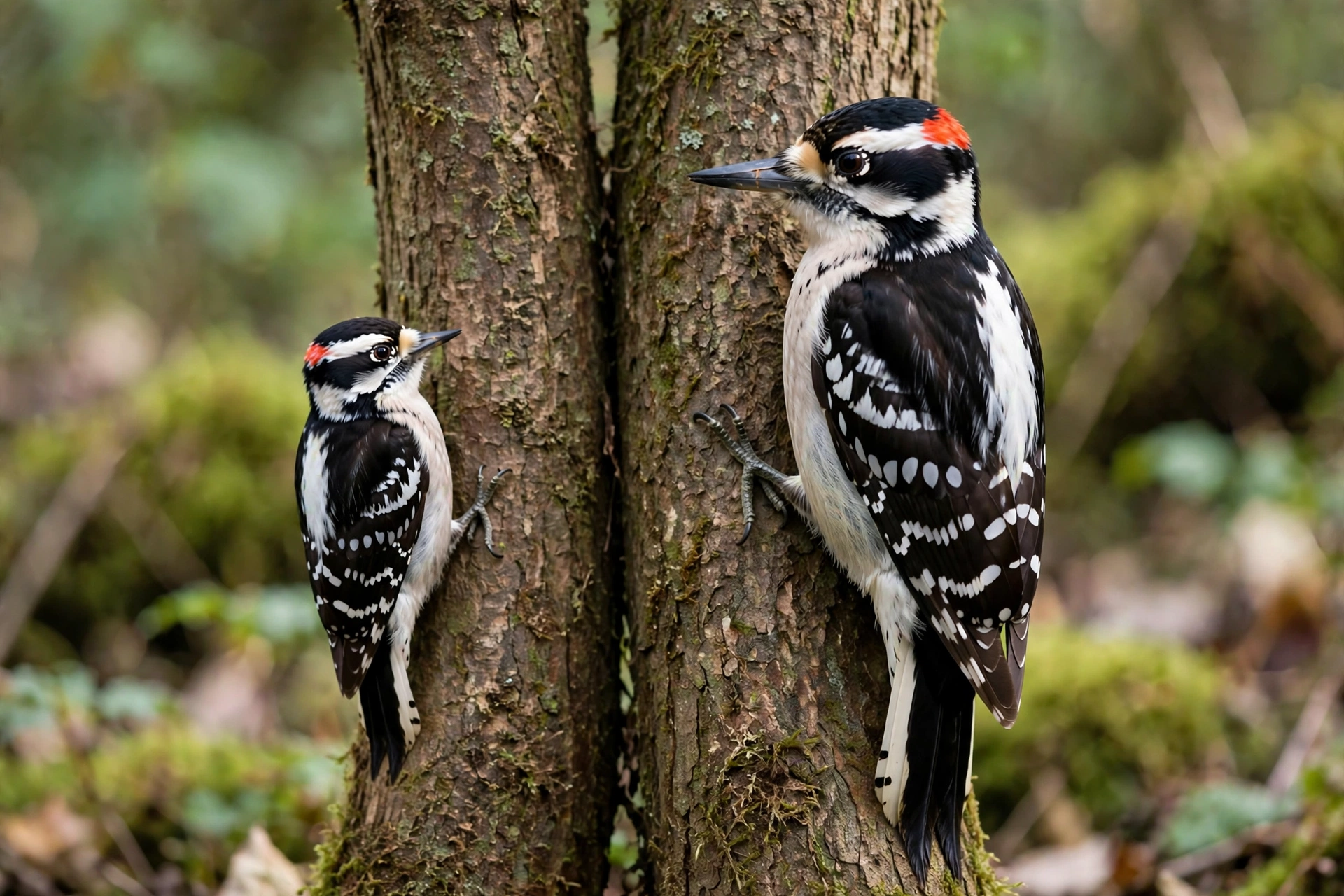
A small black-and-white woodpecker is hammering at your suet feeder. Is it a downy or a hairy? Millions of birdwatchers have asked exactly that question, because these two species look almost identical at first glance. Same crisp black-and-white plumage, same checkered wings, and a red patch on the back of the head on the males of both species.
The good news is that once you know what to check, the confusion clears up fast. This guide walks you through 7 field-tested ways to tell a downy woodpecker from a hairy woodpecker, from bill length and tail spots to calls and behaviour. Every point below is backed by the Cornell Lab of Ornithology, so you can trust what you learn here the next time one of these little drummers shows up.
Why These Two Cause So Much Confusion
Downy and hairy woodpeckers are not just similar, they are a classic example of what biologists call a “lookalike pair”. Their ranges overlap across most of North America, they visit the same feeders, and their plumage patterns match feather for feather in the field.
Size should settle it, but size is one of the hardest things to judge on a lone bird with nothing to compare against. That is why experienced birders lean on structural clues like the bill and the tail feathers instead. Work through the seven points below in order and you will rarely be wrong.
7 Ways to Tell a Downy Woodpecker From a Hairy Woodpecker
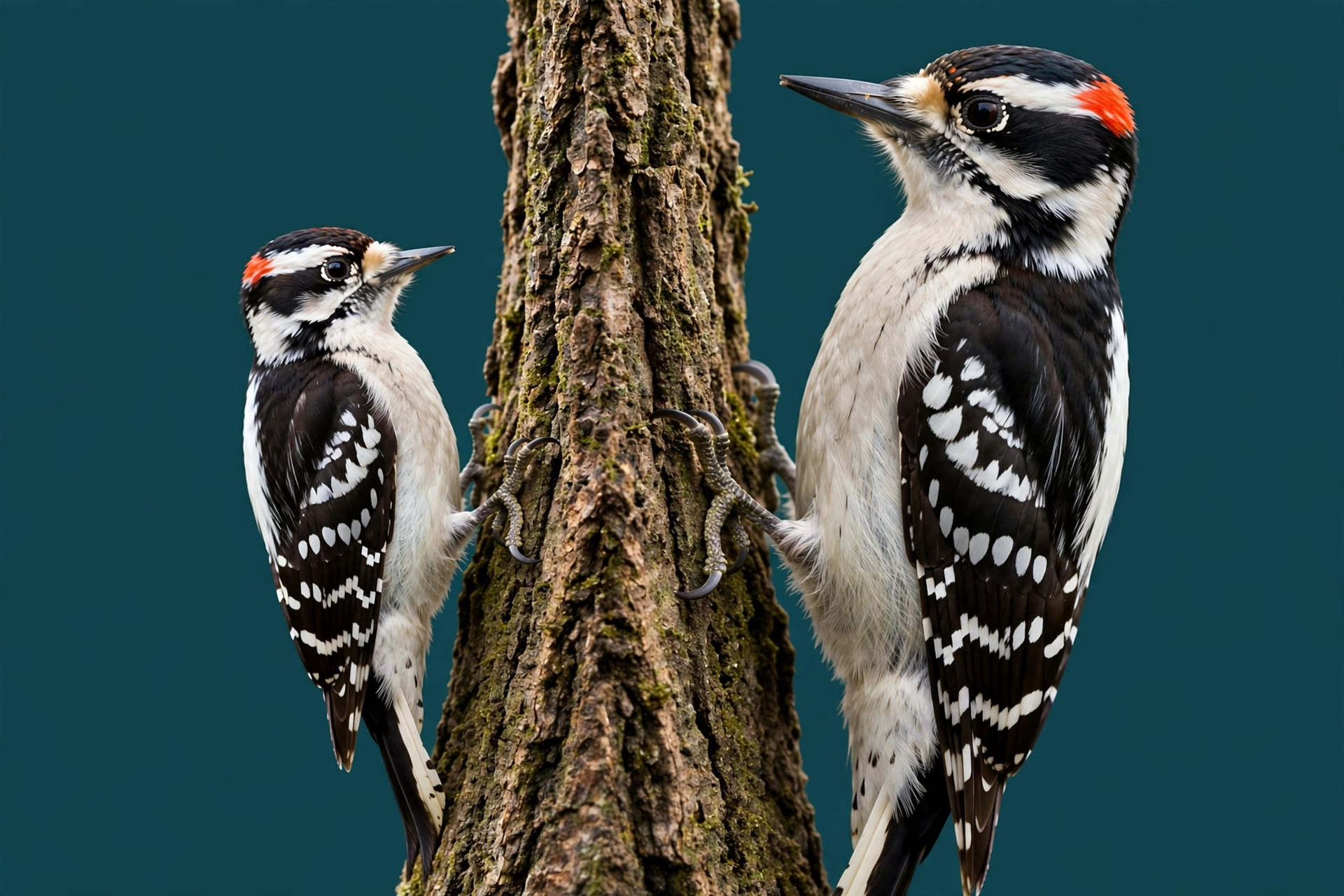
- Check the size first: a downy is about 6.5 inches long, while a hairy is about 9.25 inches, roughly the size of a robin.
- Look at the bill: the downy’s bill is short and dainty, clearly shorter than its head, while the hairy’s bill is long and chisel-like, nearly as long as its head.
- Inspect the outer tail feathers: downys show black spots or bars on white outer tail feathers, while eastern hairys have pure white ones.
- Find the shoulder comma: the hairy has a bold, well-defined black comma mark running from the shoulder onto the breast, while the downy’s version is faint or missing.
- Listen to the calls: the downy gives a soft, high-pitched “pik” and a descending whinny, while the hairy gives a sharper, louder “peek” and a harsher rattle.
- Watch how it forages: downys are acrobatic, clinging to tiny branches and weed stems, while hairys stick to trunks and main branches of larger trees.
- Note where you are: downys are regulars in suburbs, parks and backyards, while hairys prefer mature woodland and are shyer around people.
1. Size: The Hairy Is Nearly 50 Percent Bigger
When you see the two side by side, the difference is obvious. According to the Cornell Lab’s Bird Academy, the downy woodpecker measures about 6.5 inches long, making it North America’s smallest woodpecker. The hairy woodpecker measures about 9.25 inches, around the size of an American robin.
The catch is that you rarely see them side by side. On a lone bird, size deceives, because there is no reference point. Use size as your first impression, not your verdict. If the bird looks surprisingly chunky and robin-like, lean hairy. If it looks delicate and sparrow-like, lean downy. Then confirm with the bill.
2. Bill Length: The Single Best Field Mark
If you remember only one clue from this guide, make it this one. The bill is the most reliable way to separate these two species, and the Cornell Lab calls it “the real trick” to the identification.
The downy’s bill is short, stubby and dainty, clearly shorter than its head. Project FeederWatch describes it as about one-third the distance from the base of the bill to the back of the head. The hairy’s bill is a different tool entirely: long, straight and chisel-like, about as long as the bird’s whole head. Side by side, the hairy’s bill looks like a railroad spike next to the downy’s thorn.
For the best view, watch the bird in profile. Head-on views foreshorten the bill and can make a hairy’s bill look deceptively small. Give the bird a few seconds to turn, and the difference usually reveals itself.

3. Outer Tail Feathers: Spots Mean Downy
Flip your attention to the tail and you get a second excellent clue. The downy woodpecker’s white outer tail feathers carry black bars or spots, which are easiest to see from below when the bird fans its tail against a trunk. The effect is a distinctly speckled look.
Eastern hairy woodpeckers, by contrast, have completely white outer tail feathers with no markings at all. There is one wrinkle worth knowing: hairy woodpeckers from the Pacific coast and Newfoundland can show black barring too. So spotted tail feathers suggest a downy but do not prove it everywhere, while clean white outer tail feathers underneath are a strong vote for hairy in the eastern United States.
4. The Shoulder Comma: Bold on Hairy, Faint on Downy
This one takes a close view, but it is a satisfying detail once you spot it. Both species can show a black, comma-shaped mark that sweeps from the shoulder down onto the upper breast, like a little ink stroke.
On the hairy woodpecker, this comma is bold, dark and clearly defined, standing out against the white underparts. On the downy, the same mark is faint, blurry or absent altogether. Think of it as a signature: the hairy signs its name firmly, while the downy barely leaves a trace. You will need decent light and a fairly close bird to use this mark, so treat it as a supporting clue rather than your main one.
5. Calls and Drumming: Pik Versus Peek
Often you will hear these birds before you see them, and their voices differ in useful ways. The downy woodpecker’s contact call is a soft, high-pitched “pik”, usually repeated with about half a second between notes. Its most distinctive sound is an excited, descending whinny that drops in pitch toward the end, a little like a tiny horse.
The hairy woodpecker sounds bigger because it is. Its equivalent call is a sharper, louder “peek”, closer to a squeaky toy. Its rattle is harsher and stays on a single pitch instead of descending. Even their drumming differs: downys drum more slowly, at roughly 15 taps per second, while hairys drum faster at about 25 taps per second. If you want to train your ear, the Cornell Lab’s Macaulay Library holds excellent recordings of both species’ calls.

6. Foraging Style: Acrobat Versus Lumberjack
Behaviour is a wonderful clue because you can read it at a distance. The downy woodpecker is an acrobatic forager, perfectly at home on tiny branches, slender weed stems, plant galls and the edges of suet feeders. It dangles, hangs upside down and picks lightly at surfaces too flimsy for bigger birds.
The hairy woodpecker works like a lumberjack. It hitches up trunks and along the main branches of large trees with an erect, straight-backed posture, leaning on its stiff tail and hammering forcefully into bark for wood-boring beetle larvae. If the bird is delicately gleaning a twig thinner than a pencil, think downy. If it is pounding a trunk like it owns the forest, think hairy.
7. Habitat and Hangouts: Suburb Regular Versus Forest Bird
Finally, consider the setting. Both species range across most of North America, so geography alone will not split them in most places. Habitat preference, though, leans in different directions.
Downy woodpeckers are comfortable around people. They turn up in suburbs, parks, gardens, orchards and at backyard feeders all winter, and they tolerate close approach. Hairy woodpeckers prefer larger tracts of mature woodland with big trees, and they are warier and less likely to linger in busy yards. A black-and-white woodpecker working a city park feeder in January is far more likely to be a downy, though hairys do visit feeders too, especially suet and peanut feeders in quieter neighbourhoods.
Downy vs Hairy Woodpecker: Quick Comparison Table
Keep this table handy on your phone for your next outing. Run down the rows until two or three of them agree, and you can name your bird with confidence.
| Trait | Downy Woodpecker | Hairy Woodpecker |
|---|---|---|
| Length | About 6.5 inches, North America’s smallest woodpecker | About 9.25 inches, roughly robin-sized |
| Bill | Short, dainty, clearly shorter than the head | Long, chisel-like, nearly as long as the head |
| Outer tail feathers | White with black spots or bars, best seen from below | Pure white and unmarked in eastern birds |
| Shoulder comma mark | Faint, blurry or absent | Bold, dark and clearly defined |
| Contact call | Soft, high-pitched “pik” | Sharper, louder “peek” |
| Rattle/whinny | Descending whinny that drops in pitch | Harsher rattle that stays on one pitch |
| Drumming speed | Slower, about 15 taps per second | Faster, about 25 taps per second |
| Foraging style | Acrobatic, on twigs, weed stems and feeder edges | Forceful, on trunks and main branches of large trees |
| Typical habitat | Suburbs, parks, gardens, backyard feeders | Mature woodland, larger trees, shyer of people |
| Male’s red patch | Small red patch on the nape | Red patch on the nape, sometimes split in two |
Males, Females and Regional Differences
A quick note on the red patch, since it trips people up. Males of both species carry a red patch on the nape, at the back of the head. Females of both species lack it entirely, showing only black and white on the head. The patch does not help you separate downy from hairy, but it does tell you the bird’s sex at a glance.
Regional variation matters for the tail-feather clue. The “pure white outer tail feathers equals hairy” rule holds cleanly across the eastern United States. In the Pacific Northwest and Newfoundland, some hairy woodpeckers show black barring on those feathers, so western birders should lean harder on bill length and voice.
Sorting out lookalike pairs is one of the most satisfying skills in birding. If you enjoyed this one, try our crow versus raven identification guide next, or take on the bigger raptors with our bald eagle versus golden eagle identification guide.
Common Mistakes That Lead to Wrong IDs
- Judging size on a lone bird: without a second bird for scale, a downy can look big and a hairy can look small. Always confirm with the bill.
- Trusting a head-on view: bills look shorter when a bird faces you directly. Wait for a profile view before judging bill length.
- Ignoring the light: tail spots vanish in harsh backlight and glare. If you cannot see the tail clearly, do not use it.
- Assuming every feeder woodpecker is a downy: hairys visit suet and peanut feeders too. Trust the bill and the behaviour over assumptions.
- Forgetting regional variation: in the Pacific Northwest, a barred tail does not automatically rule out a hairy woodpecker.
Both species tough out the cold season in place rather than migrating, which is why they are such welcome winter visitors. To understand how they manage it, read our guide on how birds stay warm in winter.

Frequently Asked Questions
Which is smaller, the downy or the hairy woodpecker?
The downy woodpecker is the smaller of the two by a clear margin. It measures about 6.5 inches long, while the hairy measures about 9.25 inches, making the hairy nearly 50 percent longer and roughly the size of an American robin.
Do downy and hairy woodpeckers both visit backyard feeders?
Yes, both species visit feeders, especially suet, peanut and black-oil sunflower feeders in winter. Downys are the more frequent and familiar feeder guests in suburbs, while hairys visit too but tend to prefer quieter yards near mature trees.
Can a hairy woodpecker have spots on its tail feathers?
In the eastern United States, no: eastern hairys have completely white, unmarked outer tail feathers. Hairy woodpeckers from the Pacific coast and Newfoundland, however, can show black barring on those feathers, so western birders should rely on bill length and voice instead.
How do you tell a male from a female in these species?
Look at the back of the head. Males of both the downy and the hairy woodpecker have a red patch on the nape, while females show only black and white there. The red patch identifies sex, not species.
Do downy and hairy woodpeckers live in the same areas?
Broadly, yes. Their ranges overlap across most of North America, from Alaska and Canada down through the United States. Within that shared range they divide the habitat: downys favour suburbs, parks and smaller woodlots, while hairys favour mature forest with large trees.
What is the easiest call difference between the two?
Listen for the contact note. The downy gives a soft, high-pitched “pik”, while the hairy gives a sharper, louder “peek”. Their rattles differ too: the downy’s whinny descends in pitch, while the hairy’s rattle stays on one pitch.
Is the downy woodpecker rare?
Not at all. The downy is one of the most common and widespread woodpeckers in North America, and it adapts well to suburbs and backyards. If you have a suet feeder up in winter, a downy will probably find it.
The Bottom Line
Downy versus hairy comes down to a short checklist: bill length first, size second, then tail feathers, the shoulder comma, voice, behaviour and habitat. No single clue is perfect in every situation, so confirm with at least two before you log the sighting.
For the definitive visual breakdown, the Cornell Lab’s Bird Academy downy and hairy woodpecker guide lays out the same ID keys with photos, and its similar-species comparison for the hairy woodpecker shows both birds side by side. Take these seven points into the field, and the next black-and-white woodpecker on your feeder will not keep you guessing.