 Skip to content

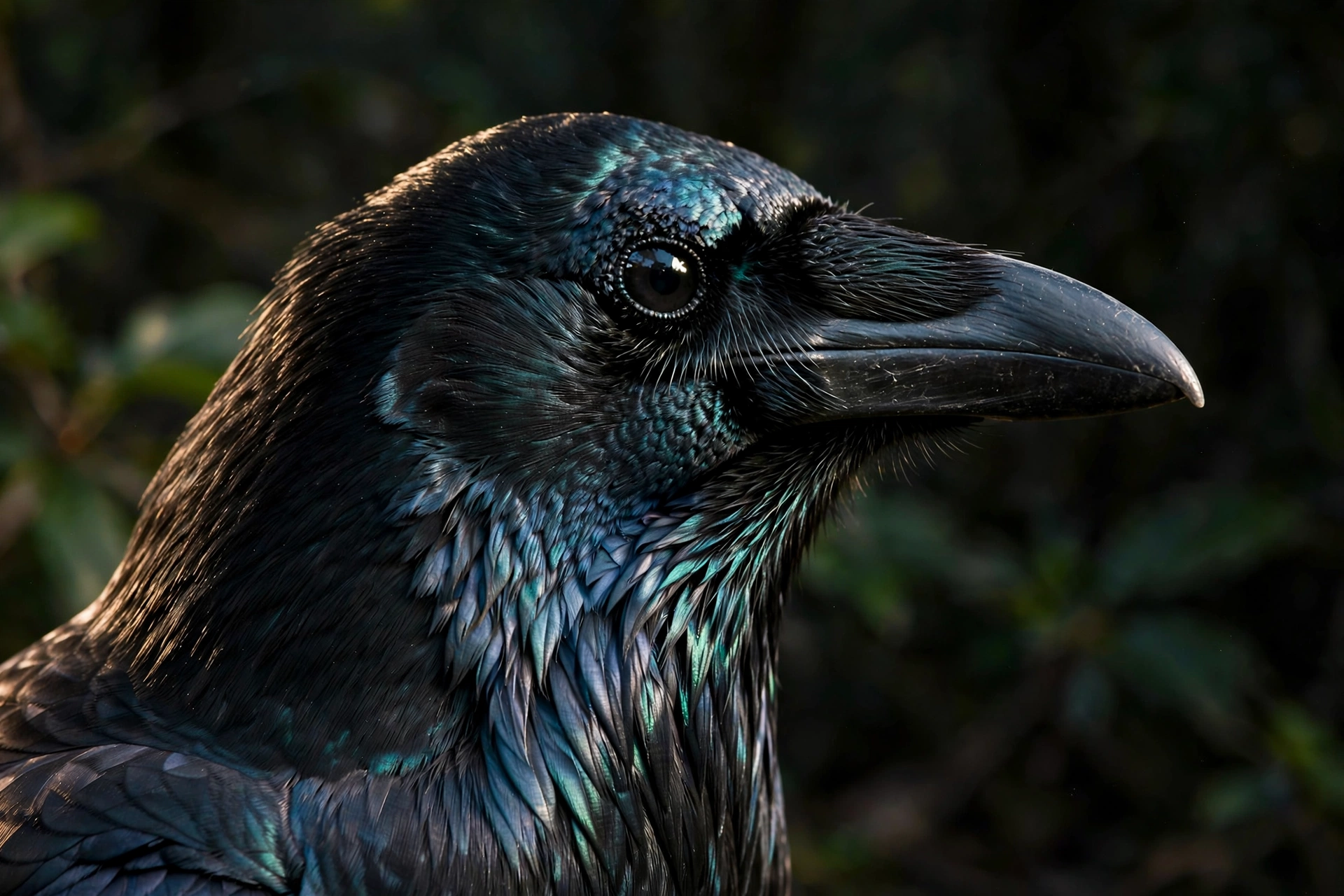
How smart are crows? The short answer: far smarter than their reputation as noisy scavengers suggests. In laboratories and in the wild, crows have bent wire into hooks, remembered human faces for years, and solved physics puzzles at the level of a young child.
Crows belong to the corvid family, which also includes ravens, rooks, jackdaws, magpies, and jays. Corvids carry some of the largest brains, relative to body size, in the bird world. Over the past three decades, scientists have tested them the way they once tested chimpanzees, and the birds keep passing.
Below are nine proofs of crow intelligence, each one grounded in published research. Names, dates, and journals are included so you can check the science for yourself.
Proof 1: They Bend Wire Into Hooks
In 2002, a New Caledonian crow named Betty stunned researchers at the University of Oxford. Presented with a straight piece of garden wire and a vertical tube holding a bucket of meat, she wedged the wire into a crack and pulled to bend it into a hook. Then she fished the bucket out.
The feat was reported by Weir, Chappell, and Kacelnik in the journal Science. It was no fluke. In nine out of ten follow up trials, Betty bent the wire and retrieved the food again. Her companion, a male crow named Abel, never pulled off the same trick and mostly stole her food instead.
What made the result remarkable was that Betty had never worked with wire before. She invented a solution for a new material on the spot. In 2009, Bird and Emery replicated the feat with rooks, a crow relative not known to use tools in the wild, publishing the result in PNAS. Later fieldwork by Rutz and colleagues showed that bending like movements are part of wild New Caledonian crows’ natural tool shaping, which makes Betty’s improvisation even more interesting, not less.
Proof 2: They Craft Hooks in the Wild
Betty’s trick was not pure laboratory magic. In the forests of New Caledonia, wild crows of her species manufacture hooked tools every day. Ecologist Gavin Hunt documented this in a 1996 paper in Nature, reporting the first evidence of hooked tool manufacture by a free living non human animal.
The crows snip twigs, strip the bark and leaves, and sculpt one end into a working hook with their beaks. They also cut tools from the stiff, barbed leaves of pandanus trees, making stepped cuts that leave the tool broad where the beak grips it and narrow at the probing tip.
The barbs along the leaf edge act as natural hooks when the tool is held the right way round. Tool designs even vary between regions of the island, a pattern researchers interpret as evidence of local tool cultures passed down through generations.
Proof 3: They Understand Water Displacement
Aesop’s fable of the thirsty crow dropping stones into a pitcher turns out to be more fact than fiction. In 2014, Sarah Jelbert and colleagues at the University of Auckland put six wild New Caledonian crows through a series of water displacement puzzles and published the results in PLOS ONE.
A piece of meat floated on water inside a tube, just out of beak reach. The crows dropped stones to raise the water level and grab the food. More impressively, they chose their tools and tubes wisely:
- Water over sand: they dropped stones into water filled tubes, not sand filled ones.
- Sinking over floating: they picked objects that sink rather than ones that float.
- Solid over hollow: they preferred solid objects, which displace more water.
- High over low: they chose tubes where the water level was already higher.
The birds failed two harder puzzles involving tube width and a U shaped apparatus, so the authors concluded their understanding was “sophisticated, but incomplete”. Still, it rivalled that of five to seven year old children. Rooks, another crow relative, have passed similar water raising tests.

Proof 4: They Remember Your Face for Years
Cross a crow and it may hold the grudge for years. Starting in 2006, wildlife biologist John Marzluff and his students at the University of Washington trapped and banded wild American crows while wearing a rubber caveman mask. On other walks, researchers wore a neutral mask and did nothing threatening.
The crows learned the difference fast. They scolded and mobbed anyone wearing the dangerous mask, even when it was worn by a different person, while ignoring the neutral mask. The peer reviewed result, published in Animal Behaviour in 2010, documented the memory lasting at least 2.7 years after a single trapping.
The story gets stranger. Birds that only watched the trapping learned the face too. So did young crows that were never present at all, taught by their parents. Cornell and colleagues reported this social spread in 2012 in Proceedings of the Royal Society B, and brain imaging published in PNAS the same year showed threat related circuits lighting up when crows saw the dangerous face.
Kindness is remembered as well. Crows that were fed by a masked person showed reward related brain activity at the sight of that face. Their social nature means news travels fast through the flock, which is one reason crows gather in huge communal roosts each evening.
Proof 5: They Console Their Friends
Intelligence is not only about puzzles. In 2010, Orlaith Fraser and Thomas Bugnyar published a study in PLOS ONE asking whether ravens console each other after fights. Watching a group of captive ravens, they recorded what happened in the minutes after aggressive conflicts.
They found strong evidence for bystander affiliation: birds that had nothing to do with the fight approached the victim and made friendly contact. This happened most often after intense conflicts and between birds that shared a valuable relationship. Victims that sought out such contact were also less likely to be attacked again.
The authors were careful with their words. They concluded that ravens “may console victims” and “may be sensitive to the emotions of others”, stopping short of claiming full human like empathy. Even so, it was the first demonstration of this kind of behavior in a non ape species.
Ravens and crows also react strongly to dead companions, gathering and calling around them. Scientists read this as danger assessment rather than grief, but the social awareness is real either way. Read more about these strange gatherings in our piece on whether crows hold funerals.
Proof 6: They Plan for Tomorrow
Planning was long considered a human specialty, then an ape specialty. In 2017, ravens joined the club. Can Kabadayi and Mathias Osvath of Lund University taught five ravens to open a box with a stone tool, then tested whether the birds would save the right tool for later use.
The results, published in Science, were striking. Given a choice of objects, the ravens picked the correct tool and kept it through delays of 15 minutes, succeeding 86 percent of the time, and 17 hours, succeeding 88 percent of the time. They also bartered tokens for future rewards and showed self control on par with great apes.
The researchers concluded that ravens plan for events unrelated to caching and that their performance parallels apes and small children. Western scrub jays, another corvid, had already shown future planning in food caching experiments published in Nature in 2007.
Ravens are the crow family’s heavyweight cousins, and the two are easy to confuse at a glance. If you mix them up, our crow versus raven identification guide sorts them out.

Proof 7: Their Brains Pack Primate Level Neurons
How does a small bird brain pull all this off? Part of the answer arrived in 2016, when Seweryn Olkowicz and colleagues published a neuron counting study in PNAS. Parrot and songbird brains, they found, contain about twice as many neurons as primate brains of the same mass, and two to four times as many as rodent brains of the same mass.
The secret is packing density. Bird neurons are small, so more of them fit, and a bigger share sits in the forebrain, the region most tied to complex thought. The avian equivalent of the prefrontal cortex is a structure called the nidopallium caudolaterale, and in crows it is wired as a genuine executive hub.
The takeaway is not that crows outthink monkeys. It is that evolution found two different ways to build a smart brain: the primate way of growing bigger, and the bird way of packing tighter.
Proof 8: They May Recognise Themselves
The mirror test is one of the toughest exams in animal cognition. A mark is placed where the animal can only see it in a mirror. Touching the mark means the animal understands the reflection is itself. For decades, only great apes, dolphins, and elephants reliably passed.
In 2008, Helmut Prior and colleagues reported in PLoS Biology that Eurasian magpies, crow family members, passed too. Two of five birds repeatedly tried to scratch off colored marks on their throats after seeing them in the mirror, while ignoring black marks that blended into their feathers.
Honesty requires the caveats. A larger 2020 replication attempt failed to confirm the result, and researchers advise treating the original finding with caution. Direct tests on crows themselves have produced mixed results. Self recognition in corvids remains an open question, which is itself a sign of a field taking the birds seriously.
Proof 9: They Can Count
In 2015, Helen Ditz and Andreas Nieder of the University of Tubingen found the neural basis of an old legend: that crows can count. Training crows to discriminate groups of dots on a screen, they recorded single neurons in the birds’ endbrain and published the findings in PNAS.
They discovered “number neurons”. Each cell fired hardest for its own preferred number, one, two, three, and so on, ignoring the size, shape, and arrangement of the dots. The same style of number coding had previously been found in the primate cortex, suggesting two very different brains converged on the same solution.
Later work pushed further. Nieder’s lab showed crows grasp the concept of zero, and that their neurons can link a seen number of dots to a planned number of pecks. Counting, it turns out, runs on single cells.
The Brain Behind the Genius
Put the nine proofs together and a pattern emerges. Crows do not have one party trick. They make tools, read physics, remember faces, comfort friends, plan ahead, and count, each ability supported by a densely packed forebrain that evolved completely separately from our own.
This is convergent evolution in action. Birds and mammals split around 300 million years ago, yet corvids landed on many of the same cognitive solutions as primates. As Emery and Clayton wrote in Science in 2004, the mentality of crows shows how flexible evolution can be.
It may also explain why crows seem to play. Observers have long reported crows sliding down snowy rooftops and car windshields, tumbling in the air, and fiddling with objects for no obvious reward. Play is hard to study formally, and no one claims a sledding crow is doing calculus, but curious brains tend to be playful ones.
How Crow Intelligence Compares
So where do crows sit in the animal kingdom’s smarts ranking? The honest answer is that different species win different events. Here is how crows stack up against three other famously clever animals:
| Cognitive task | Crows | Chimpanzees | Parrots | Dogs |
|---|---|---|---|---|
| Making a new tool from unfamiliar material | Yes, wire hooks bent on the spot | Yes, sticks and stones shaped for tasks | Rare, a few trained examples | No |
| Mirror self recognition | Mixed, magpies passed with caveats | Yes, reliably | Inconclusive | No |
| Planning hours into the future | Yes, ravens planned 17 hours ahead | Yes | Limited evidence | No, they live in the moment |
| Number sense | Yes, dedicated number neurons, plus zero | Yes | Yes, Alex the grey parrot counted to six | Basic, they can tell more from less |
| Remembering individual human faces for years | Yes, at least 2.7 years measured | Yes | Yes, they recognise familiar people | Yes, especially their owners |
The pattern is clear. Crows match or beat the competition on tool invention, planning, and face memory, while chimpanzees and parrots hold their own on self recognition and symbolic counting. Dogs, for all their social genius with humans, sit out most of these particular contests.
What This Means for You
You do not need a laboratory to benefit from crow smarts. Crows share our cities, farms, and suburbs across much of the world. Here is how to get along with the cleverest neighbors on your street:
- Be the friendly face: crows remember kindness as well as threats, so a regular scattering of unsalted peanuts can earn you a loyal audience.
- Stay consistent: they learn routines fast, including bin collection days and feeding times.
- Secure your bins: a crow that learns to open your trash has solved a puzzle you set, so make the puzzle harder.
- Watch and learn: give them novel objects and watch what happens. You are watching one of nature’s great problem solvers at work.
Above all, give them a little respect. An animal that can plan 17 hours ahead and remember your face for years has earned it.
Conclusion
How smart are crows? Smart enough to bend metal, raise water, hold grudges, comfort friends, plan for tomorrow, and count. The nine proofs above are not party tricks. They are peer reviewed findings from Science, Nature, PNAS, and PLOS ONE.
The deeper lesson is about brains themselves. Crows show that big intelligence does not require a big cortex, or even a big brain. It requires the right wiring, packed tight, tested against a demanding life. Next time a crow watches you from a rooftop, consider the possibility that it is studying you right back.

Frequently Asked Questions
Are crows the smartest birds?
They are among the smartest, alongside ravens, magpies, and parrots. New Caledonian crows lead at toolmaking, ravens at planning, and African grey parrots at vocal learning and symbolic counting. Ranking them depends on which test you pick.
How smart are crows compared to a human child?
On specific causal reasoning tasks, such as the water displacement puzzles, crows performed at the level of five to seven year old children. That does not make them child equivalent overall. Human children have language and culture that no crow matches.
Do crows really remember faces?
Yes. Wild American crows remembered a threatening masked face for at least 2.7 years after a single encounter, and the memory spread socially to birds that never witnessed the original event.
Do crows hold grudges?
They hold onto threat memories for years and teach them to flockmates and offspring. Whether that counts as a grudge in the human emotional sense is debated, but the behavior looks the part.
Can crows use tools in the wild?
Yes. New Caledonian crows manufacture hooked twig tools and pandanus leaf tools in the wild to extract insects from crevices. Most other crow species use tools rarely or never.
Are crows smarter than dogs?
At tool invention, future planning, and face memory over years, crows outperform dogs. At reading human social cues, dogs win easily. Intelligence is not one ladder, and each species excels at what its life demands.
What is the smartest type of crow?
The New Caledonian crow is the standout for toolmaking, and the common raven for planning and social cognition. Among familiar city birds, the American crow’s face memory and social learning are the best documented.




